Suit Lining Options: Full, Half, Quarter or Unlined
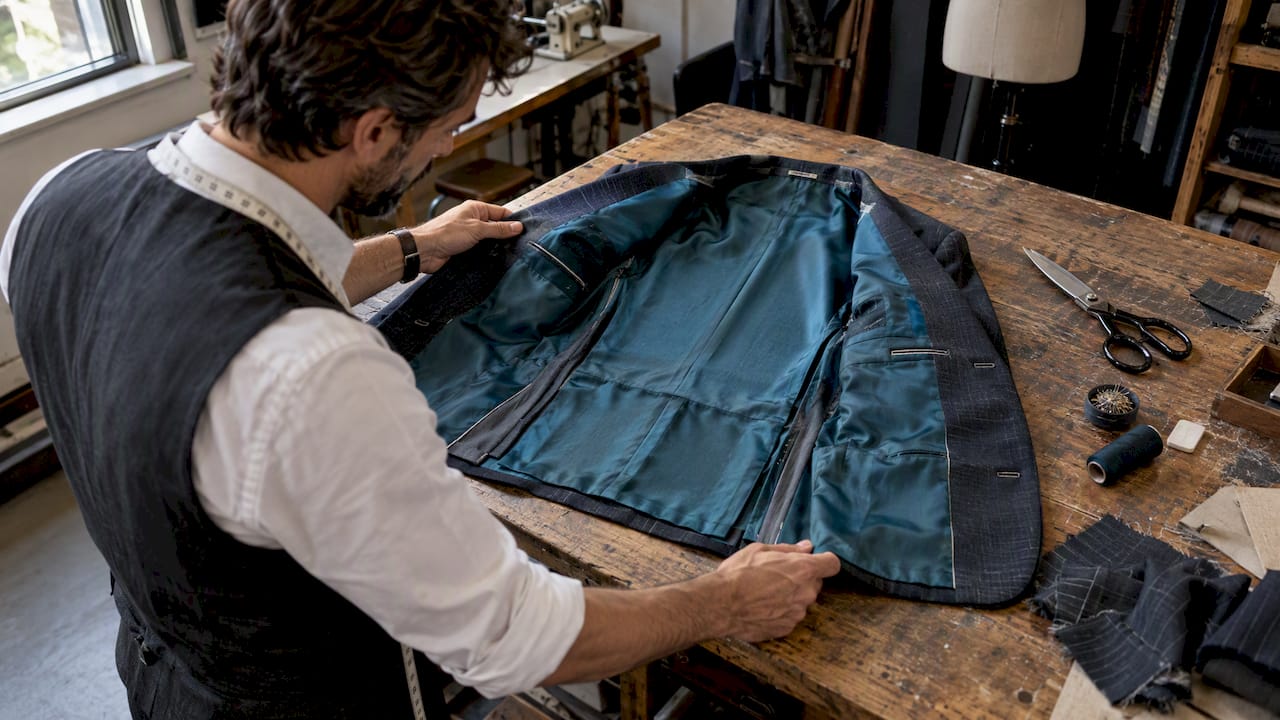
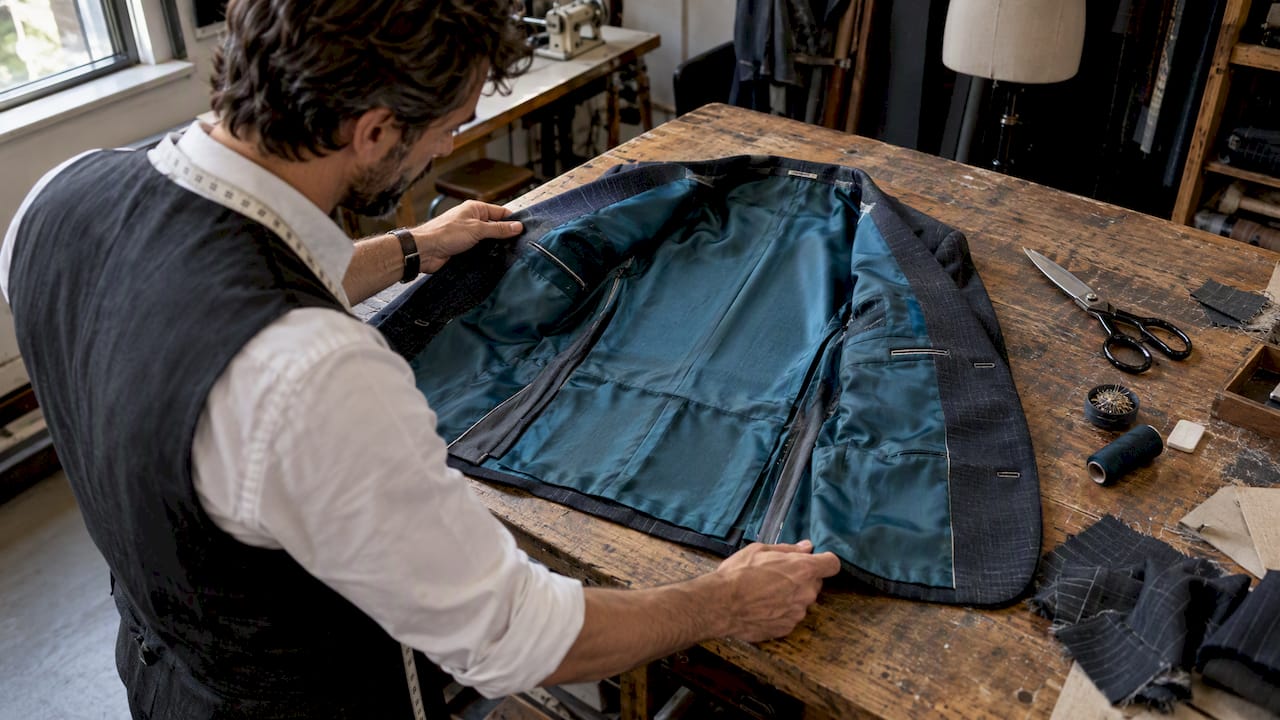
A suit lining comes down to two decisions: how much of the jacket is lined, and what the lining is made of. For Singapore’s heat and humidity, the most comfortable answer is usually a reduced lining, a half or quarter lining, in a breathable cellulose fibre such as cupro or viscose rather than polyester. Colour and pattern are the third choice, and the one where you can express yourself most freely.
Below, we explain each option, how half-lined and fully lined jackets differ, and what to settle with your tailor before the cutting begins.
TL;DR
- Fully lined gives the cleanest, smoothest and most formal finish, but holds the most warmth. Half lined and quarter lined jackets trade a little polish for much better airflow.
- Cupro (Bemberg) and viscose are the dependable fabrics. Polyester is cheaper but does not let moisture escape. Silk is luxurious but more delicate.
- In Singapore, keep the sleeve lining even when you reduce the body lining: it helps the jacket slide on and off.
- Choose colour last. A restrained lining suits the boardroom, a bolder one suits a wedding or a weekend jacket.
- Specify three things to your tailor: the extent of the lining, the fabric, and the colour or pattern.
Table of Contents
- What a suit lining actually does
- The four construction options
- Half lined vs fully lined: how to choose
- Lining fabrics compared
- Choosing a lining for Singapore’s climate
- Colour and pattern: the hidden signature
- Our perspective
- What to discuss with your tailor
- Bespoke linings at Ron & Rich
- FAQ
- Sources
What a suit lining actually does
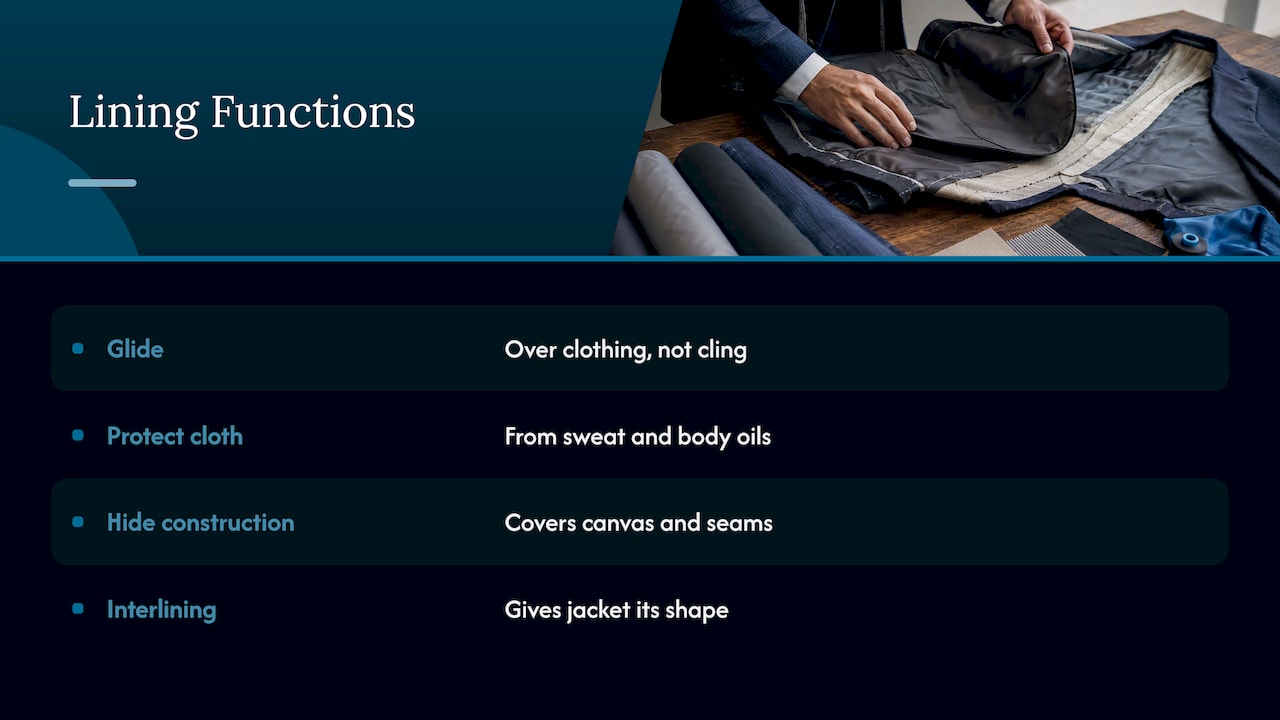
The lining is the inner layer of the jacket, the part that touches your shirt and arms. It has three jobs. It lets the jacket glide over clothing rather than cling. It protects the outer cloth from sweat and body oils. And it hides the internal construction, the canvas and seams, so the inside looks as finished as the outside.
The Guardian’s tailoring expert, Nolan, describes lining as a barrier that must protect the outer shell from sweat and oils while staying comfortable against the body. She also warns that polyester can undermine the breathability of an otherwise breathable shell. That point matters more in Singapore than almost anywhere.
The lining is separate from the interlining that gives a jacket its shape. If you are also weighing how the chest is built, our guide to fused versus canvassed suits explains that side of the jacket.
The four construction options
How much of the jacket is lined changes the weight, the drape and the finish more than the fabric of the lining does.
Fully lined
The lining covers the entire back, the body and the sleeves. Every seam is hidden. The result is the most formal and polished look, and the jacket slides on easily. It also adds the most weight and traps the most heat, which is why it suits air-conditioned offices, evening events and cooler travel better than a midday walk in the sun.
Half lined
The lining covers the upper back and the sleeves, leaving the lower back unlined, with the raw seams neatly bound or finished. Air moves more freely through the lower half of the jacket. The structure at the shoulders and chest stays intact, so from the front the jacket looks no different from a fully lined one.
Quarter lined
Only a small panel across the upper back, and the sleeves, are lined. It is lighter still. Permanent Style’s view is that the practical difference between half and quarter lining can be small, whereas the sleeve lining remains useful because it eases putting the jacket on and taking it off. We cover the warm-weather case in detail in our piece on the quarter lined jacket for warm climates.
Unlined
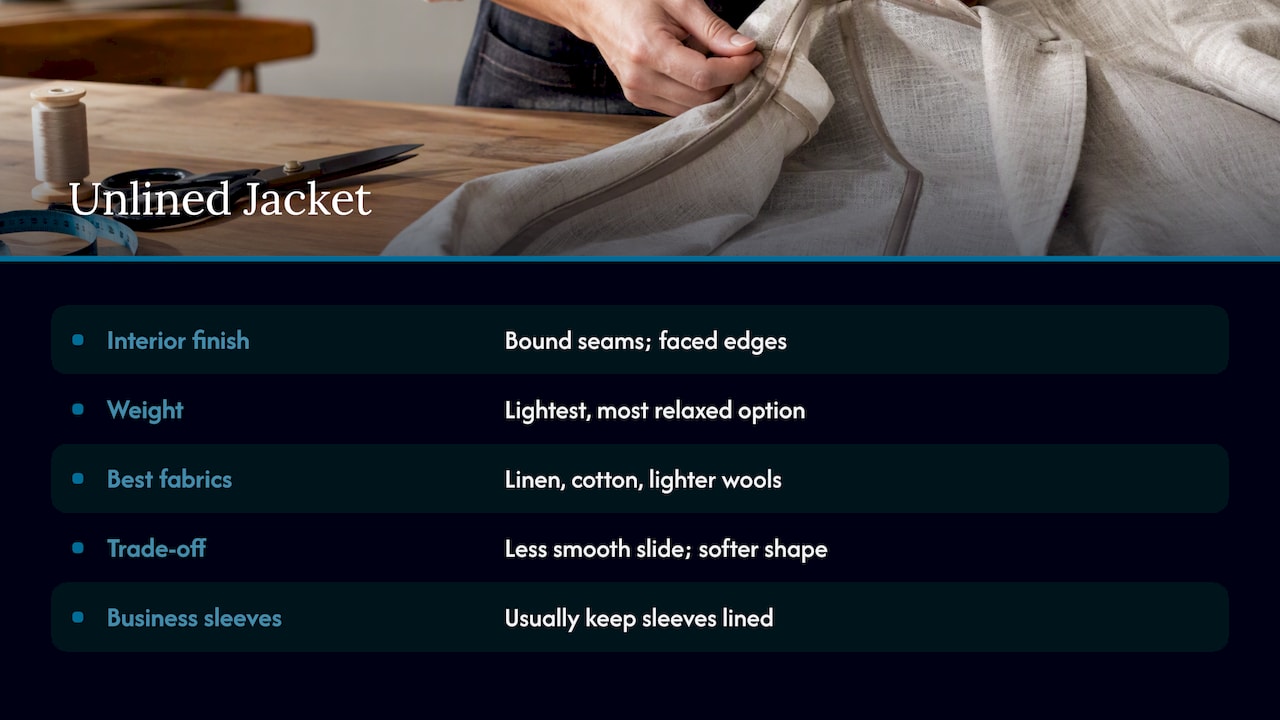
There is no lining at all. The inside seams are bound or finished and the edges are faced. An unlined jacket is the lightest and most relaxed option, and it is a natural fit for linen, cotton and lighter wools. The cost is a less smooth slide over the shirt and a looser, softer shape. Kozo Kawamura, founder of Colony Clothing, told The Straits Times that lightweight trousers and unlined jackets without sleeve linings are practical comfort options in Singapore. Note his specific advice: dropping the sleeve lining as well is the more extreme step. For a tailored business jacket, we would usually keep the sleeves lined.
Half lined vs fully lined: how to choose
The difference is easiest to see side by side.
| Fully lined | Half lined | Quarter lined | Unlined | |
|---|---|---|---|---|
| Airflow | Lowest | Good | Better | Best |
| Weight | Heaviest | Lighter | Light | Lightest |
| Look from the front | Crisp, formal | Same as fully lined | Same as fully lined | Soft, relaxed |
| Inside finish | Seams fully hidden | Seams bound on lower back | Seams bound on most of the back | All seams bound |
| Putting on and off | Smoothest | Smooth | Smooth if sleeves lined | Can drag on a shirt |
| Best for | Formal business, winter travel, evening | Everyday office wear in the tropics | Hot-weather suits | Linen and casual jackets |
A few practical rules follow from this.
- Wear the jacket on long days outdoors? Choose half or quarter lined.
- Spend most of the day in air-conditioning and want a sharp silhouette? Fully lined is a sound choice, particularly in a mid-weight wool.
- Choosing a tuxedo or a heavier evening jacket? Full lining gives the richest finish, and the colour is part of the character of the garment.
- Choosing a linen or cotton jacket? Lean towards unlined or quarter lined. The cloth is already relaxed, and a heavy lining would fight it.
The jacket’s cloth carries as much of the comfort as the lining does. Our suit fabric guide for every season and the notes on humidity-friendly office wear help you match the two.
Lining fabrics compared
Once you know how much lining you want, the fabric decides how it feels at 32°C.
Cupro (Bemberg)
Permanent Style notes that most suit linings are cupro or ermazine (viscose rayon), and that cupro is the softer and somewhat more breathable of the two. For a Singapore wardrobe, it is our usual starting point when comfort is the priority.
Viscose (ermazine)
Viscose rayon is tougher than cupro and is made in more weights and colours. If you want a precise shade or a pattern, or a jacket that must withstand daily wear, it is an excellent option. The Guardian’s expert also singles out viscose rayon and cupro as the most durable of the breathable, cellulose-based fibres.
Silk
Silk feels wonderful, but Permanent Style points out that it is more expensive, more delicate and somewhat less robust. It suits a jacket worn on occasions, a wedding or a dinner, rather than a workhorse suit worn four days a week in humid weather.
Cotton and acetate
The same source says plain cotton feels pleasant but has more friction and less strength, while acetate is light but flimsy. Cotton can work in a casual summer jacket. We would steer clear of acetate for anything you hope to keep for years.
Polyester
Polyester is the budget choice and it is durable, but it does not let moisture escape and evaporate, according to The Guardian’s tailoring expert. In a humid climate, that is the wrong trade.
| Fabric | Comfort | Breathability | Durability | Best use |
|---|---|---|---|---|
| Cupro (Bemberg) | Soft | Good | Good | Daily business suits |
| Viscose (ermazine) | Smooth | Good | Very good | Hard-wearing suits, wide choice of colour |
| Silk | Luxurious | Good | Delicate | Occasion jackets |
| Cotton | Pleasant, more friction | Good | Lower | Casual summer jackets |
| Acetate | Light | Moderate | Flimsy | Avoid for long-term wear |
| Polyester | Slick | Poor | High | Budget garments, cooler climates |
The ratings in the table are our own summary of the sources above and of what we see at fittings.
Choosing a lining for Singapore’s climate
The Meteorological Service Singapore advises loose-fitting, heat-permeable, light-coloured clothing in hot weather. A tailored jacket cannot be loose in the way a T-shirt is, so the aim is to remove every unnecessary barrier: a lighter cloth, a reduced lining, and a lining fibre that breathes.
Textile science supports the instinct. Fabrics that draw moisture away from the skin and let it evaporate keep you drier, a principle explained well in this piece on how moisture wicking works. A lining that traps sweat does the opposite.
Our recommendation for a Singapore working wardrobe:
- Everyday suit: half lined, cupro or viscose, sleeves lined.
- Hot-weather suit in lighter cloth: quarter lined, cupro.
- Linen or cotton jacket for weekends: unlined or quarter lined.
- Wedding or formal suit: fully lined, in cupro or silk, depending on how often it will be worn.
If you travel often, a reduced lining also helps a jacket pack and recover well. Our guide to travel suit fabrics covers the cloth side of that, and the piece on buggy-lined jackets explains another lightweight route that bespoke tailors favour.
Colour and pattern: the hidden signature
The lining is the one place in a suit where a conservative man may be playful, because it is seen only when the jacket is open or taken off. Think of it in two registers.
- Tone on tone. A lining a shade deeper or lighter than the cloth is calm and timeless. Navy suits with a navy or midnight lining, and charcoal with a grey, never look wrong.
- Contrast. Burgundy inside navy, a deep green inside a grey flannel, or a discreet stripe or paisley. It rewards you each time you open the jacket.
A few guidelines we give at fittings:
- Match the boldness to the occasion. A first interview or a client meeting suits a quiet lining. A wedding, where you will take your jacket off at the reception, welcomes something with personality.
- Consider the outer cloth. A strongly patterned or textured cloth, such as a corduroy or a velvet, often looks best with a calm lining. Our notes on the corduroy suit and the velvet tuxedo jacket show how we balance a rich surface with a restrained interior.
- Think about the shirt. A lining that clashes with your usual shirt colours is seen more often than you expect when you take the jacket off.
- Choose for longevity. A subtle lining ages well. Fashion colours date faster than the suit itself.
Our perspective
Lining is the least glamorous decision in a suit and, in our experience, the one clients most often skip. They choose the cloth carefully, then nod at the lining. We would ask you to give it a few minutes, because in a climate like ours it shapes how the jacket feels at three in the afternoon more than almost any other detail.
Our house has made suits since 1979, when master tailor Richard Fan founded the company, and we have always cut with the wearer’s day in mind. For Singapore, that means breathable fibres, a lining that reaches only where it is useful, and sleeves that let you take the jacket off without a struggle. A full lining remains the right choice for certain suits, and we are glad to make it beautifully. We simply prefer that you choose it knowingly.
Bring the suit you wear most to your fitting. Show us where it clings, where it traps warmth, and where you wish it were lighter. The answer is often a single line on the order form.
Ron
What to discuss with your tailor
Before you commit to a bespoke jacket, settle these points. They take ten minutes and affect every day you wear it.
- How and where you will wear it. Daily in the office, occasionally for weddings, or for travel? This sets the extent of the lining.
- How warm you run. Some men are comfortable in a full lining under air-conditioning, others are not. Say so plainly.
- The lining fabric. Ask for cupro or viscose as the default. Ask what the alternatives would cost in time and money.
- Sleeve lining. Decide whether to keep it. For most business jackets, we advise yes.
- Colour and pattern. Bring a shirt or tie you wear often, and decide whether you want the lining to match or contrast.
- Interior details. Pockets, a monogram or embroidered initials, and the way the seams are finished.
A tailor who explains the trade-offs is worth more than one who simply takes the order.
Bespoke linings at Ron & Rich
Every jacket we make is cut to your measurements and finished with traditional tailoring techniques, and the lining is chosen with you at the fitting rather than fixed in advance. Bespoke suits begin from $2,170, sports jackets from $1,790 and tuxedos from $2,270, as published on our pricing page. If you would like to see how a half-lined or fully lined jacket looks and feels in the cloth you have in mind, browse our bespoke suits and book a consultation.
For a suit worn through the working week, our business suits are a good place to begin. For a wedding or a black-tie evening, see our tuxedos.
FAQ
Is a half-lined suit as good as a fully lined one?
Yes, it is a different choice rather than a lesser one. From the front the two look the same, and the half-lined jacket is lighter and breathes better. A fully lined jacket gives a smoother, more formal interior and a little more structure. In Singapore, many men prefer half lined for daily wear.
What is the best lining for a suit?
For most men, cupro (Bemberg) or viscose. Both are breathable and durable, and viscose comes in a wider range of colours and patterns. Silk is the luxurious option, and polyester is best avoided in humid weather because it does not let moisture evaporate.
Should I keep the sleeve lining in a lightweight jacket?
Usually, yes. A lined sleeve lets the jacket slip on and off over your shirt, and it is the part of the lining that does the most for ease. If you choose an unlined jacket in linen or cotton, you accept a little more drag, in exchange for the lightest possible feel.
Can I choose any colour or pattern for the lining?
Generally you can, within the range of linings available for the fabric you choose. Viscose offers the widest selection. Pick a tone that complements the suit and the shirts you wear most, and keep bolder choices for occasions where you will remove the jacket.
Does the lining change how long a suit lasts?
It helps. The lining shields the outer cloth from sweat and body oils, as The Guardian’s expert notes, and durable fibres such as viscose and cupro hold up well to daily wear. A worn lining can also be replaced by a tailor, which is far easier than repairing damaged outer cloth.
Sources
- How to buy a timeless suit, The Guardian
- Bemberg, cupro, ermezine: the guide to linings, Permanent Style
- High temperatures advisory, Meteorological Service Singapore
- Five tips on wearing suits in Singapore, The Straits Times
- Moisture wicking explained