30% More Breathable: Why Bespoke Tailors Choose Buggy Lined Jackets
A buggy lining jacket is a jacket built with a partial back and shoulder lining rather than a full interior lining, and typically finished with a French-faced front. This construction is specified when a client wants a lighter, cooler jacket without sacrificing the clean shoulder line and finish that make a bespoke garment feel considered.
TL;DR:
- Buggy lining jackets feature a partial back and shoulder lining, stopping at the armhole, with the front face finished with a French-faced shell, and sleeves often remain unlined.
- Breathable fabrics like Bemberg cupro outperform acetate by roughly 30% in ventilation, making them ideal for buggy-lined jackets worn in hot and humid conditions.
- Proper construction requires careful sequence and restraint, including folding the shell fabric at the front, fitting the back panel slightly smaller, and ensuring the shoulder and collar clearance remains intact.
- A buggy lining offers advantages in weight, airflow, and style, but provides less structure and exposes interior seam allowances more quickly than full linings.
- Replacing a buggy lining is possible but complex due to the French-faced front, and maintenance involves gentle cleaning, steaming, and using proper hangers to prolong its wearability.
Table of Contents
- The anatomy of a buggy lining, piece by piece
- Buggy, butterfly, quarter and full lining: how they differ
- Choosing a lining fabric that actually breathes
- Construction notes: how tailors build a buggy lining
- When a buggy lining is the right call, and when it isn’t
- Can a buggy lining be replaced, and how do you care for one?
- A tailor’s honest view on buggy and quarter linings
- Sources
- FAQ
The anatomy of a buggy lining, piece by piece
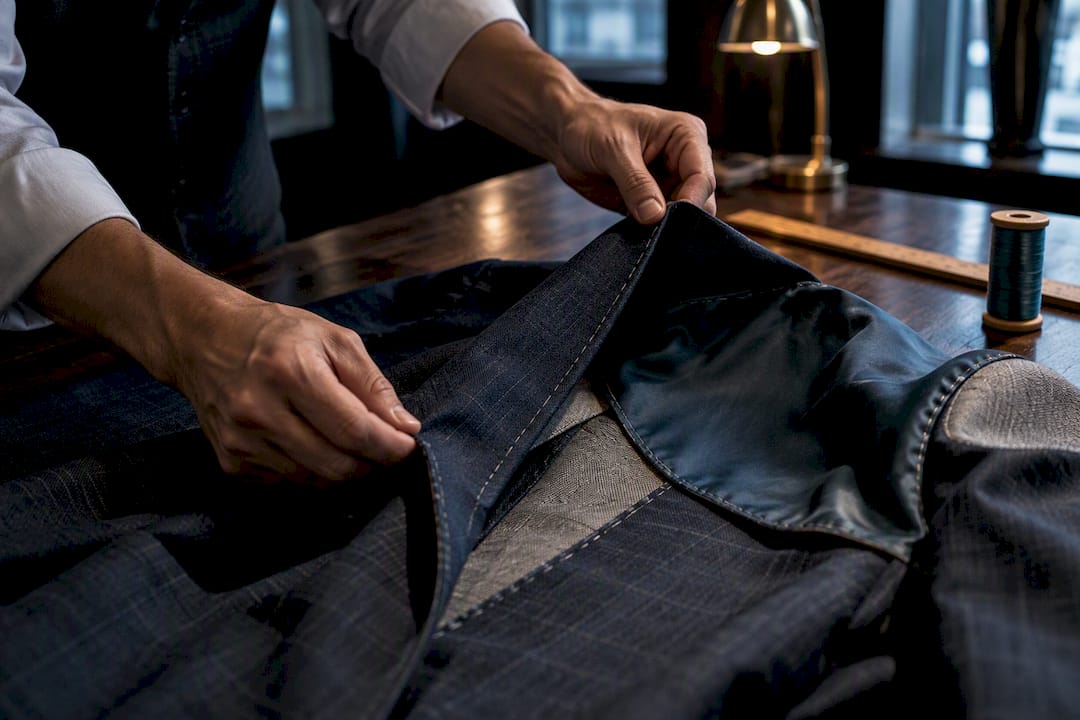
A buggy lining sits across the upper back and shoulders, extending down to roughly the base of the armhole and stopping there. The chest and front panels are treated differently: instead of a separate lining piece, the fabric of the jacket itself is folded back to face the inside, a technique called a French-faced or shell-faced front. This is the detail that most reliably identifies a buggy-lined garment, since the lining fabric simply never reaches that far forward.
The sleeves usually stay unlined in a true buggy construction, which noticeably changes how the jacket moves. Skin or shirt sleeve brushes against the shell fabric rather than a slippery lining, so reaching, driving, or shrugging into the jacket feels slightly different from a fully lined coat, looser at the shoulder, less “gliding” at the elbow.
This construction has old roots in outerwear and sport coats, garments built for movement and warmth regulation rather than formal polish, and that lineage still shapes where you see it used today:
- Sporting and shooting jackets, where a lighter back panel reduced bulk under a game bag or gun strap
- Country and travel jackets, where breathability mattered more than a fully finished interior
- Casual bespoke sports coats, where a visible half-lined interior reads as a deliberate style choice rather than a shortcut
Buggy, butterfly, quarter and full lining: how they differ
The vocabulary here gets muddled quickly, partly because retailers use these terms loosely and partly because the constructions genuinely overlap. Bernina’s guide to garment linings draws the cleanest line: full, partial and underlining are three distinct approaches, with partial linings deliberately trading some coverage for reduced bulk and better airflow.
Within “partial,” the differences are mostly about shape and where the panel ends:
- Full lining covers the entire interior, from collar to hem and down both sleeves.
- Half lining covers the back and part of the front, usually to somewhere around the waist.
- Quarter (butterfly) lining uses curved panels across the shoulders and upper back, which Paul Smith’s lining guide describes as creating a lightweight yoke rather than a hard-edged panel.
- Buggy lining is closer to a quarter lining but typically finished with a straight hem rather than a curved one, and paired with the French-faced front described above.
Tailoring purists keep buggy and butterfly separate on that hem shape alone, but the terms slide into one another constantly in retail copy and on tailoring forums, where a Styleforum thread on the term shows enthusiasts disagreeing on exactly where one ends and the other begins. A tailor might specify a curved butterfly yoke for a tropical-weight suit jacket and a straight buggy hem for a rugged field coat, largely on visual preference rather than strict rule.
Choosing a lining fabric that actually breathes
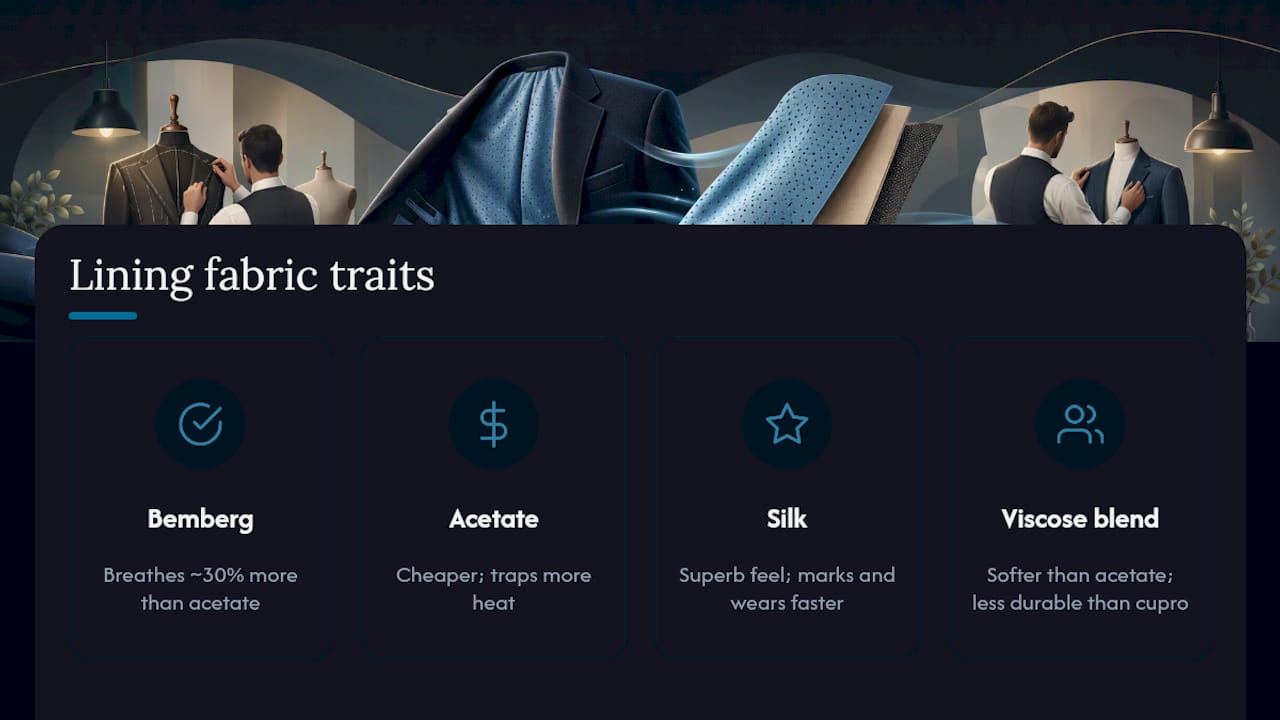
Fabric choice matters more in a buggy lining than in a full one, because the panel that remains is doing double duty: it has to move well against the shoulder and stay cool against the back of the neck. Bemberg, a cupro fibre spun from cotton linter, is the material Ron & Rich reaches for most often on warm-weather commissions. Acetate is cheaper and drapes acceptably but traps more heat. Silk feels superb but marks and wears through faster at friction points. Viscose blends sit somewhere in the middle, softer than acetate but less durable than cupro.
Statistic Callout: Open-weave Bemberg breathes roughly 30% better than standard acetate lining in comparative testing, which is precisely the margin that matters when a buggy-lined jacket is worn against bare skin in humid heat.
Weight matters as much as fibre. A heavier lining weave adds noticeable bulk exactly where a buggy construction is trying to remove it, at the back of the neck and across the shoulder seam, so a lighter, tightly woven Bemberg typically outperforms a heavier silk twill in the same cut.
Construction notes: how tailors build a buggy lining
Building a buggy lining well is less about the fabric and more about sequence and restraint. Get the order wrong and the jacket bulges at the collar or the shoulder loses its roll.
- Face the front panels. The shell fabric is folded and pressed to create a French-faced edge, eliminating a separate front lining piece entirely.
- Cut and fit the back panel. Two-piece shoulder sections, or a single curved yoke for a butterfly variant, are cut slightly smaller than the shell to sit flat without pulling.
- Set the hem line. The lining is finished with a straight or gently curved hem just below the armhole, secured so it cannot ride up during movement.
- Decide on the sleeves. Sleeves are left unlined for maximum breathability, or given a partial lining with pattern adjustments if the client wants a smoother entry and exit.
- Check the neck and shoulder. The tailor checks for clearance at the collar and confirms the shoulder retains its intended roll under the reduced lining.
Pro Tip: Layer the shoulder canvas slightly forward of where the lining ends. It stops the lining edge from printing through the shell fabric after a season of wear, a small detail that separates a well-finished buggy lining from a rushed one.
When a buggy lining is the right call, and when it isn’t
The case for a buggy lining rests on weight, temperature, and honesty about construction. The case against it rests on coverage and structure.
Advantages:
- Noticeably lighter overall weight, welcome in linen or high-twist wool jackets
- Better airflow across the back and shoulders in heat and humidity
- Shows off interior seam finishing as a deliberate style statement
- Lower material cost than a full lining, though this rarely changes the final price on a bespoke commission
Disadvantages:
- Less coverage means seam allowances and interior stitching are more exposed
- Provides less internal structure than a full lining, so it leans harder on the canvas underneath for shape
- Interior wear, fraying, or discolouration on the shell fabric shows sooner since there’s no lining to hide it
A buggy lining suits summer linen jackets, travel blazers, and heritage-style field jackets best. It interacts closely with the canvas underneath: a soft, lightly canvassed shoulder pairs naturally with the reduced structure of a buggy back, while a heavily padded, fused shoulder can look at odds with such a minimal lining. Readers weighing that trade-off may find our piece on half canvas versus full canvas useful before specifying either.
Can a buggy lining be replaced, and how do you care for one?
Replacement is generally possible and a routine job for an experienced tailor, but complexity rises quickly once a French-faced front is involved. Because the front panel’s facing is part of the shell fabric rather than a separate piece, relining work around it demands careful unpicking and reattachment rather than a simple swap.
Care is straightforward if you respect a few limits:
- Never machine wash; spot-clean small marks and send the jacket for professional dry cleaning otherwise
- Steam rather than iron directly against the lining seam to avoid flattening the shoulder roll
- Store on a proper shoulder-shaped hanger to reduce strain on the reduced internal structure
- Choose a full reline over a local patch repair once more than one seam edge has frayed, since a partial repair on a small lining rarely matches the original tension
A tailor’s honest view on buggy and quarter linings
Clients often assume a fuller lining automatically means a better jacket. It doesn’t, and in Singapore’s climate that assumption works against them more often than not. We reach for a partial or quarter lined construction whenever a client wants a jacket they’ll actually wear through a humid afternoon rather than one that looks impressive on a hanger and gets left at home.
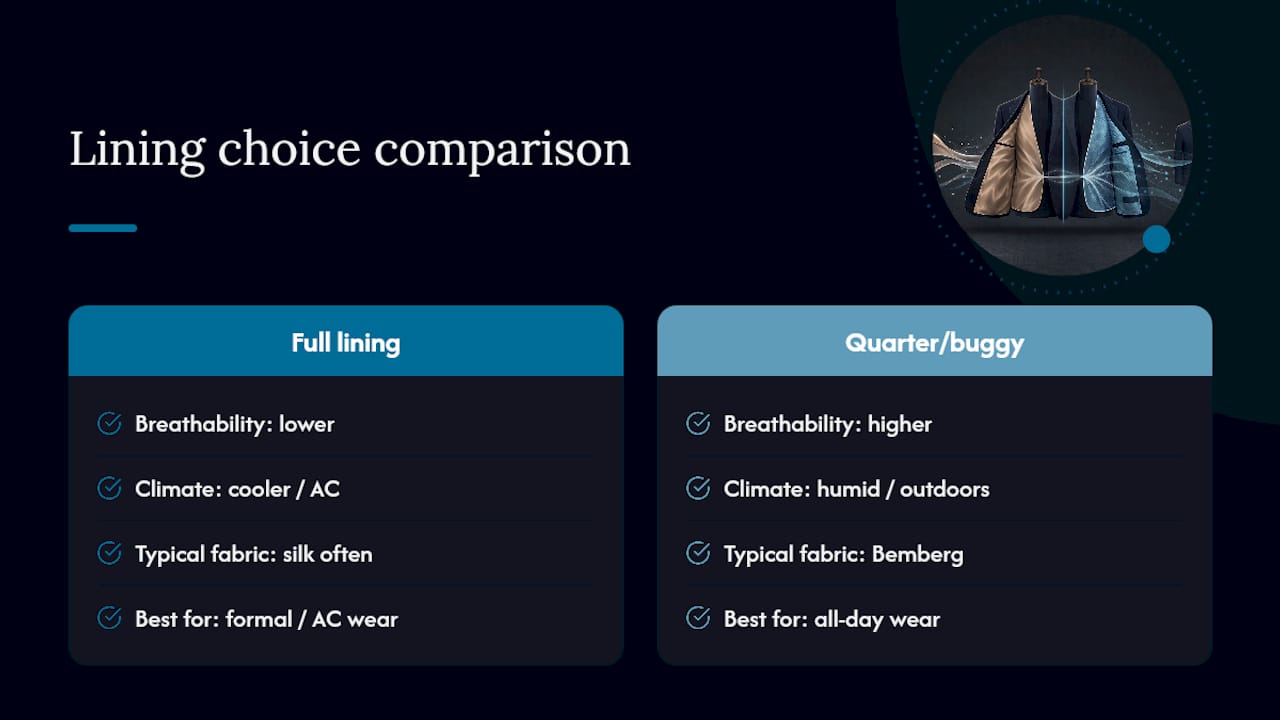
Fabric is where most of the decision lives. Bemberg is favoured for its breathability over acetate almost every time for warm-climate commissions, with silk linings reserved for jackets that will spend more time in air-conditioned rooms than outdoors. Fit checks matter just as much as fabric: we always confirm neck clearance so the collar doesn’t gap, watch how the shoulder rolls once the reduced lining is in, and test sleeve movement before calling a fitting finished.
A buggy or quarter lining isn’t a downgrade from a full one. It’s a different tool, chosen when comfort and climate outrank maximum interior coverage. Clients who want to see both approaches side by side before deciding are welcome to book a consultation and compare a full suit fitting against a partially lined sports jacket in the same visit.
— Ron
Sources
For readers who want to go deeper, Bernina’s breakdown of full, partial and underlining explains the structural trade-offs clearly. Paul Smith’s guide to suit linings covers butterfly and quarter constructions from a ready-to-wear perspective. The Styleforum thread on buggy lining is worth a read for anyone curious how much the term shifts between tailoring circles, and ShirtsMockup’s fabric comparison backs the Bemberg recommendation with practical detail.
- 3 types of garment lining: full, partial and underlining — Bernina blog
- Everything you need to know about suit linings — Paul Smith
- How to choose a lining for your custom suit jacket — ShirtsMockup
- Buggy lining explanation — The Avid Seamstress
FAQ
What is the lining of a jacket called?
The interior fabric layer of a jacket is simply called the lining, though tailors specify further by type, such as full, half, quarter, butterfly, or buggy, depending on how much of the interior it covers and how it’s shaped at the shoulder and hem.
What is the warmest lining for a jacket?
Silk and heavier acetate blends trap the most warmth of the common lining fabrics, which is why they suit formal winter suiting better than warm-climate jackets. For breathability rather than warmth, Bemberg cupro is the better choice, breathing roughly 30% better than standard acetate.
Can jacket lining be replaced?
Yes, a lining can usually be replaced or relined by an experienced tailor. Complexity increases with French-faced fronts and bespoke seam finishing, since the facing itself is cut from the shell fabric rather than being a separate lining piece that simply unpicks.
What type of lining is best for suits?
There’s no single best lining for every suit; the right choice depends on climate and use. Bemberg suits warm-weather and travel suiting for its breathability, while a full silk or acetate lining suits colder-climate formal wear where warmth and a polished interior finish matter more than airflow.