210–310 gsm Travel Suit Fabrics That Stay Sharp for Frequent Flyers
High-twist tropical wool, wool-mohair blends, and performance wool blends. Blends that include a small percentage of elastane provide stretch and durability; such blends hold up well in transit by recovering from creasing, maintaining breathability, and keeping a refined drape. Heavier fabrics or those based on cotton or linen tend to perform less reliably for these factors.
TL;DR:
- Tropical wool fresco and wool-mohair blends between 210 and 310 gsm are the best choices for travel suits due to their wrinkle recovery and breathability.
- High-twist yarns store energy like a spring, making tropical wool highly resistant to creasing and cooling against the skin through open weaves.
- Heavier fabrics above 320 gsm tend to be inflexible and less suitable for frequent packing, while lighter ones below 200 gsm may lack durability for structured tailoring.
- Proper suit construction, especially full or half canvassing, greatly influences how well a travel suit maintains shape and resists creasing after multiple trips.
- Blends with synthetic fibers reduce wrinkles and lower care needs but can develop a sheen or feel less natural, so a performance wool with minimal synthetic content balances durability with appearance.
Table of Contents
- What are travel suit fabrics, and why does it matter which one you choose?
- Why these fabrics perform: fibre science, weave, and weight explained
- What should you avoid in a travel suit fabric?
- Tailoring and construction: why the build matters as much as the cloth
- How do you pack and care for a suit to avoid wrinkles?
- How breathable are travel suit fabrics, really?
- Do travel suits resist stains, and how easy are they to clean?
- Should your travel suit fabric change with the season?
- Natural or synthetic: which fabric actually wins for travel?
- What is the environmental footprint of common travel suit fabrics?
- A tailor’s perspective: why fit and construction decide how a fabric performs
- Ready for a suit built for how you actually travel?
- Sources
- FAQ
What are travel suit fabrics, and why does it matter which one you choose?
A travel suit fabric is any cloth engineered, or simply well suited by its fibre and weave, to withstand folding, sitting, and climate shifts without looking as though it slept in a bag. The term is not an official textile category. Tailors and mills talk instead about tropical wool, fresco weaves, and high-twist worsteds. But for a reader trying to work out what to ask for at a fitting, “travel suit fabric” is the useful shorthand, and it points to a specific set of properties: wrinkle recovery, breathability, and enough structure to hold a jacket’s shape after a long-haul flight in economy.
Here is the shortlist worth knowing by name.
- High-twist tropical wool (fresco): spun from wool fibres twisted more tightly than standard worsted yarn, then woven in an open construction that leaves tiny air channels through the cloth. That twist is what gives fresco its spring. Typical weights run around 210 to 310 gsm, light enough to breathe in Singapore’s heat yet dense enough to hold a crisp lapel line.
- Wool-mohair blends: mohair fibre is naturally smooth and resistant to permanent creasing, and blending it into wool sharpens the cloth’s sheen without sacrificing wearability. A ratio of roughly 35% mohair to 65% wool is widely regarded as the sweet spot for travel tailoring, typically falling within a moderate weight range appropriate for travel suits.
- Performance wool blends: small percentages of polyester or nylon woven into wool add durability and simplify care, at the cost of a slightly less luxurious hand. Useful for suits that will see frequent pressing or dry cleaning on the road.
- Stretch worsted (wool with elastane): a few percent of elastane gives the cloth genuine give, which matters most in the seat and across the shoulders after hours seated on a plane or in back-to-back meetings.
Ask your tailor for the gsm figure and the weave name, not just the fibre content. A “100% wool” label tells you almost nothing about how the suit will behave after eight hours folded in a garment bag; the twist and the weave tell you everything. They resist creasing at first, but the cloth develops a slightly plastic sheen over time and rarely drapes as well on the body.
Why these fabrics perform: fibre science, weave, and weight explained
Fabric behaviour under stress comes down to three things: how the yarn was spun, how it was woven, and how heavy the resulting cloth is. High-twist yarns, the kind used in fresco and similar tropical weaves, store energy in the fibre the way a coiled spring does. Bend or crush the cloth and it wants to spring back, which is precisely why tropical wool resists creasing so effectively. A plain worsted with lower twist has less of that stored tension and creases more readily.
Fibre choice compounds the effect. Wool’s natural elasticity lets it stretch and recover; mohair is stiffer and smoother, which discourages a crease from setting in the first place; most synthetics simply lack the elastic memory of either, so a crease pressed into polyester tends to stay put rather than release overnight on a hanger.
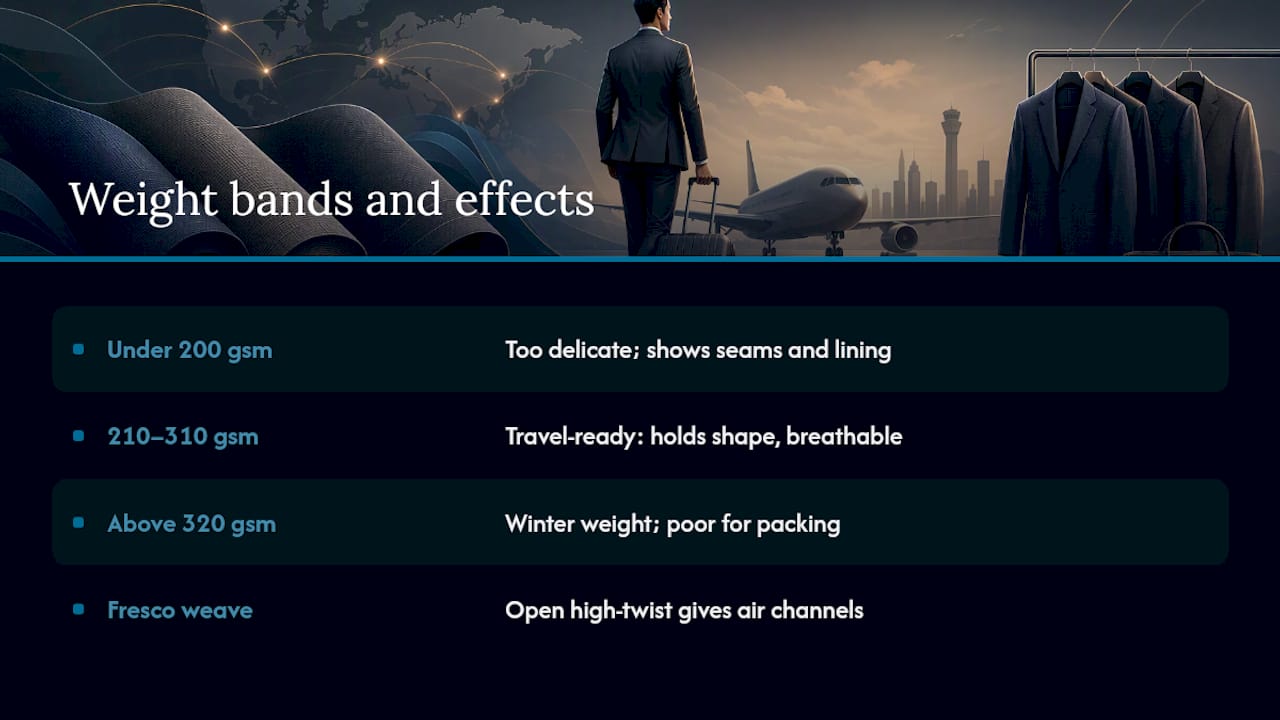
Weight matters just as much as fibre. Cloth under roughly 200 gsm often feels too delicate for structured tailoring and can show every seam and lining beneath it. Above 320 gsm, a suit becomes a winter garment: warm, substantial, and a poor packing companion. The 210 to 310 gsm range covers most genuinely travel-ready cloths, wide enough to breathe, dense enough to hold shape. The open, high-twist construction typical of fresco also creates air channels that speed moisture transfer, which is part of why the same weave that resists wrinkles also feels cooler against the skin. Finishing and lining choices then decide how that base cloth actually behaves in the case: a half-lined jacket in fresco will pack and breathe noticeably better than the same cloth fully lined in a heavy bemberg.
What should you avoid in a travel suit fabric?
Not every handsome fabric survives a suitcase, and a few of the classics are the worst offenders.
- Pure linen looks wonderful for the first hour and creased for the remaining seventy. Its fibre has almost no elastic memory, so every fold becomes a permanent line.
- Cotton suiting behaves similarly. It is comfortable and inexpensive but holds a crease and shows wear at the knees and elbows faster than wool.
- Heavy winter wools, anything well above 320 gsm, pack into a dense, stubborn block and rarely bounce back into shape after being compressed for a transatlantic flight.
- Fused construction, where fabric is glued rather than sewn to its interlining, tends to bubble and separate under repeated folding and heat.
Budget synthetics still have a place. A cheap poly-wool blend suit is a reasonable stopgap for a single conference trip, but it rarely earns a second look at 300 gsm and above the fibre feel becomes obvious under good lighting.
Tailoring and construction: why the build matters as much as the cloth
Fabric gets most of the attention, but construction often decides how a suit actually survives travel. A half-canvas or full-canvas jacket, where a horsehair and wool interlining is hand-stitched between the outer cloth and lining, moves with the body and reshapes itself once hung. A mid-grade wool blend built on proper canvassing will typically outlast a glued, fused suit in 100% wool, because the canvas, not the fibre alone, is what holds the chest and lapel line after folding.
- Full-canvas: the most durable and the most forgiving of repeated packing, at a higher price point.
- Half-canvas: canvas through the chest, fused below the waist. A sound middle ground for most frequent flyers.
- Fused: glued interlining throughout. Cheapest to produce, and the first to bubble or delaminate under sustained travel wear.
Pair the right canvassing with a lighter, less structured shoulder and a breathable half-lining, and the jacket will pack smaller and recover faster than a heavily padded, fully lined equivalent. Ron & Rich’s own guides on half-canvas versus full-canvas construction and fused versus canvassed suits go deeper into how each build behaves over years of wear, not just one trip.
Pro Tip: Ask to see the canvas at a fitting. A tailor who can show you the interlining, rather than just describing it, is one worth trusting with a travel suit.
How do you pack and care for a suit to avoid wrinkles?
- Fold the jacket inside out along the shoulder seam, tucking one shoulder inside the other, then fold once at the waist. This “hollow fold” protects the outer cloth from itself.
- For a garment bag, hang the suit rather than folding it wherever the trip allows; upright travel is always gentler than compression.
- On arrival, hang the suit immediately in the bathroom and run a hot shower for ten minutes. The steam relaxes fibres and lifts most travel creases within the hour.
- Spot-steam stubborn areas, such as the lapel roll or trouser crease, holding the steamer or iron a few centimetres from the cloth.
Pro Tip: Carry a compact travel steamer and a cedar hanger. Cedar absorbs moisture and odour overnight, and a five-minute steam session beats a rushed hotel pressing service most mornings. For anything beyond a light refresh, a local dry cleaner with a proper press will outperform a hotel’s turnaround service, particularly for wool-mohair blends that need gentle handling to keep their sheen.
How breathable are travel suit fabrics, really?
Breathability is where fresco and other high-twist tropical wools separate themselves most clearly from heavier cloths. The open weave leaves genuine gaps between yarns, and those gaps let air and moisture vapour pass through the fabric rather than trapping it against the skin. That structure gives fresco a natural cooling effect that dense worsteds simply cannot match at the same weight.
Wool itself also manages moisture more actively than most people expect. The fibre absorbs vapour into its core and releases it gradually, rather than holding sweat on the surface the way many synthetics do. That is a meaningful advantage for anyone moving between an air-conditioned lounge and a humid tarmac, or sitting through a warm afternoon meeting straight off an overnight flight. A wool-mohair blend behaves similarly, since mohair fibre is naturally smooth and does not obstruct airflow through the weave.
Performance blends with polyester content breathe less well. Synthetic fibres do not absorb moisture the way wool does, so sweat tends to sit against the skin rather than wicking away, which is part of why a heavier poly-wool suit can feel clammy after a few hours even when the ambient temperature is mild. If breathability through humid climates and long transit days is the priority, tropical wool and wool-mohair blends outperform anything with a significant synthetic share, at every comparable weight.
Do travel suits resist stains, and how easy are they to clean?
Wool’s natural fibre structure gives it a genuine advantage here. The outer layer of a wool fibre is made of overlapping scales that shed liquid rather than absorbing it instantly, so a spilled drink or dropped sauce often sits on the surface long enough to blot away before it sets. Cotton and linen absorb liquid far faster, which is one more reason they perform poorly for anyone eating and travelling in the same suit.
Wool-mohair blends carry a similar advantage, and mohair’s smooth fibre surface can make some stains easier to lift than from a pure wool cloth of the same weight. Performance blends with a polyester component resist water-based stains reasonably well, since synthetic fibres do not absorb moisture readily, though oil-based marks can bind more stubbornly to synthetic fibre than to wool.
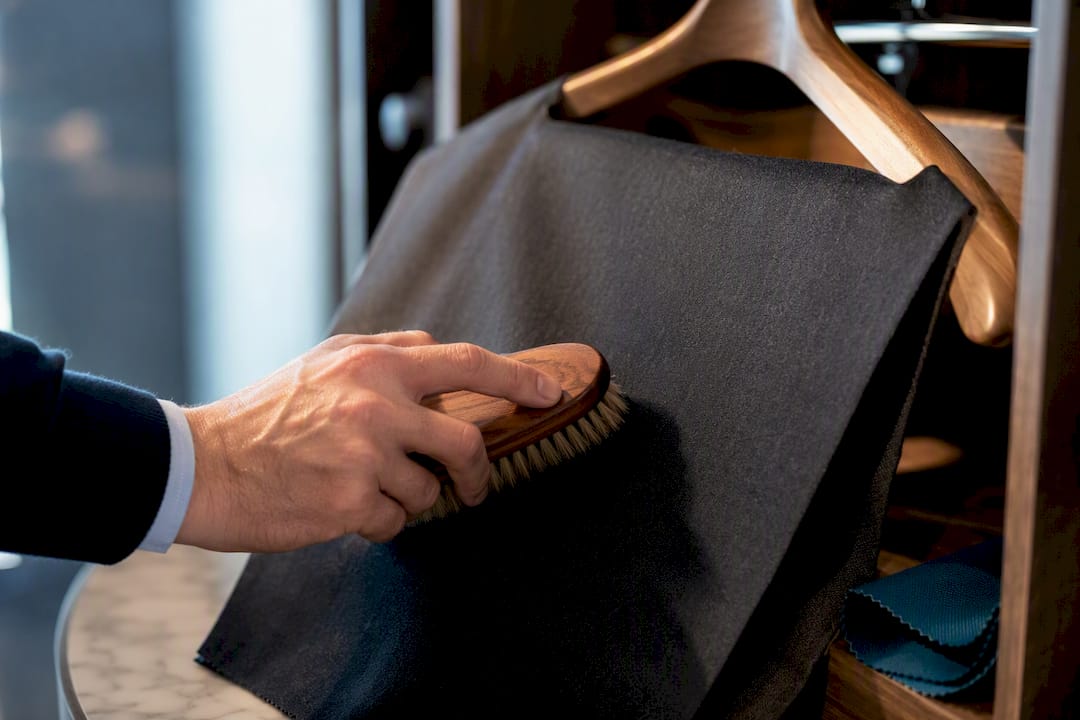
Cleaning routines differ by cloth, and getting this wrong shortens a suit’s working life fast. High-twist tropical wool and wool-mohair blends should go to a dry cleaner experienced with fine suiting. Aggressive pressing or the wrong solvent can flatten the very texture that gives fresco its wrinkle recovery. Between cleans, a soft brush after each wear and a night on a proper hanger removes surface dust and lets any moisture evaporate before it sets into the fibre. Spot-cleaning small marks with a damp cloth and mild soap, rather than sending a lightly soiled suit for a full clean, extends the interval between dry cleaning sessions and reduces overall wear on the cloth.
Should your travel suit fabric change with the season?
Yes, and the difference is bigger than most travellers assume. A tropical wool fresco at 210 to 250 gsm is built for heat and humidity, whether that means a tropical climate all year round or a summer trip through a temperate one. Its open weave and high twist keep the wearer cool while still resisting the creasing that a long flight or a full day of meetings inevitably brings.
Cooler climates call for a heavier hand, but not so heavy that the suit becomes a packing liability. A worsted wool or wool-mohair blend in the 280 to 320 gsm range holds warmth better while still travelling reasonably well, provided the weave still has some open structure rather than being a dense, felted winter cloth. Above that weight, a suit stops being practical for a garment bag or carry-on and starts being a suit you wear once you arrive and leave in the wardrobe until you leave.
Frequent travellers who move between climates on the same trip, a humid transit hub followed by an air-conditioned boardroom followed by a cooler evening flight, are usually better served by a single mid-weight fabric around 250 to 280 gsm than by packing two suits for two extremes. A well-chosen tropical wool or wool-mohair blend in that middle band handles more scenarios competently than a fabric optimised for one climate alone.
Natural or synthetic: which fabric actually wins for travel?
Natural fibres win on drape, breathability, and long-term wrinkle recovery. Wool’s elastic memory lets a crease relax out on its own overnight; mohair adds sheen and stiffness that discourages creasing from forming in the first place. Both age gracefully, developing a slightly softer hand over years of wear rather than degrading into a shine or a plastic feel.
Synthetics win on upfront crease resistance and price. A polyester-heavy blend can survive a genuinely rough packing job, being stuffed into a duffel bag rather than folded with any care, and still look presentable on arrival. That resilience comes at a cost to appearance: synthetic fibre tends to develop a subtle sheen under strong light that reads as cheap next to a wool or wool-mohair cloth, and it lacks the natural “bounce” that lets wool self-recover from wrinkles when simply hung on a hanger overnight.
The practical answer for most professionals is a blend that leans natural. A performance wool with a small percentage of polyester or elastane, typically no more than 10 to 15% synthetic content, captures most of wool’s drape and breathability while adding a genuine boost to durability and ease of care. Pure synthetics remain a reasonable choice only when a suit is a low-priority, once-a-year purchase rather than a working garment expected to perform trip after trip.
What is the environmental footprint of common travel suit fabrics?
Wool and mohair are renewable fibres, sheared annually from animals that continue producing fleece year after year, which gives both a fundamentally different sustainability profile from petroleum-based synthetics. Wool is also biodegradable at the end of its life, breaking down in soil over a matter of months rather than persisting for decades the way polyester does.
That said, wool production carries its own environmental considerations, including land use and the methane associated with sheep farming, and no fibre is free of impact once processing, dyeing, and finishing are factored in. Mohair farming, drawn from Angora goats, follows a broadly similar profile to wool in terms of renewability, though global mohair supply is far smaller and more concentrated in a handful of producing regions.
Synthetic blends bring a different set of trade offs. Polyester is typically derived from petroleum and does not biodegrade, but it can be produced from recycled plastic, and some mills now offer recycled-polyester suiting blends aimed at reducing that footprint. For a traveller weighing durability against sustainability, a wool or wool-mohair suit built to last a decade of trips, rather than replaced every year or two, is often the more sustainable choice regardless of the fibre’s individual farming footprint, simply because it is bought once and worn for longer.
A tailor’s perspective: why fit and construction decide how a fabric performs
The best fabric on paper still fails a traveller if the jacket does not fit through the shoulders or if a fused canvas bubbles after three flights. Fabric choice and construction are two halves of the same decision. A properly fitted, well-canvassed suit lets a mid-weight tropical wool or wool-mohair blend perform at its best, trip after trip, in a way no swatch card can fully predict.
— Ron
Ready for a suit built for how you actually travel?
Choosing the right gsm and weave is only half the equation; the other half is a jacket cut and canvassed to move with you through a long-haul flight and a same-day meeting. The company emphasizes personalized fittings matching premium fabrics to the local climate and to each traveller’s schedule and build.

A bespoke consultation means talking through your actual travel pattern, humid transit hubs, cooler destinations, back-to-back meetings straight off a flight, before a single swatch gets chosen, then building the jacket on canvassing suited to how hard it will actually work. Suits start from $2,170 and sports jackets from $1,790, with full pricing and every product line listed on the pricing page. Browse the current suits and jackets range or book a fitting to talk through fabric and construction for your own travel schedule.
Sources
- Mohair producers — characteristics
- Mohair fabric guide — Gentleman’s Gazette
- Sew with tropical wool suiting — Threads magazine
- Tropical wool: summer performance and temperature regulation — Selvane
FAQ
What is the best suit fabric for travelling?
High-twist tropical wool, often called fresco, and wool-mohair blends around 35% mohair to 65% wool are the top performers, thanks to natural wrinkle recovery, breathability, and a weight typically between 210 and 310 gsm.
What is a good wrinkle-free suit fabric for travel?
No suit fabric is truly wrinkle-free, but high-twist tropical wool comes closest because its tightly spun fibres store energy and spring back into shape once hung, unlike linen or cotton, which hold a crease.
What is the best lightweight fabric for a travel suit?
Tropical wool fresco at the lighter end of its typical range, around 210 to 250 gsm, offers the best combination of low weight, breathability, and structure for warm-climate or summer travel.
What type of fabric is generally best for suits overall?
Wool remains the standard for most suiting because of its drape, elasticity, and moisture management, and for travel specifically a high-twist tropical wool or wool-mohair blend outperforms both heavier wools and cotton or linen alternatives.
Should I choose a bespoke suit if I travel frequently?
Bespoke or made-to-measure tailoring lets you match fabric weight and weave to your actual travel pattern and pair it with proper canvassing, which matters as much as fibre choice for how a suit holds up over repeated trips.