Fused vs Canvassed Suits: A Buyer's Guide for Men
For everyday professional wear, a half- or full-canvassed jacket is the smarter investment. Fused suits are a reasonable budget option for occasional use, but they rarely hold up to the demands of regular wear.
-
Daily or professional wear: Choose canvassed construction. Canvassed jackets mold to your body over time, producing a lapel roll and drape that a fused jacket simply cannot replicate, and they remain repairable when something eventually gives.
-
Occasional or one-off events: A well-made fused suit can serve you adequately for a handful of wears per year, particularly if budget is the primary constraint.
Key Takeaways
Canvassed construction outlasts fused in every meaningful dimension: drape, breathability, repairability, and lifetime cost per wear.
| Point | Details |
|---|---|
| Construction hierarchy | Full-canvas outlasts half-canvas, which outlasts fused; choose accordingly for how often you wear suits. |
| Fused failure is permanent | Delamination and bubbling in fused suits cannot be repaired; treat fused jackets as finite-lifespan garments. |
| Lifetime cost often favors canvassed | A canvassed suit worn regularly for 10+ years typically costs less per year than replacing fused suits every 3–5 years. |
| Inspection shortcut | Pinch the front panel: a floating third layer means canvassed; bonded layers that feel like one mean fused. |
| Ronandrich builds in canvas | Ronandrich uses canvassed construction across its bespoke range, with half-canvas available as a price-conscious option. |
Table of Contents
-
What canvassed construction is: half-canvas and full-canvas explained
-
How construction changes look and feel: drape, lapel roll, and comfort
-
Price differences and lifetime value: when canvassed construction pays off
-
Why bespoke and canvassed construction matter: a tailor’s perspective
-
Environmental impact and sustainability of fused vs canvassed suits
What fused construction actually means
A fused jacket uses heat-activated glue to bond a synthetic interlining directly between the outer shell and the lining. The process is fast, consistent, and inexpensive, which is why fused interlining dominates mass-market production across off-the-rack suiting.
The upside is real: fused jackets hold their shape immediately out of the box, cost less to manufacture, and look presentable on the rack. The downside is structural. Because the interlining is glued rather than sewn, it cannot move independently of the shell. The jacket feels stiffer than it should, breathability suffers, and the chest can trap heat noticeably during long days.
The more serious risk is delamination. Repeated dry-cleaning, perspiration, and general wear degrade the adhesive over time, causing the interlining to separate from the shell in visible bubbles or blisters. Once that happens, the damage is effectively permanent. Lighter-weight fabrics, such as fine wool or linen blends, tend to show bubbling sooner because there is less material to conceal the separation.
What canvassed construction is: half-canvas and full-canvas explained
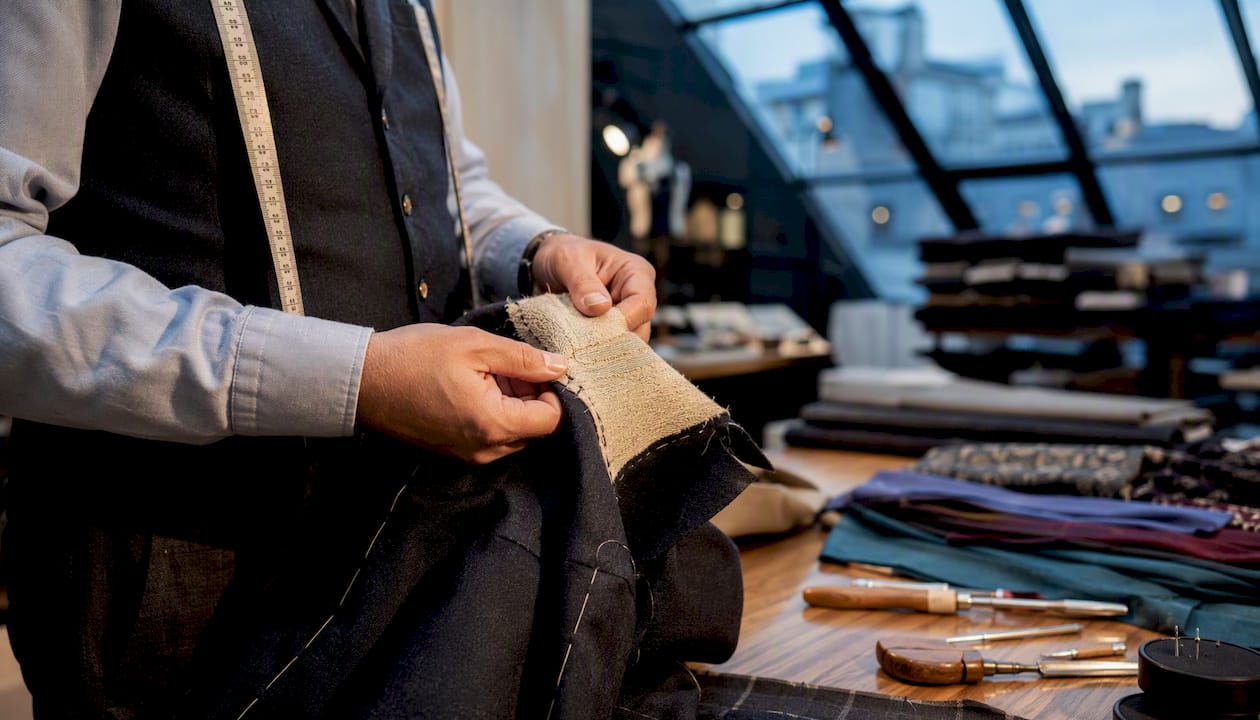
A canvassed jacket replaces the glued interlining with a layer of woven fabric, traditionally horsehair or cotton canvas, that is sewn to the shell rather than bonded to it. Because the canvas “floats” independently, it moves with your body rather than against it.
Half-canvas is the practical middle ground most quality tailors recommend. The canvas sits in the chest and lapel areas, where structure and roll matter most, while the lower portion of the jacket may use a fused or lightly bonded construction to control cost. The result is a jacket that breathes well, develops a natural lapel roll, and lasts considerably longer than a fully fused garment.
Full-canvas extends the sewn interlining across the entire front panel. It is the gold standard for longevity and drape, and the construction that bespoke tailors have relied on for centuries.
Key distinctions at a glance:
- Half-canvas: — Canvas in chest and lapels; lower front may be fused; best price-to-performance ratio for most buyers.
How construction changes look and feel: drape, lapel roll, and comfort
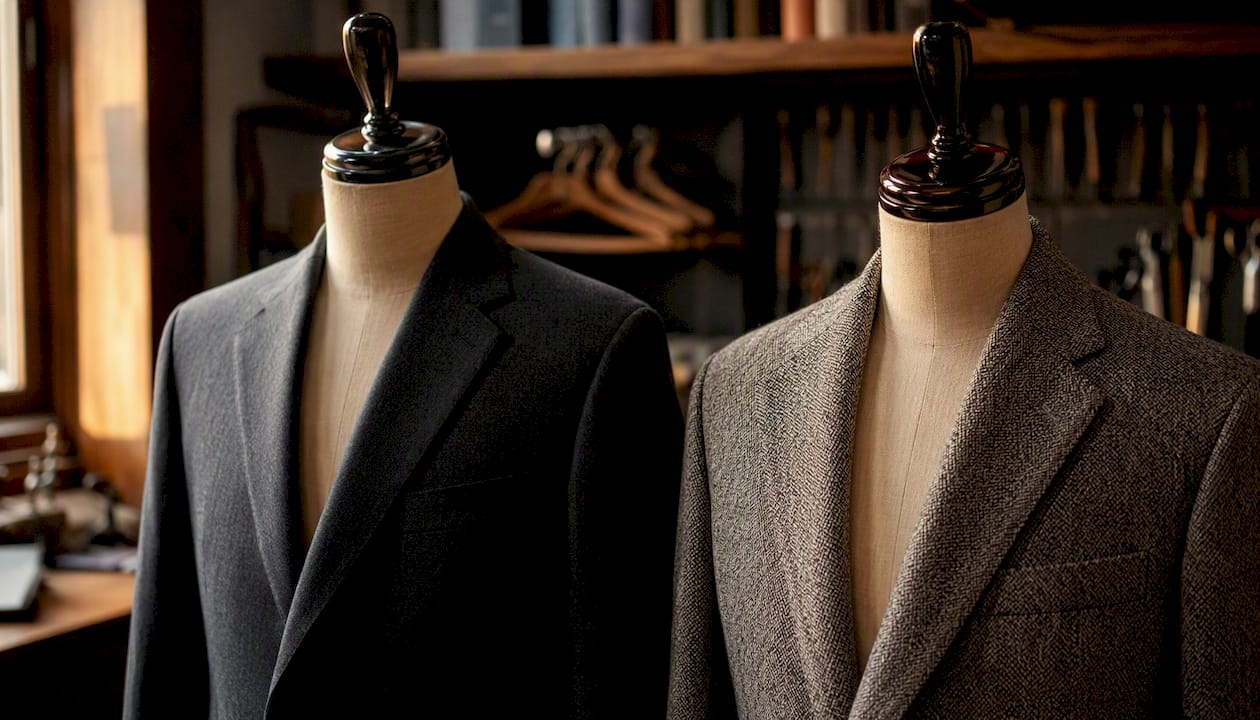
Canvassed construction produces a softer, more rounded lapel roll. A fused lapel tends to lie flat and sharp, a visual shorthand that experienced eyes read as a sign of lower-grade tailoring.
| Dimension | Fused | Half-Canvas | Full-Canvas |
|---|---|---|---|
| Lapel roll | Flat, sharp | Soft, natural | Soft, rounded, improves with wear |
| Drape | Stiff initially, may sag later | Natural from the start | Molds to body over months |
| Breathability | Lower; chest traps heat | Good | Excellent |
| Tailoring adjustments | Limited; re-pressing can damage glue | Responds well | Responds best |
| Seasonal comfort | Warmer and less suitable for summer | Versatile | Versatile; heavier full-canvas often preferable in cooler weather |
| Longevity | Typically shorter lifespan than canvassed jackets with regular wear | Medium to long lifespan | Longest lifespan with proper care |
Put a canvassed jacket on and you feel the difference within minutes. The chest yields slightly as you move; the lapels settle against your shirt rather than standing away from it. A fused jacket, by contrast, holds a single predetermined shape. It may look fine in the first season, but it does not adapt.
Fabric choice amplifies these differences. A finely woven 120s wool in a fused jacket will show bubbling faster than a sturdier 100s cloth, because the tighter weave offers less structural support to the glued layer beneath.
Durability, failure modes, and repairability
The lifespan hierarchy is straightforward: full-canvas outlasts half-canvas, which outlasts fused, often by a significant margin.
Fused failure modes:
-
Delamination and bubbling, typically appearing after repeated dry-cleaning or heavy perspiration.
-
Creases that cannot be pressed out because the glue layer has shifted.
-
General limpness as the adhesive weakens, causing the jacket front to lose structure.
Once bubbling starts in a fused suit, it cannot be reliably repaired, making the jacket effectively disposable. A tailor can do nothing to re-bond a failed interlining without stripping and rebuilding the jacket, which costs more than the garment is worth.
Canvassed failure modes are far more forgiving. Loose stitches can be resewn. A canvas that has flattened slightly from years of wear can be re-padded. The shell fabric itself may eventually thin at the elbows or cuffs, but those areas are replaceable.
Care tips by construction:
-
Fused: Limit dry-cleaning to once or twice per year; spot-clean where possible. Press on low heat with a pressing cloth. Store on a wide-shouldered hanger.
-
Canvassed: Steam rather than press directly; the canvas responds well to moisture. Dry-clean no more than once per season. Cedar blocks in storage help preserve the wool.
Price differences and lifetime value: when canvassed construction pays off
Canvassed suits cost more upfront. The labor involved in hand-padding a canvas, basting it to the shell, and fitting it through multiple stages is simply more time-intensive than running a jacket through a fusing press. Full-canvas construction requires more labor and cost but provides consistent structure and longevity that fused suits cannot match.
| Construction | Typical Price Range | Expected Lifespan (Regular Wear) | Approx. Annual Cost |
|---|---|---|---|
| Fused (off-the-rack) | Economical price range | Typical lifespan shorter than canvassed jackets | Lower annualized cost over limited lifespan |
| Half-canvas (quality RTW or MTM) | Moderate price range | Medium lifespan | Comparable annualized cost given longevity |
| Full-canvas (bespoke) | Higher price range reflecting quality | Longest lifespan with proper care | Annualized cost competitive over time |
The annual-cost figures above show why the “expensive suit” argument often inverts on closer inspection. A $400 fused suit replaced every four years costs roughly the same per year as a $1,200 half-canvas jacket worn for a decade, and the canvassed jacket will fit and look better throughout.
A useful rule of thumb: wearing a suit frequently can make canvassed construction more economical over time.
Why bespoke and canvassed construction matter: a tailor’s perspective
Canvassed construction is central to what Ron & Rich has built since Richard Fan founded the house in 1979. A fused jacket can be cut to your measurements, but it cannot be made to fit the way a canvassed jacket does, because fit is not only about dimensions. It is about how a jacket moves with you. At Ron & Rich, we only do canvassed suits.
The basted fitting process at Ron & Rich exists precisely because canvassed construction rewards patience. At the basted stage, the canvas is loosely sewn in place, allowing the tailor to observe how it sits against your chest, how the lapel begins to roll, and where adjustments are needed before the jacket is finished. That step is impossible with fused construction, where the interlining is already bonded and immovable.
Clients who wear their Ron & Rich jackets regularly notice the change within a few months. The lapel settles into a roll that belongs to them specifically. The chest softens slightly and conforms. That evolution is the canvas responding to the body, and it is something no glued interlining can replicate.
Half-canvas is available as a price-conscious option within the Ron & Rich range, preserving lapel performance and breathability while keeping the investment accessible. Full-canvas remains the recommendation for clients who would be looking to buy a suit with Ron & Rich, as they believe a suit can be worn for decades if it is well made with canvassing.
Pro Tip: During your fitting, ask your tailor to show you the canvas before the lining is sewn in. Seeing the hand-padded stitching that holds the canvas to the shell is the clearest possible demonstration of what you are paying for, and why it matters.
The history behind fused and canvassed suit construction
Canvassed construction predates the modern suit. Tailors in 18th- and 19th-century London and Naples used layers of woven horsehair and cotton to give the chest of a coat its structure, a technique passed down through apprenticeships and refined over generations. The canvas was always sewn, because bonding agents capable of withstanding daily wear did not exist.
Fusible interlinings arrived in the mid-20th century, developed alongside synthetic adhesive technology after World War II. By the 1960s and 1970s, manufacturers recognized that a fusing press could replace hours of hand-canvassing with minutes of automated bonding. The cost savings were dramatic, and the mass-market suit industry adopted fused construction widely. Fused interlining became the dominant method for inexpensive off-the-rack suits because it enabled price points that canvassed construction simply could not match at scale.
Bespoke and made-to-measure tailors largely retained canvassed construction throughout this period, not out of sentiment, but because their clients wore suits daily and expected them to last. The craft survived in Savile Row, Naples, Hong Kong, and Singapore, carried by houses that understood the difference between a garment built to be worn and one built to be sold.
Environmental impact and sustainability of fused vs canvassed suits
The sustainability case for canvassed construction is straightforward: a jacket that lasts 15–20 years generates far less waste than one replaced every three to five. Fused suits, when the glue fails, are rarely recyclable in any meaningful sense. The bonded synthetic interlining makes fabric separation difficult, complicating textile recycling processes.
Canvassed jackets, particularly those made from natural fibers with a horsehair or cotton canvas, are more amenable to end-of-life processing. The materials can be separated, and the wool shell can be composted or recycled through textile programs.
There is also the question of consumption frequency. A man who buys one well-made canvassed suit and wears it for two decades has a smaller wardrobe footprint than one who cycles through fused suits every few years. The higher upfront cost of canvassed construction is, in part, an investment in consuming less.
Caring for your suit based on how it is built
Construction type should directly inform how you maintain a jacket.
Fused suits are more vulnerable to the very processes used to clean them. Dry-cleaning solvents and heat can accelerate glue degradation. Spot-cleaning with a damp cloth and a gentle fabric brush handles most surface marks. When dry-cleaning is unavoidable, tell the cleaner the jacket is fused so they can adjust heat settings accordingly. Press only with a pressing cloth and low heat; direct iron contact on a fused jacket risks bubbling the interlining.
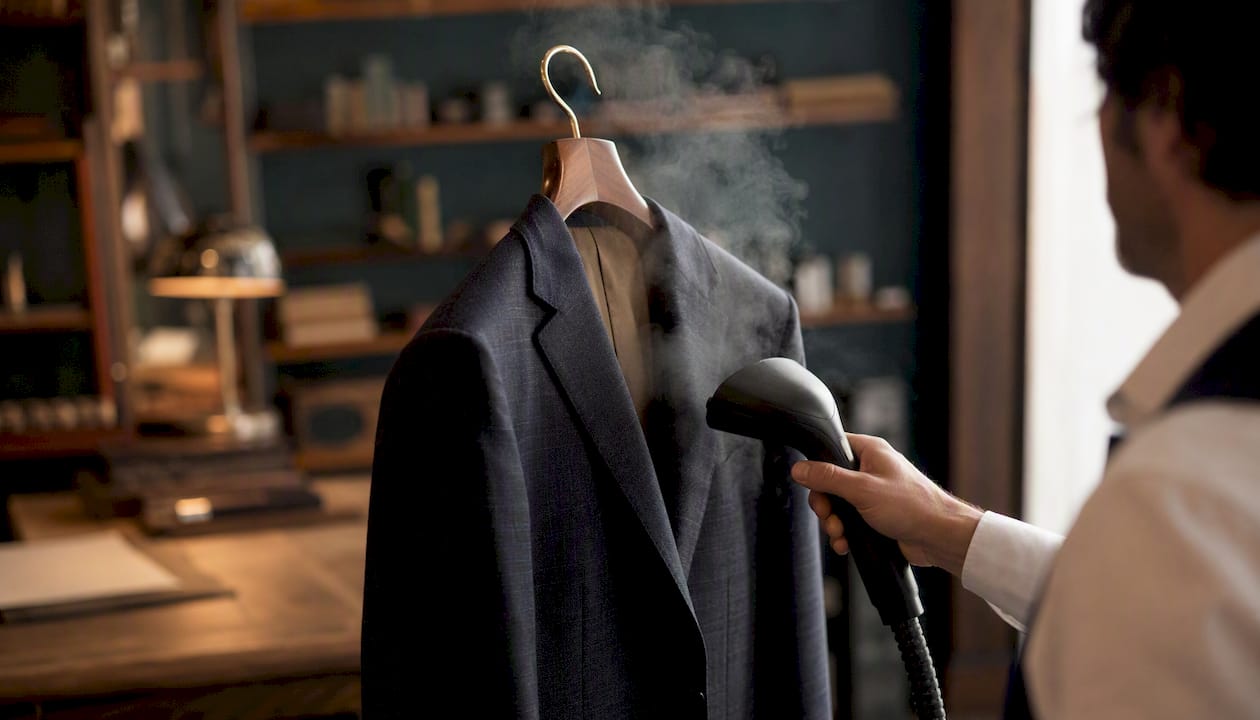
Canvassed suits tolerate more. Steam is your best tool: a handheld steamer relaxes wrinkles without the risk that a hot iron carries, and the canvas responds well to moisture, helping the jacket recover its shape after a long day. Dry-clean canvassed jackets no more than once per season. Between cleanings, hang the jacket on a wide, shaped hanger and allow it to breathe overnight before returning it to a garment bag. Rotating between two or three jackets extends the life of each considerably.
Both constructions benefit from cedar storage accessories, which deter moths and absorb moisture. For canvassed jackets specifically, avoid compressing them in tight storage, since the canvas needs space to maintain its shape.
The construction choice that actually ages with you
Canvassed construction is the one I return to, every time, for every client who plans to wear a suit more than occasionally. The reason is not tradition for its own sake. It is that a canvassed jacket changes in the right direction. The lapel softens. The chest conforms. The jacket begins to feel less like something you put on and more like something that belongs to you.
A fused jacket, by contrast, tends to move in only one direction over time. The glue weakens, the chest stiffens or sags, and eventually the bubbling begins. There is no recovering from that. You simply replace it and start again.
The one thing I would add for any man choosing his first quality suit: do not let the upfront price of canvassed construction discourage you. When you account for how long a well-made canvassed jacket lasts, and how much better it fits after the first year of wear, the arithmetic almost always works in its favor.
Ron and Rich bespoke canvassed suits: your next step
At Ron and Rich, every bespoke jacket is built on a canvassed foundation, because a suit made to last deserves construction that can keep that promise. Founded by master tailor Richard Fan in 1979, our house has spent decades refining the basted fitting process that makes canvassed construction perform at its best: the canvas is set loosely at the first fitting, adjusted to your chest and lapel line, and only finished once the drape is exactly right.

Half-canvas options are available for clients who want the lapel performance and breathability of canvassed construction at a more accessible price. Full-canvas bespoke remains our recommendation for daily wearers and anyone building a suit that will still be worn a decade from now.
Browse our bespoke suits and jackets or visit the bespoke tailoring page to learn more about the process and book a consultation. Fabric swatches and construction details are available at your first appointment.
Further reading and sources
-
Men’s Suit Basics: Fussed vs. Canvassed Suits | The Art of Manliness
-
The Biggest Difference Between Cheap and Expensive Suits, According to Expert Tailors | GQ
-
Glued / Fused Suit Vs. Half Canvas Vs. Full Canvas Construction | Gentleman’s Gazette
-
Fused Suit vs. Canvassed Suit Jacket Construction Difference | AskTheGentleman
-
How To Tell A Quality Suit: Fused Vs. Canvassed | HESPOKE STYLE