The Complete Suit Fabric Guide for Every Season
For most men, midweight worsted wool in the Super 110–130 range is the right choice for a first or everyday suit. It drapes cleanly, holds its shape through long days, and performs across three seasons without demanding special care. For hot-weather travel or humid summers, a high-twist tropical wool or wool-mohair blend handles wrinkles and breathability far better than standard worsted. Cold-weather rotation calls for flannel or tweed in a suitably heavy weight range for warmth and texture. Occasion and formalwear, from black tie to a wedding, are where silk blends and fine Super 150s+ cloths earn their place.
This guide covers the full picture: fiber families, weave constructions, Super numbers, seasonal weights, patterns, care, and the exact questions to ask your tailor before committing to a cloth.
Quick rules before you go further:
- Do choose worsted wool Super 110–130 for any suit you’ll wear weekly.
- Do ask for the cloth’s weight in g/m² and its composition before ordering.
- Do request swatches and handle them before committing; a fabric that photographs beautifully may feel stiff or thin in hand.
- Don’t rely on Super numbers alone, a Super 180 cloth worn twice a week will pill and thin within a year.
- Don’t default to polyester blends for a bespoke or made-to-measure commission; natural fibers drape and breathe in ways synthetics cannot replicate.
- Don’t ignore pattern scale relative to your frame, a large windowpane on a slight build reads as costume rather than tailored.
Key Takeaways
Midweight worsted wool in the Super 110–130 range is the most practical foundation for any suit wardrobe, with cloth weight, weave, and Super number chosen to match wear frequency and climate.
| Point | Details |
|---|---|
| Worsted wool for most wearers | Super 110–130 worsted at 240–280 g/m² covers three seasons and daily wear reliably. |
| High-twist for travel and heat | Fresco or wool-mohair blends at 200–260 g/m² recover from creasing and breathe in humid conditions. |
| Super numbers and durability | Higher Super numbers are softer but less durable; reserve Super 150s+ for suits worn infrequently. |
| Always request the technical sheet | Ask for weight (g/m²), composition, shrinkage, and abrasion data before committing to any cloth. |
| Ron & Rich bespoke service | Ron & Rich guides fabric selection through in-person swatch consultations and basted fittings for each commission. |
Table of Contents
- Why does fabric choice matter as much as the cut?
- What are the major suit fabric families?
- Which luxury fibers are actually worth the investment?
- How do weaves and construction change how a suit performs?
- How do patterns and textures affect formality and pairing?
- What do Super numbers actually tell you about a fabric?
- Which fabrics should you wear in each season and climate?
- How do you choose the right suit cloth step by step?
- How should you care for different suit fabrics?
- What do tailors know about fabric selection that buyers often miss?
- Why does fabric mill reputation matter for quality?
- What is the environmental cost of different suit fabrics?
- Bespoke fabric selection at Ronandrich
- Sources
Why does fabric choice matter as much as the cut?
Fabric determines how a suit looks and performs as much as the cut does. A beautifully constructed jacket in a limp, low-twist cloth will lose its silhouette by noon. The same block in a tightly woven worsted holds a clean line through a full day of meetings.
Four technical attributes drive every fabric decision: fiber type (natural versus synthetic), yarn preparation (worsted versus woolen), weave openness, and finishing. Natural fibers such as wool, cotton, linen help regulate temperature through moisture-wicking and breathability that synthetic yarns cannot match at the same price point. Yarn preparation changes surface character: worsted spinning combs fibers parallel for a smooth, hard-wearing face, while woolen spinning leaves fibers in random alignment for the soft, slightly fuzzy surface you see in flannel.
Weave openness affects thermal performance directly. A tight gabardine traps warmth and resists wind; an open hopsack or fresco lets air circulate, making it the better choice for summer or travel. Finishing matters, the mill’s final brushing, pressing, and chemical treatments affects crease recovery and abrasion resistance in ways that rarely appear on a retail label but always show up in wear.
The practical tradeoffs are real. Finer, softer cloths drape more elegantly but abrade faster at the seat and elbows. Heavier, tighter weaves last longer but feel warmer and less fluid. Better raw material and mill practices yield cloth that can last decades with proper care; cheaper cloths use fewer yarns and deteriorate faster regardless of how well you maintain them.
On sustainability: natural fibers are biodegradable and, when sourced from certified mills, carry a significantly lower long-term environmental cost than petroleum-based synthetics. Mill provenance matters here. A cloth woven at a mill with transparent supply-chain practices and responsible dyeing processes is a meaningfully different product from one produced without those standards, even when both carry the same fiber label.
What are the major suit fabric families?
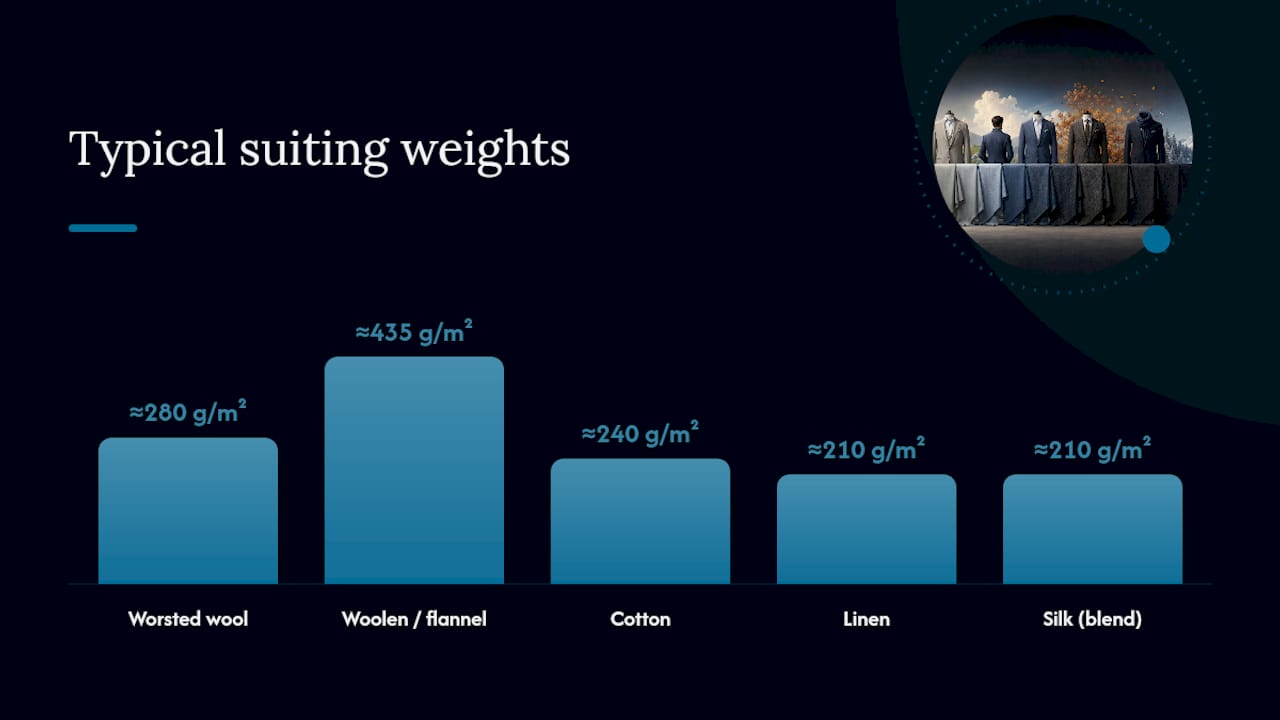
Most suits a customer will encounter are made from wool, but the fiber family you choose shapes everything from how the garment feels against your skin to how often it needs cleaning. The table below maps the major fabric types for suits against their practical attributes.
| Fabric | Key character | Typical weight (g/m²) | Best use | Main limitation |
|---|---|---|---|---|
| Worsted wool | Smooth, hard-wearing, clean drape | 240–320 | Year-round business, travel | Less texture than woolen |
| Woolen/flannel | Soft, brushed, warm | 320–550+ | Autumn/winter, country wear | Heavy; not for hot climates |
| Cotton | Breathable, casual hand | 200–280 | Casual summer suits, chinos | Creases readily |
| Linen | Open weave, very breathable | 180–240 | Summer, outdoor events | Wrinkles aggressively |
| Silk (blend) | Lustrous, fluid drape | 180–240 | Occasion wear, evening | Fragile, marks easily |
| Polyester blend | Wrinkle-resistant, low cost | 200–280 | Budget, travel | Poor breathability, cheap drape |
Worsted wool is the workhorse of tailored menswear. Combed long fibers are spun parallel, producing a smooth, dense yarn that weaves into a surface with good abrasion resistance and a clean face. Three-season midweight worsted in the 240–280 g/m² range covers the majority of professional and social occasions in temperate climates.
Woolen and flannel cloths use shorter, randomly aligned fibers that create a softer, slightly napped surface. The warmth-to-weight ratio is excellent for autumn and winter, and the texture reads as relaxed and country-appropriate. Flannel in the 320–400 g/m² range is a classic choice for winter business suits and weekend wear.
Cotton suiting is versatile but honest about its limits. It breathes well, reads as casual, and works beautifully in unstructured jackets and summer trousers. The crease behavior is the trade-off: cotton shows wear quickly and rarely recovers without pressing.
Linen is the most breathable suiting cloth available, and its wrinkle character is best embraced rather than fought. A linen suit at a summer garden party looks intentional; the same cloth in a boardroom reads as underdressed. Linen blends (linen-wool or linen-silk) soften the wrinkle behavior while preserving most of the breathability.
Silk blends bring a natural luminosity and fluid drape that no other fiber replicates. Pure silk suiting is too fragile for regular wear, but a wool-silk blend in the 200–240 g/m² range makes an exceptional occasion cloth.
On blends: a wool-mohair blend adds luster and wrinkle recovery to a standard worsted, making it one of the best choices for travel suits. For a bespoke commission, natural fibers remain the preferred foundation, with blends chosen for a specific functional reason rather than as a default.
Which luxury fibers are actually worth the investment?
Luxury fibers change the hand and warmth of a garment in ways that high-quality wool alone cannot fully replicate. Whether that difference justifies the cost depends entirely on how and how often you plan to wear the piece.
Cashmere comes from the undercoat of Cashmere goats, producing a fiber that is exceptionally soft and warm for its weight. A pure cashmere sport coat is a genuine luxury, but it pills with regular wear and demands careful storage. Reserve it for occasional use.
Mohair is shorn from Angora goats and produces a fiber with a distinctive natural luster and excellent resilience. The sheen reads as slightly formal, which suits evening and occasion wear particularly well.
Alpaca is softer than most wool grades and hypoallergenic, with a silky drape that works beautifully in overcoats and sport coats. It lacks the natural crimp of wool, so it has less inherent structure. Alpaca-wool blends balance the softness with enough body for a tailored silhouette.
Vicuña is the rarest commercially available natural fiber, shorn from wild vicuña in the Andes. The fiber is extraordinarily fine and soft, and cloth woven from it commands prices that reflect both scarcity and the labor involved in its production. It is a cloth for a single special-occasion garment, not a working wardrobe.
Practical guidance on luxury fibers:
- Use cashmere blends in overcoats and sport coats worn fewer than twice a week.
- Choose mohair blends for summer suits and any suit that travels frequently.
- Consider alpaca for a winter sport coat or overcoat where softness matters more than structure.
- Reserve vicuña for a single, carefully considered commission and budget accordingly.
- For any suit worn three or more times a week, high-quality worsted wool remains the most cost-effective choice over a five-year horizon.
Pro Tip: When ordering a cashmere or alpaca blend, ask the mill or your tailor for the abrasion rating alongside the fiber composition. A cloth with a beautiful hand but a low abrasion rating will show wear at the seat and elbows within a season of regular use.
You can explore Ron & Rich’s material comparisons for a closer look at how luxury fibers perform against standard wool in real bespoke commissions.
How do weaves and construction change how a suit performs?
Weave structure is the most underappreciated variable in fabric selection. Two cloths can share identical fiber content and weight yet perform completely differently in wear, simply because of how the yarns interlace. Weave families map directly to drape, breathability, and wrinkle behavior in ways that mill marketing rarely explains clearly.
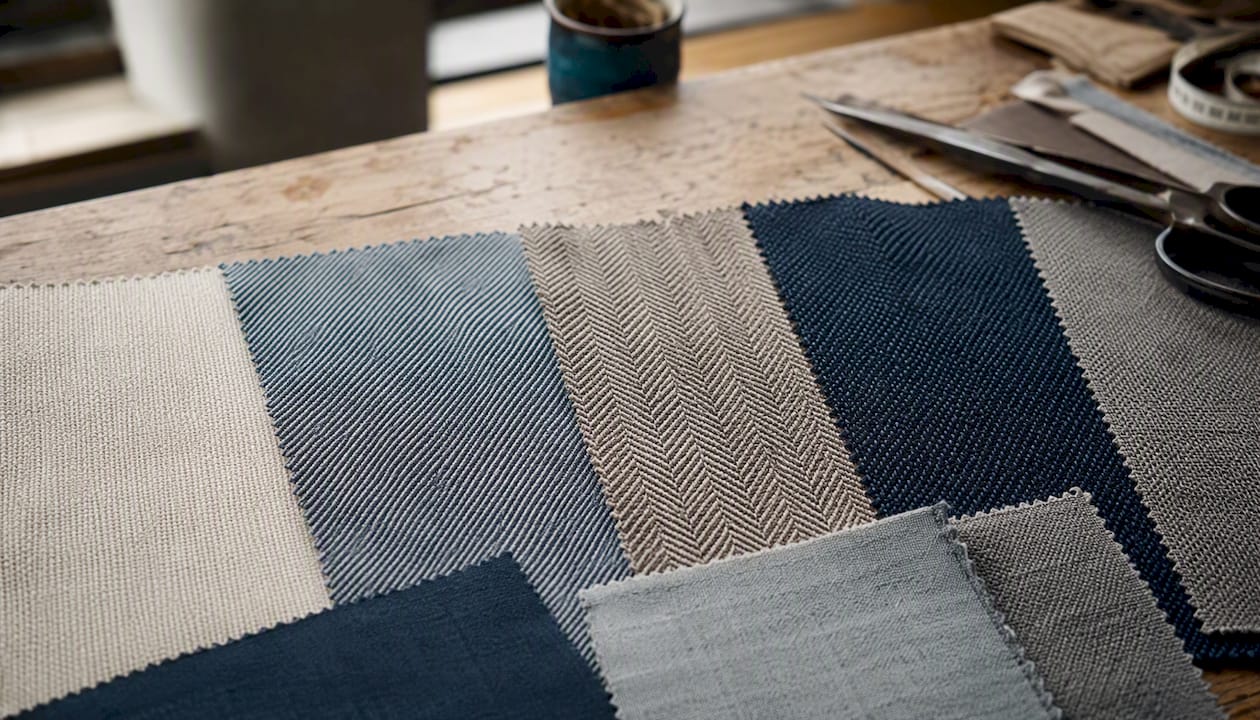
Plain weave interlaces warp and weft yarns in a simple over-under pattern. The result is a firm, stable cloth with good abrasion resistance. It reads as clean and unfussy, which suits business and formal contexts.
Twill weave creates a diagonal rib by offsetting the interlacing pattern. Gabardine is the most refined expression of twill in suiting: a tight, smooth surface with a subtle diagonal line, excellent drape, and good wind resistance. Cavalry twill is a heavier, more pronounced version, traditionally used for trousers and country wear.
Herringbone is a broken twill that reverses direction at regular intervals, creating the characteristic V-shaped pattern. It adds visual texture without sacrificing formality, and it works equally well in worsted and woolen constructions.
Hopsack uses a basket-weave structure with a slightly open, grainy surface. The openness makes it one of the most breathable weaves available, which is why it appears so often in summer blazers and unstructured jackets. It does not press to a sharp crease, so it suits relaxed rather than formal tailoring.
Fresco (also called high-twist) is woven from tightly twisted yarns that create a slightly rough, open surface. The twist is what matters: it allows air to circulate and causes the cloth to spring back after creasing, making fresco the standard recommendation for travel suits and hot-climate wear. Typical weights run 200–260 g/m².
Flannel is a woolen construction that is brushed after weaving to raise a soft nap on the surface. The nap traps air and provides warmth; it also gives flannel its characteristic matte, slightly fuzzy appearance. It is a cold-weather cloth in every sense.
Barathea is a fine, tightly woven cloth with a broken rib texture that produces a smooth, matte surface. It is the traditional cloth for dinner jackets and formal morning coats.
Beyond weave, construction details shape seasonal performance. A half-lined jacket breathes significantly better than a fully lined one, which matters in summer cloths. Floating canvas interlining allows the chest to mold to the wearer’s body over time, while fused interlining is lighter but less responsive. Vent choice (single, double, or none) affects how the jacket moves and how the back panel falls, which in turn affects how the cloth wears at stress points.
How do patterns and textures affect formality and pairing?
Pattern scale and texture register formality before a word is spoken. A solid navy worsted reads as authoritative in any professional setting. A large windowpane check in a cream ground reads as weekend country wear. Understanding where each pattern sits on that spectrum lets you dress with intention rather than guesswork.
Solids are the most versatile and the most forgiving. A solid charcoal or navy suit pairs with virtually any shirt and tie combination and reads appropriately from a job interview to a formal dinner.
Pinstripes are a city-business classic. Narrow chalk stripes on a dark ground signal formality and authority; wider stripes on a lighter ground read as more relaxed. The stripe should be proportional to your frame, a very fine stripe can disappear on a larger build, while a bold stripe can overwhelm a slight one.
Windowpane and checks add personality without sacrificing structure. A small, tight check (glen plaid, for instance) reads as business-appropriate; a large windowpane in a contrasting color reads as casual or country. Scale matters more than color here.
Houndstooth is a broken check that reads as textured from a distance and patterned up close. It works well in sport coats and odd jackets, and it pairs cleanly with solid shirts and knit ties.
Herringbone as a pattern (distinct from the weave) reads as traditional and slightly country. In a fine worsted, it can work in business contexts; in a tweed or heavy woolen, it belongs to the weekend.
Practical pairing guidance:
- Pair patterned suits with solid shirts; add a tie with a smaller, contrasting pattern if you want visual interest.
- Textured cloths (hopsack, basketweave) read as casual and pair well with open-collar shirts or knit ties.
- Velvet and corduroy are evening and country fabrics respectively; neither belongs in a standard business context.
- For a slight build, choose smaller pattern scales and avoid large checks that can read as overwhelming.
- For a larger frame, medium-scale patterns (a moderate glen plaid, a classic herringbone) add structure without exaggerating width.
What do Super numbers actually tell you about a fabric?
Super numbers indicate fiber fineness, measured by the maximum micron diameter of the wool fiber used. A Super 100s cloth uses fibers no wider than 18.5 microns; Super 150s uses fibers no wider than 15.5 microns. The finer the fiber, the softer the hand and the more fluid the drape. The trade-off is durability: finer fibers have less natural crimp and abrade more quickly under regular wear.
The practical implication is straightforward. Higher Super numbers are softer but often less durable for heavy-rotation garments. A Super 180 cloth worn twice a week will show wear at the seat, elbows, and collar break within a year or two. The same suit worn four times a year for a decade is a different calculation entirely.
| Super range | Fiber fineness | Practical character | Best use |
|---|---|---|---|
| Super 110–130 | Coarser (18.5 µm) | Durable, slightly rough hand | Hard-wearing everyday suits |
| Super 100s–130s | Medium-fine (18.5 µm) | Balanced softness and durability | Workhorse business suits |
| Super 130s–150s | Fine (15.5 µm) | Noticeably soft, good drape | Business suits worn 2–3×/week |
| Super 150s–180s | Very fine (≤15.5 µm) | Exceptional softness, delicate | Occasion suits, infrequent wear |
| Super 180s+ | Ultra-fine | Extraordinary hand, fragile | Special commission only |
Fabric weight, expressed in grams per square meter (g/m²) or ounces per yard (oz/yd), is the other essential variable. Weight tells you how the cloth will perform thermally and how it will drape. As a working rule of thumb:
- Summer and tropical suits: 180–240 g/m² (roughly 6–8 oz/yd)
- Three-season suits: 240–320 g/m² (roughly 8–11 oz/yd)
- Winter suits and heavy sport coats: 320–400+ g/m² (roughly 11–14+ oz/yd)
Midweight worsted runs approximately 240–280 g/m² for three-season use; high-twist tropical cloths typically fall in the 200–260 g/m² range, and winter flannel and woolen cloths start at 320 g/m² and can reach 550 g/m² or more for overcoating.
Which fabrics should you wear in each season and climate?
Seasonal guidance is where fabric knowledge becomes genuinely practical. The right cloth for a humid region is a different animal from the right cloth for a region with dry summers.
Hot weather (at or above 24 degree celsius high humidity)
Choose cloths in the 180–240 g/m² range with open or high-twist constructions. Fresco and hopsack are the two most reliable options: fresco for a suit that needs to hold a sharp line, hopsack for a more relaxed blazer or sport coat. Linen and linen blends work well for outdoor and social occasions where some wrinkling is acceptable. A half-lining or no lining reduces heat significantly. Mohair blends add wrinkle recovery without adding weight.
Temperate conditions (7 degree celsius to 15 degree celsius)
This is the range where midweight worsted wool performs best. A 260–300 g/m² cloth in a plain or twill weave handles the temperature variation across a typical workday without overheating or feeling insubstantial. Cotton suiting works at the warmer end of this range for casual contexts.
Cold weather (below 7 degree celsius)
Flannel and woolen cloths in the 320–400 g/m² range provide the warmth and texture appropriate to the season. A fully lined jacket with a heavier interlining adds insulation. Tweed, traditionally a country cloth, works well for weekend and outdoor occasions in cold weather.
Travel
High-twist (fresco) wool and wool-mohair blends are the standard recommendation for any suit that spends time folded in a bag. The construction of fresco means creases fall out with a short hang; mohair’s natural luster and resilience add to that recovery. Pack in a proper suit carrier rather than a standard bag, and hang the suit as soon as you arrive. A half-lining reduces bulk and speeds recovery.
Construction details to request for seasonal suitability: half-lining for summer and travel suits; full canvas interlining for winter suits that need structure and warmth; double vents for active wear; single-pleat or flat-front trousers for summer cloths that need to breathe.
How do you choose the right suit cloth step by step?
A structured approach to fabric selection prevents the most common mistakes: choosing a cloth that looks beautiful on the bolt but performs poorly in wear, or selecting a Super number without considering how often the suit will be worn.
-
Define the occasion and frequency. A suit worn three or more times a week needs a different cloth than one worn for quarterly board meetings. Frequency drives durability requirements more than any other factor.
-
Identify your climate and season. Note the temperature range and humidity where you’ll wear the suit most. This determines the weight range and weave type before you look at a single swatch.
-
Set a construction priority. Decide whether you need sharp structure (gabardine, tight worsted), relaxed drape (hopsack, fresco), or warmth (flannel, tweed). This narrows the weave family before you consider color or pattern.
-
Choose a Super range appropriate to wear frequency. Super 100s–130s for suits worn weekly; Super 130s–150s for suits worn two or three times a week; Super 150s+ for occasion wear only.
-
Request swatches and the technical sheet. A practical bespoke approach recommends ordering 5–10 swatches per garment concept and demanding technical sheets covering weight, composition, shrinkage, and abrasion data before committing to a cloth.
-
Compare two finalist cloths against your criteria. Hold each swatch against your shirt and tie. Crush it in your fist and release it; the recovery tells you more about wrinkle behavior than any description. Check the weight spec against your seasonal target.
-
Confirm lining and interlining choices. The cloth is only part of the equation. Ask your tailor to recommend a lining weight and interlining construction that suits the cloth’s weight and your climate.
Questions to ask your tailor:
- What is the cloth weight in g/m²?
- What is the fiber composition, and what is the Super number?
- What is the recommended use (three-season, summer, winter)?
- Does the mill provide shrinkage and abrasion data for this cloth?
- What lining and interlining do you recommend for this cloth and my climate?
- Is there a minimum yardage requirement, and should I order extra for future repairs?
For readers considering their first bespoke commission, choosing the right tailor is as important as choosing the right cloth. The two decisions are inseparable.
How should you care for different suit fabrics?
Proper care extends a suit’s life by years and preserves the cloth’s hand and structure. The most common mistake is over-cleaning: dry-cleaning strips natural oils from wool fibers and, done too frequently, shortens the cloth’s life rather than extending it.
Maintenance by fabric and wear frequency
Worsted wool: Air the suit after each wearing by hanging it on a shaped wooden hanger for at least 24 hours. Brush lightly with a soft clothes brush to remove surface dust and restore the nap. Spot-clean minor marks with a damp cloth and mild soap. Dry-clean no more than once or twice per season for a suit worn weekly.
Flannel and woolen: The same airing and brushing routine applies, but flannel is more susceptible to pilling from friction. Avoid wearing a flannel suit with a rough-textured bag strap or briefcase that contacts the shoulder. Dry-clean at the end of each season.
Linen and cotton: These cloths can often be hand-washed or machine-washed on a delicate cycle, but always check the garment label and the tailor’s recommendation. Linen wrinkles in the wash and needs pressing; cotton is more forgiving. Neither should be dry-cleaned routinely.
Silk blends: Dry-clean only, and choose a cleaner experienced with delicate cloths. Silk is sensitive to water spotting and heat.
Pressing and steaming
Steam is gentler than a dry iron for most suit fabrics. Use a clothes steamer or the steam function of a good iron with a pressing cloth between the iron and the fabric. Never press directly on fine Super fabrics or silk blends; the heat can crush the fibers and create a permanent shine. Flannel should be pressed on the reverse side to protect the nap.
Storage and travel
Use shaped wooden or wide-shoulder plastic hangers, never wire. For long-term storage, a breathable cotton garment bag protects against dust without trapping moisture. Cedar blocks or sachets deter moths without the chemical residue of mothballs. When traveling, a proper suit carrier with a fold-over design minimizes creasing; hang the suit immediately on arrival and allow it to breathe for at least an hour before wearing.
What to avoid: machine-washing wool suits, hanging suits in direct sunlight, storing in plastic dry-cleaning bags for more than a day or two, and wearing the same suit on consecutive days without a rest period.
What do tailors know about fabric selection that buyers often miss?
The gap between what a cloth looks like on the bolt and how it performs in a finished garment is wider than most buyers expect. A few principles from bespoke practice close that gap significantly.
Reading a cloth technical sheet: Mill spec sheets list weight, composition, width, and sometimes abrasion and shrinkage data. Weight and composition are the minimum you should request. Abrasion data (often expressed as a Martindale rub count) tells you how the cloth will wear at stress points; a higher count means longer life. Shrinkage data matters for any cloth that may be hand-washed or exposed to humidity.
The swatch test: Crush a swatch in your fist, hold for ten seconds, and release. A cloth that springs back quickly will recover from a day of sitting; one that holds the crease will need pressing after every wearing. This test takes ten seconds and tells you more than any description.
Pattern scale and the basted fitting: Pattern matching at seams is one of the most labor-intensive aspects of bespoke tailoring. A large check or bold stripe requires significantly more yardage than a solid or fine stripe, and the matching must be verified at the basted fitting stage before the garment is finished. Always order extra yardage for patterned cloths.
Common buyer mistakes:
- Over-relying on Super numbers as a quality proxy without checking abrasion data.
- Choosing a cloth based on how it looks draped over a bolt rather than how it handles in a swatch test.
- Misjudging pattern scale relative to body proportions and the formality of the intended use.
- Failing to account for lining and interlining weight when selecting a summer cloth.
- Not rotating suits: wearing the same suit on consecutive days compresses the fibers and shortens the cloth’s life. A rotation of at least three suits extends each garment’s life considerably.
Pro Tip: When choosing between two cloths of similar weight and composition, ask your tailor to drape each over your shoulder and step back. The way a cloth falls from the shoulder tells you more about its drape character than any flat swatch can.
The bespoke tailoring process at Ron & Rich includes a basted fitting stage specifically to validate how the chosen cloth behaves on the body before the garment is finished, a step that makes the difference between a suit that fits on paper and one that moves correctly in wear.
Why does fabric mill reputation matter for quality?
The mill that weaves a cloth is as important as the fiber it uses. Two fabrics with identical fiber content and Super numbers can perform very differently depending on the quality of the spinning, weaving, and finishing processes at the mill.
The most respected suiting mills are concentrated in a handful of regions: the Huddersfield and Yorkshire valleys in England, the Biella district of northern Italy, and a smaller number of specialist mills in Ireland (for tweed and linen) and Scotland (for tweed and cashmere). Mills like Loro Piana, Vitale Barberis Canonico, Scabal, Holland & Sherry, and Dormeuil have built reputations over generations by maintaining tight control over fiber sourcing, yarn preparation, and finishing. Their cloth technical sheets are detailed and reliable.
When a tailor presents you with a cloth from a named mill, that name carries real information. It tells you that the fiber sourcing, yarn count, and finishing have been held to a documented standard. A cloth from an unnamed or unverifiable source offers no such assurance, regardless of the Super number printed on the bolt end.
Mill provenance also matters for consistency. If you commission a second suit in the same cloth two years later, a reputable mill is far more likely to have the same cloth in stock, or a documented successor, than a commodity supplier. For a bespoke wardrobe built around a few core cloths, that consistency has practical value.
What is the environmental cost of different suit fabrics?
Fabric choice carries an environmental dimension that is worth understanding, particularly as the industry moves toward greater transparency in supply chains.
Wool is a renewable fiber, shorn annually without harming the animal. Responsibly managed sheep farming supports biodiversity and carbon sequestration in grassland ecosystems. The main environmental concerns are methane emissions from sheep and the chemical treatments used in scouring and dyeing. Certifications like the Responsible Wool Standard (RWS) and the ZQ Merino program provide verified assurance of animal welfare and land management practices.
Linen is among the most environmentally efficient textile fibers available. Flax, the plant from which linen is derived, requires minimal irrigation and pesticide use compared to cotton, and the entire plant can be used with minimal waste. European-grown flax (primarily from France and Belgium) is generally produced under stricter environmental standards than flax grown elsewhere.
Cotton has a more complicated profile. Conventional cotton is one of the most water- and pesticide-intensive crops in agriculture. Organic cotton and Better Cotton Initiative (BCI) certified cotton reduce those impacts significantly, but they represent a small fraction of total production. For suiting, cotton’s relatively limited use (compared to wool) means its absolute impact is modest.
Silk production involves the cultivation of silkworms and the boiling of cocoons, which raises animal welfare questions for some consumers. The fiber itself is biodegradable and produced in relatively small volumes for suiting applications.
Synthetics (polyester, nylon, and their blends) are derived from petroleum and are not biodegradable. They shed microplastic fibers during washing, contributing to aquatic pollution. For a bespoke or made-to-measure commission, the environmental case for natural fibers is clear: they biodegrade, they are renewable, and when sourced from certified mills, they carry a documented environmental standard.
The most sustainable suit is the one worn for decades. Choosing a high-quality natural fiber cloth from a reputable mill, caring for it properly, and having it altered as your body changes is a more meaningful environmental act than any certification label alone.
A tailor’s perspective on fabric selection
After more than four decades in bespoke menswear, the principle that guides every fabric conversation at our house is simple: the cloth must serve the life the client actually lives, not the life he imagines wearing the suit in. We see clients drawn to extraordinary Super 180s cloths for suits they intend to wear to work three times a week. Our role is to redirect that conversation toward a Super 120s or 130s worsted that will still be beautiful in ten years, and to reserve the finer cloth for the occasion suit that deserves it.
The other principle we hold firmly is that no fabric decision should be made from a photograph or a description. Every client who visits us for a bespoke consultation handles swatches, crushes them, drapes them, and sees them in natural light before we discuss weight and construction. That tactile step is not a formality. It is where the real selection happens.
Bespoke fabric selection at Ron & Rich
At Ron & Rich, fabric selection is not a catalog exercise. It is a conversation that begins with how you live, where you work, and how often you’ll reach for the suit. Founded in 1979 by master tailor Richard Fan, our house has spent decades sourcing cloths from the world’s most respected mills and translating technical specifications into garments that perform as well as they look.
Our bespoke service includes a swatch consultation where you handle cloths in person, a full technical review of weight, composition, and construction, and a basted fitting that validates the cloth’s drape before the garment is finished. We work with clients on suits, tuxedos, wedding suits, sport coats, and trousers, each built to your measurements and your specific use-case. Ready-to-wear options are also available for clients who want a finished garment sooner.
To begin, book a bespoke consultation or browse our suits and jackets collection to see the cloths and constructions we currently offer. Pricing is quoted per commission based on cloth and construction; inquire directly for details.
Sources
The following resources were used to build this guide and are recommended for deeper reading on specific topics.
- Customtailors
- These Are the Best Fabrics for a Suit, According to Tailoring Experts | GQ
- What’s the Best Suit Material? A Top NYC Tailor Weighs In | Gear Patrol
- Textile Glossary: Suiting Fabrics