Men’s Suit Sleeve Length: 6–12 mm, When to Alter or Go Bespoke
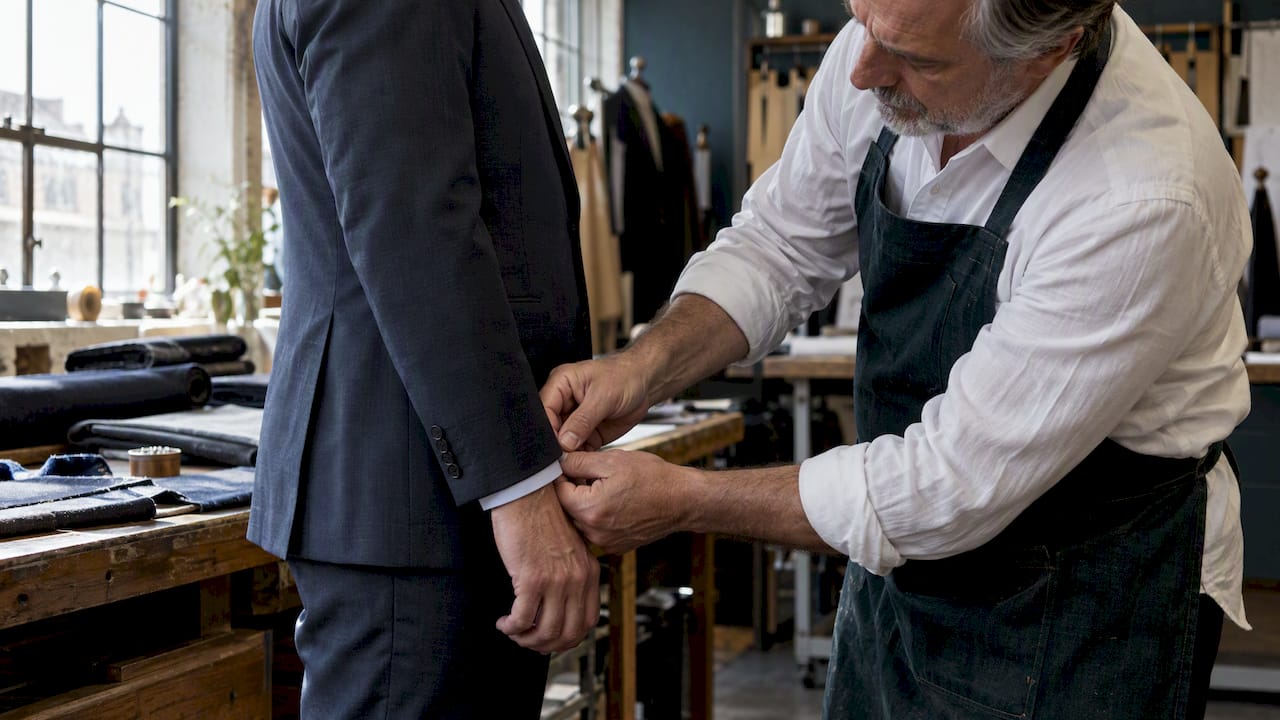
Your jacket sleeve should finish at the base of the wrist bone, allowing roughly 6 to 12 millimetres of shirt cuff to show beyond it. That small reveal is what separates a jacket that looks considered from one that simply fits. Before trusting the number, check that your shoulders sit correctly and that someone else has measured you properly.
TL;DR:
- Have someone measure from your shoulder point to your wrist bone with your arm relaxed and slightly bent; avoid measuring with your arm extended.
- Tell your tailor which shirt you will wear, because shirts commonly add about 2 centimeters to the equivalent jacket measurement.
- Decorative cuff buttons usually permit shortening at the hem, but working buttonholes may require resetting the sleeve at the shoulder to preserve spacing.
- A tailor cannot correct a poor shoulder fit with a simple sleeve alteration; fixing it may require rebuilding the jacket.
- Formal tuxedos generally suit a cleaner, slightly shorter cuff reveal, while sports jackets allow more latitude; keep the finish consistent with the outfit.
Table of Contents
- The rule of thumb: where the sleeve should sit and why it matters
- How to measure sleeve length correctly
- Quick fit checks and common sleeve mistakes
- Alterations, working buttonholes and what tailors will (and won’t) do
- Why shoulder and armhole fit matter more than sleeve length alone
- Tailor’s checklist: Ron & Rich fitting tips for sleeve harmony
- How sleeve length affects overall suit silhouette and style
- Differences in sleeve length preferences based on suit type
- Influence of modern versus traditional fits on sleeve length choices
- Customizing sleeve length for different arm shapes and lengths
- Role of cuff buttons on sleeve length adjustment and style variation
- A short tailor’s perspective on modern sleeve proportions
- How bespoke tailoring solves sleeve-fit problems
- FAQ
The rule of thumb: where the sleeve should sit and why it matters
Two bones decide where a sleeve hem belongs. The acromion, the bony point at the edge of your shoulder, marks where the sleeve begins its journey down the arm. The styloid process, the small knob at the base of your wrist, marks where it should end. A jacket sleeve cut to finish right at that wrist bone gives your shirt cuff somewhere to appear without disappearing into the jacket or hanging below it awkwardly.
The 6 to 12 millimetre reveal exists because it does two jobs at once. It signals that the garment was made for you specifically, not pulled off a rack and left alone, and it breaks up the visual mass of the jacket sleeve with a sliver of white or pale colour that draws the eye toward your hands.
The effect of getting this wrong is immediate:
- Too little cuff, and the jacket sleeve looks like it has swallowed your shirt, ageing the whole silhouette.
- Too much cuff, and the jacket reads as borrowed or outgrown, regardless of how well the rest of it fits.
- No cuff at all, often from sleeves worn too long, flattens the hand and shortens the visible leg of the arm.
How to measure sleeve length correctly
Getting an accurate figure before a fitting saves a wasted trip and gives your tailor a real starting point rather than a guess.
- Stand naturally, shoulders relaxed, with a slight bend at the elbow rather than a rigid straight arm.
- Have a second person run a tape along the outside of your arm, starting at the acromion and finishing at the styloid process.
- Note the figure without rounding it, since a few millimetres matter more in a jacket sleeve than almost anywhere else on the body.
- Tell your tailor which shirt you intend to wear underneath, since shirts commonly add about 2 centimetres to the equivalent jacket measurement to allow the cuff to sit correctly.
Pro Tip: Measure in the clothes and shoes you would actually wear with the suit, since posture shifts slightly with footwear and that changes where the sleeve falls.
Self-measuring with your arm fully extended gives a longer, less reliable number. The arm’s natural resting position is what a tailor works from, so test in that position rather than the one that looks tidiest in a mirror.
Quick fit checks and common sleeve mistakes
A few seconds in front of a mirror tells you most of what you need to know before any tailor gets involved.
- Let your arms hang naturally and check that a slim band of cuffs is visible at the wrist, not hidden and not spilling past your knuckles.
- Look at the whole line from lapel to cuff to trouser break, since a sleeve that is technically correct can still look off if the rest of the proportions are mismatched.
- Avoid judging fit with your arms raised or extended, since that stretches the fabric and shows a false length.
- If the sleeve runs long, a straightforward shortening at the cuff often solves it; if it runs short, lengthening is only possible when the original seam allowance and lining leave enough spare fabric.
Alterations, working buttonholes and what tailors will (and won’t) do
Not every sleeve fix is a simple hem. Shortening from the cuff end is the quicker route and works well on jackets with decorative, non-functional buttons. Resetting the sleeve at the shoulder is slower and more exacting, but it preserves the cuff detail and vent proportions on a jacket that was otherwise cut well everywhere else.
Working buttonholes complicate the choice considerably, since a sleeve with functional cuff buttons often cannot simply be hemmed from the bottom without destroying the buttonhole arrangement. In that case, the sleeve typically needs to come off at the armhole and be reattached at the new length, a more involved piece of work than a basic shortening.
Before committing to a purchase or an alteration, check:
- How the cuff is constructed, and whether the buttonholes are working or purely decorative.
- Whether the lining allows the sleeve to be opened and reset without visible repair marks.
- How much seam allowance remains inside the sleeve, since a jacket with minimal spare fabric limits what any tailor can do later.
Why shoulder and armhole fit matter more than sleeve length alone
Sleeve length is the easiest thing to fix and, on its own, the least important. The shoulder seam and the armhole, or scye, determine how the whole jacket hangs and how freely you can move your arms, and neither responds to a simple hem adjustment. A jacket with shoulders cut too wide or too narrow will pull, bunch or droop regardless of how precisely the cuff sits at the wrist.
This is where ready-to-wear reaches its ceiling. A jacket can have an ideal sleeve length and still fit poorly through the shoulder, and no tailor can alter that structural element without effectively rebuilding the garment. For men who have tried several off-the-rack sizes without finding one that sits cleanly across the shoulder, made-to-measure or bespoke construction addresses the problem at its source rather than compensating for it elsewhere.
Tailor’s checklist: Ron & Rich fitting tips for sleeve harmony
We ask a second person to take initial measurements whenever possible, since a self-measured arm length is rarely as reliable as one taken by someone standing beside you. At the first fitting, we record your preferred cuff reveal so every later adjustment works from that same reference point rather than a generic default.
During basted fittings, we test how the sleeve behaves in motion, reaching, sitting, shaking hands, before any stitching is made permanent, and we check the shirt cuff style you intend to wear against the jacket sleeve so the two sit in proportion together. We also ask about posture habits and typical movement, since a desk-bound day and an active one call for slightly different allowances in the same sleeve.
How sleeve length affects overall suit silhouette and style
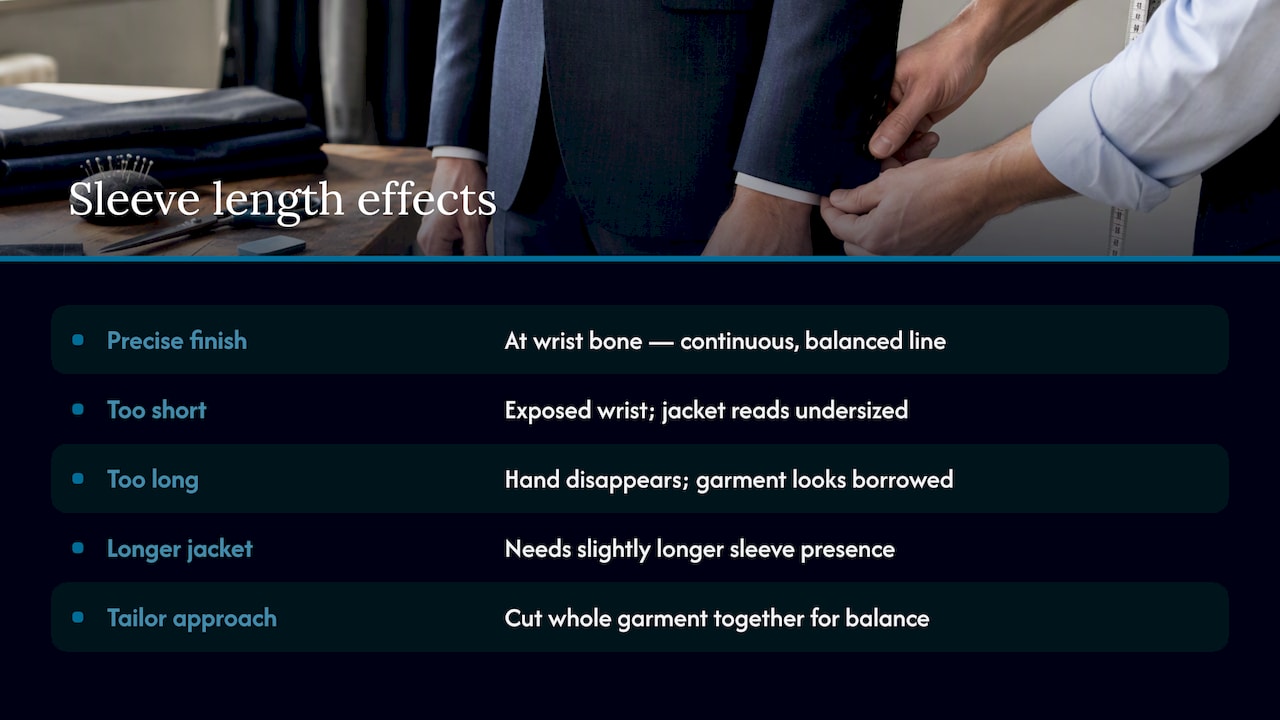
Sleeve length does more than finish the arm. It sets the proportion between torso and limb that the eye reads first when assessing whether a suit fits. A sleeve finished precisely at the wrist bone keeps the jacket’s line continuous, letting the lapel, shoulder and cuff read as one considered shape rather than separate pieces loosely assembled.
Shorten the sleeve too much and the jacket can look undersized even when the chest and shoulders fit well, since the eye registers the exposed wrist and shirt cuff as an imbalance. Lengthen it and the opposite happens: the hand disappears, the arm looks shortened, and the whole garment reads as borrowed. The sleeve is a small detail in terms of fabric, but it carries a disproportionate share of the visual verdict on fit.
This is also why sleeve length should never be adjusted in isolation from the jacket’s overall proportions. A longer jacket body generally wants a touch more presence in the sleeve to stay balanced, while a shorter, more cropped silhouette reads cleaner with a slightly higher sleeve finish. Tailors who cut the whole garment together, rather than assembling it from separate standard pieces, build this balance in from the start rather than correcting it afterwards.
Differences in sleeve length preferences based on suit type
A tuxedo and a sports jacket are not held to quite the same sleeve standard, even though both still respect the same basic wrist-bone guideline. Formalwear tends toward a slightly cleaner, more precise cuff reveal, since the occasion calls for sharper lines and less visual noise. A tuxedo sleeve finished a touch shorter than a business suit sleeve, showing a crisp line of cuff, suits the formality of the garment and complements the simpler cuff styling often worn with evening dress.
Sports jackets and more casual tailoring allow slightly more latitude. A tweed or cotton sports jacket worn with a knitted tie and a more relaxed shirt collar can sit marginally looser through the sleeve without looking undone, since the whole outfit is already pitched at a more informal register. The wrist-bone rule still applies as the anchor point, but the tolerance either side of it widens a little once the rest of the outfit has relaxed.
Trying to apply a single rigid sleeve length across every type of jacket in a wardrobe usually backfires. A sleeve that reads as sharp and correct on a formal suit can look slightly severe on a casual jacket, and one that feels relaxed and appropriate on a sports coat can look careless on a tuxedo.
Influence of modern versus traditional fits on sleeve length choices
Traditional tailoring tends to favour a slightly more generous sleeve, cut with enough room through the forearm to move comfortably and finished at a conservative length that errs toward showing less cuff rather than more. This approach has served formal menswear for generations because it ages well and rarely looks dated a few years later.
Modern fits, by contrast, often favour a closer sleeve through the forearm and a marginally shorter finish, consistent with the slimmer shoulder and narrower lapel that define contemporary tailoring. The wrist-bone guideline still holds as the baseline, but a modern cut might sit at the lower end of the 6 to 12 millimetre reveal rather than the upper end, since the overall silhouette is already pared back.
Neither approach is objectively correct. The choice depends on the rest of your wardrobe, your build and how you want the jacket to read against your own frame. A man who favours fuller, more traditional cuts throughout his wardrobe will look better in a sleeve that matches that register, while someone building a slimmer, more contemporary rotation should keep the sleeve consistent with that line rather than importing a traditional finish into an otherwise modern jacket.
Customizing sleeve length for different arm shapes and lengths
Arms vary considerably in proportion, and a sleeve length that flatters one build can look wrong on another even at an identical measurement. Longer, leaner arms generally carry the standard wrist-bone finish without issue, since there is enough length to work with and the cuff reveal reads naturally.
Shorter arms, or a build where the forearm is notably more developed than the upper arm, sometimes need the sleeve tapered slightly differently through its length rather than simply shortened or lengthened as a single measurement. A sleeve that is correct in overall length but cut too wide through the forearm can still bunch at the wrist and obscure the cuff reveal, undoing the effect the length was meant to achieve.
This is precisely where made-to-measure and bespoke construction earn their place over standard sizing. A ready-to-wear jacket offers one sleeve shape per size, built for an average proportion, while a jacket cut to your own arm can account for width and taper along the whole length, not only where it ends. Men with distinctly non-average arm proportions, whether notably muscular, very slender or simply longer or shorter than their jacket size suggests, tend to see the biggest improvement from this kind of individual cutting rather than from alterations applied after the fact.
Role of cuff buttons on sleeve length adjustment and style variation
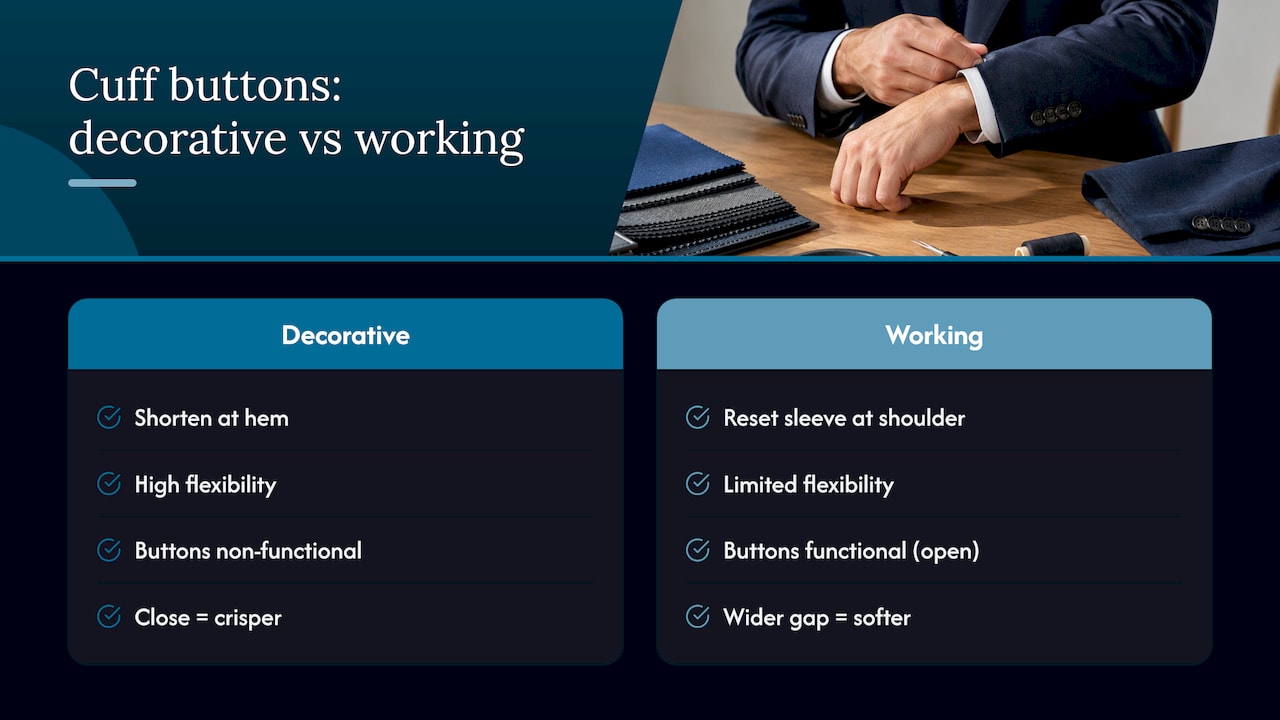
Cuff buttons do more than decorate the sleeve end. Their number, spacing and function all affect how an alteration can be carried out and how the finished sleeve looks once it is adjusted. A standard three or four button configuration, purely decorative, gives a tailor the most flexibility, since the sleeve can be shortened from the hem without touching the buttons at all.
Working buttonholes change that equation. Because the buttons genuinely fasten and unfasten, shortening the sleeve from the bottom would either remove a buttonhole entirely or crowd the remaining ones too close to the hem, which looks wrong and compromises the function. This is why a jacket with working cuffs that needs a length adjustment is usually better served by resetting the sleeve at the shoulder, preserving the button spacing exactly as it was cut.
Button spacing and placement also carry a style signal independent of function. Buttons set close to the cuff edge read as crisper and more formal, while a slightly wider gap between the last button and the hem gives a marginally softer, more traditional look. Either way, the buttons should sit in proportion to the cuff reveal they are framing, since a sleeve finished correctly at the wrist bone but fitted with buttons bunched awkwardly near the hem will still look unresolved despite the length being right.
A short tailor’s perspective on modern sleeve proportions
A slightly narrower reveal can suit a close, modern cut, while a traditional suit often looks better with the fuller half-inch. French cuffs tend to want a touch less exposure than barrel cuffs. Test small variations at a fitting rather than abandon the guideline altogether.
Ron
How bespoke tailoring solves sleeve-fit problems
Getting a sleeve to finish at exactly the right point on your wrist, with the right amount of cuff showing, is harder than it sounds when you are working from a size chart rather than your own arm. We take your measurements in person, build a basted fitting into the process, and adjust the cuff reveal against the shirt and posture you actually wear, rather than against a standard that assumes an average build.

Our Suits, starting from $2,170, and sports jackets, from $1,790, are both built around this fitting process, as are our tuxedos from $2,270. A few places to start:
- Read our suit measurement guide for the full set of points we check before cutting.
- Browse our suits to see how sleeve, shoulder and cuff come together across different styles.
- Pair the jacket with a tailored shirt cut to the same proportions so the cuff reveal sits exactly where it should.
Book a fitting through our pricing page and we will take it from there.
FAQ
What is the ideal sleeve length for a coat?
A coat sleeve, like a suit jacket sleeve, should generally finish at the base of the wrist bone so a small band of shirt cuff remains visible. The same 6 to 12 millimetre reveal used for suit jackets applies, though heavier overcoats sometimes sit slightly longer to allow for a jacket worn underneath.
What is a good sleeve length?
A good sleeve length ends right at the styloid process, the small bone at the base of your wrist, leaving roughly 6 to 12 millimetres of shirt cuff showing beneath the jacket hem. Anything that hides the cuff entirely or shows much more than that tends to throw off the proportion of the whole jacket.
What is the sleeve length on a 42R jacket?
Ready-to-wear sizing labels describe chest size and jacket length category rather than a fixed sleeve measurement, so the actual sleeve length varies by brand and cut. Because of that variation, the sleeve on any off-the-rack jacket should still be checked against the wrist-bone rule and adjusted individually rather than assumed correct from the size alone.
What does sleeve length 32-33 mean?
A sleeve length written as a range usually refers to a shirt sleeve measurement taken from the centre back of the neck, across the shoulder and down to the cuff, rather than a jacket sleeve measurement. It is a shirt sizing convention distinct from the jacket wrist-bone rule, so the two should not be confused when checking fit.