Dress Shirt Length: How Long It Should Be for a Proper Fit
A tucked dress shirt should run roughly 30 to 34 inches long, and an untucked shirt should sit between 26 and 32 inches, depending on your height and build. If you have seen a “34–35” printed inside a collar, that second number is your sleeve length in inches, measured from the center of your back to your wrist.
- Tucked shirts: about 30–34 inches
- Untucked shirts: about 26–32 inches
Those ranges are a starting point, not a rule carved in stone. Torso length, fabric weight, and how a shirt is cut all shift the ideal number, which is exactly why bespoke tailoring exists.
Key Takeaways
Correct dress shirt length depends on tucked versus untucked wear, torso proportion, and sleeve notation, and bespoke tailoring is the most reliable way to get all three right.
| Point | Details |
|---|---|
| Know your ranges | Tucked shirts run about 30–34 inches; untucked shirts run about 26–32 inches. |
| Understand sleeve notation | A “34–35” label means sleeve length in inches, measured center back to wrist. |
| Measure with posture in mind | Stand naturally and measure center-back and front length separately for accuracy. |
| Match length to height and torso | Height bands are a starting point; torso proportion determines the final fit. |
| Choose bespoke for precision | Ronandrich measures, mock-fits, and adjusts length directly on your body for a guaranteed fit. |
Table of Contents
- How to Measure Dress Shirt Length Correctly
- What Does the “34–35” Sleeve Number Mean?
- Recommended Shirt Length by Height and Use
- Which Shirt Length Actually Flatters Your Body?
- When Should You Alter a Dress Shirt for Length?
- How Bespoke Tailoring Solves the Length Problem
- Get a Dress Shirt Built to Your Exact Length
- Sources
How to Measure Dress Shirt Length Correctly
Stand naturally, arms relaxed at your sides. Posture matters here. Slouching or squaring your shoulders too hard will throw off every number that follows.
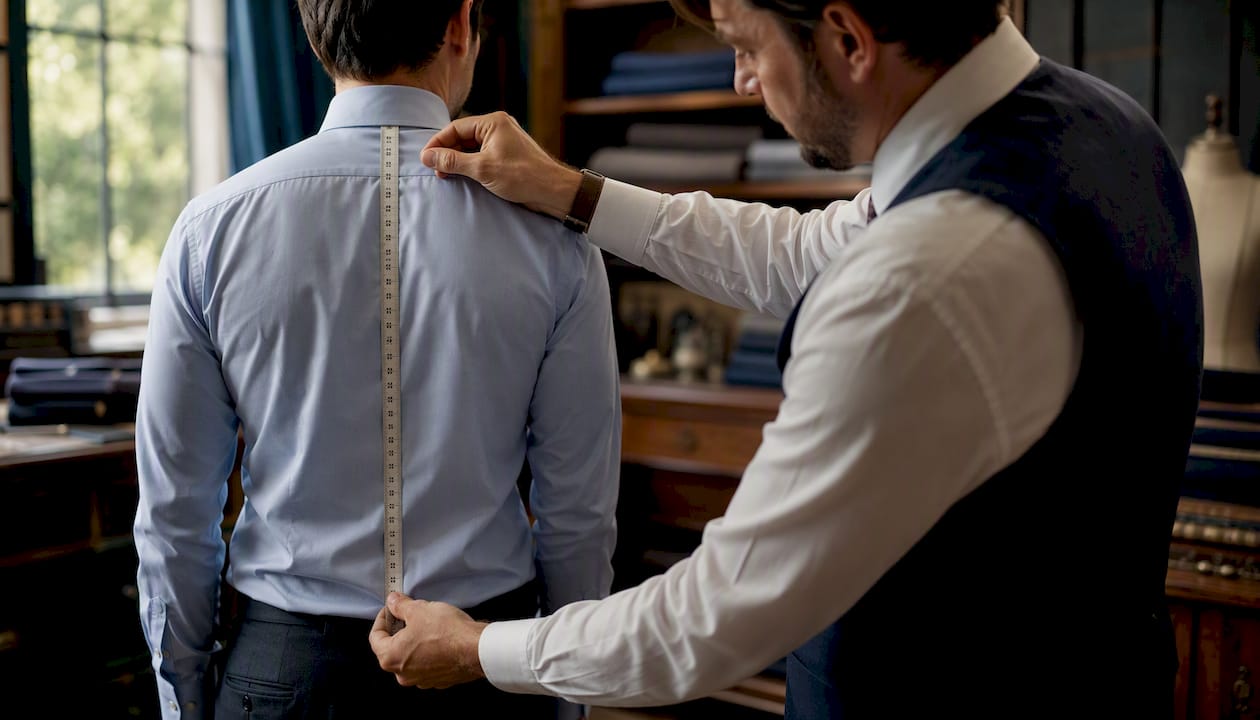
Center-back length is your primary reference. Run a tape from the base of your neck, straight down your spine, to wherever you want the hem to fall. Front length is measured the same way from the collarbone down. These two numbers rarely match exactly, since most dress shirts are cut a bit longer in back to stay tucked through movement.
Here is a simple checklist to follow at home:
- Wear a well-fitted shirt, or measure directly on the body if you are starting from scratch.
- Measure center-back length from collar seam to desired hem point.
- Measure front length from the top button to the hem.
- Record everything to the nearest half inch. Rounding up “close enough” is how sleeve and hem lengths end up wrong.
- Repeat the measurement twice to confirm consistency.
Pro Tip: Measure over a thin undershirt, not bare skin, since that is how the shirt will actually sit day to day. A second pair of hands holding the tape square to your spine will save you from the crooked numbers that come from guessing behind your own back.
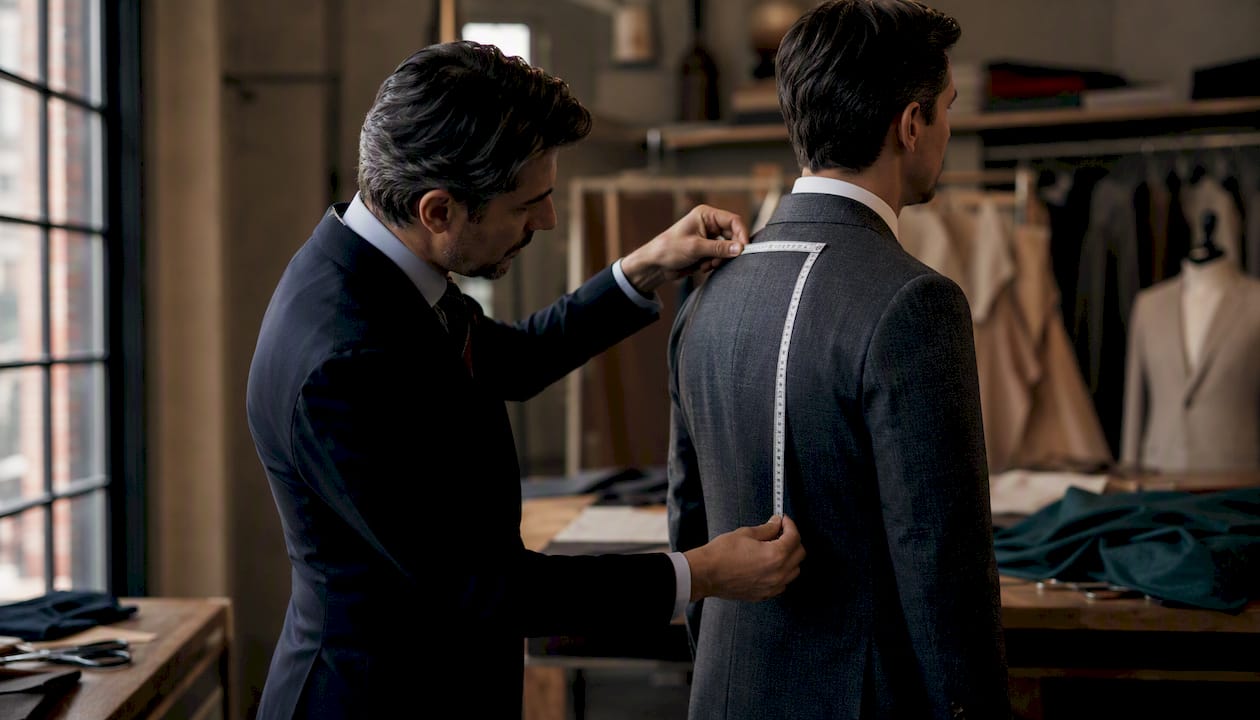
A simple diagram showing the nape-to-hem path down the back, alongside the shoulder-to-wrist line for sleeves, makes this far easier to visualize than text alone.
What Does the “34–35” Sleeve Number Mean?
That second number on a dress shirt label is sleeve length in inches, typically measured from the center back of the neck, across the shoulder, and down to the wrist bone. Manufacturers settled on this convention decades ago as a way to standardize mass production, and it has stuck ever since.
To measure it yourself: start at the center back of your neck, run the tape across your shoulder seam, past your elbow (with your arm slightly bent), and down to your wrist bone. If that comes out to 34.5 inches, you would typically buy a “34–35” sleeve, since brands group sleeve lengths in half-inch to one-inch bands rather than selling every fraction individually.
Two things throw people off. First, rounded size bands mean two men with different actual sleeve lengths can end up wearing the “same” size. Second, cuff button placement changes how much sleeve shows at the wrist, which can make an accurate sleeve length look too short or too long even when the raw number is correct.

Recommended Shirt Length by Height and Use
Height alone will not tell you the right length, but it is a useful starting point before you factor in torso proportion.
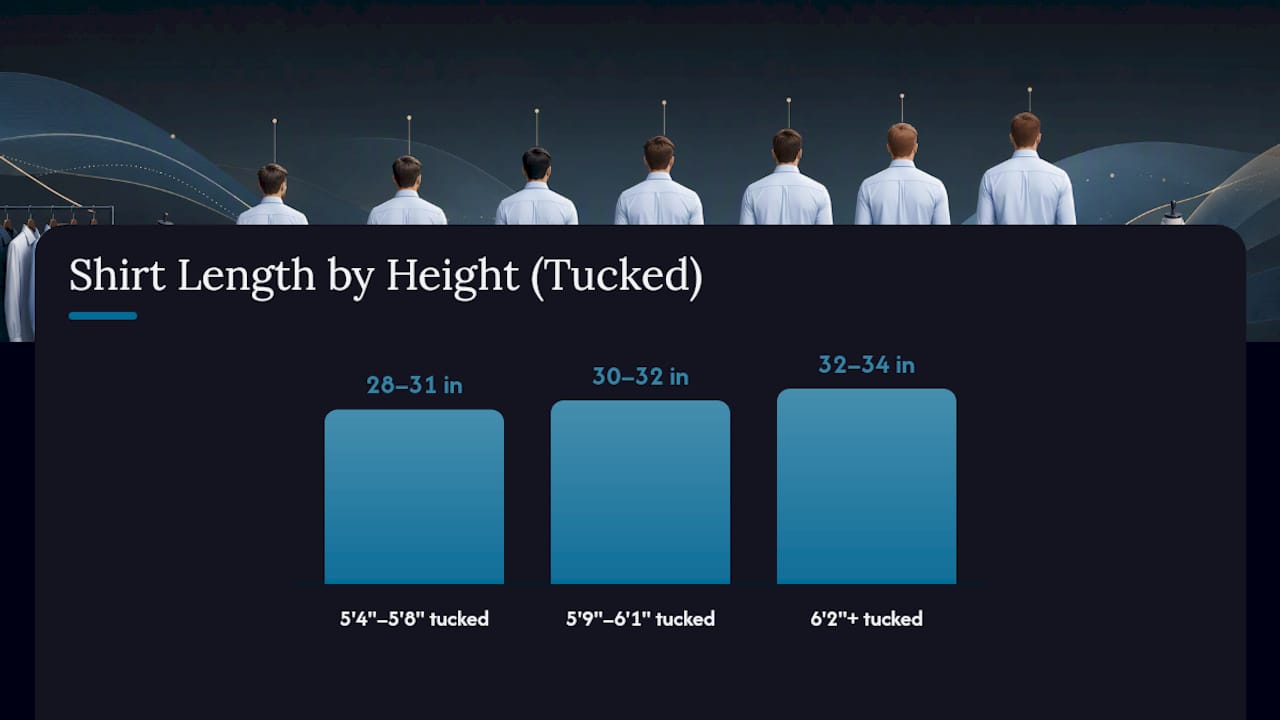
- 5’4" to 5’8": tucked shirts around 28 to 31 inches; untucked around 26 to 28 inches tends to prevent bunching on shorter frames.
- 5’9" to 6’1": tucked shirts around 30 to 32 inches; untucked around 28 to 30 inches.
- 6’2" and taller: tucked shirts around 32 to 34 inches; untucked around 30 to 32 inches.
A proper dress shirt fit depends on five zones working together, not just length in isolation: collar, shoulders, chest, sleeves, and hem, with the hem falling a few inches below your beltline so it stays tucked when you reach or sit. A long torso on a shorter man, or a short torso on a taller one, can push you outside these bands entirely, which is where standard sizing starts to fail people.
Pro Tip: Softer cottons and linen blends can shrink noticeably after a few hot washes. Add half an inch to a full inch of length if you plan to launder a shirt often, especially with untreated natural fibers.
Which Shirt Length Actually Flatters Your Body?
The goal is balance: your shirt length should make your torso and legs look proportionate, not competing with each other. Get this wrong and even a well-tailored shirt reads sloppy.
- Do keep tails short if you are on the shorter side. Long tails add visual bulk exactly where you don’t want it.
- Don’t wear an overly cropped hem if you have an athletic or longer torso. It cuts the body awkwardly at the waist.
- Do pair a slightly shorter untucked hem with higher-rise trousers to lengthen the leg line.
- Don’t let excess fabric bunch at the waist when tucked. That signals the shirt is too long for your frame.
Pro Tip: A half tuck only works with shirts cut specifically for that look. On a standard dress shirt, a half tuck usually looks unfinished rather than casual.
When Should You Alter a Dress Shirt for Length?
If the hem rides above your seat when tucked in, if fabric bunches excessively at the waist, or if cuffs swallow your hands, it is time to see a tailor. These are not cosmetic complaints. A quick tuck-and-raise-your-arms test will tell you immediately whether a shirt is long enough to survive normal movement.
- Shortening a hem by up to roughly 3 inches is usually possible without re-cutting the shirt.
- Sleeve length can typically be adjusted to the nearest half inch through the cuff.
- Side seams can be taken in to correct bunching that hem length alone won’t fix.
Pro Tip: Ask your tailor to preserve the front placket and original side seam lines, then request a mock tuck during your fitting so you can see the real result before it’s final.
How Bespoke Tailoring Solves the Length Problem
Bespoke tailoring removes the guesswork entirely, because your hem and sleeve lengths are built from your actual body, not a rounded size band. Ready-to-wear shirts assume a population average; your torso and arms rarely match that average exactly.
At Ronandrich, the process runs in three stages: precise measurement, a mock fitting to check how the garment moves with your body, and final adjustments before the shirt is finished. Length gets checked at every stage, tucked and untucked, arms raised and at rest.
- Measurements taken directly from your body, not estimated from a chart
- A mock fitting to catch length issues before the final garment is cut
- Final adjustments so sleeve and hem length are correct the first time
Off-the-rack sizing works from neck-and-sleeve averages meant to fit as many men as possible. That convenience is exactly what makes it imprecise for anyone whose proportions fall outside the mean.
If your torso or arm length has ever made off-the-rack shirts feel wrong no matter the size on the tag, our size chart is a useful starting point for comparison before booking a fitting.
A Note From the Tailor
Precise length matters because a shirt that’s even an inch off shows up the moment you move, reach, or sit down. The mistake we see most often isn’t a shirt that’s too short. It’s one that’s too long and bunches at the waist, which men mistake for a “safe” choice.
Get a Dress Shirt Built to Your Exact Length
Standard sizing forces you to round up or down to the nearest half-inch band and hope your torso cooperates. Ron & Rich builds the shirt to your measurements instead, so hem and sleeve length are right the first time, not adjusted after the fact.

Our custom shirting collection covers both tucked and untucked designs, with length built into the pattern from your first fitting rather than corrected afterward. Every order runs through the same bespoke process, measurement, mock fitting, and final adjustment, so length issues get caught before the shirt is finished. If you would rather see the full range of tailored pieces first, our suits and jackets collection shows the same fit standard applied across a full wardrobe. Book a fitting and get a shirt that fits the way it should from day one.
Sources
- How Long Should a Shirt Be? | Kiwi Sizing
- How Should Your Dress Shirt Fit? - A Complete Guide | Caswell’s Fine Menswear
- Dress shirt sizes | Hugh & Crye