5 Questions Singapore Men Must Ask Before Adding Working Buttonholes
Working buttonholes, known in tailoring circles as surgeon’s cuffs, are functional sleeve buttons that actually open and close, rather than sitting sewn shut for decoration. The main trade-off is straightforward: you gain a genuine sartorial flourish, but you lose flexibility to shorten or lengthen the sleeve later without shoulder work. What follows covers how they’re made, whether your existing jacket can take them, and the questions worth asking before you commit.
TL;DR:
- Adding working buttonholes is only feasible if the jacket sleeve already has a vent or placket; retrofit options are limited and may require significant reconstruction.
- The process involves precise pattern work, with hand-finished buttonholes offering greater durability and a traditional look compared to machine-made options.
- Future sleeve alterations become more complicated and costly once functioning buttonholes are sewn, especially if the jacket lacks an existing vent.
- Working buttonholes are a subtle sign of high craftsmanship, suited for bespoke or made-to-measure jackets in formal or style-conscious settings.
- Before commissioning, it is crucial to verify sleeve construction, ask about future flexibility, and obtain a detailed quote based on in-person inspection.
Table of Contents
- What are working buttonholes, and where did the name come from?
- How are working buttonholes actually made?
- Can you add working buttonholes to an off-the-rack jacket?
- Style, etiquette and when working buttonholes make sense
- What should you ask your tailor before commissioning working buttonholes?
- Notes from Ron: craftsmanship choices behind working buttonholes
- The honest take on this detail
- How Ron & Rich can help with working buttonholes
- Sources
What are working buttonholes, and where did the name come from?
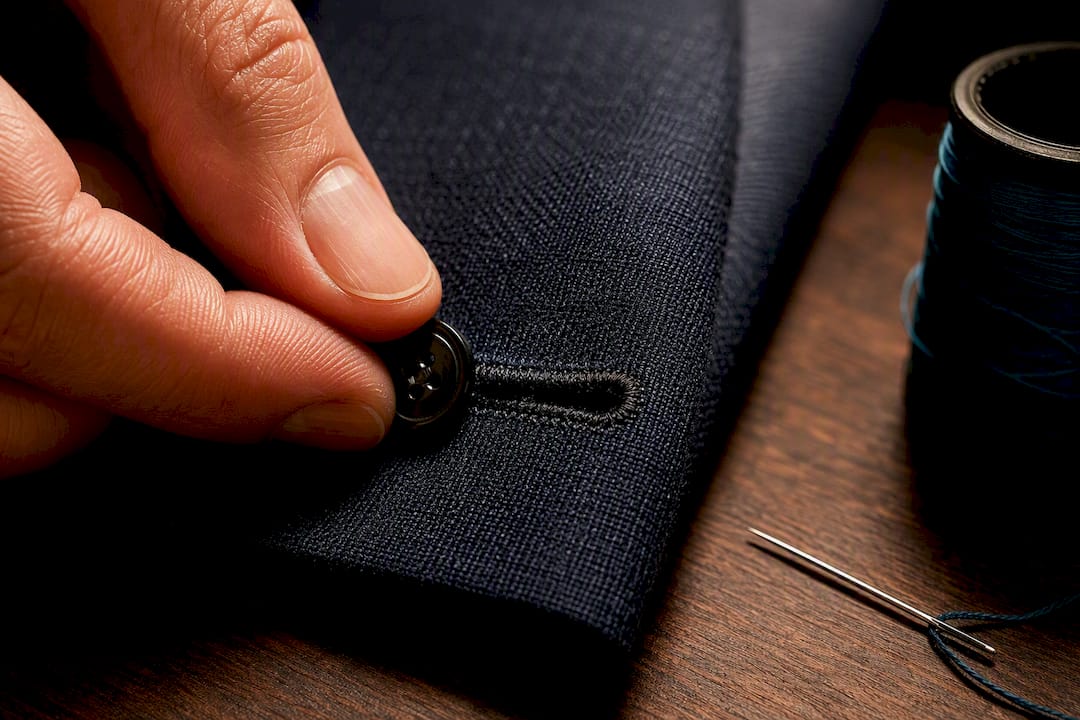
Most ready-to-wear jackets carry decorative cuff buttons stitched flat against the fabric, purely for show. Working buttonholes are different: the sleeve actually opens, because the buttons pass through cut holes rather than sitting on top of the cloth.
The nickname “surgeon’s cuff” traces back to Savile Row in the late 19th century, when doctors reportedly asked their tailors for cuffs they could unfasten and roll back before examining patients, according to Gentleman’s Gazette. Whether every surgeon on the Row genuinely needed this or whether the story has been polished over a century of retelling is impossible to verify. Either way, the name stuck.
Today the practical case has mostly evaporated. Few professionals need to roll a jacket sleeve mid-consultation. What survives is the signal:
- A visible marker that a jacket was cut with more attention than average
- A small detail only noticed by people who know what they’re looking at
- A talking point that separates bespoke and made-to-measure work from mass production
How are working buttonholes actually made?
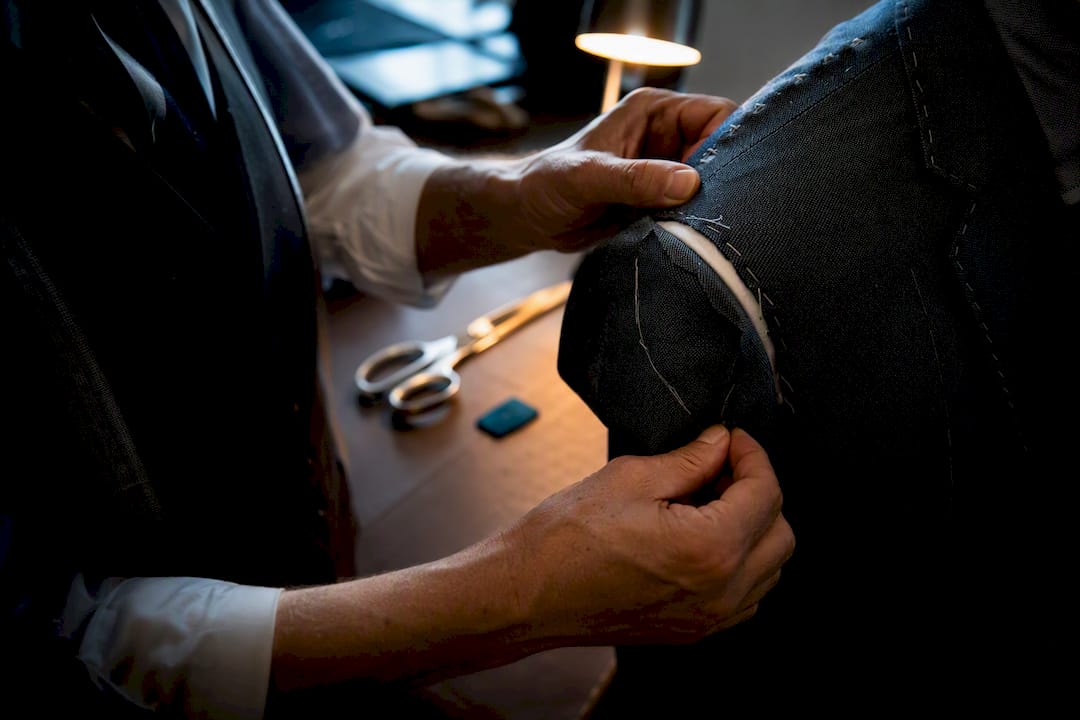
Building a functional cuff starts with the pattern, not the buttons. The sleeve needs a vent, or placket, with enough hem allowance for an underlap and overlap that close cleanly when buttoned. Get that allowance wrong and the cuff either gapes or refuses to lie flat. Threads magazine’s construction breakdown shows just how many small decisions go into making a proper surgeon’s cuff, from the initial vent allowance through to the final press.
The typical build order runs like this:
- Cut the sleeve pattern with the vent and hem allowance built in, not added afterwards.
- Construct the underlap and overlap so the seam rolls inward and hides once buttoned.
- Mark buttonhole positions precisely, since even a millimetre of drift throws off symmetry.
- Sew the buttonhole, either by hand with a stitched-then-cut method or by machine with a cut-then-stitch approach.
- Press the cuff so the vent lies flat and the lining sits without pulling.
Hand-worked buttonholes tend to show denser, more even stitching around the edge, with a slightly raised, corded look that resists fraying. Machine buttonholes, common on ready-to-wear, are faster and neater in a uniform way but lack that texture, a contrast Gentleman’s Gazette draws out clearly when comparing finishing standards.
Pro Tip: Run a finger along the edge of a finished buttonhole. If you feel a clean, slightly raised ridge rather than flat, uneven thread, you’re looking at hand-finished work.
Can you add working buttonholes to an off-the-rack jacket?
The honest answer is: it depends entirely on what’s already inside the sleeve. The first thing to check is whether a placket or vent exists under the current decorative buttons. If it does, a tailor has something to work with. If it doesn’t, you’re asking for reconstruction, not a simple upgrade, a distinction GQ makes plainly when discussing retrofit requests.
Where a placket is absent, a tailor typically has three options:
- Open the lining and check whether enough seam allowance exists to fake a vent
- Reconstruct the sleeve end entirely, which costs more and risks a slightly different cuff line
- Create a “sham” hole, styled to look functional but left partially closed, preserving future flexibility
None of this is reversible once the cut is made. Buttonholes fix the cuff’s position permanently, so any future shortening or lengthening has to happen at the shoulder seam instead of the hem, as Threads explains in its construction notes. That’s a materially bigger job: removing the sleeve, adjusting shoulder shape, and re-setting it, which changes how the sleeve hangs if done poorly.
Fabric pattern, lining type, and available seam allowance all determine how visible the retrofit ends up looking, and forum reports on Styleforum suggest close inspection often reveals the alteration regardless of skill.
Style, etiquette and when working buttonholes make sense
Showing off working buttonholes has an unwritten code. The convention is to leave one button undone on each cuff, never all of them, and to keep both sleeves symmetrical rather than unbuttoning one side more than the other.
This is a detail for people who already know what it means. Most colleagues and clients won’t register it at all, and that’s precisely the point: it’s a quiet nod between people who understand tailoring, not a statement aimed at a general audience, according to Gentleman’s Gazette.
Some contexts suit the detail far better than others:
- Well-fitted bespoke or made-to-measure jackets where the cuff already sits correctly, since a loose or badly proportioned sleeve makes an open buttonhole look accidental rather than deliberate
- Formal or sartorially literate settings such as tailoring events, weddings, or client meetings in fashion-adjacent industries
- Jackets you don’t expect to alter again, since the whole appeal assumes the sleeve length is already settled
Avoid it on a jacket you suspect will need resizing soon, or on very casual smart-casual pieces where the gesture reads as fussy rather than considered.
Pro Tip: If you’re not sure whether to unbutton at all, leave the cuffs closed for your first few wears of a new jacket. Let the tailoring settle before you start signalling anything with it.
What should you ask your tailor before commissioning working buttonholes?
A short conversation before the shears come out saves most of the disappointment reported in tailoring forums. Work through these points with whoever is doing the job:
- Ask them to check for an existing placket or vent before quoting anything.
- Ask specifically whether adding the feature will limit future shoulder or sleeve alterations.
- Confirm the finish type you’re paying for. Hand-worked and machine buttonholes carry different price points and different durability.
- Ask whether they’ll leave one sham buttonhole unfinished, preserving room to let the sleeve out later.
- Get a written quote after inspection rather than accepting a number based on a phone description.
Red flags worth noting: a tailor who quotes without looking at the actual sleeve construction, or one who can’t explain how the alteration affects future resizing. Neither answer should be vague.
If your jacket has no placket at all and you want the detail done properly rather than faked, made-to-measure or bespoke construction from the outset is usually the more sensible route than retrofitting, since the pattern can be built with the vent allowance from day one rather than fought into an existing seam. Our bespoke tailoring process walks through exactly how that pattern work happens before a single stitch goes in.
Pro Tip: Bring the jacket in person rather than describing it over the phone. Seam allowance and lining thickness are things a tailor needs to see, not hear about.
Notes from Ron & Rich: craftsmanship choices behind working buttonholes
When we build working buttonholes into a jacket, the decision starts at the pattern stage, not the sewing machine. We treat the lining as part of the structure, not an afterthought stitched in once the shell is finished, because a cuff that fights its own lining never sits flat no matter how neat the buttonhole looks from outside.
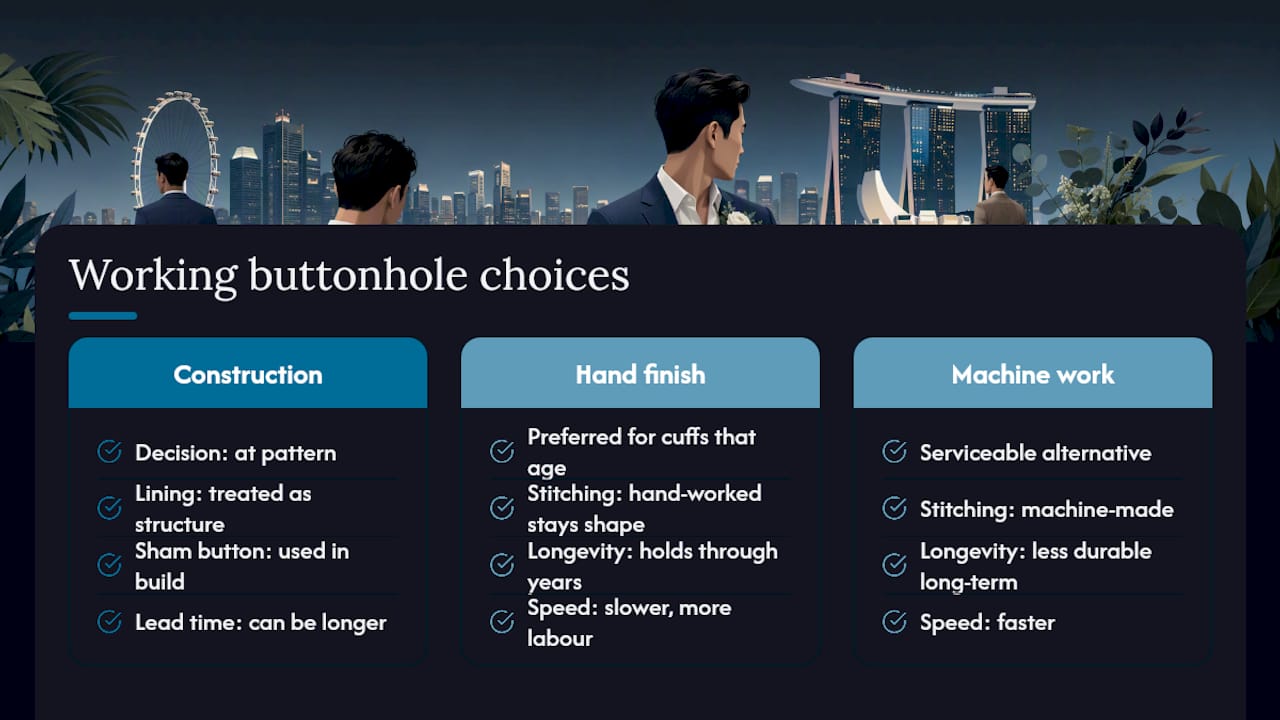
Hand finishing remains our preference for anyone who wants the cuff to age well. Machine buttonholes are faster and perfectly serviceable, but hand-worked stitching holds its shape through years of buttoning and unbuttoning in a way machine work rarely matches.
One habit worth borrowing from experienced tailors: keeping a single button as a sham during construction, so a future letting-out doesn’t run into a dead end. It’s a small concession that costs almost nothing at the fitting stage and saves considerable trouble years later.
Lead time for adding this detail properly, with lining adjustment and hand finishing, can vary and may take longer than a standard alteration. The variables that actually move the price are fabric weight, existing seam allowance, and whether the lining needs to be reconstructed rather than simply reopened.
Cost varies enough by jacket that we’d rather inspect it than guess, a caution GQ also raises when citing wildly different charges between tailors for the same job.
The honest take on this detail
Working buttonholes get talked about as though they’re a mark of serious tailoring, and sometimes they are. But plenty of the enthusiasm online treats them as a checkbox rather than a considered choice, and that’s where the conventional advice falls short. A jacket with badly fitted shoulders and a beautifully worked cuff is still a badly fitted jacket. The detail doesn’t rescue anything.
What the evidence actually supports is narrower than the hype suggests: working buttonholes reward people who already have a wardrobe they’re happy with and simply want one more layer of craft signalling on top of it. They’re a poor fix for indecision about fit, and a poor investment on a jacket you expect to alter again soon, given how firmly they lock the cuff position in place.
If you’re weighing this up, prioritise the sleeve’s underlying construction before the buttonhole itself. Ask whether a placket exists. Ask what happens if you need the sleeve taken in next year. Get those answers first, and the buttonhole decision usually becomes obvious on its own.
Aaron Fan
How Ron & Rich can help with working buttonholes
Certain bespoke tailoring services build working buttonholes with proper lining treatment, pattern-stage vent allowance, and offer a choice between hand and machine finishing depending on client preferences. For jackets that already exist, tailors typically inspect the sleeve in person before quoting, as seam allowance and lining thickness are difficult to judge remotely. This services are only available to our existing clients who have made suits with us. We run a small workshop of artisans as such we do not have the capability to take on garments not made by us.

A consultation starts with a look at what you’re bringing in, whether that’s a jacket needing alteration or a new commission built from scratch. For a jacket built the right way from the outset, with the vent and hem allowance designed in rather than retrofitted, our bespoke suits and jackets service gives you full control over cuff finish, fabric, and fit before a single seam is cut. Booking a fitting with a tailor can help assess sleeve construction and discuss realistic options for your jacket.
Sources
- Surgeon’s cuffs: myth or magic? | Gentleman’s Gazette
- Upgrading off-the-rack jackets | GQ
- The tailored jacket: how to make a surgeon’s cuff, part 1 | Threads
- Adding working button holes to a jacket | Styleforum