Shoulder Fits: Why it is important and what you need to know.
Shoulders that overhang, dip or wrinkle across the top are rarely a quick fix. A tailor can sometimes soften the look, but true narrowing means rebuilding the upper jacket, and that is only worth doing on garments that deserve the effort. The practical rule stands: buy for the shoulders first, because almost every other alteration is straightforward by comparison.
TL;DR:
- Shoulder narrowing requires a full rebuild involving detaching the sleeve, trimming the shoulder pad, and reshaping the armhole, often costing hundreds of dollars.
- The feasibility of shoulder alterations depends on the jacket’s construction, seam allowance, and fabric softness, with higher-quality, structured jackets being harder and more expensive to reconstruct.
- Buying jackets with the shoulder seam sitting exactly at your natural shoulder minimizes the need for costly or complex alterations later.
- A proper fit always starts at the shoulders, since poor shoulder fit affects lapel roll, chest drape, and overall balance, regardless of other adjustments.
- Light padding, soft construction, and careful fabric choice can visually reduce shoulder width and improve silhouette on broad frames.
Table of Contents
- How to tell if your suit shoulders are too wide
- Why shoulder fit matters more than other alterations
- What tailors can and cannot do about wide shoulders
- Cost, timeline and trade-offs for shoulder work
- Should you repair, replace or go bespoke?
- How to buy so the shoulders fit from day one
- Getting a straight answer from your tailor
- Do shoulder construction and suit style change how wide you look?
- Choosing suits that minimise the look of wide shoulders
- Does fabric choice affect how wide shoulders look?
- Common styling mistakes that make wide shoulders look wider
- Posture and wearing habits that improve shoulder appearance
- Ron’s perspective: why we assess the shoulder first
- Book a shoulder assessment with Ron & Rich
- Sources
How to tell if your suit shoulders are too wide
The shoulder seam should sit exactly where your natural shoulder ends and your arm begins. When it hangs past that point, the jacket is carrying width that your body doesn’t need, and no amount of waist suppression will hide it.
Look for these signals with the jacket buttoned and your arms relaxed at your sides:
- Overhang beyond the arm joint. If you can pinch fabric hanging past where your arm meets your torso, the shoulder is oversized.
- Sleeve dip or flare. The sleeve head should sit flush; a divot or a flared cap both signal a shoulder built too big.
- Horizontal wrinkles across the chest or back. These often mean the shoulder is pushing fabric forward or back rather than sitting flat.
- Collar gap. A gap between collar and neck frequently traces back to shoulder width rather than the collar itself. Fit guides consistently flag this pairing as one of the clearest tells.
- Shoulder pad overhang. If you can see or feel the pad’s edge before your arm starts, the built structure is too wide for your frame.
Try the one-hand test: place your palm flat against the point where shoulder meets sleeve. If there’s a gap wide enough to slide two fingers under, it’s too big. Photograph yourself from the front and from directly above the shoulder line, standing naturally rather than pulling your shoulders back, since posture can mask or exaggerate the problem. Bring those photos to any consultation.
Pro Tip: Take the photos in a well-lit room against a plain wall, and shoot one with your arms relaxed and one mid-stride. Tailors read movement fit as much as static fit.
Why shoulder fit matters more than other alterations
The shoulder sets the foundation for everything else the jacket does. Lapel roll, chest drape and the balance between front and back all take their cue from how the shoulder sits, which is why a jacket with the wrong shoulder width never looks quite right no matter what else you adjust.
A jacket with excess shoulder width reads as oversized even when the waist is nipped in and the sleeves are shortened to the correct break. That’s the frustrating part: you can spend money tightening everything else and the garment still looks borrowed.
Compare that to the alterations tailors handle routinely:
- Taking in the waist, which adjusts fabric that was always meant to be trimmed
- Shortening sleeves, a simple recut at an existing seam
- Adjusting trouser length or waistband, both standard workshop tasks
None of those touch the structural cage that the shoulder forms. A general rule worth internalising is that if the shoulders fit, everything else is fixable. If they don’t, you’re negotiating with the one part of the jacket that resists negotiation.
What tailors can and cannot do about wide shoulders
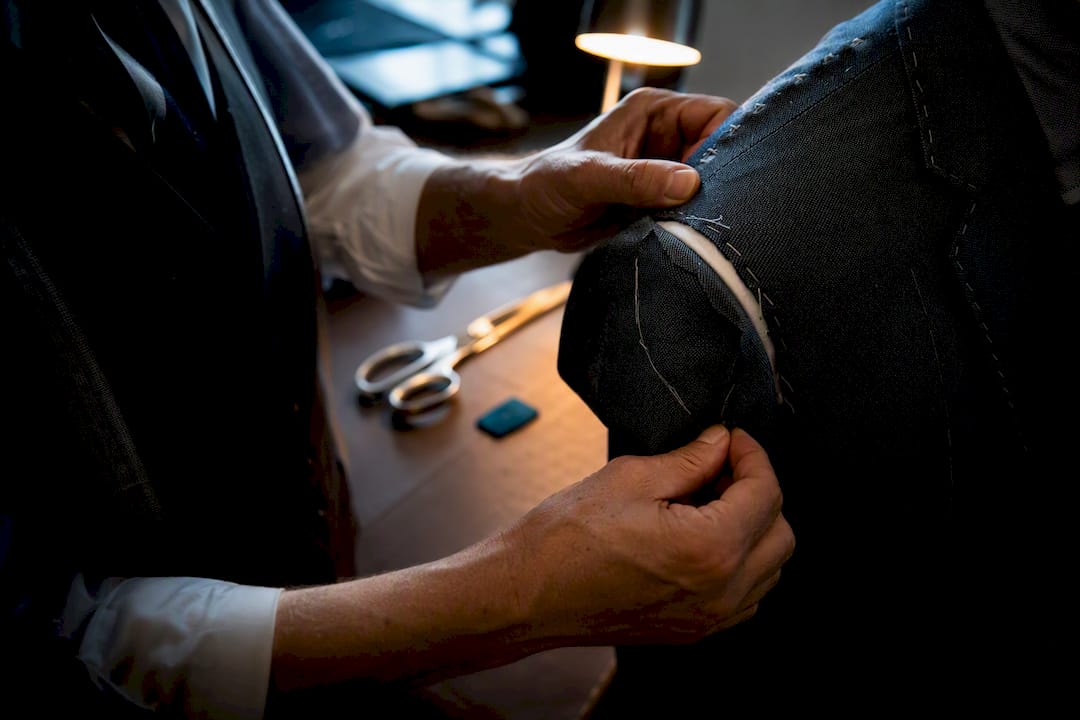
Narrowing a shoulder is not a seam adjustment. It’s a partial rebuild. A competent tailor doing this properly will detach the sleeve, remove or trim the shoulder pad and canvas, re-cut the armhole to a smaller circumference, reshape the shoulder seam itself, then reattach the sleeve and rework the lining to match the new shape.
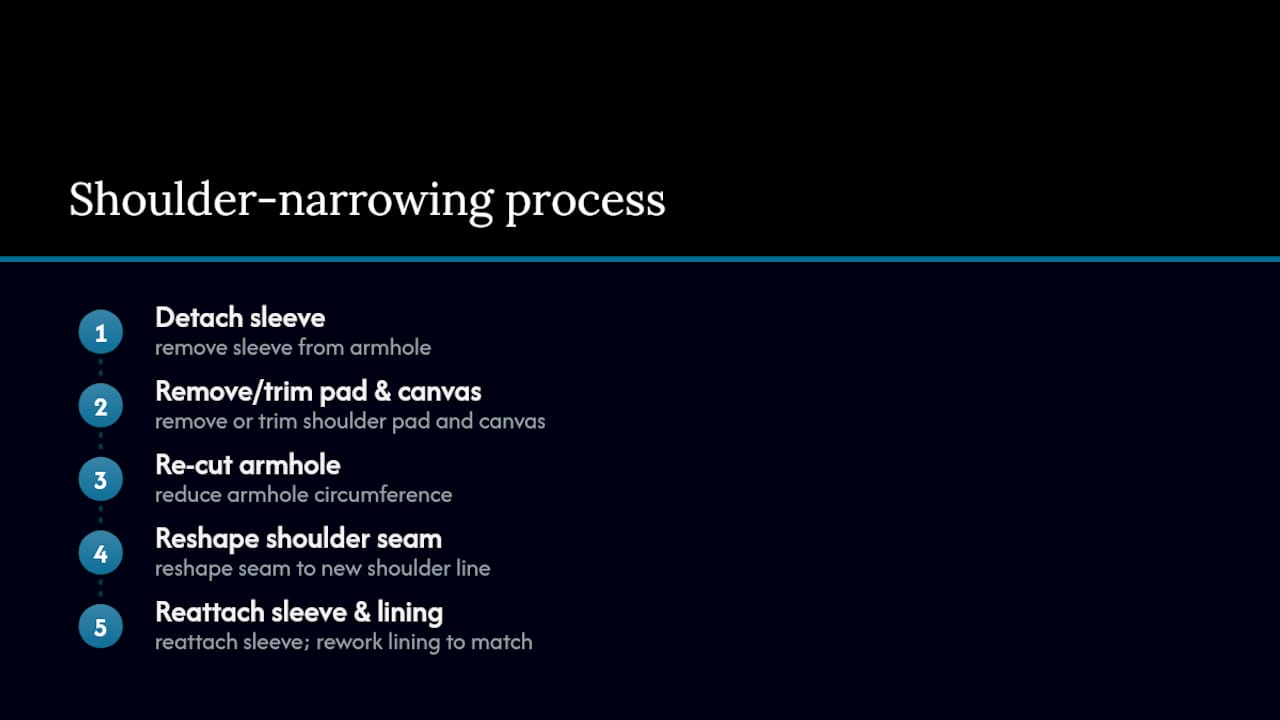
That sequence explains the cost and the risk. Reconstructing the upper jacket disturbs the canvas structure, the drape, and often the lapel roll, so even a technically successful job can leave a jacket looking subtly different from how it fit before, and not always for the better.
Success depends on three things: how much fabric the seam allowance actually contains, how well the original canvas and shoulder padding were constructed, and how forgiving the fabric is to reshaping. A soft, loosely woven wool takes a recut far better than a stiff fused suit that was never built to be altered.
Reconstructing a shoulder can run into the hundreds of dollars once labour and materials are counted, a cost that often exceeds what the jacket itself is worth for anything bought off a mass-market rail. That single fact drives most of the advice in this article. Tailors will generally recommend the work only on bespoke pieces, high-quality ready-to-wear with generous construction, or garments carrying enough sentimental value to justify the spend. Everywhere else, replacement tends to make more financial sense.
Cost, timeline and trade-offs for shoulder work
Shoulder reconstruction sits at the expensive end of the alteration scale, well above routine work like hemming trousers or taking in a waist. Expect two to three fittings spaced over several weeks, since the tailor needs to check drape and balance after each stage rather than committing to the full recut in one sitting.
- Routine alterations (sleeve length, waist suppression, trouser hem): usually a single fitting, completed within days
- Shoulder narrowing or reconstruction: multiple fittings, weeks rather than days, and a materially higher labour cost
- Full canvas and lining rework alongside the shoulder: the longest and most expensive path, approaching what a new made-to-measure jacket would cost
Weigh the quote against what a comparable replacement costs, not just the price you originally paid. A £150 jacket rarely justifies a £300 shoulder rebuild, however much you like the fabric.
Pro Tip: Ask for the quote broken into stages, sleeve detachment, armhole recut, reattachment and pressing, so you can see exactly where the cost concentrates and whether a partial fix might be enough.
Should you repair, replace or go bespoke?
Run through this before committing to any quote:
- Check the garment’s quality. Full or half canvas construction with generous seam allowance tolerates alteration far better than fused, budget tailoring.
- Ask about seam allowance directly. A tailor checking this early in the consultation is usually the difference between a feasible job and a wasted quote.
- Weigh sentimental value. A father’s wedding suit justifies spending that a recent high-street purchase doesn’t.
- Compare against replacement cost. If a new jacket in your size costs less than the repair, replacement wins on logic alone.
- Consider how often you’ll wear it. A suit worn weekly deserves investment; one worn twice a year rarely does.
Cheap, fused, minimal-allowance jackets almost always point towards replacement. Well-constructed bespoke or premium ready-to-wear, worn often and fitted with real fabric to spare, is where reconstruction earns its cost.
How to buy so the shoulders fit from day one
Shopping with the shoulder as your first checkpoint saves you from ever needing this conversation again. Buying for the shoulders first is repeated across fit guides for good reason: it’s the one measurement you can’t alter your way out of cheaply.
- Check the seam sits exactly at the edge of your natural shoulder before you look at anything else the jacket does
- If you have an athletic or broader build, look for cuts with a slightly higher armhole and less shoulder padding, which follow your natural line rather than adding to it
- Consider a pagoda shoulder or structured shoulder style if you want the shoulder line to hold shape without adding visible width
- For anyone who has struggled with off-the-rack fit repeatedly, made-to-measure or bespoke removes the guesswork by building the shoulder to your actual frame rather than a size chart
- Repeat the one-hand test in-store on every jacket you try, and check the full fit guide against your own reflection before deciding
Bring a jacket you already know fits well, if you have one, so a fitter can reference it directly rather than working from description alone.
Getting a straight answer from your tailor
A good consultation starts with questions, not measurements. Ask directly: how much seam allowance does this jacket actually have? Have you done shoulder narrowing on this type of construction before? What’s realistic to expect from the result?
- Bring the photos from your fit check, plus the jacket itself, so the tailor can see the overhang rather than take your word for it
- Ask to see an example of previous shoulder work if the tailor has photos on hand
- If a tailor discourages the job, treat that as useful information rather than a sales knockback. Seam allowance is often the deciding factor, and an honest refusal usually means the fabric genuinely won’t support it
- Agree specific, measurable acceptance criteria before work starts: exact seam position, sleeve pitch, and how many fittings are included in the quote
Pro Tip: Ask what happens if the first recut doesn’t sit right. A tailor confident in the work will have a plan for a second fitting built into the price, not treated as an extra.
Do shoulder construction and suit style change how wide you look?
Shoulder construction changes the visual read of width more than most men expect, sometimes more than actual measurement does. A heavily padded, structured shoulder with a sharp roped edge broadens the silhouette because it adds height and a defined corner at the deltoid. A soft, natural shoulder with little or no padding follows your own slope instead, which reads narrower even at an identical measurement.
Double-breasted jackets tend to visually widen the upper body further, since the extra fabric across the chest draws the eye horizontally. Single-breasted, notch-lapel jackets with a moderate lapel width do the opposite, creating a vertical line that balances a broad frame rather than emphasising it.
Lapel width matters more than most buyers realise. A narrow lapel on a broad-shouldered man exaggerates the width gap between shoulder and chest, while a lapel proportioned to your frame closes that gap visually. The same logic applies to shoulder seams themselves: a slightly extended seam with a rounded, natural cap adds width, while a seam that sits precisely at the joint with minimal padding does the reverse.
If you already carry width naturally, a soft shoulder with light or no padding, paired with a single-breasted cut and a proportionate lapel, is usually the combination that looks most balanced rather than exaggerated.
Choosing suits that minimise the look of wide shoulders
Certain style choices genuinely counteract a broad frame rather than fighting it. Structure is the first lever: a natural or soft-constructed shoulder, built with minimal padding, follows your own line instead of extending past it artificially.
Cut is the second. Single-breasted jackets with a moderate to slightly higher button stance elongate the torso, which balances shoulder width by drawing the eye downward rather than across. Avoid short, boxy jacket lengths, since they compress the proportions and make the shoulder line look even wider relative to the body.
Darker, more textured cloth in solid or subtle patterns tends to read as more tailored and less bulky than bright, flat colour. A slightly fitted waist, without going tight, creates a visible taper from shoulder to hip that reinforces the V shape rather than the block shape a boxier cut produces.
If you’re working with a tailor or ordering made-to-measure, ask specifically for a shoulder seam that sits precisely at your natural joint, light to moderate padding rather than heavy structure, and a lapel width proportioned to your chest measurement rather than a stock template. Those three requests do more for balance than any amount of alteration after the fact.
Does fabric choice affect how wide shoulders look?
Fabric weight and pattern both change how the eye reads shoulder width, sometimes as much as cut does. Heavier, stiffer cloths hold their shape more rigidly, which can exaggerate a shoulder’s edge and make width more obvious. Softer, finer wools drape rather than hold a hard line, softening the same shoulder construction considerably.
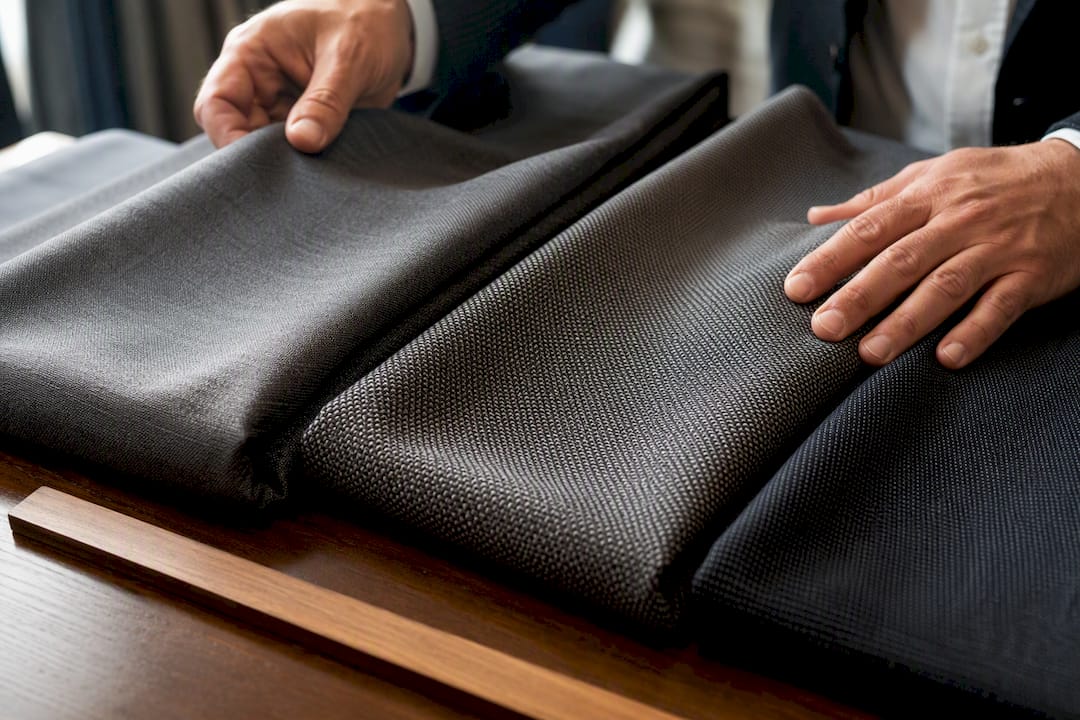
Pattern matters just as much. Bold horizontal stripes or large-scale checks across the shoulder line draw the eye outward and widen the visual field. Fine pinstripes running vertically do the opposite, pulling the eye down the body and countering shoulder width rather than adding to it. Solid or subtly textured cloths, like a fine birdseye or sharkskin, sit in the middle: they avoid the horizontal emphasis of a bold check without the starkness of a plain flat weave.
Colour plays a smaller but real role. Lighter colours and high-shine fabrics catch more light across the shoulder plane, making the area more prominent. Matte, darker cloth absorbs light rather than reflecting it, which reduces how much attention the shoulder line draws.
If you already have a broad frame, a mid-weight, matte wool in a fine pattern or solid colour is usually the safer choice over a stiff, boldly patterned, or high-shine fabric. It’s a small decision at the counter that has an outsized effect on the finished silhouette.
Common styling mistakes that make wide shoulders look wider
The most frequent mistake is buying a jacket a size up to “fit the shoulders,” which only adds bulk everywhere else while leaving the actual shoulder overhang untouched. Sizing up never fixes a shoulder problem; it just adds more fabric around a foundation that was already wrong.
Heavily padded shoulder pads on a jacket layered over a broad frame is another common error, since it stacks structural width on top of natural width rather than working with it. The same goes for boxy, unstructured jackets bought specifically to “hide” shoulders. Loose fabric doesn’t disguise width; it just moves the eye to a different, equally unflattering silhouette.
Accessories cause trouble too. Wide-shouldered men often overcompensate with narrow ties and skinny lapels, which creates a jarring mismatch between a broad top half and a delicate accessory. Bags or briefcases with thick, structured straps worn across one shoulder can also emphasise asymmetry rather than balance it.
Layering is the final trap. Stacking a heavy overcoat with its own structured shoulder over a suit that already carries shoulder padding compounds the problem twice over. If you’re broad through the shoulder, choose an overcoat with a soft, raglan, or minimally structured shoulder line to avoid doubling up on width.
Posture and wearing habits that improve shoulder appearance
How you stand changes how a jacket reads almost as much as how it’s cut. Rounded, forward shoulders exaggerate width because they push the shoulder line forward and out, creating a hunched silhouette that draws attention to bulk rather than shape.
Standing with a naturally upright spine, shoulders relaxed rather than pulled back forcefully, keeps the jacket sitting as it was designed to. Overcorrecting by pulling your shoulders sharply back is just as counterproductive as slouching, since it tightens the fabric across the back and creates the horizontal pulling that mimics an oversized shoulder even on a well-fitted jacket.
Keep your arms relaxed at your sides rather than crossed or in pockets for extended periods when wearing a tailored jacket in a professional or formal setting. Crossed arms bunch the shoulder and sleeve fabric, exaggerating any existing width. When sitting, unbutton the jacket to avoid the fabric pulling taut across the shoulder blades, which otherwise creates visible strain lines that make the shoulder look wider than it is.
Walking with a natural, even gait rather than a stiff, squared-off posture also helps. A jacket built and fitted correctly should move with you, and forcing a rigid stance often works against the very silhouette you’re trying to achieve.
Ron & Rich’s perspective: why we assess the shoulder first
Every consultation starts at the shoulder, because it’s the one measurement that determines whether the rest of the fitting is even worth pursuing. It’s better to tell a client honestly that a jacket needs replacing than take on reconstruction work that fights the garment’s own construction. Bespoke earns its cost because the shoulder is built for one body from the outset, not adjusted afterwards. When a client brings in ready-to-wear with genuine shoulder issues, the first question is always the same: is this jacket good enough to justify the rebuild, or does it make more sense to start fresh?
Aaron Fan
Book a shoulder assessment with Ron & Rich
Ron & Rich’s bespoke tailoring process starts with exactly that: a consultation where we check seam allowance, construction quality and shoulder placement before recommending anything, whether that’s a targeted alteration, a full rebuild, or a fresh bespoke commission.
Unlike a walk-in alteration shop working to a fixed price list regardless of what your jacket can actually take, we look at the garment first and tell you plainly whether reconstruction is worth your money. For anyone who has been through the sizing frustration described above, that honesty saves you from paying for work that was never going to hold. Where reconstruction doesn’t make sense, we build the alternative properly from the start, a custom bespoke suit cut to your actual shoulder line rather than a rack size, or a piece from our ready-to-wear range fitted and adjusted to suit your frame.
Bring the jacket, and if you have them, the photos from your own fit check. Book a consultation and we’ll tell you straight whether it’s worth saving.
Sources
- Suit Alterations: What A Tailor Can (& Can’t) Do | Gentleman’s Gazette
- How should a suit jacket fit? Sizing breakdown | SuitShop
- Can you resize a suit jacket? What to expect – TmTailor