Measure 9 Suit Points at Home for Bespoke and MTM Fits with Ron's Tips
Nine measurements matter most: neck, chest, shoulder point-to-point, sleeve length, jacket length, waist, seat, rise, and inseam. Use a soft cloth tape, work with a helper wherever possible, and measure the jacket points first, then the trousers. Take each measurement twice and aim for accuracy within half a centimetre, since that tolerance is what separates a suit that fits from one that merely covers you.
TL;DR:
- Measuring across the body with a soft fabric tape and with a helper ensures accuracy within half a centimetre, especially for jacket points and trouser measurements.
- Key measurements such as neck, chest, shoulders, and waist should be taken in a consistent sequence, with multiple readings recorded to identify the median and avoid errors.
- Basing trouser waist, seat, and inseam measurements on where the waistband sits and how the trousers should break gives a better fit than relying solely on size labels.
- Self-measurements generally work as a starting point, but adjustments during a fitting are crucial for men with uneven shoulders, unusual proportions, or posture quirks.
- Flat garment measurements can serve as a useful quick check for vintage or online purchases but cannot replace personal body measurements for bespoke tailoring.
Table of Contents
- Tools and preparation for taking your own measurements
- How do you measure your neck, chest and shoulders?
- How do you measure your waist, seat and inseam for trousers?
- What order should you measure in and how do you check your numbers?
- Can you measure an existing jacket instead of your body?
- Ron’s tailoring perspective: when self-measuring isn’t enough
- Book a fitting once you have your numbers
- Sources
- FAQ
Tools and preparation for taking your own measurements
The tape you use matters more than most men assume. A soft fabric tape gives an accurate read against the body’s curves; a metal DIY tape distorts the number and flattens what should be a rounded measurement.
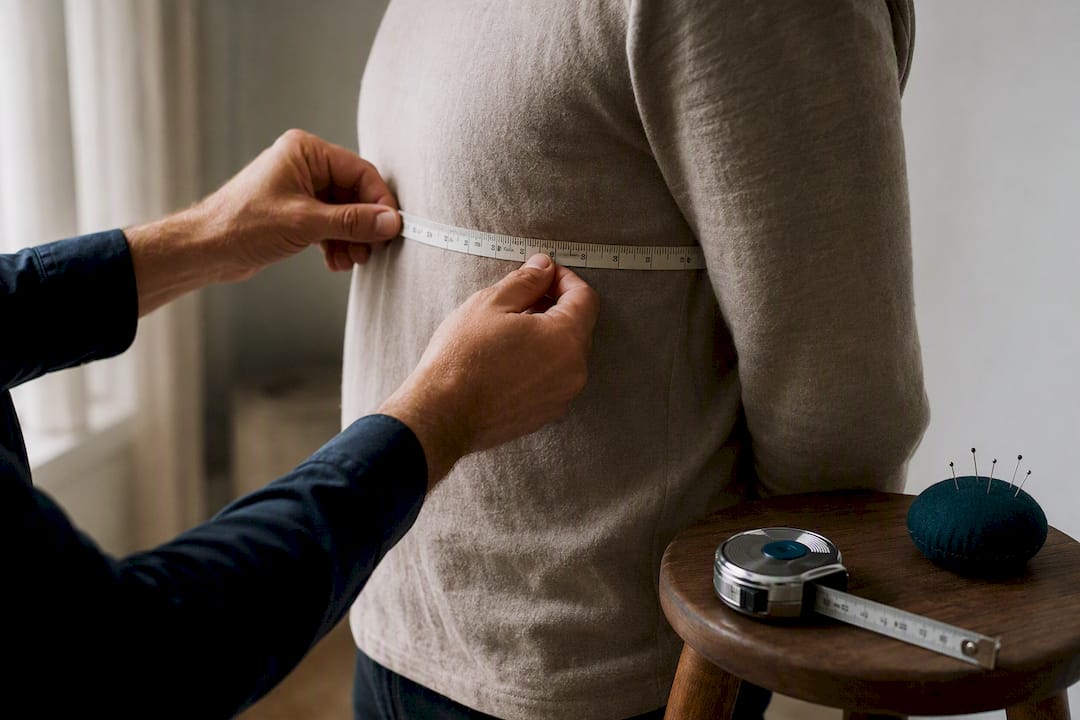
Wear a thin dress shirt or a fitted T-shirt, nothing bulky, and stand naturally with your feet roughly shoulder width apart. Slouching or bracing yourself against a wall throws off shoulder and chest readings by a surprising margin. A helper makes the biggest difference of all, since reaching around your own back to check a jacket length or waist point almost always pulls your posture out of shape.
Before you start, gather:
- A soft cloth or fabric tape measure, never a rigid metal one
- A second person to hold the tape and read the numbers
- A mirror, if you’re measuring solo
- Pen and paper (or a phone note) to record each figure immediately
- A fitted shirt or T-shirt, worn snugly but not tight
Decide upfront whether you’re working in centimetres or inches, and stick to one unit for every measurement. If you’re not sure where your natural waist sits, tie a piece of string around your midsection and let it settle. Where it lands is your reference point.
How do you measure your neck, chest and shoulders?
Each jacket measurement controls a different part of how the garment sits, and getting them wrong in isolation rarely shows up until the jacket is on your back.
- Neck. Wrap the tape around the base of your neck, where a shirt collar would sit, and leave room for two fingers between tape and skin. This gives collar comfort without the shirt gaping.
- Chest. Measure at the fullest part of your chest, tape held level under the arms and across the shoulder blades. This differs from overarm, which is taken with your arms slightly forward and captures more room across the back, useful for men with broader shoulders relative to their chest.
- Shoulders. Find each shoulder point, the small bone where your arm meets your shoulder, and measure straight across your back from one to the other. Get this wrong and no amount of tailoring elsewhere will fix the jacket’s hang.
- Sleeve length. Measure from the shoulder point to your wrist bone with your arm relaxed and slightly bent at the elbow, which accounts for natural movement. Some tailors prefer a centre-back method instead, running the tape from the middle of your neck, across the shoulder, and down to the wrist.
- Jacket length. Measure down the centre of your back from the base of the collar to wherever you’d like the jacket to end, typically level with the middle of your palm when your arm hangs naturally. Work to a tolerance of half a centimetre to one centimetre here, since jacket length is one of the more forgiving figures to adjust later.
Pro Tip: Bend your elbow slightly while your helper measures sleeve length. A straight-arm reading looks tidy but leaves the jacket sleeve too short the moment you reach for a door handle or a handshake.
How do you measure your waist, seat and inseam for trousers?
Trouser fit lives or dies on where the waistband actually sits, not where a size label assumes it sits.
- Waist. Measure around your body at the height you intend the trousers to sit, which for most suit trousers is at or just below the navel. Keep the tape snug but not compressed, and breathe normally rather than pulling your stomach in.
- Seat. Measure around the fullest part of your hips and seat with your feet together, tape held level all the way round. This figure, alongside the waist, determines how much room the trousers give through the top block.
- Rise. This is the distance from your waistband line to your crotch seam, and it’s worth understanding the relationship: outseam minus inseam gives you the rise. A shorter rise sits lower and looks more contemporary; a longer rise sits higher and gives a cleaner, more classic silhouette.
- Inseam and outseam. Measure the inseam from the crotch to wherever you want the trouser hem to break over your shoe, and the outseam from the waistband to the same point along the outside of your leg. Decide your preferred break, whether that’s a full break pooling slightly at the shoe or a no break that skims the top of it, before you take this measurement.
- Thigh, knee and hem. Measure the thigh at its fullest point just below the seat, the knee straight across the kneecap, and the hem circumference at the intended trouser opening. Take these against the skin rather than over trousers you’re already wearing, since existing garments add their own ease into the number.
What order should you measure in and how do you check your numbers?
A consistent sequence stops you missing a point or measuring the same one twice with different results.
Work through jacket measurements first: neck, chest, shoulders, sleeve, then jacket length. Move to trousers next: waist, seat, rise, inseam, then thigh, knee and hem. Doing it in this order keeps you moving down the body logically, which matters more than it sounds once you’re twenty minutes into the process and starting to lose patience.
For each point, stand relaxed, breathe normally, and let your helper take the reading three times rather than once.
- Record all three readings, not just the one that looks right
- Take the median of the three, not the average, since a single stray reading skews an average
- Photograph the tape on your body at each measurement point
- Label every figure clearly with the unit you’re using
- Store the whole set in one document before sending it anywhere
This kind of repetition isn’t excessive caution. Measuring incorrectly, whether from a tight tape, thick clothing, or poor posture, is one of the most common errors self-measurers make, and a half-centimetre tolerance only holds if the underlying readings are consistent. When you send your measurements to a tailor, attach the photos alongside the numbers. A labelled photo set lets a remote tailor catch an obvious error before fabric gets cut, which saves you a second round of measuring later.
Can you measure an existing jacket instead of your body?
Laying a well-fitting jacket or pair of trousers flat and measuring it works as a shortcut, and it’s often more forgiving for men who find measuring their own body awkward or inconsistent.
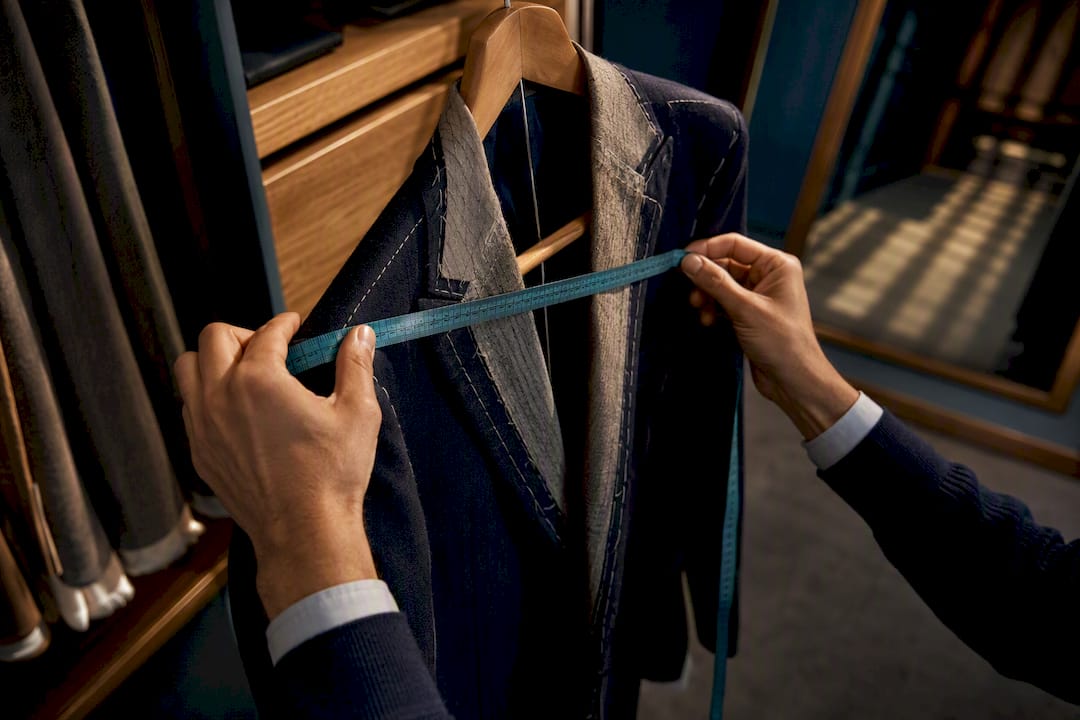
Lay the jacket flat and measure pit-to-pit (armpit to armpit across the front), the shoulder seam, sleeve outseam, and centre-back length. For trousers, measure the waistband straight across, the rise, and the inseam along the inside leg seam.
- Double the pit-to-pit figure to estimate chest circumference, since flat measurements only capture half the garment; the Bexley size guide explains these garment-flat measurement conversions in detail
- Double a flat waistband measurement the same way to estimate waist circumference
- Compare your converted figures against a brand’s size chart rather than assuming they translate directly
- Add a small tailoring allowance if the reference garment fits slightly loose, and subtract one if it fits slightly tight
Flat measuring suits online marketplace purchases and vintage pieces well, where you can’t try before buying. For bespoke work, it’s a useful sanity check rather than a substitute for taking body measurements directly, since it can’t capture posture, muscle build, or how you actually carry the garment.
Ron & Rich's tailoring perspective: when self-measuring isn’t enough
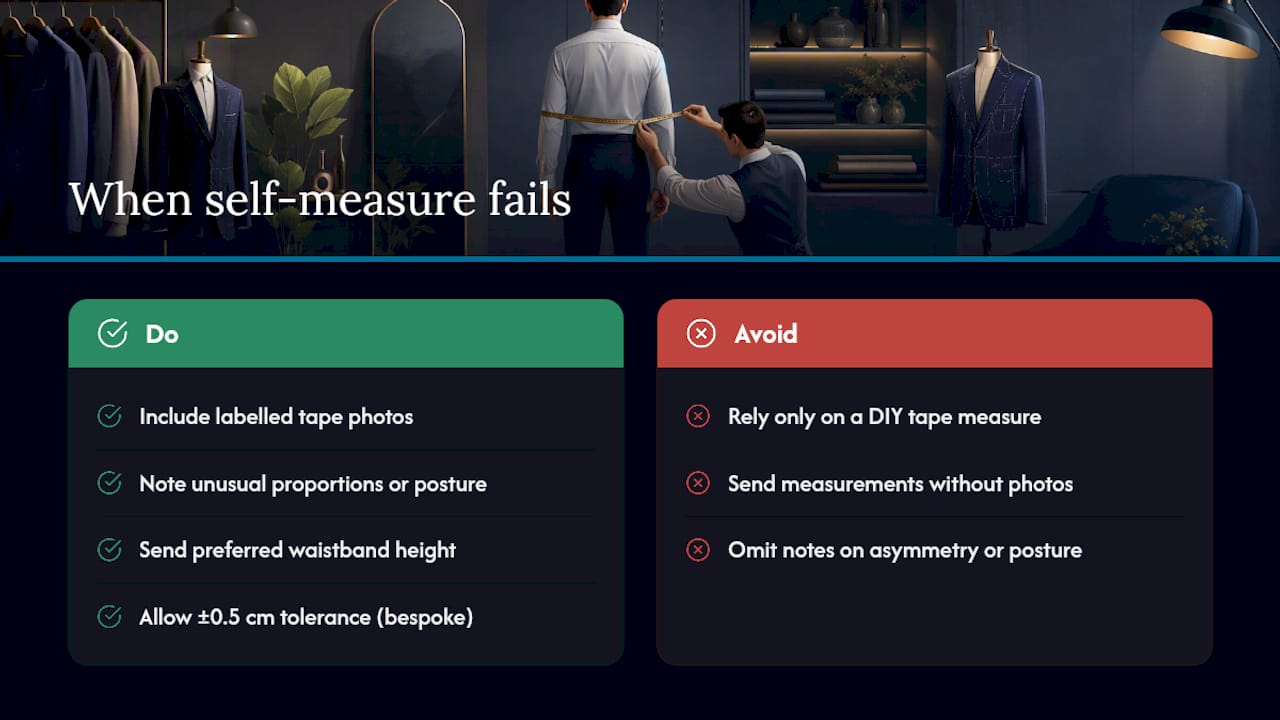
Self-measurement gets most men to a workable starting point, but I’d flag a few cases where it genuinely isn’t sufficient. Uneven shoulders, a pronounced forward head posture, or unusual proportions between torso and limb length rarely show up accurately on a tape held by an unpractised hand. These are precisely the cases where a fitting catches what a self-measured form cannot.
For bespoke work, we work to tighter tolerances than off-the-rack sizing allows, generally aiming for half a centimetre either way. When you send measurements ahead of a fitting, include labelled photos of the tape on your body and a note on anything unusual, whether that’s a preferred waistband height or a shoulder that sits noticeably lower than the other. It gives the tailor something concrete to check against, rather than a number in isolation.
— Aaron Fan
Book a fitting once you have your numbers
Self-measuring gets you close. A fitting gets you exact. Ron & Rich builds every suit around your own body rather than a size on a rack, and our tailors refine every measurement you bring in during the fitting itself, catching the shoulder tilt or posture quirk that no tape measure, however carefully handled, ever quite picks up.
If you’ve worked through your neck, chest, shoulder, sleeve, waist and inseam figures using this guide, the next step is straightforward: bring them to a consultation and let a fitting confirm or correct what you’ve measured at home. Our suits, sports jackets, tuxedos and more start from $2,170 for a bespoke suit, and every fitting is where your self-measured numbers get sharpened into a finished garment. Visit the pricing page to see the full range of services and book your first consultation.
Sources
For deeper technique detail, the step-by-step measurement guide from Bespoke Unit covers the full list of standard suit points. For garment-flat conversions, the Bexley size guide explains pit-to-pit and half-waist methods. Check your own figures against Ron & Rich’s size chart once you’re done.
- How To Take Measurements For A Suit At Home | Guide To Men’s Suits
- How to Measure Yourself for a Bespoke Suit: A Step-by-Step Guide for International Clients - The Alex Fashion House
FAQ
How do I measure my suit size?
Measure your neck, chest, shoulders, sleeve length, waist, seat, rise, and inseam using a soft cloth tape, ideally with a helper. Work jacket points first and trousers second, and take each reading twice, aiming for consistency within half a centimetre.
What does a 44 suit size mean?
A size 44 suit generally refers to a standard chest size paired with a jacket length and drop (the difference between chest and waist) suited to that build. Standard sizing is only a starting point. Booking a fitting for bespoke tailoring lets a tailor adjust every point to your actual shoulders, sleeve length, and waist rather than a fixed chest number.
What size is a 42 regular suit?
A 42 regular suit typically fits a standard chest measurement on a man of average height. “Regular” refers to jacket length rather than chest size, distinguishing it from “short” or “long” fits.
What size is a 34 suit?
A size 34 suit is one of the smaller standard chest sizes. It’s less commonly stocked off-the-rack, which is one reason made-to-measure or bespoke tailoring, where every jacket and trouser measurement is taken individually, suits men at either end of the standard size range particularly well.