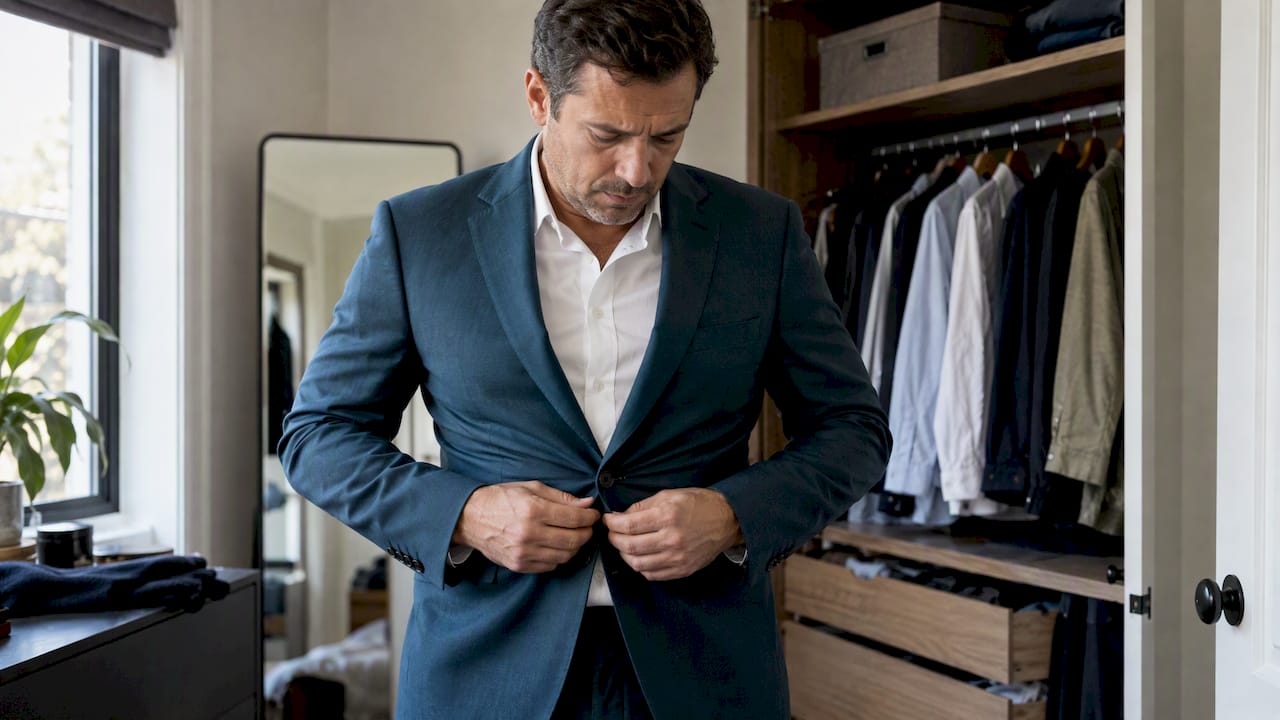
Suit Button Rules: Why the Bottom Button Can Warp the Fit
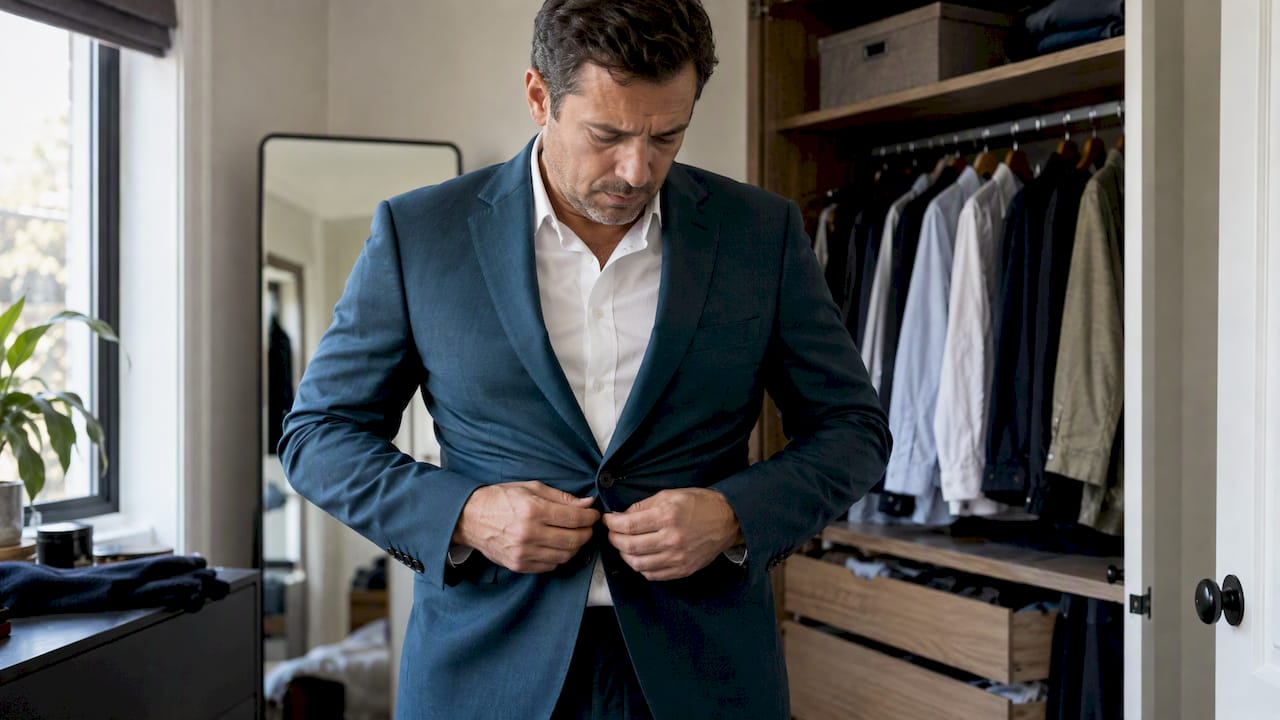
Leave the bottom button of a single-breasted jacket open, always. On a two-button jacket, fasten the top button only; on a three-button jacket, fasten the middle button and treat the top as optional. A double-breasted jacket stays fastened. Unbutton before you sit, and button again as you stand.
TL;DR:
- A jacket with overlapping fronts should close without pulling or limiting movement; if it strains when fastened, a tailor should adjust its cut.
- With a waistcoat, fasten every button except the lowest; leaving the jacket open is acceptable in relaxed settings, but an open waistcoat looks careless.
- Creases radiating from the fastened button signal a tight waist or chest; front gaping points to excess room or incorrect button placement.
- For unstructured blazers, safari jackets, and chore coats, follow the cut: fasten buttons that sit comfortably, since these styles need not follow suit conventions.
- On a structured jacket, fastening the lowest button pulls the flared skirt out of shape and can deform the buttonhole over time.
Table of Contents
- Which buttons to fasten on each type of jacket
- When to button and unbutton: standing, sitting and moving
- Three-piece suits and waistcoat rules
- How fit and tailoring affect buttoning
- Practical checks and common mistakes to avoid
- Author expertise and why you can trust this guidance
- Buttoning etiquette for sports jackets, safari jackets and other styles
- How lapel styles influence buttoning conventions
- Seasonal and fabric considerations affecting buttoning
- Where the buttoning rules come from
- A note on the importance of detail
- Tailored suits and fittings for jackets that button properly
- FAQ
- Sources
Which buttons to fasten on each type of jacket
The rule for every single-breasted jacket begins in the same place: the bottom button stays open. What changes is how many buttons sit above it, and that decides which one you fasten. Once you understand the logic, you can read any jacket at a glance.
One-button jackets are the simplest case. You fasten the single button when standing, and the jacket closes at the natural waist. A one-button jacket is often cut with a lower, more fitted waist, so the button should close without any pulling across the stomach. If you see horizontal creases radiating from it, the jacket is either too tight or the button has been set at the wrong height for your frame.
Two-button jackets are the most common cut. Fasten the top button only and leave the bottom one open. The reason is practical rather than arbitrary. Modern jackets flare gently below the waist, and closing the bottom button forces the fabric to pull and wrinkle. Do it often enough and the buttonhole itself can deform, which damages the line of the whole garment.
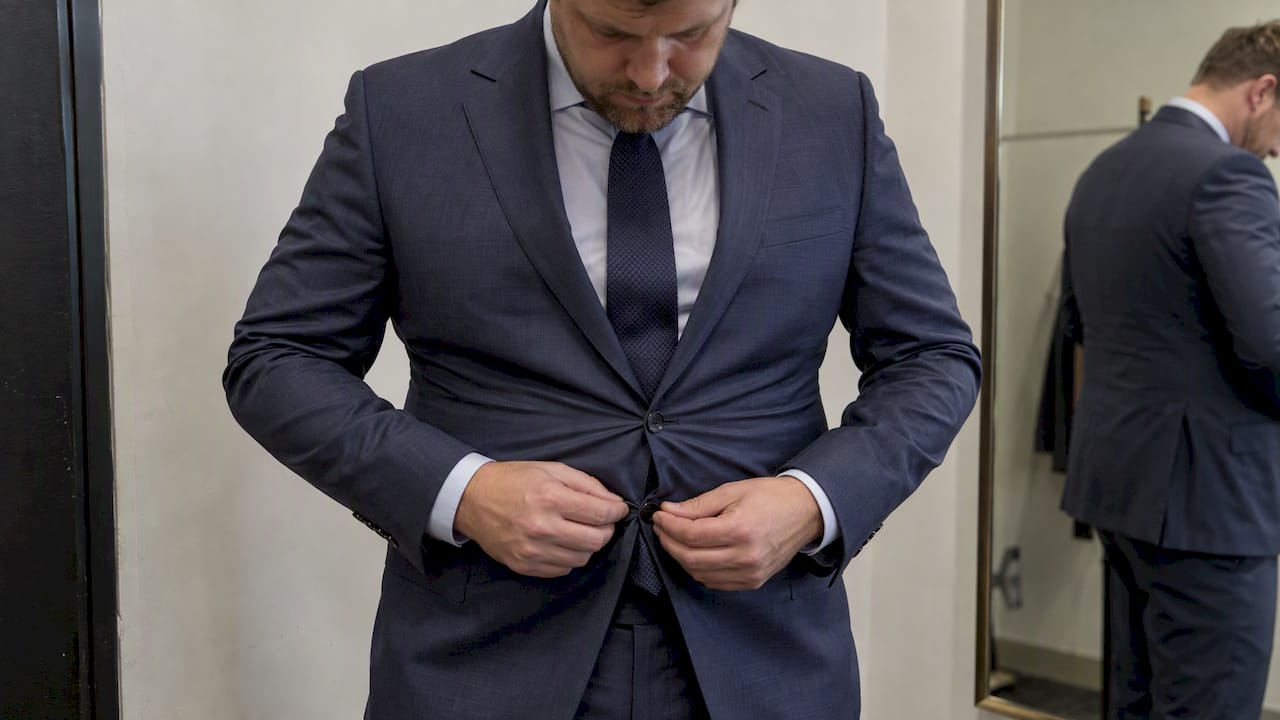
Three-button jackets follow a similar pattern, with the middle button as the anchor. A useful way to remember it is “sometimes, always, never”: the top button is sometimes fastened, the middle always, the bottom never. Fastening the top and middle together gives a more formal, buttoned-up look, though many gentlemen prefer the middle alone because it keeps the lapel rolling gracefully.
In summary, the rules by jacket type are:
- One button: fasten it when standing.
- Two buttons: fasten the top, leave the bottom open.
- Three buttons: fasten the middle, the top is optional, the bottom stays open.
- Four or five buttons (single-breasted): fasten the middle buttons, usually the two in the centre on a four-button jacket, and leave the bottom open.
- Double-breasted: keep it fastened.
Four- and five-button single-breasted jackets are less common and tend to appear in more fashion-forward or vintage-inspired cuts. The principle holds: the lowest button remains open, and you fasten the buttons that fall around the natural waist. Because the rule applies consistently across two- to five-button configurations, you rarely need to memorise anything new when a jacket has an unusual button count.
Double-breasted jackets are the true exception. Etiquette guides agree that these are generally kept buttoned, because the overlapping front is designed to be closed and the lapels sit properly only when it is. That has a consequence for cut: a double-breasted jacket must be made so that it closes without strain and still allows you to move. If you are considering one, our double-breasted suit guide explains how button stance and fit work together.
When to button and unbutton: standing, sitting and moving
Buttoning is not a one-time decision made in front of the mirror. A jacket is a living garment that responds to what your body is doing, and the etiquette follows that movement.
The sequence is short enough to learn quickly:
- Fasten the correct button as you stand up from a chair or step out of a car.
- Keep it fastened while walking, standing and speaking with others.
- Before you sit, undo the button with a single, unhurried movement.
- Leave the jacket open for as long as you are seated.
- When you rise, button it again straight away, even if you expect to sit down shortly afterwards.
The reason you unfasten before sitting is purely mechanical. Conventional etiquette advises opening the jacket so that it does not pull upwards towards the neck when you sit. A closed jacket on a seated body bunches at the waist, stretches the button and distorts the drape across your shoulders. Left that way for an entire dinner or a long meeting, it will look crumpled by the time you stand.
Re-buttoning on standing matters just as much. Many men unfasten when they sit and then forget the jacket altogether, walking around with it hanging open. It is a small lapse, but it is among the first things a trained eye notices.
Short movements are where people hesitate. For a handshake, a brief introduction or a few words at a lectern, you remain buttoned. If you are standing to give a presentation, fasten the jacket before you begin and keep it closed while you speak. Unbuttoning is reserved for sitting, or for a relaxed moment when you are clearly at ease, such as reaching into a pocket in a casual setting.
A simple mnemonic helps: stand and fasten, sit and release. If your feet are planted and you are facing someone, the jacket should be closed. If your weight is on a chair, it should be open.
Pro Tip: Undo the button as you begin to sit, not after you land. It keeps the movement smooth and stops the jacket from creasing against the seat.
Three-piece suits and waistcoat rules
A waistcoat changes how the jacket behaves, and it has rules of its own. The usual jacket guidance still applies when you are standing, but the waistcoat brings a little extra freedom and one important exception.
The central waistcoat rule is that you fasten every button except the lowest. The unfastened bottom button is a long-standing convention, and etiquette sources confirm that the bottom button of a worn waistcoat should be left undone. It also makes practical sense, since the open point allows the waistcoat to sit comfortably when you bend or sit.
Here is how the three-piece ensemble affects what you do:
- Waistcoat fastened, jacket open: acceptable in warm rooms or relaxed settings, because the waistcoat keeps the silhouette tidy.
- Jacket fastened over the waistcoat: the more formal choice for arrivals, introductions and ceremonial moments.
- Waistcoat unfastened: avoid it. An open waistcoat looks careless and undermines the point of wearing one.
- Sitting: still unfasten the jacket, but keep the waistcoat closed above the bottom button.
A three-piece suit raises the level of formality, and it also limits movement a little. Three layers of cloth through the torso leave less room, so the fit of each piece needs to be precise. If the waistcoat pulls when you sit, or the jacket does not close over it cleanly, the issue is almost always the cut rather than your posture.
How fit and tailoring affect buttoning
Buttoning rules and tailoring are inseparable. A jacket can follow every convention perfectly and still look wrong if it was not cut to fit your body. Specialists note that the fit of a suit is linked to its buttoning rules: a jacket cut too tight restricts your movement when closed, while one cut too loose appears sloppy. A good tailor balances a clean, modern silhouette with the room you need to move.
When you try a jacket, the button is a quick diagnostic. Fasten it and look for these signs:
- An X-shaped crease radiating from the button means the jacket is too tight at the waist or chest.
- Fabric gaping at the front when closed means the jacket is too loose or the button stance is wrong.
- A collar that lifts away from your neck when you fasten the button points to a problem with the shoulder or balance of the jacket.
- A skirt that flares outward at the hips suggests the waist has been over-suppressed for your shape.
If you are having a jacket made or altered, these are the points worth raising with your tailor:
- Shoulder fit, which should sit flush to the seam without dimples or overhang.
- Chest ease, enough to close the button without pulling, yet not so much that the front bubbles.
- Button stance, meaning the height at which the buttons sit relative to your natural waist.
- Sleeve length, since a jacket that fits at the body but not at the wrist will look unfinished. Our guide to suit sleeve length explains the adjustment.
Double-breasted jackets deserve particular care. Because they are designed to stay fastened, they must be cut so that closure never strains the cloth. A well-made double-breasted jacket has generous overlap and a waist that closes without any pull, so you can wear it all day without thinking about it. For a fuller picture of what correct proportions look like, see our suit fit guide.
Pro Tip: Always test a jacket by fastening it and then sitting down in the fitting room. If it feels comfortable both ways, the cut is right.
Practical checks and common mistakes to avoid
Before you walk out of the door, a quick run through a few visual checks will tell you whether the jacket is behaving as it should. None of them takes more than a few seconds.
- Shoulder seam: it should end where your shoulder ends, with no sagging or hollowing beneath it.
- Button strain: look for any pulling or creasing around the fastened button. A smooth line means a good fit.
- Skirt at the hips: the lower part of the jacket should fall cleanly without flaring outward or hugging too tightly.
- Lapel roll: the lapel should curve gently from the top button rather than lying flat or buckling.
The most frequent error is fastening the bottom button on a single-breasted jacket. It is so common that it is often assumed to be correct, yet it contradicts the convention that has held for generations. The habit is widely traced back to King Edward VII, whose own jacket buttoning is the commonly cited origin of the bottom-button-open rule.
Other mistakes worth avoiding:
- Leaving the jacket buttoned while seated.
- Forgetting to re-button after standing.
- Fastening every button on a three-button jacket.
- Applying formal rules rigidly to unstructured or casual blazers, where the convention softens a little.
- Pulling at the jacket by its buttons when taking it off, which loosens the stitching over time.
Care matters too. Repeated strain from a fastened lowest button can deform the buttonhole, and buttons that are tugged during travel or a crowded commute can work loose. Hang your jacket on a shaped hanger, and avoid stuffing the pockets so full that the front distorts.
A point worth remembering: the bottom-button rule exists for a functional reason, not only for appearance, so following it also protects the jacket.
Author expertise and why you can trust this guidance
We have been making tailored menswear since master tailor Richard Fan founded our house. That long history informs everything in this guide, and the rules we describe are those that sit behind good tailoring. For questions that go deeper, our article on working buttonholes sets out what to ask a tailor before adding them.
The rules of buttoning are etiquette-backed, but they can be adapted deliberately when a jacket has been cut to carry the change.
Buttoning etiquette for sports jackets, safari jackets and other styles
Not every jacket belongs to a matching suit, and the conventions shift a little when it does not. A sports jacket is generally treated like the jacket of a suit: fasten the top button on a two-button style, the middle on a three-button style, and leave the bottom open. Because sports jackets are often worn in more relaxed settings, you will see them worn open more frequently, and that is perfectly acceptable when you are seated or at ease.
Safari jackets and chore coats follow different logic. These are closer to workwear in origin, with patch pockets and a straighter body, and they are designed to be worn either buttoned or open depending on the weather and occasion. When buttoned, they are usually fastened from top to bottom, since they are not cut with the flared waist that gives the bottom-button rule its purpose. Worn open, they function as a light layer over a shirt or knit.
The common thread is purpose. If a jacket has a structured, suppressed waist, the classic rules apply. If it is unstructured or utilitarian, use the cut as your guide: close the buttons that sit comfortably and leave open anything that creates strain. We make both sports jackets and safari jackets, and each is cut with its own intended buttoning in mind.
How lapel styles influence buttoning conventions
Lapels shape the way a jacket closes, and they quietly influence which button feels most natural to fasten. The lapel should roll, not fold, and that roll typically begins near the top fastened button.
A notch lapel is the standard on single-breasted jackets and works with every buttoning rule described above. The roll falls towards the top or middle button, depending on whether the jacket has two or three buttons, and it gives the front a clean, versatile line. The usual conventions apply without adjustment.
A peak lapel points upward and outward, and it is traditionally associated with double-breasted jackets and more formal single-breasted styles such as dinner suits. Because the peak draws the eye upward and widens the chest, these jackets look best when fastened properly. A peak-lapel double-breasted jacket should stay closed, and the strong line of the lapel is part of the reason.
A shawl lapel, with its continuous rounded collar, is mainly found on tuxedos. Here the button is usually a single fastening at the waist, and the unbroken curve is meant to be seen. Fasten it when standing and open it when sitting, as with any other jacket.
The lesson is that the lapel and the button stance are designed together. If the lapel buckles or lies flat when you fasten the jacket, it is a signal that the button is in the wrong place or the cloth is under tension.
Seasonal and fabric considerations affecting buttoning
The fabric you wear and the temperature around you change how a jacket behaves, though they do not rewrite the rules. What shifts is how long you keep a jacket closed and how it responds to repeated fastening.
In warm weather, lightweight cloths such as linen, tropical wool and cotton blends breathe well but crease more readily. A fastened linen jacket will show every fold at the waist, so many wearers unbutton more freely in the heat, particularly once seated or at ease. The convention for standing remains the same, but you will find a looser attitude is understood in summer.
In cooler months, heavier cloths such as flannel and tweed hold their structure and tend to keep a clean line when fastened. They also tolerate being buttoned for long periods, which is welcome when you are outdoors. Because these fabrics have more body, they show strain less obviously, so check the fit carefully before relying on the button alone.
Fabric also affects how well a button and buttonhole age. Soft, loosely woven cloth can stretch around the buttonhole if the lowest button is repeatedly fastened, which is another reason to leave it open. A well-made jacket with firm stitching around the buttonholes will last far longer, whatever the season.
Where the buttoning rules come from
Most of what we now treat as fixed etiquette began as habit and fashion. The best-known story is that King Edward VII, who was a considerable man of appetite, left the bottom button of his waistcoat undone for comfort, and that his courtiers followed suit. Guides to jacket etiquette commonly trace the open bottom button to him, and it is cited as a historical origin of the rule, though the precise details are a matter of tradition rather than documented fact.
What began with the waistcoat gradually passed to the jacket. As cuts evolved, with more suppression at the waist and a flare below it, the rule gained a practical justification on top of its fashionable one. Fastening the lowest button pulls the skirt of the jacket out of shape, so the habit of leaving it open reinforced itself.
Modern tailoring has also introduced room for deliberate variation. A relaxed double-breasted silhouette or an unstructured jacket can bend the rules, provided the garment is cut so that it sits and moves correctly. The convention is a starting point, and understanding why it exists lets you break it with purpose rather than by accident.
A note on the importance of detail
I have always believed that small details carry more weight than they seem to. A button fastened or left open is a tiny decision, yet it tells people whether you understand the garment you are wearing. When buttoning becomes second nature, you stop thinking about your jacket and start carrying yourself with ease. That ease is what confidence looks like.
Treat buttoning as part of caring for the suit and as a point of conversation with your tailor. If a jacket will not close cleanly, say so at the fitting, and let the cut be corrected.
Ron
Tailored suits and fittings for jackets that button properly
Most buttoning problems are really fit problems. We cut and fit bespoke suits to your measurements and preferences. Take a look at our suits, or book a fitting and bring your jacket along so we can show you the difference.
FAQ
Do you button your suit when you sit?
No. Unfasten your jacket before you sit, which stops the fabric from pulling up towards your neck and keeps the drape intact. Button it again as soon as you stand.
How do you wear a three-button suit?
Fasten the middle button and leave the bottom one open. The top button is optional, and many people prefer to leave it undone so the lapel rolls naturally.
Are two-button or three-button suits in style?
Both remain in use, and the choice is largely a matter of taste and proportion. Two-button jackets are the more common modern cut, while three-button jackets suit those who like a higher, more traditional stance.
Why do you leave the bottom button open?
It is partly tradition and partly practical. Closing it makes the flared skirt of a modern jacket pull and wrinkle, and it can deform the buttonhole over time.
Should a double-breasted jacket stay buttoned?
Yes, as a rule. A double-breasted jacket is designed to be worn closed, which is why it must be cut to fasten without strain.
Sources
- Realmenrealstyle
- Welche Knöpfe am Sakko schließen | Wirtschaftsforum
- Sakko - der unterste Knopf bleibt offen! | Knigge