How Should a Suit Fit? Your Complete Fit Guide
A well-fitted suit sits close to your body without pulling, restricts nothing when you move, and follows the line of your natural stance rather than fighting it. That is the entire definition. Everything else in this suit fit guide is detail work in service of that one idea.
Before you read another word about fabric or lapels, run this 30 to 60 second check the next time you try one on:
- Shoulders: the seam sits right at your shoulder bone, no overhang, no divot.
- Chest and buttoning: the front closes without pulling; no X-shaped strain around the button.
- Sleeve length: a small amount of shirt cuff typically shows past the jacket sleeve.
- Jacket hem: lands around the middle of your hand or your first thumb knuckle.
- Trouser waist and break: waistband sits comfortably at rest, with one soft break at the shoe.
Button the jacket. Walk a few steps. Raise your arms halfway. If the shoulders fail this test, stop there. Nothing else about the suit matters until that’s solved.
Pro Tip: Do this test in the shoes and shirt you’ll actually wear with the suit. A dress shoe changes your trouser break, and a slim shirt changes how the jacket collar sits.
Key Takeaways
Proper suit fit is verified at the shoulder seam and confirmed by movement, not by a static mirror check.
| Point | Details |
|---|---|
| Shoulder seam is decisive | It must align with your shoulder bone; divots or overhang signal the wrong size, not a fixable flaw. |
| Test in natural stance | Button, walk, sit, and raise your arms before judging fit, since static posture hides real problems. |
| Know the alteration limits | Hemming, waist, and sleeve length are easy fixes; shoulder rebuilds are costly and often impractical. |
| Layer before you judge fit | Try on with the actual shirt, undershirt, or seasonal layer you’ll wear underneath. |
| Bespoke fixes structural issues | Ron & Rich builds patterns from your own measurements and uses basted fittings to correct shoulder and torso fit before final construction. |
Table of Contents
- Suit Fit Guide: Jacket Fit Checkpoints From Shoulder To Hem
- Trouser Fit Checklist: Rise, Seat, Thighs, And Break
- How Do You Properly Try On A Suit To Test Fit?
- Fit Problems That Signal Walk Away, Not Tailor It
- What Can A Tailor Actually Fix After You Buy?
- How Do You Choose Between Off-The-Rack, MTM, And Bespoke?
- Slim Fit, Modern Fit, Or Classic Fit: What’s The Difference?
- How Does Fabric Choice Affect The Way A Suit Fits?
- Single-Breasted Vs Double-Breasted: Fit Considerations
- Fit Adjustments For Shirts And Underlayers
- How Should Fit Change With The Seasons?
- Off-The-Rack Or Made-To-Measure: Which Fits You Better?
- A Tailor’s Honest Note On What Actually Matters
- Bespoke Solves What Alterations Can’t
- Sources
Suit Fit Guide: Jacket Fit Checkpoints From Shoulder To Hem
The jacket carries most of a suit’s visual weight, and most of its unfixable problems. Start at the top, because everything below the shoulder line is negotiable at a tailor’s bench, and everything at the shoulder often isn’t.
1. Shoulders. The seam should sit exactly on top of your shoulder bone, where your arm meets your torso. If it extends past that point, you’ll see the fabric collapse downward in a soft fold, sometimes called a divot. If it sits inside that point, the seam rides up and pulls the sleeve head with it. Shoulder placement is the single measurement that determines whether a jacket is your size at all. Everything else adjusts around it.
2. Collar and back. The jacket collar should sit flush against your shirt collar with no visible gap. A gap that opens when you stand naturally, not when you slouch, usually means the balance of the jacket is off between front and back, which is a harder fix than it sounds.
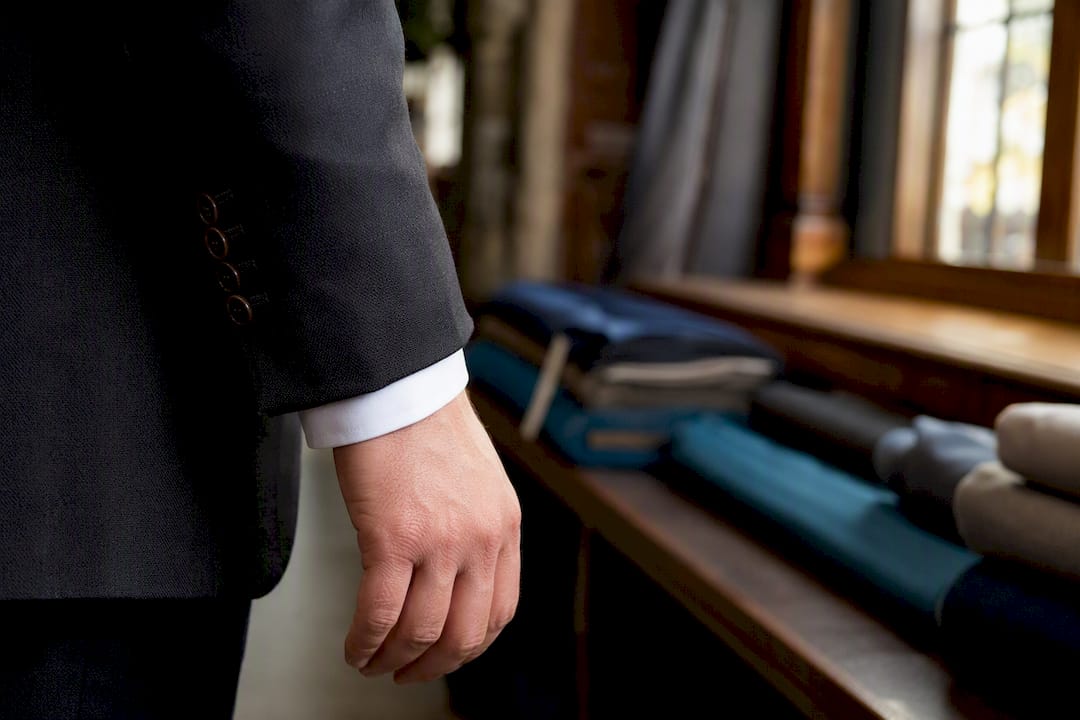
3. Sleeves and pitch. About a half inch of shirt cuff should show beyond the jacket sleeve when your arms hang naturally. That’s a guideline, not gospel. Watch also for sleeve pitch: does the sleeve hang straight down, or does it twist toward your body or away from it when your arm relaxes? Twisting indicates the sleeve was set into the armhole at the wrong angle.
4. Chest and buttoning. Close the jacket and look for wrinkles that radiate outward from the button in an X pattern. That strain means the jacket is too tight through the chest or torso. A clean, flat lapel roll with no pulling is what you want.
5. Waist. A jacket should taper in slightly at the waist without creasing horizontally across the back. Some soft draping at the sides is normal; hard puckering is not.
6. Length. The hem should land near the middle of your hand, or your first thumb knuckle, and cover your seat when you turn sideways. A jacket cut too short or too long throws off your entire proportion, even if every other checkpoint passes.
Roughly a third of jacket fit issues buyers notice trace back to the shoulders alone, which is exactly why that checkpoint comes first and why tailors treat it differently from the rest.
Trouser Fit Checklist: Rise, Seat, Thighs, And Break
Trousers get less attention than jackets, but a poor trouser fit is just as visible, especially when you’re seated across a table or walking into a room.
- Waist and rise: the waistband should rest comfortably, without digging in when seated or gapping when standing. It shouldn’t need a belt cinched tight to stay up.
- Seat: a good seat drapes smoothly against the body without pulling tight across the buttocks or hanging loose like an empty sack.
- Thighs: you should be able to sit and walk without the fabric straining or bunching. Too much extra fabric here reads as sloppy, not comfortable.
- Pockets: front and back pockets should lie flat. Pockets that flare open are usually a sign the trousers are cut too narrow through the hip or seat.
- Length and break: the hem should just touch the top of your shoe, creating one soft, subtle break rather than heavy pooling at the ankle.
The waistband test is the one most men skip. Try trousers on and sit down before deciding anything about the waist. A waistband that feels fine standing but bites when you sit isn’t sized correctly, no matter how good it looks in the mirror.
Pro Tip: Horizontal wrinkles fanning out under the buttocks almost always mean the seat is too tight, not that you need to size up everywhere. A skilled tailor can usually let out the seat without touching the rest of the trouser.
How Do You Properly Try On A Suit To Test Fit?
Testing a suit in your natural stance is the difference between an honest fit check and a flattering illusion. Natural stance means standing the way you actually stand: relaxed shoulders, weight even, arms at your sides, not braced or pulled back for the mirror. Exaggerated posture hides exactly the problems you’re trying to catch.
Run through this sequence every time:
- Button the jacket and check the front for pulling or strain.
- Raise both arms to shoulder height and watch what happens at the shoulder seam and sleeve.
- Sit down in a chair for a full minute, then stand back up.
- Walk several steps, checking that the collar stays put and the sleeve doesn’t twist.
- Check the trouser waist and break both seated and standing.
While you’re doing this, jot down or photograph the checkpoints that matter later: where the shoulder seam lands, how much cuff shows, where the jacket hem sits against your hand, and how the trouser break looks in your actual dress shoes.
Skipping this movement test is one of the most common sizing errors buyers make, whether trying on in a store or ordering online. A suit that looks perfect standing still can fail the moment you sit or reach for something. If the shoulders and chest pass every one of these movement checks and only the hem, waist, or sleeve length need adjusting, off-the-rack plus a tailor will likely serve you well. If the shoulders fight you at any point in that sequence, that’s a structural issue no amount of alteration reliably solves.
Fit Problems That Signal Walk Away, Not Tailor It
Some fit issues are minor annoyances. Others are warnings. Knowing the difference saves you money and a closet full of suits you never wear.
- Button strain and X-shaped wrinkles: usually fixable if mild, since a tailor can let out the side seams. If the strain is severe, the jacket is simply too small.
- Shoulder divots or rumpling at the top of the sleeve: almost always structural. This is the shoulder placement problem again, and it’s expensive to correct.
- Twisted sleeves: caused by incorrect sleeve pitch at construction. Minor twist can sometimes be adjusted; significant twist usually can’t without resetting the entire sleeve.
- Horizontal wrinkles or U-shaped sagging in the trouser seat: signals the seat is either too tight or too loose for your shape.
A suit that fails at the shoulder or collar in a natural stance is telling you something a tailor’s needle can’t undo. Every other checkpoint is a conversation. That one is a verdict.
What Can A Tailor Actually Fix After You Buy?
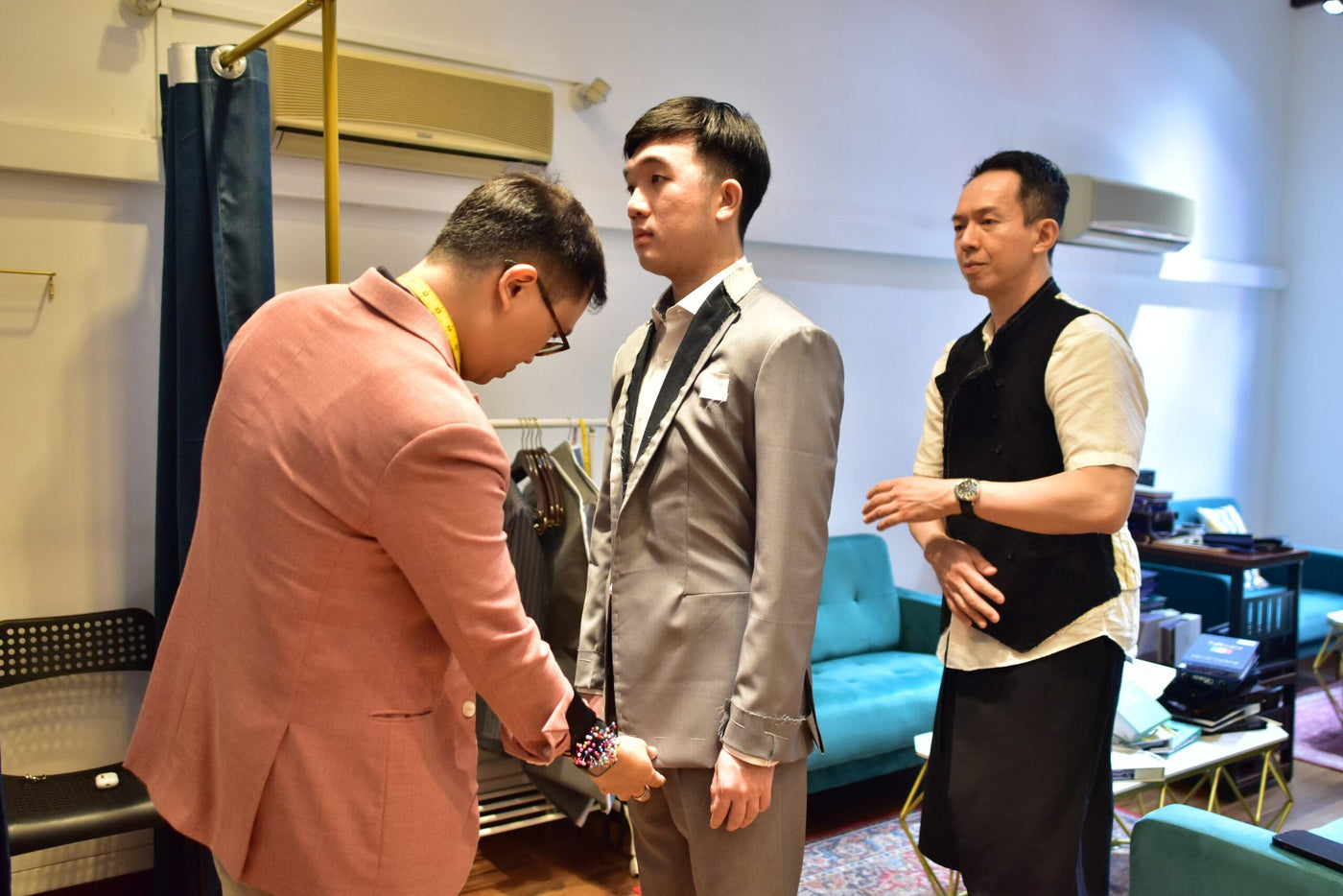
Ron & Rich has spent decades handling alterations for men who bought a suit that was close, but not quite right, and understanding that boundary saves real money.
Straightforward, reliable fixes include:
- Shortening or lengthening sleeves
- Taking in or letting out the waist
- Hemming trouser length
- Adjusting the seat and thigh within a moderate range
Shoulder rebuilds require removing the sleeve entirely and altering the jacket’s internal padding and canvas, which is time-consuming and rarely worth the cost compared to buying the right shoulder fit from the start. A basted fitting, where the garment is assembled with temporary stitching before final construction, is the ideal stage to catch and correct structural issues, because nothing is permanently sewn yet.
Turnaround for standard alterations typically runs from several days to a couple of weeks, depending on complexity, and costs scale with the scope of work. When you brief a tailor, bring your best-fitting jacket for reference, note any specific pinch points, and if possible, photos of yourself in the suit from front, side, and back.
Pro Tip: Point at the exact spot on your body where something feels wrong, not just the garment. “It pulls here when I reach forward” tells a tailor far more than “the sleeve feels weird.”
How Do You Choose Between Off-The-Rack, MTM, And Bespoke?
Your body proportions and budget decide this faster than most style debates do.
- Standard proportions, standard budget: off-the-rack plus a competent local tailor covers hemming, waist, and sleeve adjustments well.
- Noticeably asymmetric shoulders, unusual torso-to-leg ratio, or hard-to-fit build: made-to-measure or bespoke solves problems off-the-rack sizing structurally can’t.
- Frequent formal wear, executive roles, weddings: bespoke pays for itself in fit precision and the number of fittings involved.
Before buying anything, ask the seller directly: what’s the alteration policy, how many fittings are included, and what fabric weights are available for the climate you’ll actually wear the suit in? Show up to any fitting appointment in the shoes and shirt you intend to pair with the suit, stand naturally, and bring photos or notes from a previous well-fitting garment if you have one.
Walk away if the shoulders fail the buttoning and movement test and the seller can’t offer a different size or cut. No alteration budget fixes that.
Slim Fit, Modern Fit, Or Classic Fit: What’s The Difference?
These three labels describe how much room a suit carries through the chest, waist, and leg, not a quality tier.
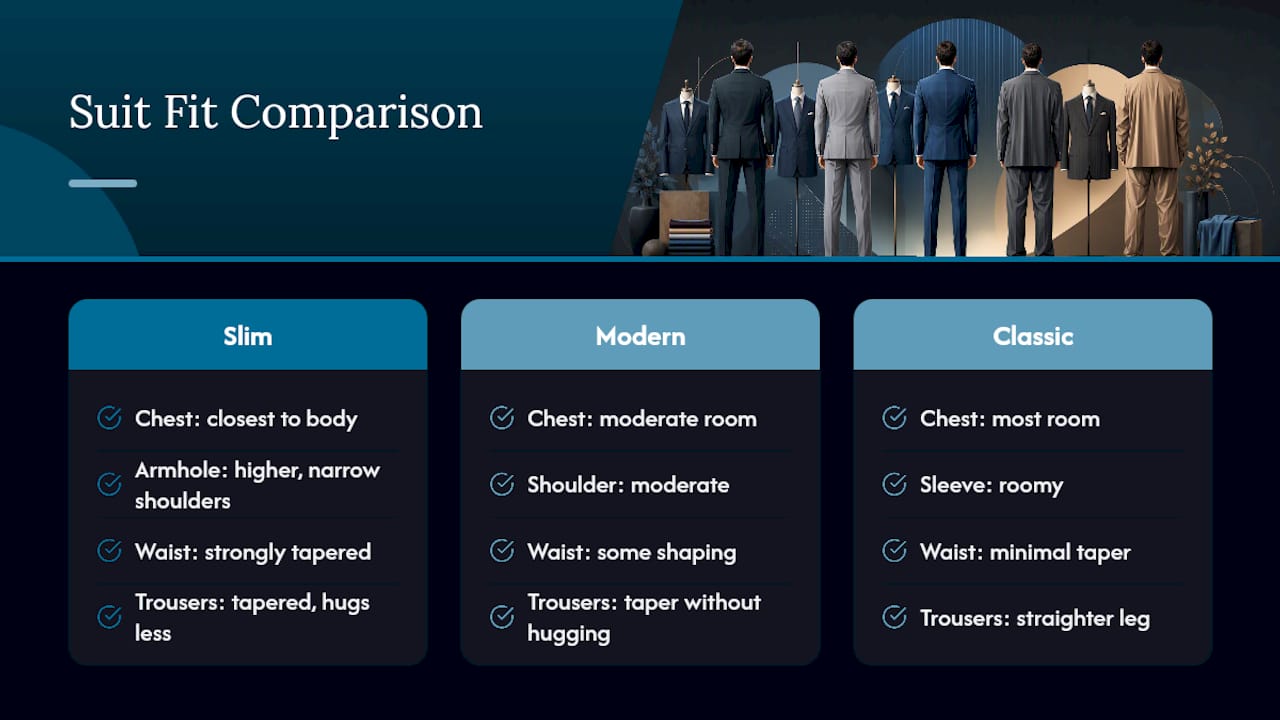
Slim fit cuts closest to the body, with a higher armhole, narrower shoulders, and tapered trousers. It suits leaner builds and reads as contemporary, but it leaves almost no room for movement error. A slim fit jacket that’s even slightly tight will strain at the button within weeks of regular wear.
Modern fit sits between the two extremes: some shaping at the waist, a moderate shoulder, trousers that taper without hugging. This is the safest starting point for most buyers because it flatters a wider range of body types without the extremes of the other two.
Classic fit carries the most room through the chest, waist, and sleeve, with a straighter trouser leg. It favors comfort and durability of fit over time, particularly useful if your weight fluctuates seasonally.
None of these labels overrides the fundamental checkpoints. A “slim fit” jacket still needs correct shoulder placement, and a “classic fit” jacket still shouldn’t gap at the collar. The fit style changes the silhouette; it doesn’t change what counts as correct fit.
How Does Fabric Choice Affect The Way A Suit Fits?
Fabric weight and weave affect how a suit drapes, moves, and holds its shape through a workday, sometimes more than the cut itself.
Heavier wools, in the 12 to 14 ounce range, hold structure well and hide minor construction imperfections, which is part of why classic tailoring has favored them for generations. Lighter wools and wool blends, closer to 8 to 10 ounces, drape more fluidly and suit warmer climates, but they also reveal fit flaws more readily since there’s less body in the cloth to smooth over an uneven seam.
Stretch content, usually a small percentage of elastane blended into wool, changes how forgiving a suit feels through the shoulders and seat without changing the measurements on paper. A suit with a touch of stretch can fit a size that would otherwise feel restrictive in pure wool.
Fabric also interacts with tailoring limits. A tightly woven, structured cloth holds an alteration crisply. A loosely woven or heavily textured fabric can shift and pucker after significant alterations, which is worth asking about before a tailor takes in a substantial amount of fabric.
Single-Breasted Vs Double-Breasted: Fit Considerations
The fit checkpoints stay the same across both styles. How forgiving each style is toward fit imperfections does not.
A single-breasted jacket closes with one column of buttons and a narrower overlap, which means less fabric stands between a good fit and a visible strain line. The buttoning test described earlier applies most directly here, since there’s nowhere for excess tightness to hide.
A double-breasted jacket overlaps significantly more fabric across the front, which can mask minor torso fit issues but demands more precision at the shoulder and chest to avoid looking bulky. Because the front closes with a wider wrap, a double-breasted jacket that’s even slightly too large will look noticeably heavier through the midsection than the same oversizing would on a single-breasted cut.
Shoulder and collar checkpoints matter equally on both. Where they diverge is forgiveness through the torso, and double-breasted suits offer less room for error there than most buyers expect.
Fit Adjustments For Shirts And Underlayers
Every layer under your jacket changes how the jacket itself needs to fit, which is why trying on a suit over the wrong shirt gives you false information.
A slim dress shirt sits close to the body and adds minimal bulk, meaning the jacket you try on over it should fit almost exactly as it will in real wear. A fuller cut shirt, or an undershirt layered beneath it, adds measurable bulk across the chest and shoulders, tightening a jacket that fit fine over a slimmer layer.
Collar height matters too. A shirt collar that sits higher on the neck needs a jacket collar cut to accommodate it without gapping. Swapping shirt brands or collar styles after a fitting can quietly undo a fit that was correct at the time.
If you’re deciding between suit and shirt at the same time, get the shirt fit locked first, then fit the jacket over it. Reversing that order means re-checking the jacket every time you change shirts.
How Should Fit Change With The Seasons?
The same suit that feels right in an air-conditioned office can feel wrong entirely once temperature and layering shift.
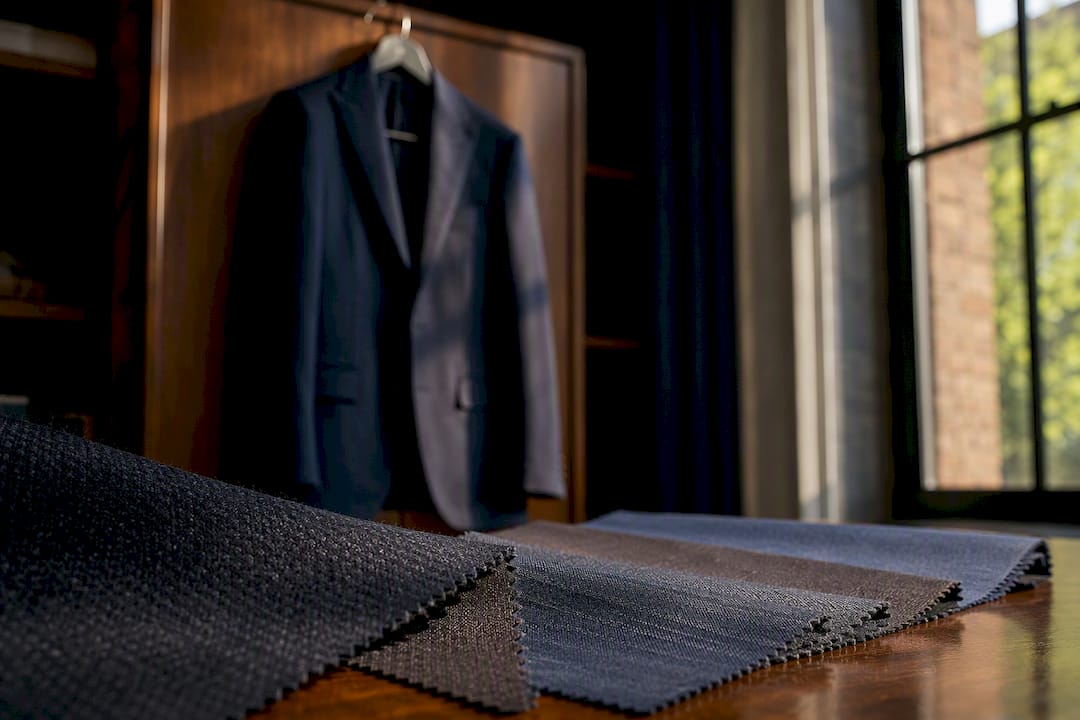
Warmer months call for lighter fabric weights and, often, a slightly more room through the torso to allow airflow, since heat and humidity make even a well-fitted jacket feel more restrictive against the skin. Cooler months introduce heavier layers, like a sweater vest or an extra undershirt, which means a suit fitted in summer can feel noticeably tighter across the shoulders and chest once winter layering enters the picture.
The practical answer isn’t to own a suit for every season, unless your wardrobe and budget support it. It’s to be honest about what you’ll wear underneath most often when you have the suit fitted, and to mention that to whoever fits you. A tailor who knows you’ll be layering a vest underneath in cooler months can build in the right amount of ease from the start rather than leaving you to discover the shortfall the first cold morning you put it on.
Off-The-Rack Or Made-To-Measure: Which Fits You Better?
Off-the-rack suits are built to standardized body proportions and sized in increments, meaning they’ll fit closest to the “average” build within each size and require some degree of alteration for almost everyone else. The value proposition is speed and lower upfront cost, provided the shoulders and chest are already close.
Made-to-measure and bespoke start from your actual measurements and, in bespoke’s case, a pattern built specifically around your body’s proportions rather than adjusted from a standard block. This matters most for men with shoulder asymmetry, a longer or shorter torso relative to standard sizing, or a build that off-the-rack increments simply don’t cover well.
The practical test: if you’ve tried on several off-the-rack suits in your general size and the shoulders consistently pass the buttoning and movement checks, off-the-rack plus a tailor is a sound, economical path. If you find yourself compromising on the shoulder fit across multiple brands and sizes, that pattern is worth listening to. It usually means your proportions sit outside what standard sizing anticipates, and made-to-measure or bespoke will save you money over time compared to repeated alteration attempts that never quite close the gap.
A Tailor’s Honest Note On What Actually Matters
Two things separate a suit that fits from one that doesn’t: the shoulder seam, and how it holds up in your natural stance, not a mirror pose. I’ve seen clients bring in jackets that looked flawless standing still and failed the moment they sat down or reached for a handshake. Run the checklist above before you buy anything.
Aaron Fan
Bespoke Solves What Alterations Can’t
Off-the-rack plus a good tailor handles most fit problems this guide covers. What it can’t fix is a shoulder built for a different body than yours, or a torso proportion that no amount of taking in will correct. That’s the gap bespoke tailoring closes.
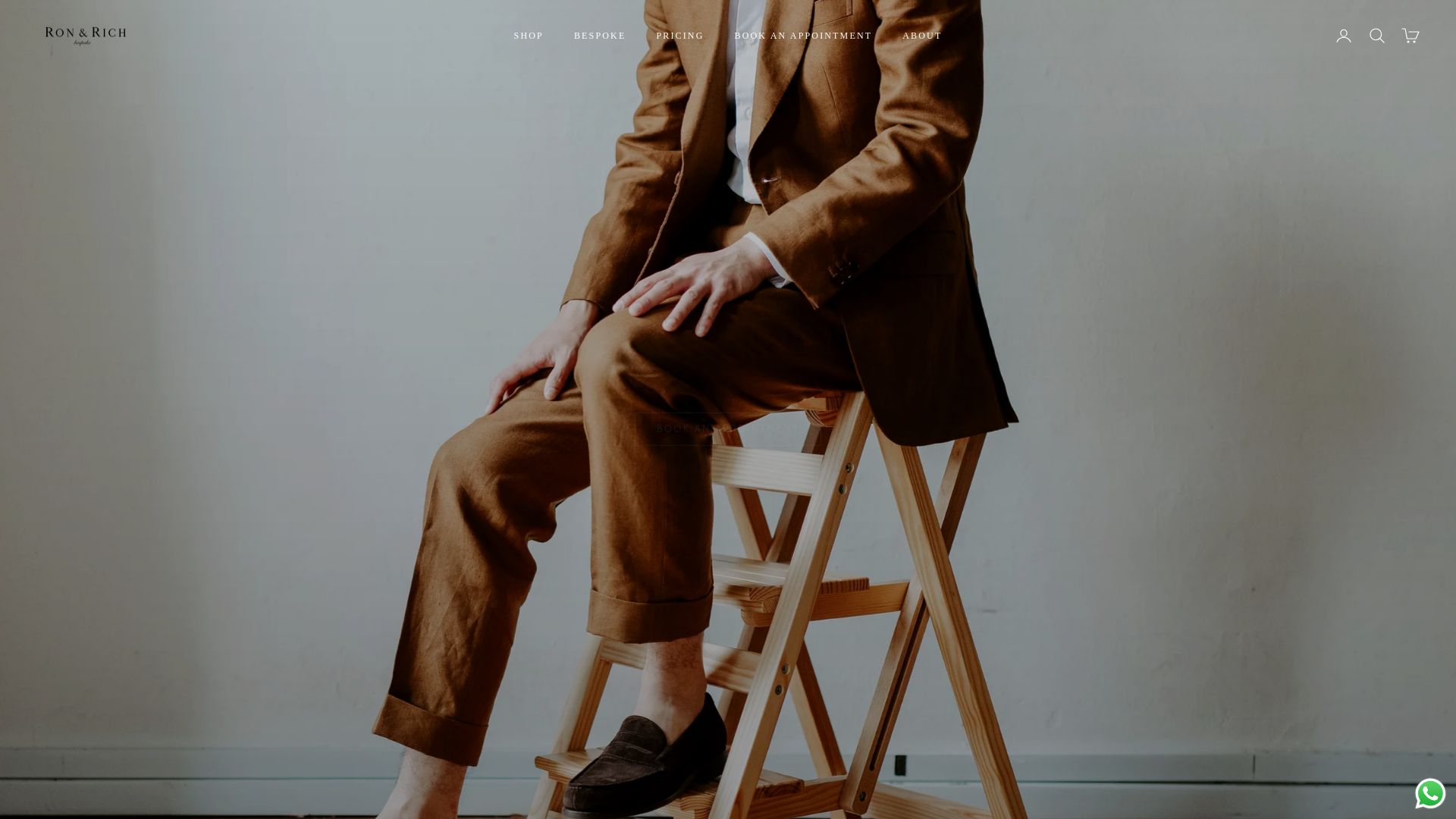
At Ron & Rich, every bespoke suit starts from your own measurements and a pattern cut specifically for your build, not adjusted from a standard block. A basted fitting lets you and your tailor see the garment assembled with temporary stitching, catching shoulder placement, chest balance, and sleeve pitch before anything is permanently sewn. That’s the exact stage where the structural issues this guide flags as “hard to fix” get solved correctly the first time, across multiple fittings rather than one rushed try-on.
If you’ve struggled to find a jacket that clears the shoulder and buttoning test off-the-rack, browse our suits and jackets or explore the bespoke process to book a fitting and start from measurements built around you.
Sources
- How Should a Suit Fit? Your Easy-to-Follow Visual Guide | The Art of Manliness
- How Should a Suit Fit? An Illustrated Style Guide | WikiHow
- Online clothing sizing errors: stop returns, buy right – JV London