
Double Breasted Suit: Fit, Style, and Buying Guide
A double-breasted suit features overlapping front panels secured by two parallel columns of buttons, with an internal anchor button (called the jigger) that holds the inner panel flat and preserves the jacket’s V-shape. The verdict: it is the right choice for formal occasions, boardroom authority, and any moment when a structured, deliberate silhouette matters. It is less versatile than a single-breasted suit and demands precise tailoring to look its best.
- Who it flatters most: Taller and leaner frames, though bespoke adjustments can make it work for fuller builds.
- Core styling rule: Wear it buttoned while standing; the front panels are cut to drape correctly only when fastened.
- Primary occasions: Weddings, galas, boardroom presentations, and formal evening events.
Table of Contents
- What makes a suit double-breasted?
- How does a double-breasted suit compare to single-breasted?
- How should a double-breasted jacket fit?
- Which body types does a double-breasted suit flatter?
- When should you wear a double-breasted suit?
- How do you style a double-breasted suit?
- What fabrics work best for a double-breasted suit?
- What are your options for buying a double-breasted suit?
- Why bespoke matters for a double-breasted suit
- How do you care for a double-breasted suit?
- Key Takeaways
- Why I recommend double-breasted jackets to certain clients
- Ronandrich bespoke double-breasted suits: what to expect
- Useful sources and further reading
What makes a suit double-breasted?
The defining construction is the overlap: the right front panel crosses significantly over the left, creating a wide chest panel secured by two vertical rows of buttons. One row is functional; the other is decorative. Inside, the jigger button anchors the inner panel to the outer, distributing tension evenly across the chest and keeping the overlap symmetrical when you move.
Button configurations and what they do to your silhouette
The most common configurations are named by total buttons × functional buttons:
- 6×2: A common traditional choice with wide overlap and imposing chest, classic formality. Can shorten the perceived torso on shorter men.
- 6×1: A configuration with a softer look and a lower closing point.
- 4×2: A modern option with a cleaner chest panel, suits a range of heights.
- 4×1 (“The Kent”): Four buttons, one functional. Higher visual line, better for shorter torsos because it pushes the eye upward and creates the impression of greater height.
- 2×1: A configuration often seen on soft-shoulder sport coats, offering a casual and contemporary look.
Lapels, vents, and cut variations
Double-breasted jackets almost always feature peak lapels, which complement the wide chest panel and reinforce the jacket’s authority. Shawl lapels appear occasionally on evening versions. Double vents are standard on modern cuts, allowing freedom of movement while preserving the back line. The classic 1980s silhouette was boxy with padded shoulders and a low gorge; contemporary versions are slimmer through the body, with a higher gorge placement and reduced shoulder padding. Three broad style categories exist: classic/traditional (structured, wide lapels, 6×2), modern-slim (suppressed waist, higher gorge, 4×2 or 4×1), and casual-luxe (soft shoulder, unstructured or lightly canvassed, often in textured cloth).
How does a double-breasted suit compare to single-breasted?
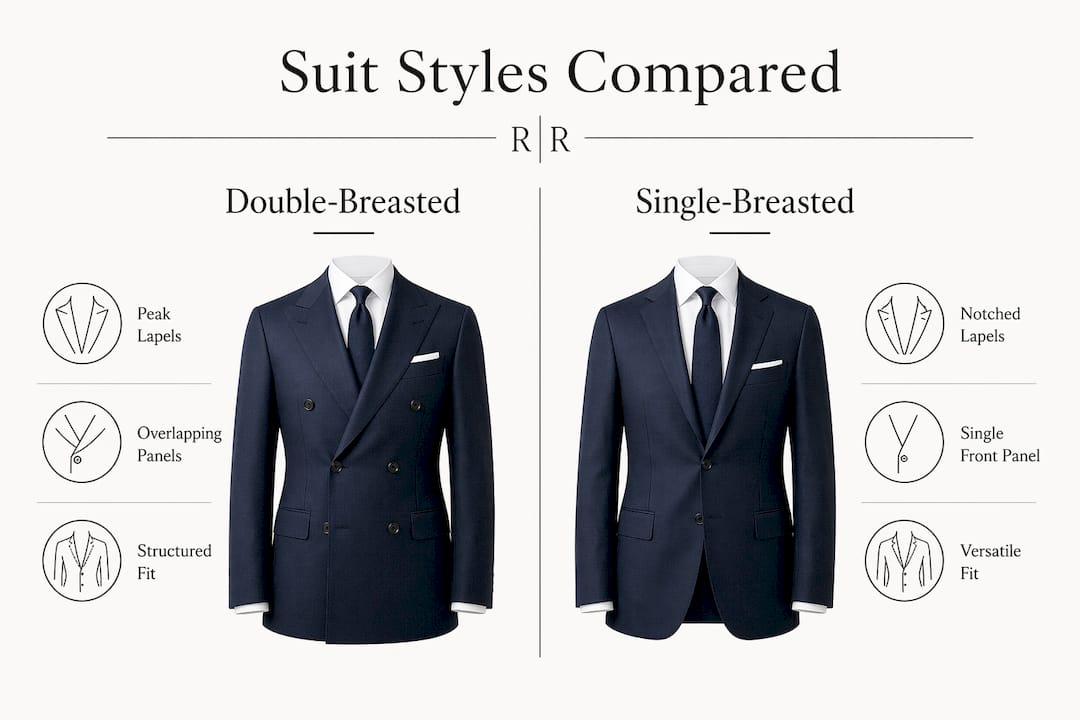
Double-breasted suits provide a more structured, formal aesthetic compared to the versatile, streamlined profile of single-breasted options. The DB broadens the chest and shoulders into an inverted triangle silhouette; a single-breasted jacket creates a vertical line that reads as leaner and more adaptable.
Key contrasts:
- Silhouette: DB widens the upper body; single-breasted elongates.
- Lapels: DB almost always peaks; single-breasted offers notch, peak, or shawl.
- Versatility: Single-breasted jackets separate easily as blazers; DB jackets are harder to wear casually without looking overdressed.
- Wearing open: Single-breasted jackets look fine open. A DB jacket worn open causes the panels to hang improperly and loses its intended shape.
- Accessories: DB suits pair naturally with a tie or pocket square; going tieless works only with modern, softer cuts.
Three use-case examples:
- Courtroom or boardroom: A navy 6×2 DB in worsted wool signals authority and formality that a single-breasted suit rarely matches.
- Wedding (groom or guest): A DB in a lighter color or textured cloth reads as intentional and elegant without being ostentatious.
- Day-to-day office or casual events: A single-breasted suit wins here. The DB’s structure can feel heavy for relaxed environments, and the inability to wear it open limits comfort.
How should a double-breasted jacket fit?
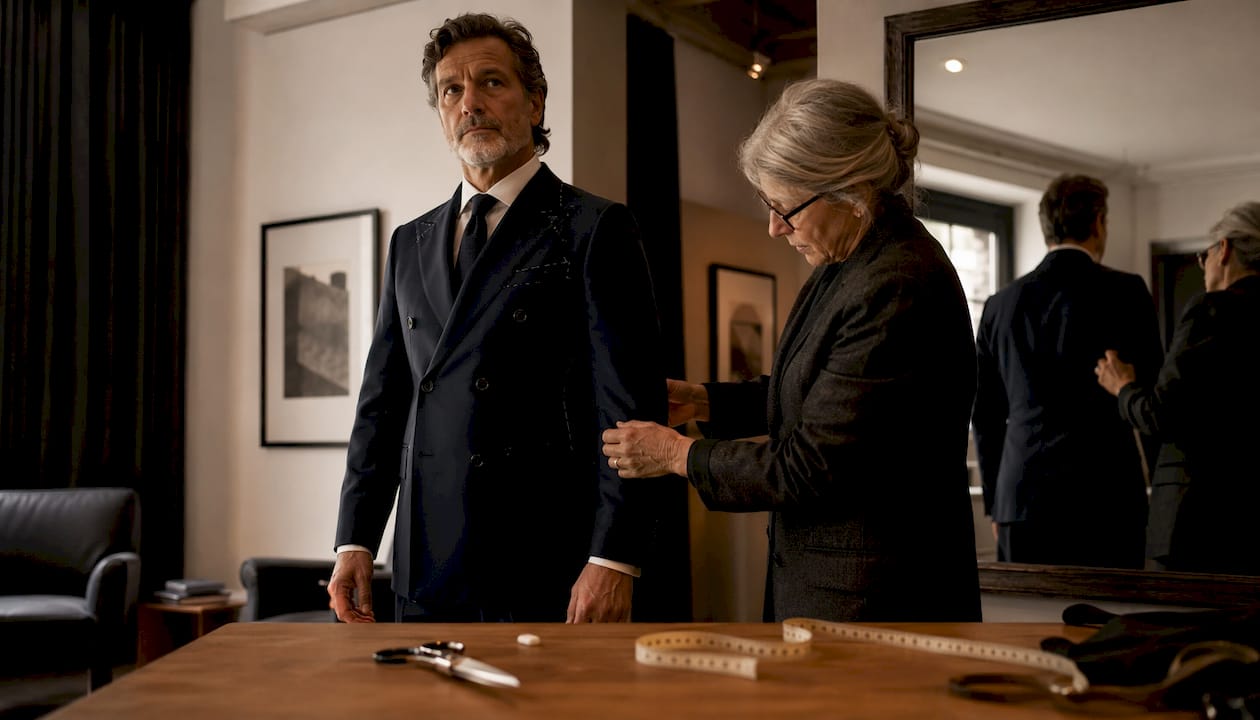
Because of the overlapping panels and structured front, any fit imperfection on a DB jacket is immediately visible. Precise tailoring is not optional. Six checkpoints define a correct fit:
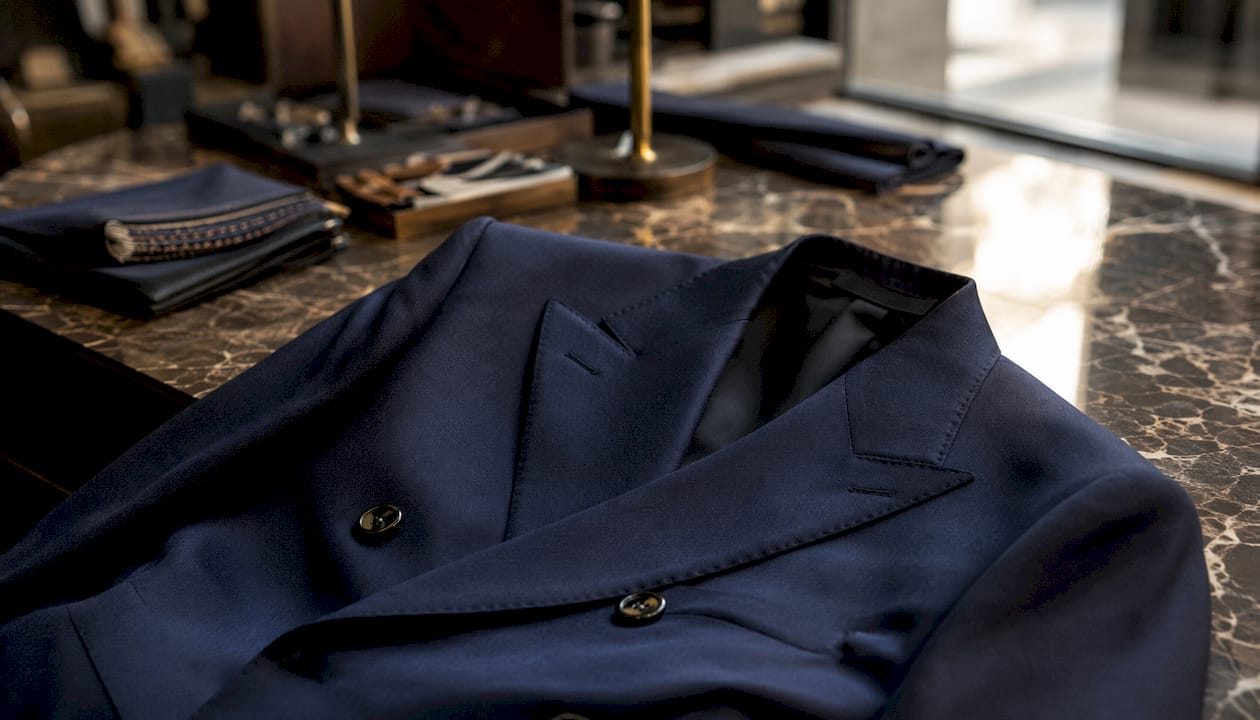
1. Shoulder line. The seam sits exactly at the shoulder’s edge, with no overhang and no pulling toward the neck. This is the one alteration that cannot be fixed cheaply after purchase.
2. Gorge height. The point where the lapel meets the collar should sit high on the chest. A higher gorge pushes the visual center upward, creating the impression of greater height and a more contemporary look.
3. Button stance. The functional buttons should close without pulling the chest fabric. If the lapels bow outward or the chest panel gaps, the stance is too low or the chest is too tight.
4. Chest ease. You should be able to slip a flat hand inside the buttoned jacket. More than that and the jacket looks baggy; less and it pulls.
5. Waist suppression. A slight inward curve at the waist defines the silhouette. Without it, the jacket reads boxy rather than tailored.
6. Sleeve length. Half an inch of shirt cuff should show below the jacket sleeve. Measure with your arms relaxed at your sides.
Questions to bring to your tailor: Ask whether the jacket is full canvas or fused — full canvas allows the jacket to mold to your body over time and holds the DB’s structure better. Ask about the jigger button placement; it should align with the functional external button so tension is balanced across the chest. Ask whether the lapel width can be adjusted to suit your proportions.
Pro Tip: Try the jacket buttoned and then sit, reach forward, and turn at the waist. A well-cut DB should move with you without the chest panel twisting or the back riding up. If it does either, the pattern needs adjustment before you commit.
A full-canvas construction also means the jacket can, in the right cut, be worn open without collapsing entirely. A fused jacket loses its shape the moment the buttons are undone.
Which body types does a double-breasted suit flatter?
Double-breasted styles are particularly effective for taller or leaner frames, but bespoke tailoring can adapt the cut to flatter fuller builds. The key variables are button stance, lapel width, and degree of waist suppression.
- Tall and slim: Almost any configuration works. A 6×2 with wide peak lapels and moderate waist suppression creates a commanding presence without overwhelming the frame.
- Athletic build (broad shoulders, narrow waist): A 4×2 with a suppressed waist and slightly narrower lapels keeps the silhouette proportionate. Avoid excessively wide overlaps, which can make the chest look even broader.
- Shorter men: Choose a 4×1 configuration and a higher gorge placement to lengthen the visual line. Keep lapels moderate in width. Avoid the 6×2, which can visually compress the torso.
- Fuller midsection: A higher button stance and a suppressed waist through bespoke patterning draw the eye upward and inward. Avoid oversized overlaps and very wide lapels, which add horizontal visual weight at the widest point.
Practical dos and don’ts:
- Do request a higher button stance if you are shorter than average.
- Do ask for moderate lapel width if you are shorter or have a fuller build.
- Don’t choose a 6×2 if you are shorter than average and buying off the rack; the proportions are rarely right without significant alteration.
- Don’t wear an oversized overlap on a fuller midsection; it emphasizes width rather than structure.
When should you wear a double-breasted suit?
A double-breasted suit sits one step above single-breasted in formality. That distinction matters in practice: it reads as a deliberate choice, not a default.
Occasions where it excels:
- Boardroom presentations and client meetings where authority is an asset
- Weddings, whether as the groom or a guest in a formal dress code — for grooms considering a wedding suit, a DB in navy or charcoal carries genuine elegance
- Black-tie adjacent events and galas (a DB tuxedo in midnight blue is a strong alternative to a standard single-breasted tuxedo)
- Formal evening events and dinners
When to avoid it:
- Casual offices with relaxed dress codes
- Informal daytime events (backyard gatherings, casual brunches)
- Any setting where you will be sitting for extended periods without the ability to unbutton
Two dress-down examples that work: A slim 4×1 DB blazer in a textured cloth paired with well-fitted dark trousers and clean white sneakers can read as fashion-forward without looking mismatched. A soft-shoulder DB in camel or olive, worn over a plain crew-neck tee with slim chinos, works when the proportions are right and the jacket is unstructured enough to carry the informality.
How do you style a double-breasted suit?

The core principle: the jacket carries significant visual weight at the top, so everything below should be slim and uncluttered. Bulky trousers, thick-soled shoes, or a heavy tie knot all compete with the jacket’s structure.
Five outfit formulas:
- Navy 6×2 + white poplin shirt + medium-width silk tie + black cap-toe oxfords. The classic boardroom combination. Keep the tie knot a four-in-hand or half-Windsor; a full Windsor can look too wide against peak lapels.
- Charcoal 4×2 + pale blue shirt + no tie + dark brown Derby shoes. Modern and clean. Works for business-casual environments where the DB reads as intentional rather than overdressed.
- Camel 4×1 + cream shirt + suede loafers (no tie). A warmer, more relaxed formula suited to daytime events or creative industries. The softer color palette reduces the jacket’s formality without undermining its structure.
- Midnight blue DB tuxedo + white dress shirt + black bow tie + patent leather oxfords. Evening events and black-tie adjacent occasions. The DB tuxedo is one of the strongest statements a man can make at a formal dinner.
- Olive soft-shoulder DB + plain white tee + slim dark chinos + white leather sneakers. Fashion-forward casual. Works only when the jacket is unstructured and the proportions are genuinely slim.
Dos and don’ts:
- Do use a pocket square; it completes the chest panel without adding bulk. A simple flat fold in white linen is always correct.
- Don’t wear a vest under a DB jacket. The layered chest panels create enough visual complexity; a vest adds unnecessary bulk.
- Do match shoe formality to the jacket’s weight. Heavy worsted wool calls for leather oxfords or Derbies; lighter cloths can carry suede or loafers.
- Don’t wear a tie with a very wide knot against narrow lapels, or a very thin tie against wide lapels. The proportions should echo each other.
Quick pre-departure checklist:
- Jacket buttoned and lying flat across the chest (no pulling, no gaping).
- Shirt collar visible above the jacket collar.
- Half inch of shirt cuff showing at the sleeve.
- Trousers slim through the thigh and breaking cleanly at the shoe.
- Pocket square in place (flat fold or simple puff, not an elaborate fold).
- Shoes polished and appropriate to the cloth weight.
What fabrics work best for a double-breasted suit?
Cloth weight and weave matter more on a DB jacket than on a single-breasted suit because the jacket’s structure depends on the fabric holding its shape across the wide chest panel. Worsted wool and full-canvas construction are better for maintaining DB structure; linens and fused jackets can flatten the intended silhouette.
| Fabric | Season | Pros | Caveats | Best occasions |
|---|---|---|---|---|
| Worsted wool | Year-round | Holds structure, drapes well, resists wrinkles | Can feel warm in summer | Boardroom, weddings, formal events |
| Flannel | Fall/Winter | Rich texture, excellent warmth, structured drape | Too heavy for warm climates | Winter weddings, evening events |
| Tweed | Fall/Winter | Distinctive texture, durable, casual-luxe appeal | Informal; avoid for black-tie | Country events, creative offices |
| Tropical wool blend | Spring/Summer | Lightweight, breathable, retains shape better than linen | Less structure than heavier wool | Warm-weather weddings, travel |
| Linen blend | Summer | Breathable, relaxed texture | Wrinkles easily; structure suffers | Casual summer events only |
On linings and interlinings: A full canvas interlining (horsehair and wool felt) gives the DB jacket its characteristic chest roll and allows the garment to mold to your body over time. A half-canvas is a reasonable compromise for MTM. Fused interlinings are cheaper but can bubble after cleaning and reduce the jacket’s ability to hold the DB’s wide chest panel flat. For a jacket you intend to wear regularly, full canvas is worth the investment.
What are your options for buying a double-breasted suit?
Off-the-rack is the fastest and least expensive route; bespoke is the most precise and the most time-intensive. Made-to-measure sits between them. For a DB jacket specifically, the case for bespoke is stronger than for most garments because the wide overlap and structured front amplify every fit imperfection.
| Route | Price range | Timeline | Fit quality | Best for |
|---|---|---|---|---|
| Off-the-rack | $ (entry–mid) | Same day | Standard sizing; alterations often needed | Budget-conscious buyers; standard proportions |
| Made-to-measure | $$ (mid–high) | 4–8 weeks | Good; adjusted from a base pattern | Men who know their measurements and want a faster process |
| Bespoke | $$$ (high–premium) | 8 weeks | Highest; pattern built from scratch | Complex proportions; investment pieces; best long-term value |
What drives cost: The cloth (mill and weight), the canvas (full vs. fused), and the amount of handwork (hand-stitched lapels, hand-padded chest, hand-finished buttonholes) all affect price. A bespoke DB jacket with full canvas and hand-finished details represents a significant investment, but it is also a garment that can be altered and re-pressed over decades.
Buyer checklist for your first fitting:
- Bring the dress shirt you plan to wear with the suit so sleeve length and collar height are measured correctly.
- Wear the shoes (or the heel height) you intend to pair with the suit so trouser length is accurate.
- Bring reference photos of button stances and lapel widths you prefer.
- Ask how many fitting rounds are included and whether a basted (tacked together) fitting is offered before the final construction.
For a first-time bespoke client, a basted fitting is particularly valuable on a DB jacket because it lets the tailor check the button stance and gorge height before committing to the final cloth.
Why bespoke matters for a double-breasted suit
Bespoke resolves fit problems that off-the-rack and MTM cannot address, and those problems are more consequential on a DB jacket than on almost any other garment. The jigger button placement, the gorge height, and the button stance are all set during patterning; changing them after construction is expensive and sometimes impossible.
At Ronandrich, the bespoke process follows a clear sequence:
- Consultation: Discussion of cloth, configuration (6×2, 4×2, 4×1), lapel width, and intended occasions.
- Patterning: A pattern built from your measurements, not adapted from a standard block. Button stance and gorge height are set here to suit your proportions.
- Basted fitting: The jacket is tacked together in the actual cloth so the tailor can check the shoulder line, chest ease, and button stance before final construction. This is the step that separates bespoke from MTM.
- Final fitting and adjustments: The finished jacket is tried on, pressed, and adjusted. Typical timeline from consultation to delivery: 8–12 weeks.
Craftsmanship details worth looking for: hand-rolled lapels (the lapel edge is stitched by hand, giving it a soft, natural roll rather than a pressed crease), a correctly placed internal jigger button (aligned with the functional external button so tension is balanced across the chest), and full canvas construction throughout the chest and front. These are the details that determine whether a DB jacket looks authoritative or merely expensive.
Clients who try bespoke DB jackets often find that tailoring corrects the subtle balance issues that make DB jackets look imposing or sloppy off the rack. The difference is not always visible in a photograph; it is felt in how the jacket moves with you.
How do you care for a double-breasted suit?
A DB jacket’s structured front is its most vulnerable element. Frequent pressing flattens the canvas and reduces the chest roll that gives the jacket its shape.
Care checklist:
- Rotate the jacket with at least one other suit; wearing the same garment two days in a row compresses the canvas and cloth.
- Steam rather than press after wearing. A handheld steamer removes light creases without flattening the chest panel.
- Spot-clean stains immediately with a damp cloth; avoid rubbing, which can damage the weave.
- Have the suit professionally pressed two to three times per year, not after every wearing.
- Store on a wide, shaped hanger (not a wire hanger) that supports the shoulder line. Use a breathable garment bag, not plastic, which traps moisture.
Alterations that are safe and common:
- Taking in or letting out the waist (within the seam allowance).
- Adjusting sleeve length from the cuff end, not the shoulder, to preserve the shoulder line.
- Re-pressing and re-hanging after any alteration to restore the jacket’s drape.
When to call in a specialist: If the canvas has separated from the cloth (visible as bubbling or rippling across the chest), the jacket needs re-canvassing, not just pressing. Shoulder re-padding is a structural repair that requires a skilled tailor. Communicate these needs clearly: describe what you see (bubbling, shoulder roll, lapel lying flat) rather than naming the repair, and let the tailor diagnose the solution.
Key Takeaways
A double-breasted suit is the most architecturally demanding garment in a man’s wardrobe, and its success depends entirely on fit, fabric, and the discipline to wear it buttoned.
| Point | Details |
|---|---|
| Fit is non-negotiable | Any shoulder, button stance, or waist imperfection is immediately visible on a DB jacket. |
| Button stance shapes your silhouette | A 4×1 configuration lengthens shorter torsos; a 6×2 suits taller frames and formal occasions. |
| Fabric determines structure | Worsted wool with full canvas holds the DB’s wide chest panel; fused or linen constructions flatten it. |
| Styling rule: keep it slim below | Slim trousers, moderate tie knots, and leather oxfords balance the jacket’s upper visual weight. |
| Ronandrich bespoke process | Consultation through basted fitting to final delivery resolves fit issues off-the-rack cannot address. |
Why I recommend double-breasted jackets to certain clients
The double-breasted jacket is the one garment where I consistently see the gap between what a man expects and what he actually gets when he buys off the rack. The wide overlap and structured front are unforgiving. A shoulder that is a quarter-inch too wide, a button stance that sits a centimeter too low, a gorge that is cut too flat — any one of these makes the jacket look like it belongs to someone else. The man wearing it knows something is wrong but cannot name it.
What I tell clients who come to us specifically for a DB jacket: the garment rewards patience. The basted fitting is not a formality; it is the moment when we can see whether the button stance is creating the V-shape we intended or whether the chest is pulling. We can move the stance, adjust the gorge, and narrow the overlap before a single permanent stitch is placed. That is the difference between a jacket that looks like a statement and one that looks like a costume.
The detail most men overlook is the jigger button. Its placement relative to the external functional button determines whether the chest panel lies flat when you move or twists slightly to one side. A correctly aligned jigger, tensioned evenly across the chest, is what allows a well-engineered DB jacket to retain its shape through a full day of movement. It is invisible, and it is everything.
Ronandrich bespoke double-breasted suits: what to expect
For men who want a double-breasted suit that fits the way the garment was designed to fit, Ronandrich offers a bespoke tailoring service built on the craft principles Richard Fan established in 1979. Every DB jacket begins with a personal consultation: cloth selection, button configuration, lapel width, and occasion are discussed before a single measurement is taken. The pattern is built from scratch for your proportions, with gorge height and button stance set to suit your frame, not a standard block.
The process includes a basted fitting in the actual cloth, final construction, and a finishing appointment. Typical delivery runs 8–12 weeks. For men considering a DB suit for a wedding, a significant professional occasion, or as a long-term wardrobe investment, the bespoke route eliminates the fit compromises that make off-the-rack DB jackets so difficult to wear well. Browse the full range of tailored suits and jackets or book a consultation to begin the process.
Useful sources and further reading
- Double-breasted — Wikipedia: Technical construction details, button configurations, and the history of the jigger button. A reliable reference for terminology and historical context.
- Single vs. Double-Breasted Suits — Men’s Wearhouse: A practical comparison of silhouette, formality, and occasion guidance, with notes on fabric and construction.
- Double-Breasted vs. Single-Breasted — VIOSSI: Covers gorge height, button stance effects on perceived height, and the buttoning rule.
- Single Breasted vs. Double Breasted Suits — Men’s Suit World: Fit imperfection visibility and why precise tailoring is essential for DB jackets.
- Bespoke Tailoring Process — Ronandrich: Step-by-step process and timeline for bespoke clients, including fitting rounds and what to bring to a consultation.
- Bespoke Services — Ronandrich: Overview of Ronandrich’s bespoke offering, craft details, and how the process addresses common DB fit challenges.
Pairing suggestion: an annotated diagram showing button stance positions (6×2, 4×2, 4×1) alongside a bespoke workshop photograph would strengthen the fit and construction sections for visual learners.
Recommended
- How to Pick the Right Suit Tailor in Singapore for Your First Custom S
- How to Choose the Best Custom Suit Tailor in Singapore?
- Best Bespoke Suit Tailor in Singapore
- Why More Men Are Choosing Tailor-Made Suits in Singapore?

%20that%20holds%20the%20inner%20panel%20flat%20and%20preserv...)