Chore Coat Styling: How to Wear One in Singapore
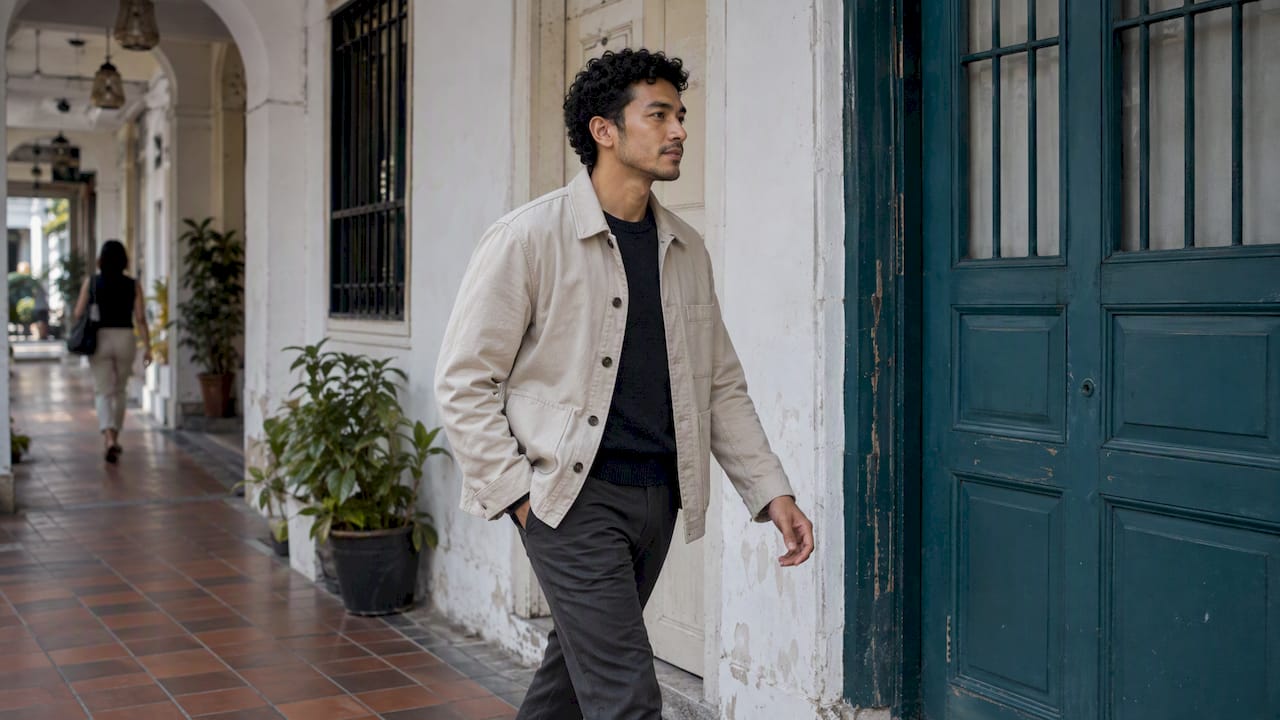
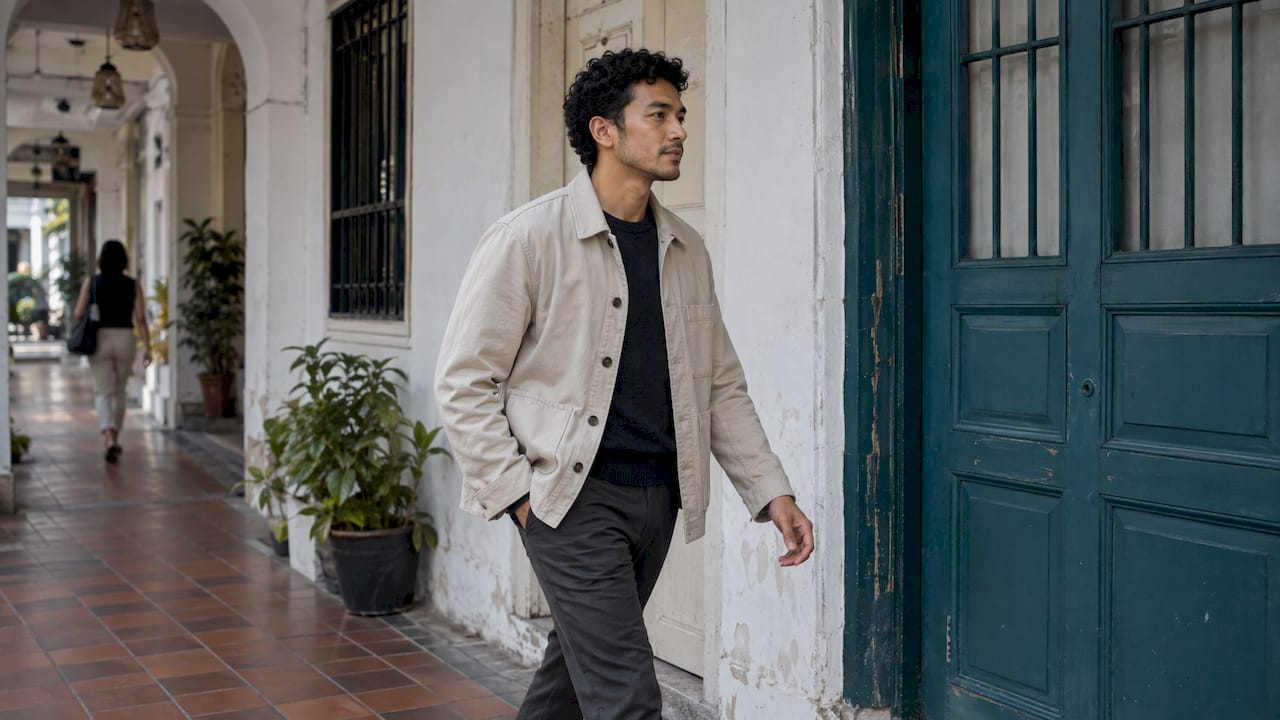
A chore coat is best styled as a relaxed, slightly roomy layer over simple, well-fitted basics: a plain T-shirt, an open-weave shirt, a fine knit. In Singapore, cloth matters more than any outfit formula. Choose a light, breathable, unlined coat, and it will work from the office to the weekend. Below we cover the fit, the fabric, the outfits and the point at which a tailored version is worth considering.
TL;DR
- A chore coat has a straight hem, a shirt-like front and usually three patch pockets. It is more of a jacket than an overshirt, and less formal than a tailored jacket.
- In Singapore’s heat, choose an unlined coat in light cotton, linen or a fine blend. Keep heavy canvas for cooler, air-conditioned rooms.
- Wear it slightly roomy, with a high-hip length, and roll the sleeves.
- Dress it up with a fine knit, a linen shirt and tailored trousers. Dress it down with a T-shirt and jeans. Avoid formal dress shoes and a tie.
- A tailored chore coat, cut to your own measurements, keeps the ease of workwear while fixing the shoulder, length and sleeve.
Table of Contents
- What a chore coat is, and what it is not
- Choosing the fit
- Fabric for Singapore’s climate
- Casual outfits
- Smart-casual outfits
- Layering without overheating
- When a tailored chore coat makes sense
- Perspective: why we cut it the way we do
- Make your own chore coat
- Frequently asked questions
- Sources
What a chore coat is, and what it is not
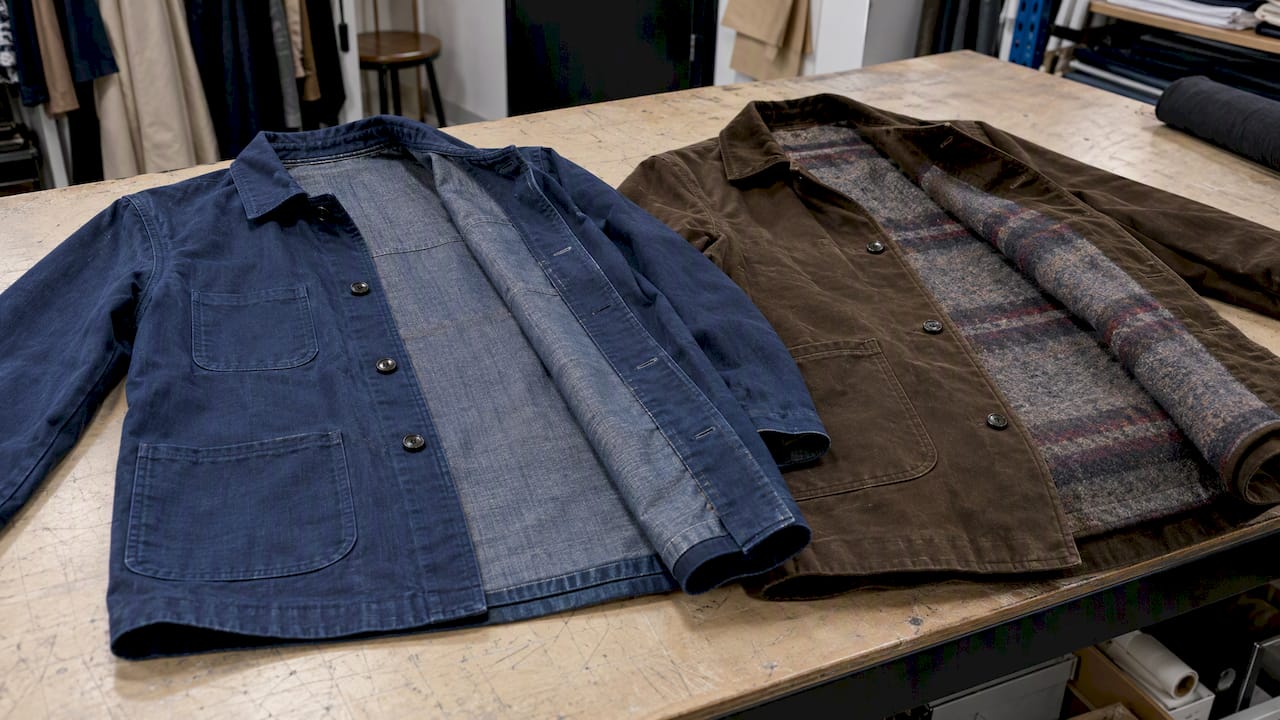
The chore coat began as French workwear. The French worker’s jacket dates from 19th-century France, and its deep indigo colour gave it the name bleu de travail, or working blue. It was made for labourers, railway workers and farmers: hard-wearing cloth, big patch pockets and sleeves that rolled up easily.
That is the French chore jacket men search for today. The character has survived: a boxy body, a button front, a turned-down collar and roomy pockets, usually two on the hips and sometimes one on the chest. The Daily Telegraph describes it as a lightweight, utilitarian hybrid of shirt and jacket, with durable fabric and large patch pockets.
Chore coat or overshirt?
The two are close cousins, and the difference is mostly one of construction and purpose. British GQ notes that both share a shirt-like silhouette, buttons and pockets, but that a chore jacket is tougher and warmer, while an overshirt is principally a mid-layer.
In practice:
| Chore coat | Overshirt | |
|---|---|---|
| Construction | Jacket-like, sturdier cloth | Shirt-like, lighter cloth |
| Pockets | Usually three patch pockets, including the hips | Usually chest pockets only |
| Hem | Straight | Often curved, like a shirt |
| Sleeves | Often no cuff buttons | Usually shirt cuffs |
| Role | Outer layer | Mid-layer or light top layer |
| Formality | Casual, can be raised with fine cloth | Casual |
In a warm country the line blurs. A chore coat in thin cotton or linen is, in effect, a jacket you can wear in place of a blazer on days when a blazer is too much.
Choosing the fit
A good chore coat is not slim. It should sit with a slightly dropped shoulder, a little ease through the body and a hem that falls around the high hip. The coat was made to be worked in, so freedom of movement is part of its look.
The usual advice is to go a size up from your blazer. MR PORTER’s David Keyte makes the same point in his guide to workwear: chore jackets were designed to move in. That works for ready-made coats. If you are having one made, you do not need to guess: the ease is built to suit your frame rather than added by size.
A few checks before you buy or order:
- Shoulders. A relaxed shoulder is right, but the seam should not hang halfway down the upper arm.
- Length. The hem should end near the high hip, covering the belt line. Longer than that and it starts to look like a coat.
- Sleeves. They should reach the wrist bone when worn down and still look neat when pushed to the forearm.
- Chest and waist. Enough room to fit a thin knit beneath without pulling across the buttons.
- Pocket placement. Patch pockets should sit where your hands fall naturally, and be deep enough to hold a phone without sagging.
Fabric for Singapore’s climate
This is where most chore coat advice, written for London or New York, fails in Singapore. A blanket-lined moleskin coat is a sweat trap at 31 degrees and 80 per cent humidity.
For the region’s rainy season, VMAN Southeast Asia recommends a loose, unlined chore jacket that lets you regulate temperature and leaves room to layer light knitwear. It also contrasts two cloths: heavy cotton canvas is dense and wind-resistant, while garment-dyed twill is softer and drapes more easily. A Singapore styling guide goes further, favouring lightweight denim, chambray and thin cotton over blanket-lined versions, and treating the jacket mainly as something for air-conditioned interiors or to carry outdoors.
Our reading of that is practical:
- Cotton twill, light to mid weight: the all-rounder. It holds its shape, softens with wear and takes a wide range of colours.
- Linen and linen blends: the coolest option. They crease, which suits the look, but they need a little tailoring to stay sharp.
- Fine wool twills and cotton blends: smarter and surprisingly comfortable in air-conditioning. Sunspel’s David Telfer tells the Telegraph that refined wool twills and fine-cotton blends make a chore jacket work with smarter trousers as well as jeans.
- Heavy canvas or moleskin: authentic, but best saved for travel or a cold office.
We go into cloth weights and weaves in more detail in our guide to chore coat fabrics for Singapore.
Unlined also means less to wear. Fewer internal layers make a jacket more breathable in warm weather, which is why tailors often leave a summer jacket unlined. The same logic applies to a chore coat.
Casual outfits
The easiest way to wear a chore coat is the simplest one.
- T-shirt, jeans, sneakers. A plain crew-neck T-shirt, dark or raw denim and clean trainers or boots. Roll the sleeves to the forearm. This is the combination MR PORTER suggests for a casual look, with selvedge jeans.
- Chino shorts and a striped tee. The same guide suggests a Breton T-shirt with chino shorts. In Singapore this is a natural weekend look, with a thin coat tossed over the shoulders between shops.
- Washed denim shirt underneath. Tonal blues work well, provided the coat is a different shade from the shirt.
- Earth tones. Olive, tobacco, navy and stone coats sit well with cream, grey and white. Black can look severe in the tropics, but a charcoal coat over a white tee is a strong evening option.
The point is proportion. A roomy coat looks best with a clean, fitted base: straight or tapered trousers, not baggy ones.
Smart-casual outfits
The chore coat earns its place at work when it replaces the blazer on a casual day. Telfer’s argument is that refined fabrics take away some of the overt workwear character, letting the jacket bridge casual and smarter dressing. He pairs it with jeans, smarter trousers, T-shirts, merino polos and Oxford shirts.
Some combinations that work in our climate:
- Fine knit polo, tailored trousers, loafers. A knit polo under a stone or navy chore coat reads relaxed but considered. A refined polo in a performance knit, such as one of the best men’s golf polo shirts, is comfortable in the heat and looks neat beneath a light coat.
- Linen shirt, knitted tie. MR PORTER proposes a linen shirt with a knitted tie for a more sartorial take. It is a good option for a creative office or a dinner.
- Oxford shirt, wool trousers, suede shoes. Open at the collar, without a tie. Tuck the shirt in for a cleaner line.
- Hand-knitted or fine-gauge sweater. A thin knit under the coat gives depth and is useful when the air-conditioning is set low.
For more formulas in the same register, our guide to smart casual outfits for men lays out quick combinations, and the blazer and jeans formulas show what to reach for when the day calls for a little more structure.
What to avoid
A chore coat is a bridge between registers, but not a replacement for tailoring. Formal dress shoes, a stiff dress shirt and a silk tie work against it: the cloth, pockets and shape belong to a more casual world. If the occasion needs a tie, wear a suit or a sports jacket. Likewise, a very slim cut defeats the purpose: a coat built for movement should not restrict it.
Layering without overheating
In Singapore, layering is an indoor strategy. Keep each layer light, and expect to take the coat off between buildings.
- Base: a cotton or linen shirt, or a fine T-shirt.
- Middle (optional): a thin merino or cotton knit for cold offices and cinemas.
- Outer: the chore coat, unbuttoned for most of the day.
An overshirt is generally worn over a shirt and beneath a heavier coat, while a chore coat is the outer layer itself. If you travel to cooler countries, a sturdier chore coat can sit under a topcoat, but for daily Singapore wear one layer of cloth is plenty.
When a tailored chore coat makes sense
A ready-made chore coat is cut for an average body and often misses at the shoulder, the sleeve or the length. Permanent Style places the chore coat below the tailored jacket in formality, and notes that finer materials and internal zipped pockets can produce more luxurious versions. That is the gap a tailored chore coat fills: workwear ease, with the cut and cloth of a considered garment.
What changes when it is made to measure:
- The shoulder and collar sit correctly, so the coat hangs cleanly even when open.
- The sleeves are the right length, which matters when you roll them.
- The cloth is chosen for the climate, rather than for a winter catalogue.
- Pocket size and position are set for how you actually carry things.
- The ease is deliberate, not accidental.
The result also takes you further across the week. The same coat can go over a T-shirt on Saturday and over a fine knit with pressed trousers on Monday.
If you like the idea of a coat in this spirit, our safari jacket guide shows how a similar utility garment is worn, and when bespoke matters.
Perspective: why we cut it the way we do
We have been making clothes by hand since Richard Fan founded our house in 1979, and we approach a chore coat as we would a suit: the fit comes first. A workwear jacket looks effortless only when the shoulder and the balance are right. That is difficult to find on a rack, and it is why a relaxed garment can benefit most from a tailor.
In Singapore, we also think the cloth deserves more thought than the silhouette. The tradition of the chore coat is hard-wearing and heavy, but the climate asks for something lighter, so we choose premium fabrics that breathe, keep the proportions of workwear and leave out the heavy lining. The aim is a coat that feels like a favourite shirt and looks like it was made for you, because it was.
Our advice is simple: buy fewer coats and choose better ones. One well-cut coat in a good cloth, worn often, will do more for your wardrobe than three that almost fit.
Ron
Make your own chore coat
We make chore coats from $790, with fittings that follow your measurements rather than a size chart. Our price list shows every garment we make, from shirts at $199 and trousers at $290 to suits from $2170, so you can plan a coat alongside the pieces you will wear with it. For the shirt beneath, see our tailor made shirts, and for a knit layer, browse our knits collection. Book a consultation and we will talk through cloth, length and pockets with you.
Frequently asked questions
How should a chore coat fit?
Relaxed, but not shapeless. Look for a slightly dropped shoulder, a little ease in the body and a hem near the high hip. Many stylists suggest a size up from your blazer in ready-made coats, so you can move and layer a thin knit underneath.
Can I wear a chore coat in Singapore’s heat?
Yes, if the cloth is right. Choose an unlined coat in light cotton, chambray, linen or a fine blend, and treat it as a layer for air-conditioned spaces. Avoid blanket-lined or heavy canvas versions for daily wear.
What is the difference between a chore coat and an overshirt?
A chore coat is built like a jacket, in sturdier cloth, with a straight hem and usually three patch pockets. An overshirt is lighter and closer to a shirt, with cuffs and chest pockets, and works mainly as a mid-layer. In thin cloth the two look similar, so judge by the cut and weight.
Can a chore coat be worn with a tie or dress shoes?
It is better not to. A chore coat is a casual piece and tends to clash with a tie and formal shoes. For a smarter look, wear a fine knit or linen shirt with tailored trousers and loafers or suede shoes, and keep a suit or sports jacket for occasions that need a tie.
Is a tailored chore coat worth it?
If you wear one often, yes. A made-to-measure coat corrects the shoulder, sleeve and length that ready-made coats get wrong, and lets you choose a cloth for the climate. It also gives a casual jacket the polish to move between smart-casual and weekend wear.
Sources
- Chore jacket, Wikipedia
- This French style staple flatters both men and women, The Daily Telegraph
- Best men’s chore jackets, British GQ
- The Stylish Gent’s Guide To Workwear, MR PORTER
- Best men’s chore jackets for unpredictable weather, VMAN Southeast Asia
- Workwear Style: Americana Guide Singapore
- Overshirt, chore, teba: defining the new casual jacket, Permanent Style
- Different Ways to Go Unlined, Die, Workwear!