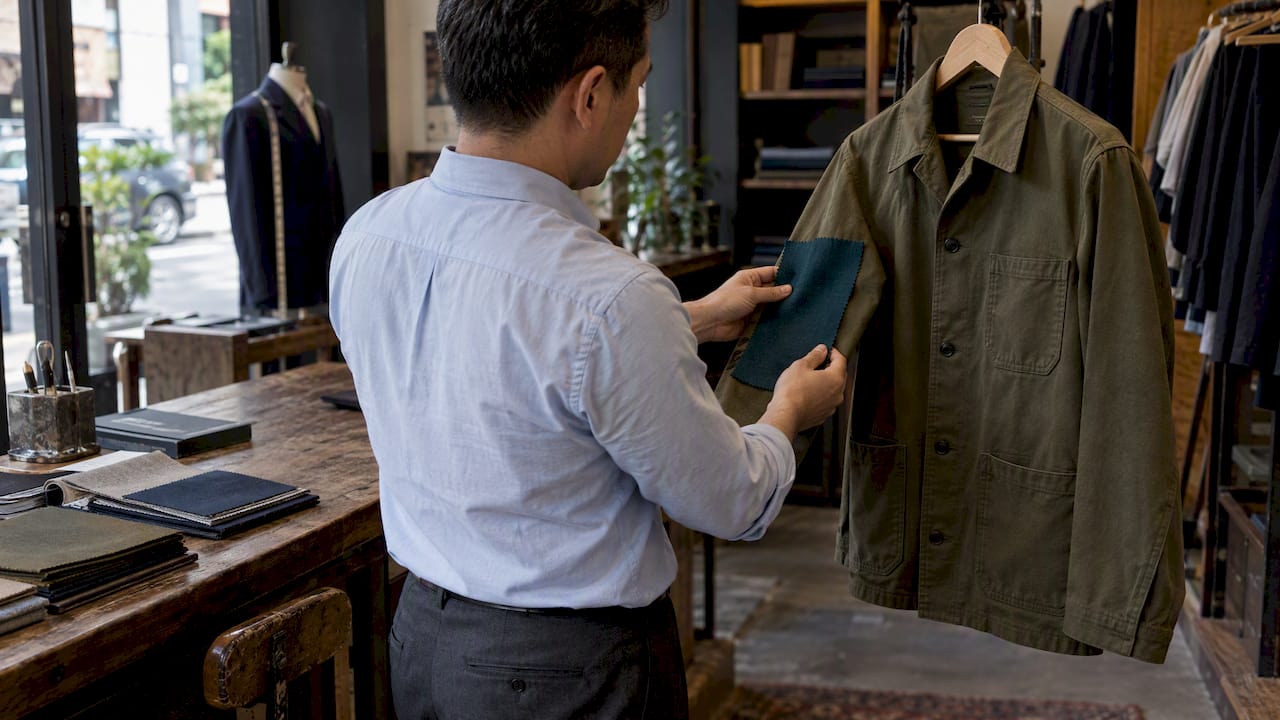
Chore Coat Fabrics: Choosing the Right Cloth for Singapore
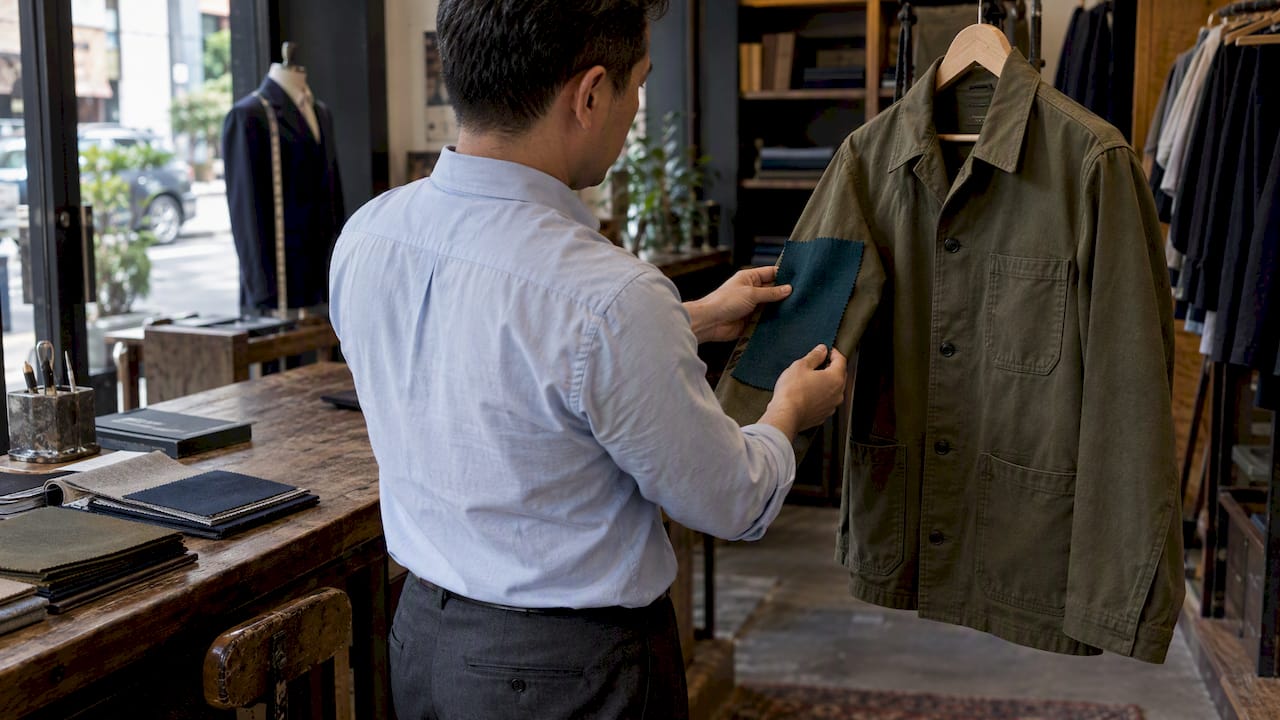
The fabric decides almost everything about a chore coat: how it hangs, how it ages, and whether you can bear to wear it at 31°C. Traditionally the cloth is a dense cotton, usually moleskin, drill or duck canvas. For Singapore, we often recommend a lighter linen-cotton blend or a stonewashed linen that keeps the workwear character without the weight.
This guide explains each cloth in plain terms, what the weights mean, how to judge quality, and how to choose when the coat is made for you rather than taken off a rail.
TL;DR
- Moleskin is the heritage choice: dense, soft-faced cotton that is wind resistant and develops a patina. It is warm, so it suits air-conditioned days and the cooler evenings abroad.
- Cotton duck canvas is the sturdiest and most characterful, but heavy canvas above roughly 450 to 550 g/m² can be stifling in Singapore.
- Linen-cotton blends and stonewashed linen are the practical answer for year-round wear here, with the same structured look at a fraction of the heat.
- Judge a cloth by weave density, yarn quality, shrinkage behaviour and hand-feel, not by weight alone.
- A bespoke chore coat from our house starts from $790 and is cut to your measurements, pockets included.
Table of Contents
- Why the cloth matters more than the cut
- The traditional chore coat fabrics
- The case for lighter cloths in Singapore
- How the fabrics compare
- What to look for in a quality cloth
- Colour and the cloth
- Fit, pockets and the tailored chore coat
- Our perspective
- Commissioning a chore coat with us
- FAQ
- Sources
Why the cloth matters more than the cut
The chore coat began as French and British workwear: a boxy, unlined jacket with large patch pockets, built to survive a day of labour. Its silhouette is simple by design, so there is nowhere for a poor cloth to hide. A good fabric gives the coat body at the collar, a clean fall from the shoulder and pockets that hold their shape.
The same simplicity is what makes the chore coat so useful in a modern wardrobe. In a refined cloth and a considered colour, it sits comfortably between a shirt and a blazer, which is why so many of our clients ask for one as a smart casual layer.
The traditional chore coat fabrics
Moleskin
Despite the name, moleskin is cotton. It is a densely woven fabric, traditionally described as a satin weave, prized for wind resistance and durability, and historically worn by sailors and labourers. The surface is shaved or brushed after weaving, which gives the soft, faintly suede-like face that people notice first.
Up close, moleskin is a twill-family cloth, the same family as denim. Its character comes from density. The tighter the weave, the more protective and the more stiff it feels when new, and the more handsomely it softens with wear.
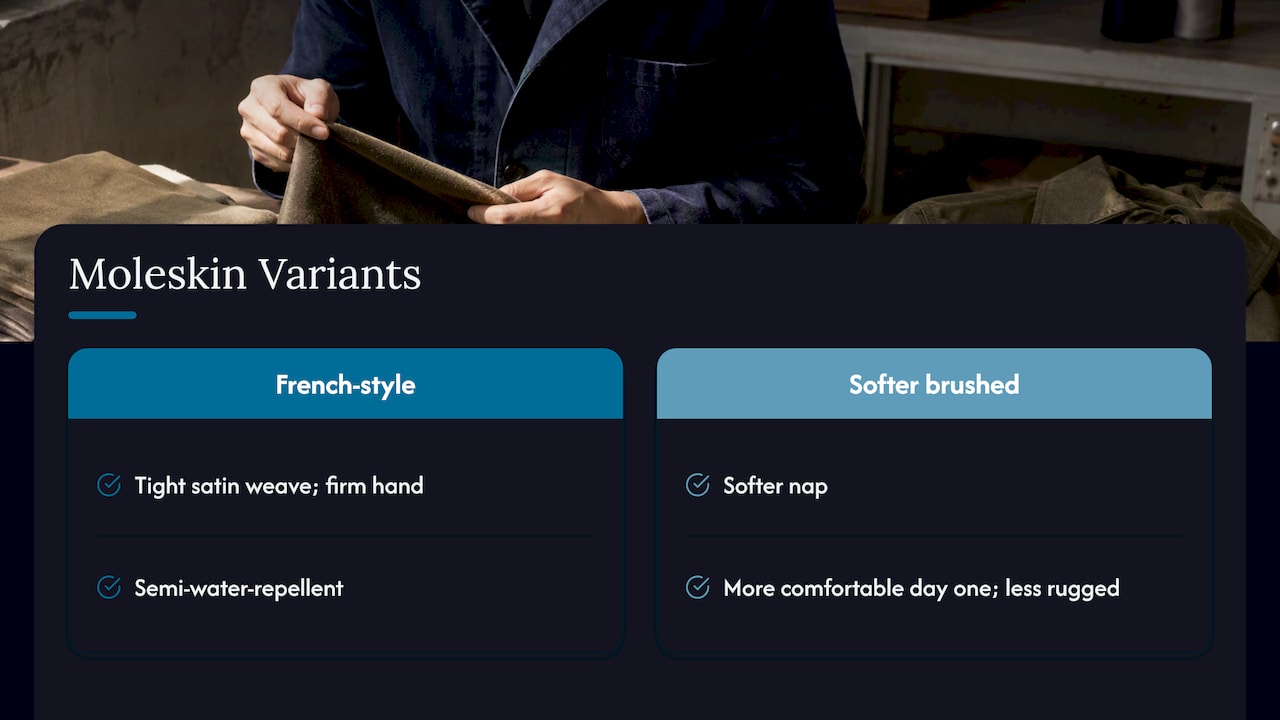
A point worth asking about when you order: not all moleskin is the same. Traditional French-style moleskin has a tight satin weave and a firm, semi-water-repellent hand. Some other versions favour a softer brushed nap that is more comfortable on day one but less rugged. Neither is wrong. They suit different wearers, and a fitting is the right moment to feel both.
Best for: cool, air-conditioned settings, travel to colder cities, and anyone who wants a coat that gains character over years.
Cotton duck canvas
Canvas, sometimes called duck, is a plain or twill-weave heavy cotton with exceptional resistance to abrasion and tearing. Heavy workwear canvases often exceed 450 to 550 g/m², which is substantial: more than double the weight of a typical year-round suiting.
Canvas gives the most structured, architectural chore coat. It starts crisp, creases with intent and fades at the seams and pockets, which many people consider its chief appeal. The trade-off is heat and initial stiffness.
A note on terminology, since this is a frequent point of confusion: the canvas in a suit jacket is a different thing altogether. That is the internal layer that shapes the chest, and we explain it in our guide to half canvas versus full canvas. Chore coat canvas is the outer cloth itself.
Best for: a rugged, characterful coat worn in air-conditioned spaces, or on trips to cooler climates.
Drill, twill and herringbone
Cotton drill and heavy twill are the versatile middle ground. They have the diagonal weave of moleskin and canvas, but without the shaved surface of the first or the extreme weight of the second. Denim, canvas and herringbone cloths entered workwear after the first plain cotton jackets, and each remains a legitimate choice.
Herringbone adds a quiet visual texture, a broken V that catches light without announcing itself. In a mid-weight cotton it gives a chore coat that looks at home with tailored trousers.
Best for: a balanced coat with everyday durability and a little more refinement than plain drill.
Wool and tweed
Wool and tweed chore coats exist, and they are handsome, but they belong to cooler places. We would only suggest them to clients who travel frequently to temperate or cold climates, or who simply love the cloth.
The case for lighter cloths in Singapore
Heritage is a good starting point, but a coat you do not wear is a poor investment. Singapore’s temperatures usually range between 25°C and 33°C all year round, and the government’s guidance on warm weather is to wear breathable, loose-fitting, light-coloured clothing.
A heavy, tightly woven canvas sits at the opposite end of that advice. This is why master tailors often steer clients here towards lighter options:
- Stonewashed linen. Washed after weaving, it is softer from the first wear and breathes freely. It creases, and that is part of its relaxed appeal.
- Linen-cotton blends (often called half-linen). A 50/50 blend keeps more body and a smoother face than pure linen, while retaining much of its airiness. For many clients this is the best compromise for a structured chore coat.
- Lighter cotton drill or twill. A mid-weight cotton gives the workwear look with much better heat regulation than heavy duck.
Our view is simple. Choose moleskin or canvas if you love the cloth and mostly wear the coat in cool, air-conditioned settings or when travelling. Choose a linen-cotton blend or stonewashed linen if you want to wear it often, outdoors, in Singapore.
How the fabrics compare
| Fabric | Feel | Weight | Heat in Singapore | Ageing |
|---|---|---|---|---|
| Moleskin | Soft, suede-like face, dense | Medium to heavy | Warm | Softens, develops a patina |
| Cotton duck canvas | Crisp, rugged | Heavy | Hot | Fades and creases characterfully |
| Cotton drill, twill, herringbone | Smooth, structured | Medium | Moderate | Steady, even wear |
| Linen-cotton blend | Textured, lightly crisp | Light to medium | Comfortable | Relaxed creasing, softens |
| Stonewashed linen | Soft, airy | Light | Most comfortable | Creases freely, softens |
| Wool or tweed | Warm, textured | Medium to heavy | Too warm for daily use | Very long-lived |
The weights in the table are descriptive, not guaranteed specifications. Cloths vary by mill and by finish, so we ask you to feel and lift the actual swatch.
What to look for in a quality cloth
Weave density and yarn
Density is what gives moleskin and canvas their protection. Two details often separate a lasting coat from a fashion replica: ring-spun yarns, which are more durable than cheaper open-end yarns, and two-ply construction, which adds strength. Ask whoever is making your coat whether the cloth has either.
Behaviour after washing
Durability is not only about tearing. It includes whether the cloth shrinks, twists or loses its appearance. A European Commission study on textiles discusses robustness testing after repeated cleaning cycles, using ISO 15487 for appearance and ISO 3759 for dimensional change. As a working guide, woven cloths such as canvas or moleskin should show minimal shrinkage and no visible deterioration. If you are choosing between two cloths, ask which has been pre-washed or sanforised, and whether the tailor recommends dry cleaning or washing at home.
Hand-feel
A premium chore coat balances a crisp, structured outer face with a comfortable interior. Strength does not require rigidity. When you try a fabric, move your arms, sit down and reach forward. The coat should move with you rather than against you.
Finish and construction
Longevity also depends on what surrounds the cloth: sound buttons, reinforced seams and pockets that are stitched to be repaired, not replaced. Good fabric ages with a patina. Poor construction simply wears out.
Colour and the cloth
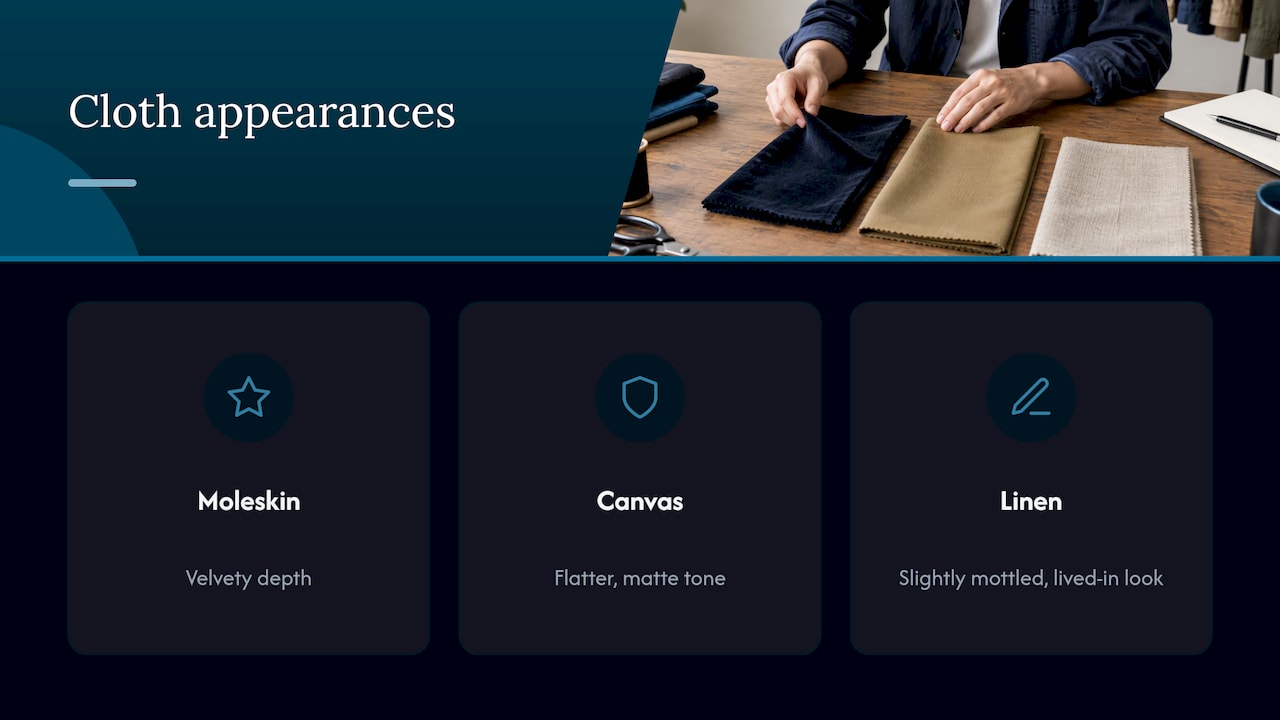
Historic chore coats were navy, black or the brown of duck. Modern versions have widened to sage, olive, ochre, stone and tobacco. Colour behaves differently on each weave: moleskin has a velvety depth, canvas a flatter, matt tone, and linen a slightly mottled, lived-in look.
In Singapore’s climate, lighter earth tones are kinder to the wearer and consistent with official advice on light-coloured clothing. Olive and stone are good places to start, and both pair well with trousers in grey flannel or cream cotton.
Fit, pockets and the tailored chore coat
Fit
The classic chore coat has a boxy, relaxed shape, but boxy does not mean shapeless. The shoulder should sit at your own shoulder point, the sleeve should end at the wrist bone, and the body should skim you rather than tent around you. Heavier cloths need a little more ease to move. Lighter cloths can be cut closer.
This is where a tailored chore coat differs from an off-the-rack one. A garment cut to your measurements lets us adjust the length, the sleeve pitch and the body shape for your posture, and select the cloth weight to match.
Pockets
Pockets are the chore coat’s signature. Three large patch pockets, two at the hip and one at the chest, are traditional. Heavy cloths hold a square patch pocket well, while softer linens benefit from reinforced corners and slightly smaller proportions to avoid sagging when loaded with a phone and wallet. When you order, tell us what you actually carry.
Chore coat or blazer?
A blazer is shaped, lined and constructed to look formal. A chore coat is unlined or lightly lined, with a looser body and patch pockets. If you wear a jacket to the office daily, a blazer or suit remains the correct choice. The chore coat is the stronger option for creative offices, weekends, travel and dinners where a tie would feel excessive. Many clients choose both, with the chore coat as the relaxed counterpart.
Our perspective
Our house was founded in 1979 by master tailor Richard Fan, and the principle he set remains ours: the garment must serve the person who wears it. A chore coat is a good test of that principle. Its workwear ancestry invites heavy, uncompromising cloth, yet the man wearing it in Singapore is walking through humidity, then into air conditioning, then back again.
We therefore treat tradition as a starting point, not a rule. We admire moleskin and canvas, and we will happily make a coat in either for the client who values them. But we most often recommend a lighter, breathable cloth with the structure and honesty of the original, because a coat that is comfortable is a coat that is worn, and a coat that is worn becomes a favourite.
When you visit, ask to handle the cloths side by side. A few minutes of touching, lifting and draping will tell you more than any specification.
Ron
Commissioning a chore coat with us
We make chore coats, safari jackets, sports jackets and a full range of tailored garments, each cut to the client’s measurements through in-person consultations and fittings. Our pricing page lists current starting prices: chore coats from $790, safari jackets from $790, sports jackets from $1,790 and suits from $2,170.
If you already own a suit or two, a chore coat is a natural next commission. Bring a garment you like the fit of, tell us where you will wear the coat, and we will propose cloths accordingly. You can also read our broader suit fabric guide to see how we think about weight and season, or our notes on travel suit fabrics if the coat is meant to travel with you.
FAQ
What is the best fabric for a chore coat in Singapore?
For frequent wear, a linen-cotton blend or stonewashed linen is the most comfortable choice, because it keeps the structured look while allowing air to circulate. Moleskin and canvas remain excellent for those who mostly wear the coat indoors in air conditioning or abroad in cooler climates. A fitting with swatches will settle the question quickly.
Is moleskin the same as canvas?
No. Moleskin is a dense cotton with a shaved, soft, suede-like surface, while canvas is a heavier, plainer and more rigid cotton cloth. Moleskin feels softer from the start, whereas canvas begins crisp and softens more gradually. Both are cotton and both are durable.
Will a tailored chore coat shrink?
Any cotton or linen cloth can shrink if it is cleaned carelessly. Quality woven cloths should show minimal dimensional change, and the right care method depends on the particular fabric. Ask your tailor for care instructions for the exact cloth you choose before the first wash.
Can I wear a chore coat instead of a blazer?
In relaxed or creative settings, yes. In a formal office or at an event with a dress code, a blazer or suit remains more appropriate. A chore coat in a refined cloth such as moleskin or a linen blend works very well with tailored trousers for smart casual occasions.
Sources
- Robust fabrics for guild pants and workwear
- How to Wear a Chore Coat: A Guide to Workwear’s Most Versatile Jacket
- Media advisory on warm temperature, Meteorological Service Singapore
- Textile preparatory study, European Commission Joint Research Centre