Grooms: 5 wedding waistcoat styles for 2026 trends and perfect fit
Five waistcoat styles cover almost every wedding a groom will attend: single-breasted, double-breasted, three-piece matching, shawl-collar, and textured designs in tweed, linen or velvet. The rule that ties them together is simple. Let formality and venue decide the cut, and let fabric decide the season. A double-breasted silk waistcoat belongs at a black-tie hotel reception, not a barn wedding in June.
TL;DR:
- Double-breasted waistcoats are best suited for formal evening events and create a squarer silhouette, while single-breasted styles offer versatility for day and casual weddings.
- Fabric choices should align with the venue and climate, favoring matte, textured materials like tweed or linen for outdoor rustic settings and sheen fabrics like silk or velvet for indoor, evening occasions.
- Proper waistcoat fitting, including length, back adjustment, and button placement, is crucial for comfort and appearance, with bespoke tailoring providing the best results.
- Coordinating accessories like ties, pocket squares, and shoes should follow the waistcoat’s formality, with the waistcoat setting the overall tone of the outfit.
- Costs vary from rental options in the lowest price range to bespoke tailoring starting around $380, with fit and fabric precision being key factors.
Table of Contents
- What are the main wedding waistcoat styles?
- How do fabric and colour choices suit the venue?
- What fit and tailoring details matter most?
- How do you accessorise a wedding waistcoat?
- A bespoke tailoring company with a long history emphasizes solving the common problem many grooms face: a waistcoat that looks perfect on a hanger but is uncomfortable on the hips, shoulders, and back strap. Bespoke tailoring addresses this by taking measurements tailored to individual posture and movement rather than averages.
- Choosing a waistcoat style to match your wedding theme
- Should you rent or buy a wedding waistcoat?
- What do wedding waistcoats cost?
- What tailored customisations are common for wedding waistcoats?
- Which waistcoat style suits your body type?
- What actually matters when choosing a wedding waistcoat
- Book a fitting for your wedding waistcoat with Ron & Rich
- Sources
- FAQ
What are the main wedding waistcoat styles?
Every waistcoat tells the eye something different about formality before a guest even notices the tie. The cut, the collar, and the button count each carry their own signal, and knowing what each one says makes choosing far easier than scrolling through hundreds of look-book photographs.
Single-breasted waistcoats are the workhorse of wedding tailoring. A single row of buttons, usually five or six, sits flat against the chest with no overlap of fabric. This cut suits almost any wedding formality, from a registry office morning to a marquee reception, because it reads as smart without tipping into eveningwear territory. It’s also the most forgiving cut for a range of builds, since the vertical button line elongates the torso rather than adding bulk.
Double-breasted waistcoats cross at the front with two parallel columns of buttons, creating more visual weight across the chest. This is the style to reach for when the wedding calls for genuine formality: a black-tie evening ceremony, a grand hotel ballroom, or a groom who wants the waistcoat itself to be a statement rather than a supporting layer. The overlapping fabric panels give a squarer, more structured silhouette, so it flatters slimmer builds better than it does a fuller frame.
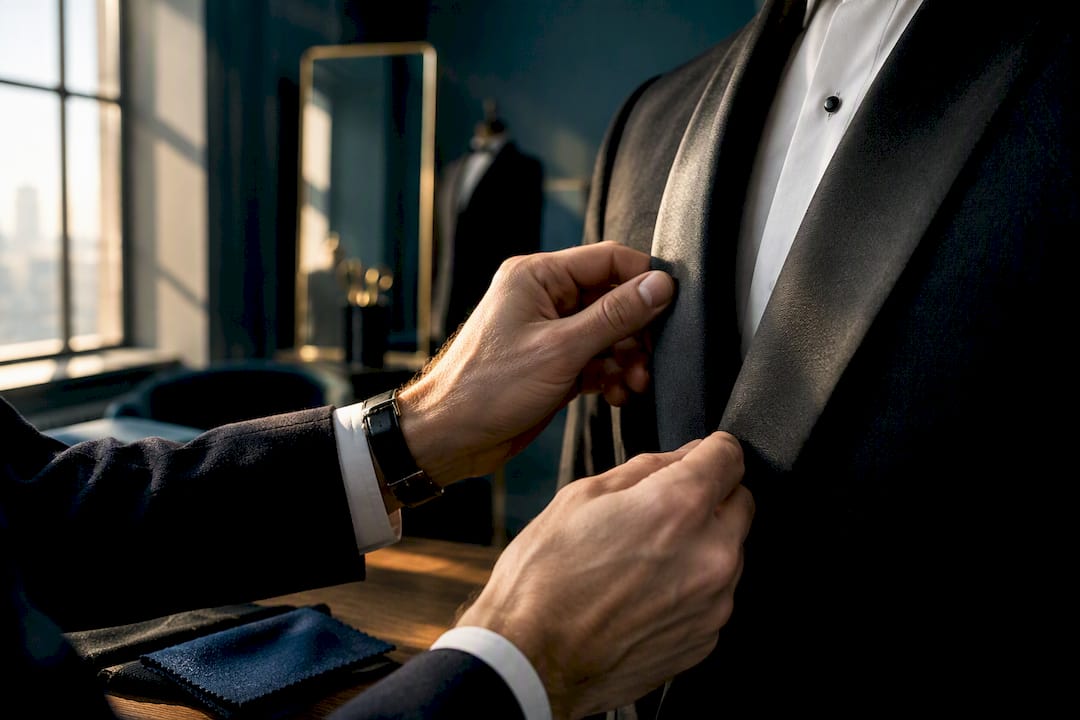
Shawl-collar and peaked waistcoats borrow their lapel shape directly from eveningwear. A shawl collar curves smoothly without a notch, echoing the satin lapel of a dinner jacket, while a peaked version adds a sharper point. Both are built for tuxedo pairings and formal evening weddings rather than daytime garden ceremonies. They photograph beautifully under low lighting, which is worth remembering if the reception moves indoors after dusk.
Three-piece matching waistcoats, cut from the same cloth as the suit, have become the default choice for a huge share of modern weddings. According to recent wedding-style trend analysis, three-piece suits with a waistcoat as the focal piece are increasingly the standard choice for 2026 weddings, largely because they give a groom a coherent look with or without the jacket on. That matters more than most men expect at a long reception.
Textured waistcoats in tweed, linen, or velvet step outside the matching-suit convention entirely. They’re chosen deliberately to add contrast, character, or seasonal appropriateness, and they’ve become one of the clearest style statements a groom can make without touching the jacket or trousers.
A few visual cues worth checking against photographs before you commit to a cut:
- Low-cut waistcoats expose more shirt and tie, which suits slimmer ties and simpler knots.
- High-cut waistcoats hide the tie almost to the knot, giving a cleaner, more buttoned-up finish.
- Wider lapel-adjacent V-shapes on double-breasted cuts draw the eye across the chest, useful for broader shoulders.
- Notch-lapel waistcoats (less common, but seen in vintage-inspired suits) sit between the softness of a shawl collar and the crispness of a plain V-neck.
If you’re building a photograph reference board, save one image per style rather than dozens of near-duplicates. Group them by ceremony type, since a shawl-collar tuxedo waistcoat photographed at noon looks entirely different from the same waistcoat under evening light.
How do fabric and colour choices suit the venue?
Fabric decides comfort and photographic quality far more than most grooms expect, and getting it wrong shows up in every photograph taken after the first hour.
Wool and wool-silk blends remain the safest all-round choice for temperate, indoor, or transitional-season weddings. They hold their shape through a long day of standing, hugging, and dancing, and they take tailoring alterations well if a fitting needs adjusting close to the date. Linen suits warm-weather and outdoor ceremonies, trading some structure for breathability. Tweed and other heavier woollen textures work best at rustic, countryside, or autumn weddings, where their matte finish and visible weave read as considered rather than costume-like. Velvet and silk belong at evening and black-tie events, where their sheen catches candlelight rather than midday sun.
That sheen is exactly the problem outdoors. Tailoring guidance consistently warns that highly formal waistcoats and shiny fabrics can look out of place at rustic outdoor weddings, where matte, textured cloth photographs far more naturally against grass, timber, and daylight. A satin waistcoat that looks sharp in a hotel ballroom can look strangely formal, even slightly out of place, under a marquee.
Pro Tip: Bring a swatch of the bride’s dress fabric, not just a colour photo on your phone, to any tailoring appointment. Matching a white waistcoat against an ivory dress by eye alone is exactly how photographs end up with the dress reading as discoloured next to the groom’s outfit.
Colour strategy for 2026 weddings tends to split into two camps:
- Tonal matchingwaistcoat, tie, and pocket square drawn from the same colour family for a calm, unified look.
- Deliberate contrasta champagne or patterned waistcoat against a brown or green suit. This combination has grown noticeably more popular this year.
- Jewel and earth tonesemerald, burgundy, and burnt orange waistcoats, often chosen specifically to stand out against a neutral suit.
- Seasonal lighteningpale sage, dusty blue, or soft grey for spring and summer ceremonies where deep tones can read as heavy in daylight photography.
Climate matters just as much as colour. A wool-silk blend breathes noticeably better than pure wool across a long outdoor afternoon, and it holds its shape better than linen once the dancing starts.
What fit and tailoring details matter most?
A waistcoat that fits badly is more noticeable than almost any other tailoring mistake, because it sits directly under the jacket with nowhere to hide.
Length is the first thing to check. The hem should sit right at the waistband, covering the top of the trousers without any gap of shirt showing when you move or sit. Too short, and the shirt peeks through at the front; too long, and it bunches awkwardly under the jacket hem.
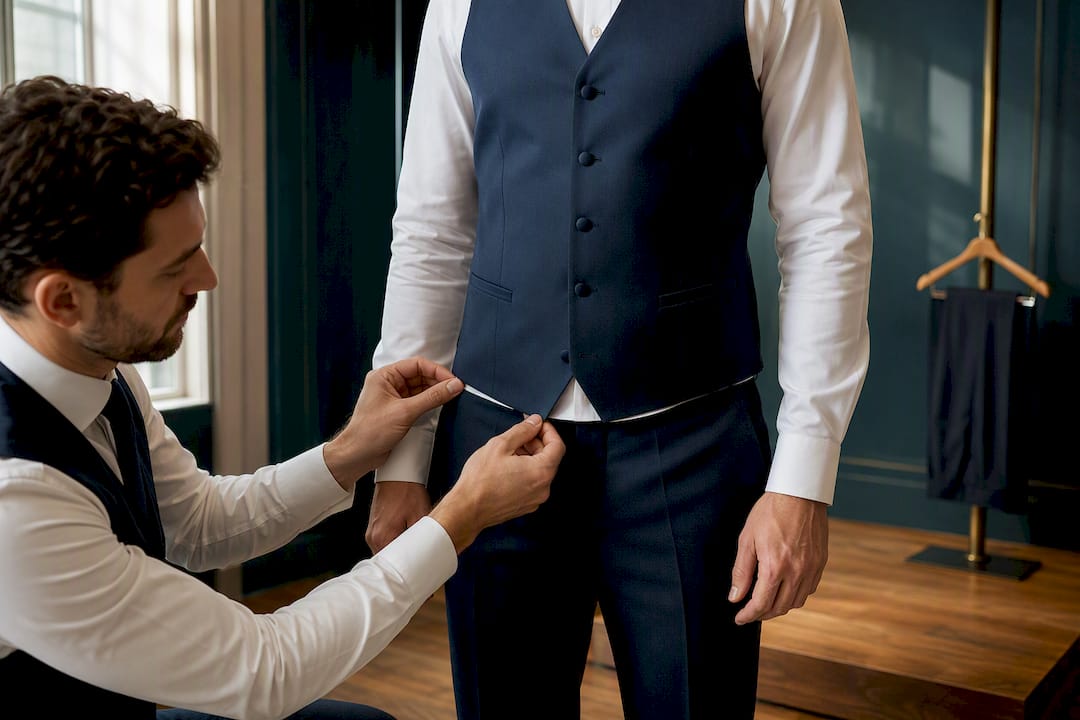
Ease, the small amount of room built into the fit, needs to allow movement, sitting, and reaching for a ring or a glass, without ever going slack across the chest. A waistcoat cut too tight will gape between buttons the moment you raise an arm for a photograph.
Back adjustments matter more than most ready-to-wear buyers realise. Bespoke waistcoats use an adjustable strap and buckle at the back, letting the fit tighten or loosen through a long day of eating and standing. Getting this adjustment right at the fitting solves most of the gaping and pulling problems that plague off-the-peg options.
Buttoning rules follow a simple convention: fasten all buttons except the very bottom one, which traditionally stays open on single-breasted cuts to allow easier movement when seated. Double-breasted waistcoats are typically fastened fully, since the overlapping front panel needs the buttons to hold its shape.
Bring this checklist to any fitting, whether bespoke or off-the-peg:
- Confirm the hem sits precisely at the waistband with the jacket on and off.
- Check for gaping between buttons when seated, reaching, and standing.
- Ask about the back strap material and adjustment range for the day.
- Confirm the lining fabric, since a breathable lining changes comfort significantly on a warm day.
- Test movement in the shoulders and armholes, since a stiff waistcoat restricts arm-raising more than any other garment layer.
- Ask how many buttons the cut expects you to leave open.
How do you accessorise a wedding waistcoat?
The waistcoat sets the formality baseline, and everything else, tie, pocket square, shoes, needs to follow its lead rather than compete with it.
Neckwear should match the waistcoat’s neckline. A low-cut single-breasted waistcoat, which shows more shirt, pairs well with a full Windsor knot or a patterned tie that fills that visible space. A high-cut waistcoat, which hides most of the tie, suits a simpler knot since little of it will be seen anyway. Shawl-collar waistcoats worn with a tuxedo call for a bow tie or a slim cravat, never a standard business tie.
Pocket squares offer three honest strategies: match the waistcoat exactly for a formal, coordinated look; pick a complementary shade from the same colour family for something softer; or contrast deliberately, a white square against a jewel-toned waistcoat, for definition in photographs. Whichever you choose, fold it simply. An elaborate fold reads as fussy against tailored formalwear.
Shoes and belts should echo the waistcoat’s formality level rather than its colour. A double-breasted or shawl-collar waistcoat calls for polished oxfords in black or deep oxblood. A textured tweed waistcoat at a rustic wedding allows more room for brown brogues or suede.
Removing the jacket is entirely acceptable once the ceremony and formal photographs are done, provided the waistcoat is smart enough to stand alone, which is precisely why the three-piece matching suit has become so popular; it keeps the outfit looking deliberate rather than half-undressed through the reception.
Three combinations worth borrowing directly:
- Formal ceremony: double-breasted or shawl-collar waistcoat, silk tie or bow tie, polished black oxfords.
- Semi-formal ceremony: three-piece matching waistcoat, patterned silk tie, contrasting pocket square, brown leather shoes.
- Smart-casual ceremony: textured linen or tweed waistcoat, knitted tie, suede shoes, no jacket for the reception.
A bespoke tailoring company with a long history emphasizes solving the common problem many grooms face: a waistcoat that looks perfect on a hanger but is uncomfortable on the hips, shoulders, and back strap. Bespoke tailoring addresses this by taking measurements tailored to individual posture and movement rather than averages.
It also solves the photography problem. A made-to-measure waistcoat, fitted alongside the rest of the wedding suit, lets us match fabric weight and colour precisely against the partner’s dress rather than approximating from a swatch card.
Before your consultation, bring:
- A fabric swatch or close-up photo of the bridal dress fabric and colour.
- Photographs of the venue, indoors or out, to judge how fabric texture will read in that light.
- Any reference images of silhouettes you like, whether double-breasted, shawl-collar, or textured.
- Your preferred formality level for the ceremony versus the reception, since these sometimes differ.
Choosing a waistcoat style to match your wedding theme
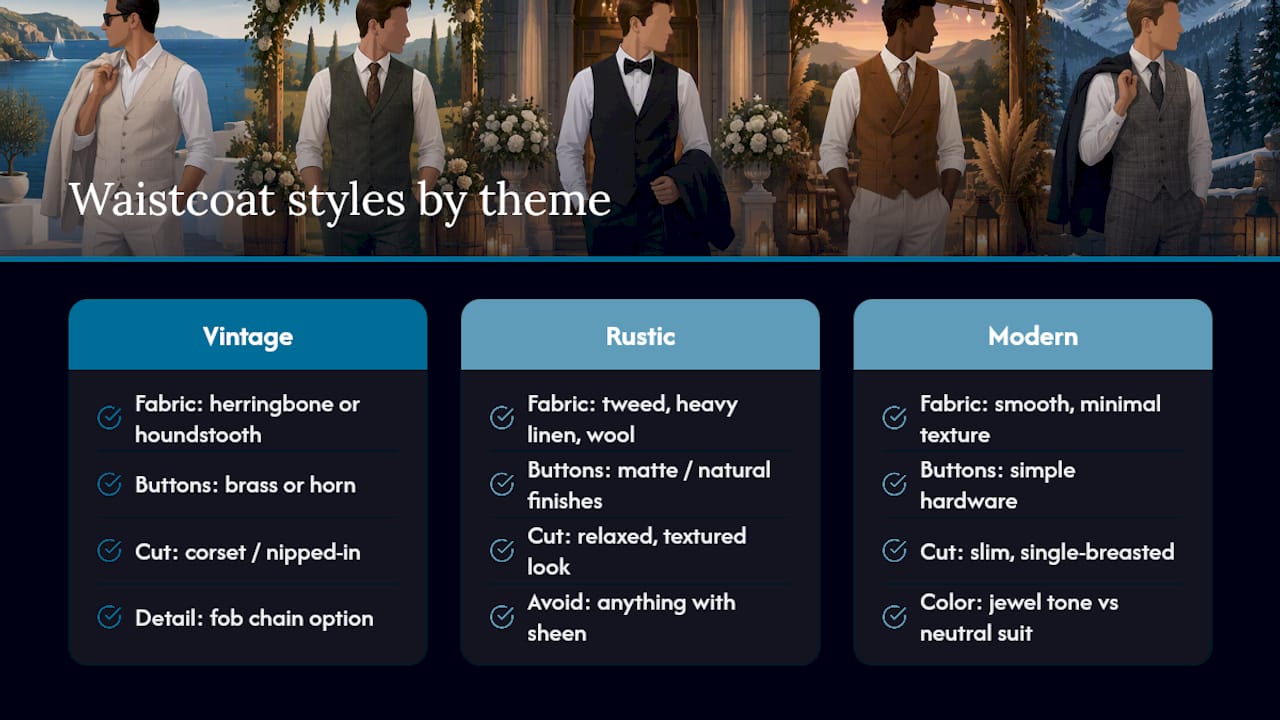
The theme of the wedding usually decides the waistcoat before the colour or fabric even comes into it, because a style that reads as elegant at a vintage-themed wedding can look flat and generic at a modern one.
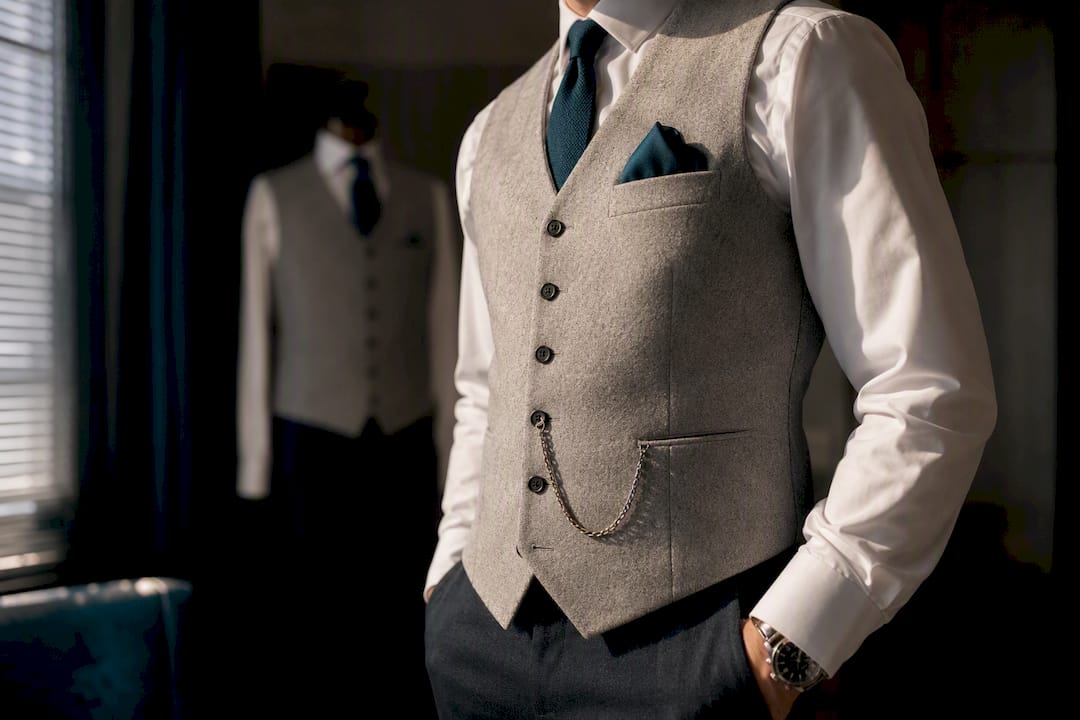
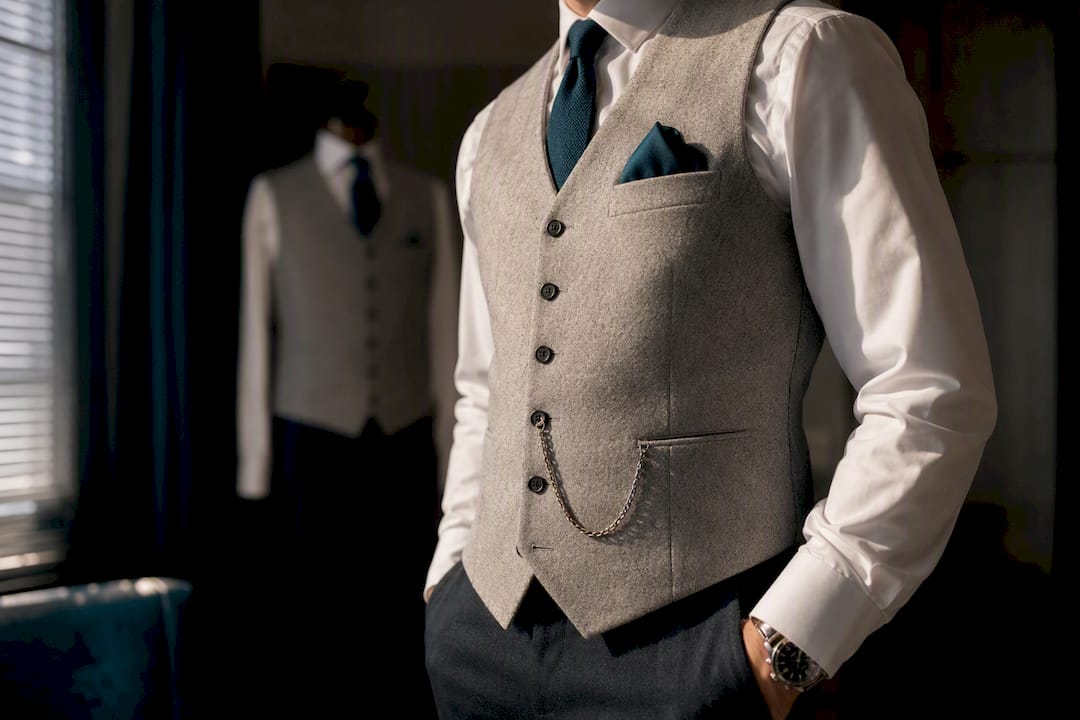
Vintage weddings favour waistcoats with character: fabric in herringbone or houndstooth, brass or horn buttons rather than plain plastic, and occasionally a fob chain for a pocket watch. Corset-style waistcoats with a more structured, nipped-in cut, a style seen in vintage-inspired menswear collections, suit this era-specific aesthetic particularly well for grooms who want something distinct from the standard three-piece suit.
Rustic and outdoor weddings call for exactly the matte, textured fabrics already covered: tweed, heavier linen, or wool with visible weave. Avoid anything with sheen, since rustic settings tend to be lit by daylight or string lighting rather than the controlled lighting of a hotel ballroom.
Modern weddings lean toward cleaner lines and deliberate contrast. Think a slim-cut single-breasted waistcoat in a jewel tone against a neutral grey or navy suit, minimal patterning, and hardware kept simple. This is where the three-piece matching suit does its best work, giving a coherent, photograph-ready silhouette without extra embellishment.
Should you rent or buy a wedding waistcoat?
Renting suits a groom who wants a single specific look for one day and has no intention of wearing formal eveningwear again soon, particularly for shawl-collar or heavily embellished styles used once. It also removes storage and alteration concerns entirely.
Buying, whether ready-to-wear or bespoke, makes more sense once you consider the waistcoat’s second life. A well-cut single-breasted or textured waistcoat gets far more wear at work events, other weddings as a guest, and smart-casual occasions than most grooms expect at the time of booking. Bespoke buying also removes the fit compromises that come with rental stock, which is sized to a limited run of standard measurements rather than to you specifically.
The deciding factor is usually cost against reuse. If the waistcoat is part of a three-piece suit you’ll wear again, buying almost always wins on value over two or three years. If it’s a highly specific eveningwear cut you’ll likely never repeat, renting avoids paying full price for one afternoon’s use.
What do wedding waistcoats cost?
Costs vary widely depending on whether you rent, buy off-the-peg, or commission bespoke tailoring, and the gap between those three routes is larger than most first-time buyers expect.
Rental waistcoats sit at the lowest price point but come with the least fit precision and no long-term value beyond the wedding day. Ready-to-wear purchases cost more upfront but reuse indefinitely, provided the standard sizing suits your build reasonably well. Bespoke tailoring costs more again, reflecting individual pattern-cutting, fabric selection, and fitting adjustments, and Ron & Rich lists bespoke waistcoats from $380, a price that reflects a garment cut and fitted specifically to your measurements rather than adjusted from a standard block.
Budgeting for the full outfit matters more than budgeting for the waistcoat alone. A waistcoat bought in isolation, without matching it against the suit fabric and the wedding’s formality level, often ends up replaced or heavily altered anyway, which erases any initial saving.
What tailored customisations are common for wedding waistcoats?
Bespoke waistcoats offer far more customisation range than most grooms realise before their first fitting.
Lapel style is the most visible customisation: notch, shawl, or no lapel at all for a plain V-neck front. This single choice shifts the waistcoat between daytime-appropriate and eveningwear-ready more than almost any other detail.
Pocket style ranges from simple welt pockets to more decorative flapped versions, with some grooms choosing a small ticket pocket as a nod to traditional English tailoring. Pocket placement also affects how a pocket watch chain sits, worth discussing early if that’s part of the look.
Back fabric and strap hardware can be customised too. A contrasting lining fabric on the back panel, invisible when the jacket’s on but a personal touch when it comes off, is a detail several grooms request specifically for reception photographs.
Button choice, from horn to brass to fabric-covered, changes the waistcoat’s formality register almost as much as the fabric itself. Horn buttons read as classic and slightly rustic; brass suits a more vintage aesthetic; fabric-covered buttons keep the look understated and formal.
Which waistcoat style suits your body type?
Certain cuts work harder for certain builds, and knowing this before a fitting saves a lot of back-and-forth with swatches.
Taller, leaner builds generally suit double-breasted waistcoats well, since the horizontal button rows and wider front panel add visual weight the frame doesn’t otherwise carry. Shorter builds often do better in single-breasted cuts, where the single vertical button line elongates the torso rather than cutting it visually into blocks.
Broader or fuller builds tend to suit single-breasted waistcoats with a slightly lower cut, avoiding the extra fabric bulk that a double-breasted front can add across the midsection. A well-placed back strap adjustment, set correctly at the fitting, does more for comfort on a fuller frame than fabric choice alone.
Whatever the build, the single most reliable fix for an unflattering waistcoat isn’t a different cut. It’s a proper fitting.
What actually matters when choosing a wedding waistcoat
Most wedding style guides treat the waistcoat as decoration, something chosen last, to match a tie that was chosen after the suit. That order is backwards. The waistcoat sits closest to the body and holds its shape all day; get its fit and fabric right and the rest of the outfit falls into place far more easily than the reverse.
The conventional advice to “match everything” also oversells uniformity. A contrasting waistcoat against a neutral suit, done deliberately rather than by accident, photographs better than a head-to-toe monochrome look in most modern wedding settings. What the research genuinely supports is prioritising fabric behaviour over trend-chasing: matte texture outdoors, breathable blends in heat, sheen reserved strictly for evening light.
If you take one thing from this guide, prioritise the fitting over the fabric swatch. A beautifully matched colour on a badly fitted waistcoat still photographs as ill-fitting. Get the back strap, the length, and the button count right first. Everything else is genuinely easier to fix afterwards.
Ron
Book a fitting for your wedding waistcoat with Ron & Rich
Ron & Rich is the direct alternative to guessing your way through rental racks or standard-block sizing: every wedding waistcoat is cut to your own measurements, fitted alongside the rest of your suit, and matched fabric-for-fabric against your partner’s dress before the final pattern is cut.
A consultation starts with the practical groundwork covered above, your fabric swatch, venue photographs, and preferred silhouette, then moves into fabric selection and a fitting schedule built around your wedding date. Waistcoats start from $380, and the same visit can cover the full three-piece suit if you want jacket, trousers, and waistcoat cut as one coherent set. Browse the current suit and jacket range for silhouette ideas, then book a fitting to start the process with a proper measurement session rather than another round of online browsing.
Sources
- What to wear to a wedding, Love, Bonito
- Beliebte Hochzeitsanzug-Stile im Jahr 2026 | TruClothing
- Hochzeitsanzug Herren 2026: Die Kunst, Ihren Stil auf die Location abzustimmen - ITALIAN SUITS
- Hochzeitsanzüge 2026: Trends & Fachberatung bei Lin-Riehl
FAQ
What are the different styles of waistcoats?
The main styles are single-breasted, double-breasted, three-piece matching, shawl-collar, and textured waistcoats in fabrics like tweed, linen, or velvet. Each carries a different formality level, from the everyday versatility of a single-breasted cut to the eveningwear association of a shawl collar.
What are the current waistcoat trends for 2026?
Three-piece suits with the waistcoat as the focal styling piece are leading 2026 wedding fashion, alongside a rise in deliberately contrasting waistcoats, such as champagne or patterned vests against brown or green suits. Jewel tones like emerald and burgundy are also proving popular for grooms who want their waistcoat to stand apart from the suit.
What are the etiquette rules for wearing a waistcoat?
Fasten all buttons on a single-breasted waistcoat except the bottom one, which traditionally stays open for ease of movement when seated. Double-breasted waistcoats are usually fastened fully, and jackets can be removed for the reception once formal photographs are finished, provided the waistcoat is smart enough to carry the look alone.
Are waistcoats still fashionable for 2026 weddings?
Yes. Three-piece suits are increasingly the standard choice for weddings because they give structure and photographic continuity once the jacket comes off later in the day. Far from fading, the waistcoat has become one of the more expressive parts of a groom’s outfit, particularly through contrasting colours and textured fabrics.
How much does a wedding waistcoat cost?
Costs depend heavily on the route chosen, with rental sitting cheapest, ready-to-wear in the middle, and bespoke tailoring reflecting individual fit and fabric choice. Bespoke waistcoats at Ron & Rich start from $380, cut specifically to your measurements rather than adjusted from stock sizing.