Bespoke Velvet from $2,270: A Tailor's Verdict on Velvet Tuxedo Jackets
We recommend bespoke tailoring for any velvet tuxedo jacket you intend to wear more than once, because velvet magnifies fit faults that wool quietly forgives. Ready-to-wear suits suit a tight budget or a last-minute invitation. We built this guide to walk you through fabric choice, fit, styling and care before you commit.
TL;DR:
- A bespoke velvet tuxedo is essential if you wear it multiple times, because fit issues are more visible due to velvet’s tendency to magnify faults.
- Velvet’s fabric composition significantly influences its durability, sheen, and cost, with cotton being sturdy, silk the most luxurious, and viscose a mid-range option.
- Proper nap alignment, construction details like canvas lining, and natural shoulders are critical for a well-fitting and lasting velvet jacket.
- Buying off-the-rack is suitable for occasional wear and typically involves limited alterations, while bespoke tailoring ensures perfect fit for frequent use or special occasions.
- Velvet jackets are ideal for autumn and winter events, especially for weddings or formal nights, due to their warmth and light-catching fabric qualities.
Table of Contents
- What to check on a product page or at a fitting
- Fit and tailoring: what to expect for a velvet tuxedo
- How to style a velvet tuxedo for weddings, proms and formal nights
- Care, cleaning and travel for a velvet tuxedo
- Why bespoke suits velvet: our tailoring advantages
- Key velvet fabrics and how they differ
- Composition and lining details shown on product pages
- Price range: entry-level to luxury velvet tuxedo jackets
- Recommended retailers and brands for quality velvet jackets
- Timeline: from selection to tailoring and delivery
- A tailor’s honest take on velvet tuxedos
- Book a fitting with RON & RICH
- FAQ
- Sources
What to check on a product page or at a fitting
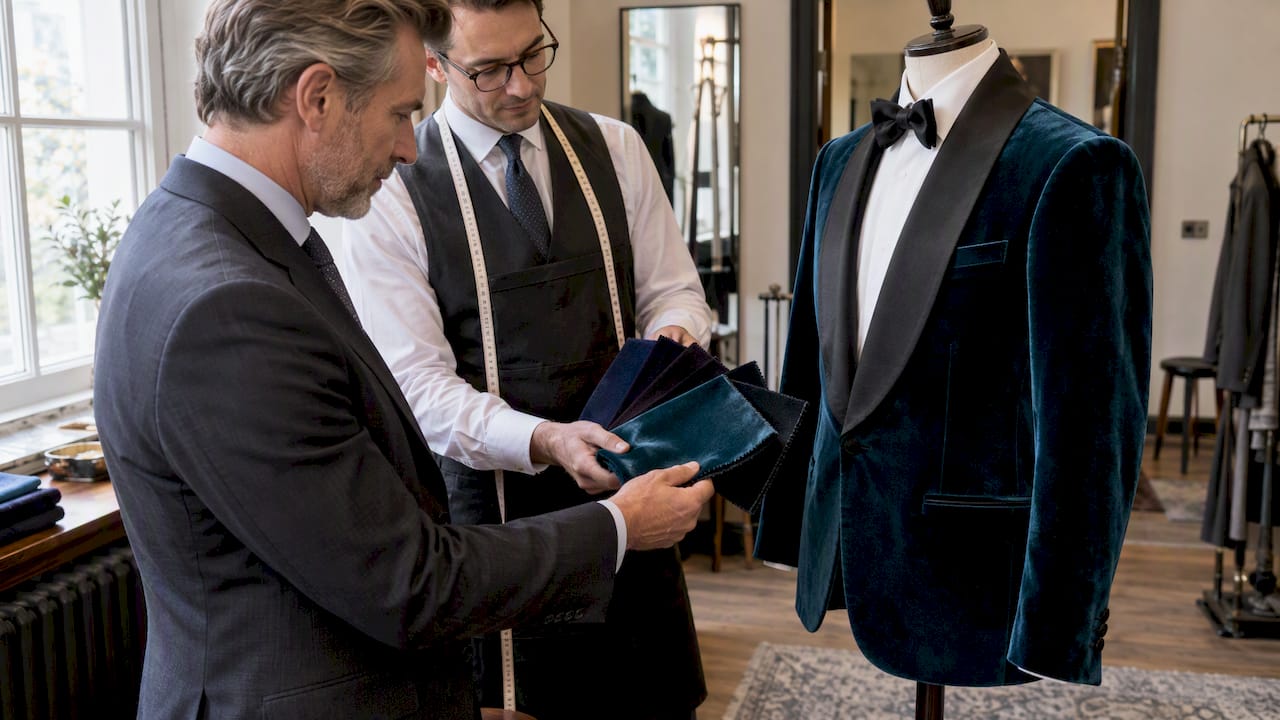
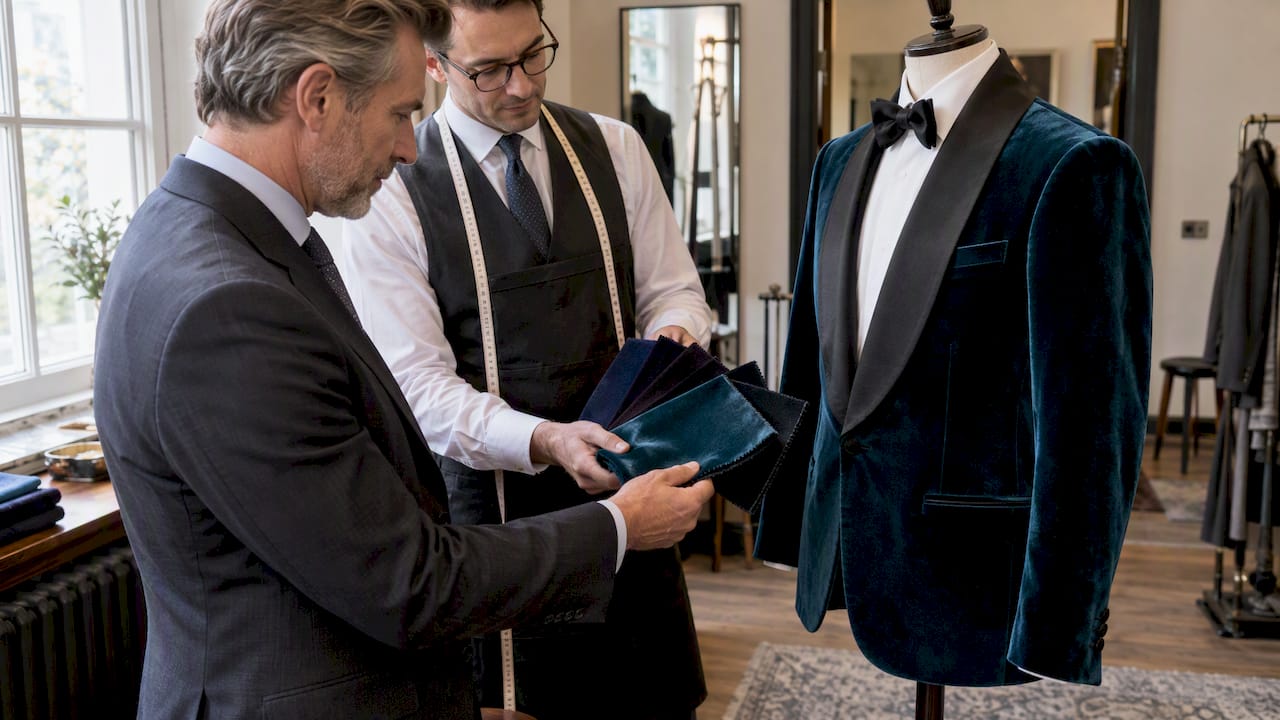
Velvet is not one fabric but several, and the composition line on a listing tells you almost everything about how the jacket will behave. Cotton velvet has a firm, matte hand and resists crushing well, which makes it forgiving for a first purchase. Silk velvet carries the deepest sheen and the softest drape, but it marks more easily and costs more. Viscose and viscose blends split the difference, offering sheen closer to silk at a gentler price, while stretch blends trade a little lustre for movement, useful if you plan to dance all night.
Pile direction, or nap, matters more with velvet than with almost any other fabric. Light hits the pile differently depending on which way it runs, so a jacket cut with mismatched nap across the seams will show patches of colour that shift as you move. A well-made jacket keeps the nap running in one consistent direction across both panels and the collar.
Lapel finishing is another tell. Shawl lapels in silk or satin facing read as classically formal, while peak lapels with a sharper facing suit a bolder, more modern look. A notch lapel on a velvet jacket, borrowed from everyday suiting, tends to undercut the occasion.
Before buying, check these construction signals:
- A full or half canvas front rather than fused interlining, which affects how the jacket drapes and ages.
- Natural shoulder construction with minimal padding, since velvet already adds visual weight.
- A smooth, breathable lining such as Bemberg or silk, named explicitly on the product page.
- Consistent nap direction visible across the front panels and collar in product photography.
Pro Tip: Run your hand across the fabric in both directions under a strong light; if the sheen flips dramatically, the nap is loosely woven and will crush faster with wear.
Fit and tailoring: what to expect for a velvet tuxedo
Fit targets for a velvet tuxedo are the same as for any evening jacket: a clean line through the chest with no pulling across the button, shoulders that end exactly at the natural shoulder bone, and sleeves finishing where a half inch of shirt cuff shows. Waist suppression should follow your natural shape without gaping at the lapel when buttoned.
Routine alterations are straightforward:
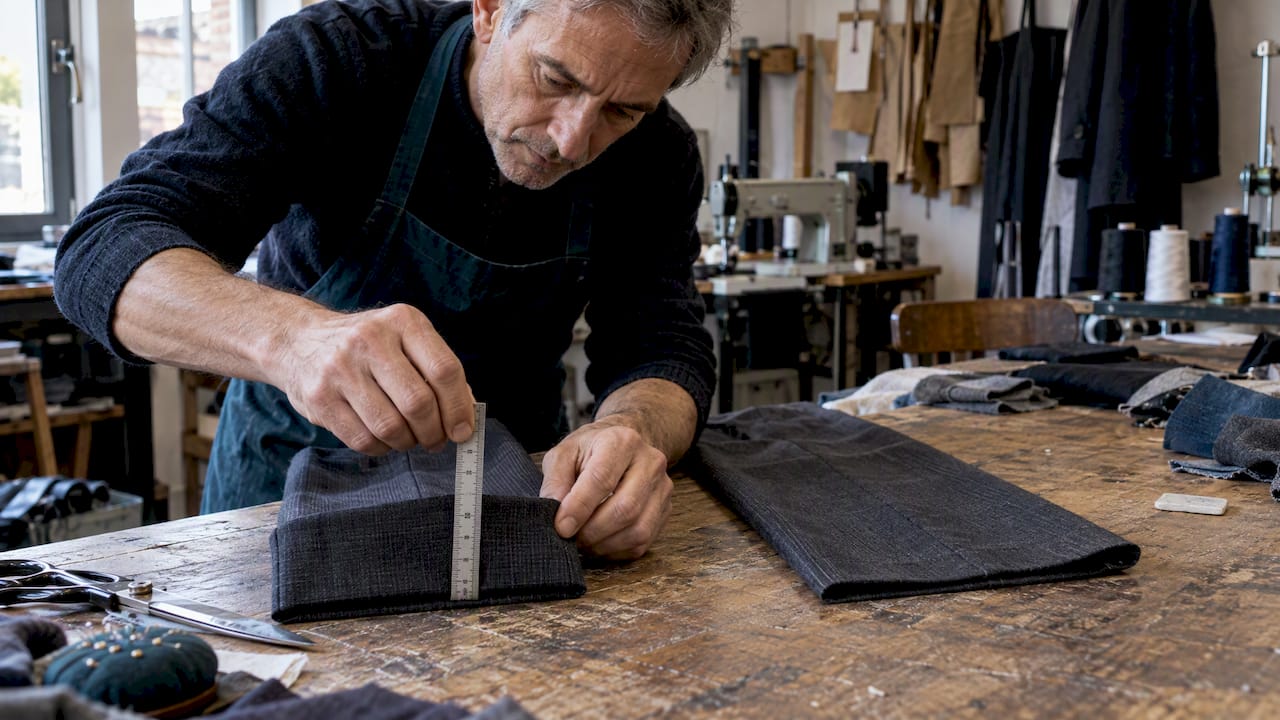
- Sleeve length and trouser hem, which rarely touch the pile or nap.
- Waist suppression on the side seams, usually safe on plain velvet.
- Shoulder adjustments, which are far more delicate on a patterned or napped fabric because they can disrupt nap alignment across the seam.
Because velvet has more body than wool, many buyers find ready-to-wear sizing runs slightly tight across the shoulders and chest. Sizing up and taking the waist in is often easier than the reverse. Structural changes such as resetting a sleeve or narrowing shoulders on a patterned velvet are where bespoke earns its keep, since a tailor can recut the panel with the nap preserved rather than patching around it.
Pro Tip: Try the jacket buttoned and seated before buying; velvet’s stiffness shows pulling across the back far sooner than softer wool does.
How to style a velvet tuxedo for weddings, proms and formal nights
Black velvet with a satin shawl lapel, a plain white dress shirt and black grosgrain bow tie is the safest black-tie formula, suited to weddings and formal galas alike. Navy and burgundy velvet read as modern alternatives that still respect a black-tie dress code when paired with black trousers and classic black patent or velvet slippers.
- Keep trousers in flat black wool or matching velvet, never jeans or casual chinos.
- Choose a silk bow tie over a necktie for traditional black tie, though a slim satin tie suits a less formal “black tie optional” setting.
- Add a plain white or black silk pocket square rather than a patterned one, which can clash with the pile’s sheen.
- Save patterned or jacquard velvet for less formal evenings, and tone the rest of the outfit down to solid black or navy.
Velvet runs warmer than wool, so it suits autumn and winter events far more comfortably than an outdoor summer wedding.
Care, cleaning and travel for a velvet tuxedo
Brush velvet after every wear with a soft garment brush, working in the direction of the nap to lift crushed pile. Steam rather than iron; direct heat from an iron flattens the pile permanently, while steam from a distance restores loft without contact.
- Spot clean small marks immediately with a dry cloth rather than rubbing, which spreads the stain into the pile.
- Send the jacket to a specialist dry cleaner experienced with velvet, not a general press service.
- Store on a wide wooden hanger with breathing space either side, never under plastic.
- Travel with the jacket rolled in a garment bag with tissue padding at the shoulders, since folding crushes the nap at the crease.
Professional cleaning after each significant event, rather than routine dry cleaning on a fixed schedule, helps velvet’s pile recover without excess chemical exposure, a point echoed in specialist luxury fabric care guidance. Bridal and menswear editors also note that velvet’s appeal lies in how it absorbs light differently from flat wool, which is exactly the quality that heat and over-pressing destroy.
Why bespoke suits velvet: our tailoring advantages
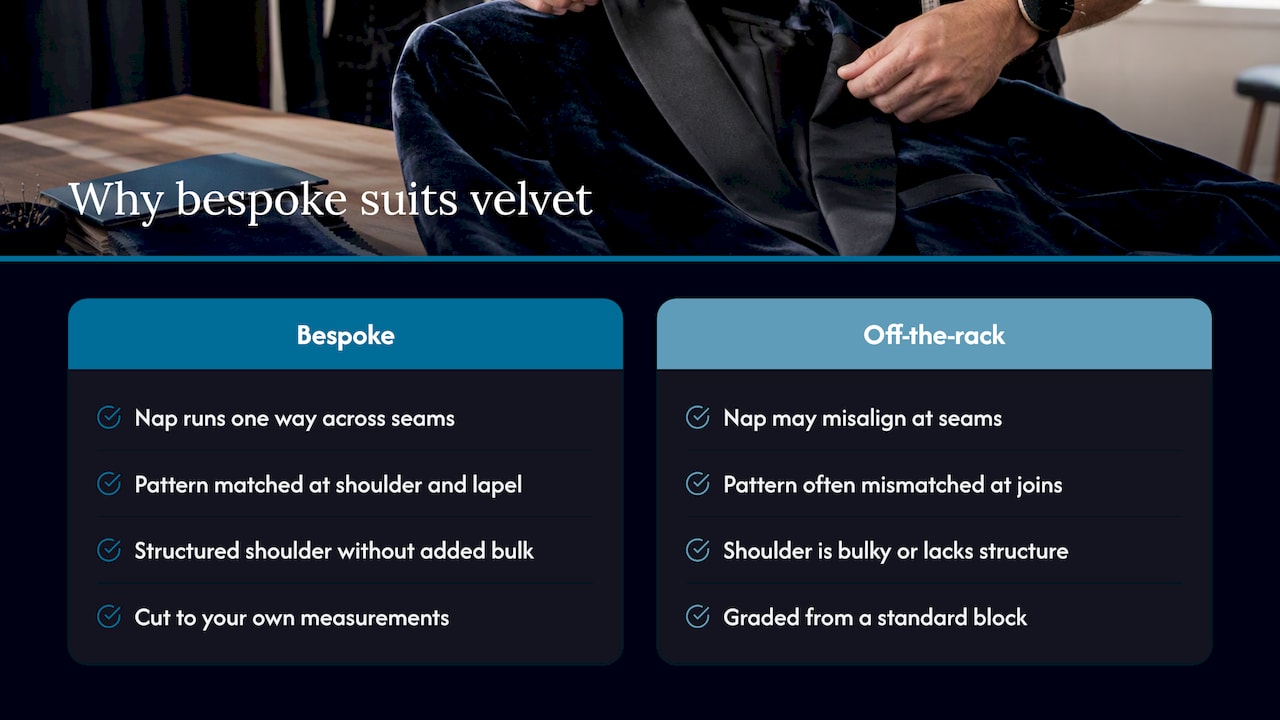
Velvet punishes shortcuts. Nap has to run in one direction across every seam, pattern has to match at the shoulder and lapel join, and the shoulder itself needs enough structure to hold its line without adding bulk to an already heavy fabric. We have built our practice around exactly this kind of precision, addressing the fit challenges that off-the-rack velvet jackets routinely get wrong.
A bespoke jacket is cut to your own measurements rather than graded from a standard block, so the shoulder, chest and sleeve all meet at the proportions that suit your frame, not an average one. For event wear, that precision matters in ways a photograph will show: a jacket that sits correctly through the back and shoulders photographs cleanly from every angle and still allows you to move through a full evening without pulling. Each adjustment is documented at fitting, so a return visit or a future order starts from a record rather than a guess.
Key velvet fabrics and how they differ
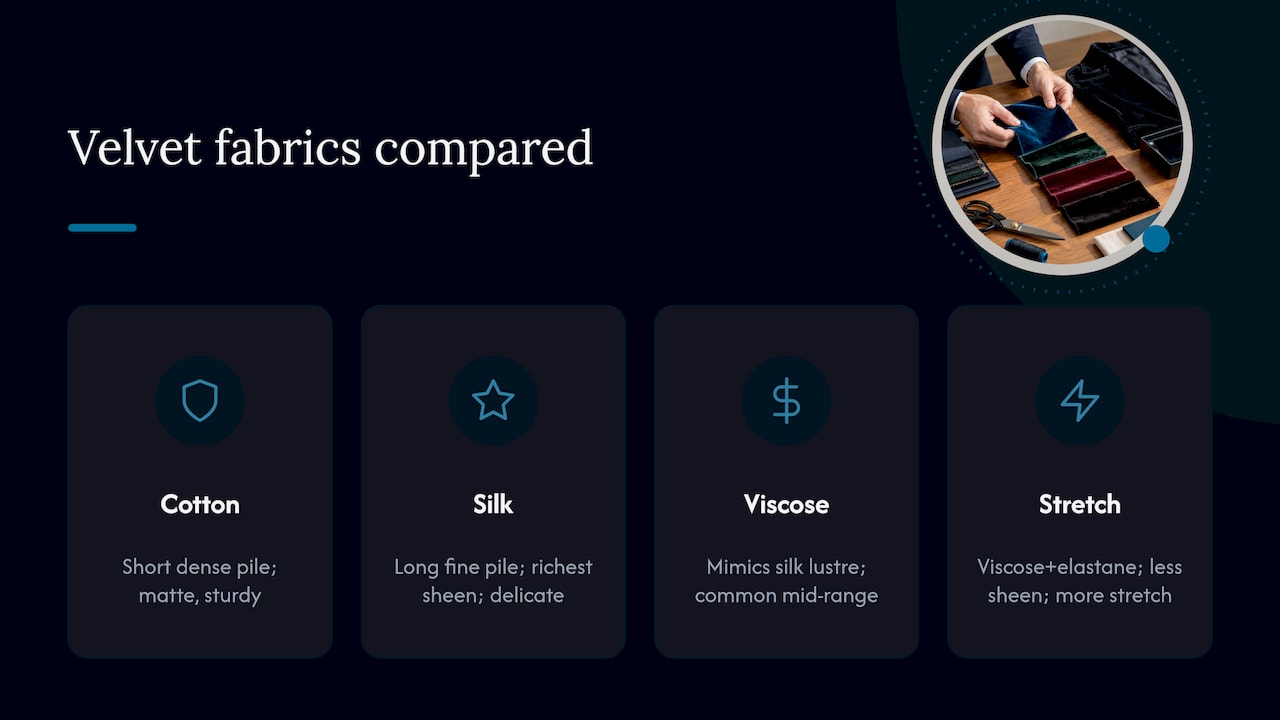
Cotton velvet is woven with a shorter, denser pile, which gives it a matte finish and a sturdiness that holds up to repeated wear, making it a sound choice for a first velvet jacket. Silk velvet is woven with a longer, finer pile that catches light with far greater depth, producing the richest sheen in the category, though it is also the most delicate and the most expensive.
Viscose velvet, often blended with silk or cotton, mimics silk’s lustre at a gentler price point and is now the most common base for mid-range jackets. Stretch velvet blends, usually viscose with a small percentage of elastane, sacrifice a touch of sheen for ease of movement, a reasonable trade for a long reception or a night on the dance floor.
None of these fabrics is objectively superior. The right choice depends on how often you expect to wear the jacket, how formal the occasion is, and how much handling the garment will take. A groom wearing the jacket once might choose silk for maximum impact; a man wearing his jacket through several winters of events is usually better served by cotton or a viscose blend.
Composition and lining details shown on product pages
A trustworthy product page states fabric composition as a percentage breakdown, such as a cotton and viscose blend, rather than a vague description like “luxury velvet.” That figure tells you how the jacket will wear and clean. The lining matters just as much: a Bemberg or silk lining allows the jacket to slide on smoothly over a dress shirt, while a cheaper polyester lining can cling and generate static against velvet’s pile.
Listings worth trusting also state lapel facing material separately from the main fabric, since a satin or silk facing on a velvet body is standard for formal jackets and its absence is a sign of a more casual cut. Washing and care instructions, usually specifying dry clean only, should appear alongside composition rather than buried in a separate policy page. Treat a listing that omits composition, lining and care details as one to question before you buy, bespoke or otherwise.
Price range: entry-level to luxury velvet tuxedo jackets
Velvet tuxedo jackets span a wide price range driven mostly by fabric and construction quality. Entry-level ready-to-wear jackets in cotton velvet with fused fronts sit at the lower end, offering a reasonable option for occasional wear. Mid-range jackets in viscose blends with half-canvas construction cost more but hold their shape through repeated wearing and cleaning.
At the bespoke end, our tuxedo service starts from $2,270, reflecting individual pattern-cutting, nap-matched construction and a fitting process built around your own measurements rather than a standard size run. For readers assembling a full outfit, trousers start from $290 and shirts from $199 through the same pricing page. Luxury silk-velvet bespoke commissions sit above that baseline, since the fabric itself costs more and demands more careful handling at every stage of construction.
Recommended retailers and brands for quality velvet jackets
Quality velvet jackets come from two broad sources: established ready-to-wear labels with a track record in formalwear, and bespoke tailoring houses that cut to individual measurement. For a finished jacket bought off the rack, look for retailers that state fabric composition, lining material and lapel facing clearly on the product page, and that offer alteration services in-house rather than leaving you to find a separate tailor.
For a jacket built around your own proportions, our ready-to-wear range at RON & RICH suits readers who want a faster option, while our bespoke suits and tailoring service suits anyone planning to wear the jacket for more than a single event. Bridal and menswear editors continue to point attention toward velvet as a statement choice for grooms and formal guests heading into the colder months, which is where quality construction pays off most visibly in photographs.
Timeline: from selection to tailoring and delivery
A bespoke velvet tuxedo begins with a consultation, where you choose fabric, lapel style and colour against your event date and existing wardrobe. A first fitting follows, usually within one to two weeks, where the jacket is cut and basted for an initial check on shoulder and chest fit. A second fitting refines the details, sleeve length, waist suppression and lapel roll, before a final pressing and delivery.
Readers planning around a wedding or a major event should start the process well ahead of the date, since velvet’s nap-matching and canvas construction take longer at each stage than a simple wool suit. Our own wedding suit guidance sets out what to expect booking-wise for anyone tailoring around a fixed date. Ready-to-wear, by contrast, can be bought and adjusted within days, which is the main argument for choosing it when time is short, a trade-off we cover in our rental versus purchase guide.
A tailor’s honest take on velvet tuxedos
Choose bespoke if the jacket is for a wedding, a recurring professional event or anywhere you will be photographed, since fit is the one thing velvet cannot hide. The two mistakes we see most often are a cheap lapel facing that looks flat next to the pile, and nap running in different directions across the seams, both signs of a rushed cut rather than a deliberate one.
Ron
Book a fitting with RON & RICH
A consultation with us starts with fabric selection, since the velvet you choose dictates everything from lapel finish to how warm the jacket will feel through an evening. From there, we take full measurements and talk through lapel style, lining and the occasion itself before cutting begins.
If you are planning a wedding, a gala or a run of formal events, our tuxedo service is built around exactly that kind of repeat wear, with pricing and the full range of jackets, trousers and shirts on our pricing page. Prefer a faster route, browse our ready-to-wear collection instead. Either way, booking a fitting is the next step.
FAQ
Is a velvet tuxedo appropriate for a wedding?
Yes, velvet is widely recommended by bridal and menswear editors as a statement choice for grooms and formal guests, particularly for autumn and winter weddings. It suits both traditional black-tie ceremonies and more relaxed black-tie optional settings when paired with classic trousers and a silk bow tie.
Is a velvet tuxedo warm to wear?
Velvet is noticeably warmer than wool because of its dense pile, which makes it better suited to autumn and winter events than a hot summer afternoon. For an outdoor or warm-weather occasion, a lighter stretch velvet blend is more comfortable than a traditional silk or cotton velvet.
What is the difference between a velvet dinner jacket and a tuxedo?
A velvet dinner jacket refers specifically to the jacket itself, cut in velvet rather than wool, while a tuxedo describes the full black-tie outfit, jacket, trousers and accessories together. In practice, a velvet dinner jacket is simply the jacket component of a velvet tuxedo outfit.
Is the velvet jacket still in style?
Velvet remains a recurring favourite in formalwear, with bridal and menswear editors continuing to recommend it for grooms and gala guests seeking a modern, luxurious alternative to plain wool. Its appeal lies in how the fabric catches light differently from flat weaves, which keeps it feeling current rather than dated.