Travel Suit Care: Preserve Bespoke Shape with Tailor's Fabric and Packing Tips
Carry your suit in an in-cabin garment bag whenever you can, or fold it with care if a carrier is not practical, then hang it the moment you reach your room. Place it at the top of the bag, away from shoes and heavy items, so nothing presses against the fabric during the flight. At the hotel, unzip the bag first and let the jacket breathe before you reach for a steamer.
TL;DR:
- Using an in-cabin garment bag is the safest way to keep a suit wrinkle-free during travel, especially for short trips.
- Folding suits properly with tissue paper or a soft shirt inside helps maintain shape, but overstuffed bags increase wrinkling risks.
- Midweight wool suits recover from compression better than lighter fabrics, and hanging the jacket overnight helps release natural creases.
- Light steaming and hanging are effective for minor wrinkles, but deep creases require professional finishing for proper restoration.
- Proper storage on a wide, shaped hanger preserves the suit’s structure, especially for bespoke garments with internal canvases.
Table of Contents
- Practical packing methods: carriers, folds and a travel checklist
- Which fabrics travel best and how to treat each
- Handling a suit in transit and on arrival
- Safe wrinkle removal methods and when to choose professional finishing
- Care labels, stain triage and deciding between home and professional cleaning
- Compact toolkit and five-minute fixes every traveller should know
- Tailor’s advice on preserving a bespoke suit’s structure
- A note from Ron on what matters most when you travel
- Another option: travel-friendly fabrics and in-house finishing
- Primary sources and technical references
- Sources
- FAQ
Practical packing methods: carriers, folds and a travel checklist
A suit carrier or garment bag is the surest way to arrive with a jacket that still holds its shape. It works best for short trips where you can keep the bag in-cabin, since checked carriers are at the mercy of baggage handlers and stacking. For longer journeys or when a carrier will not fit your travel style, a careful fold inside a normal case is the next best option.
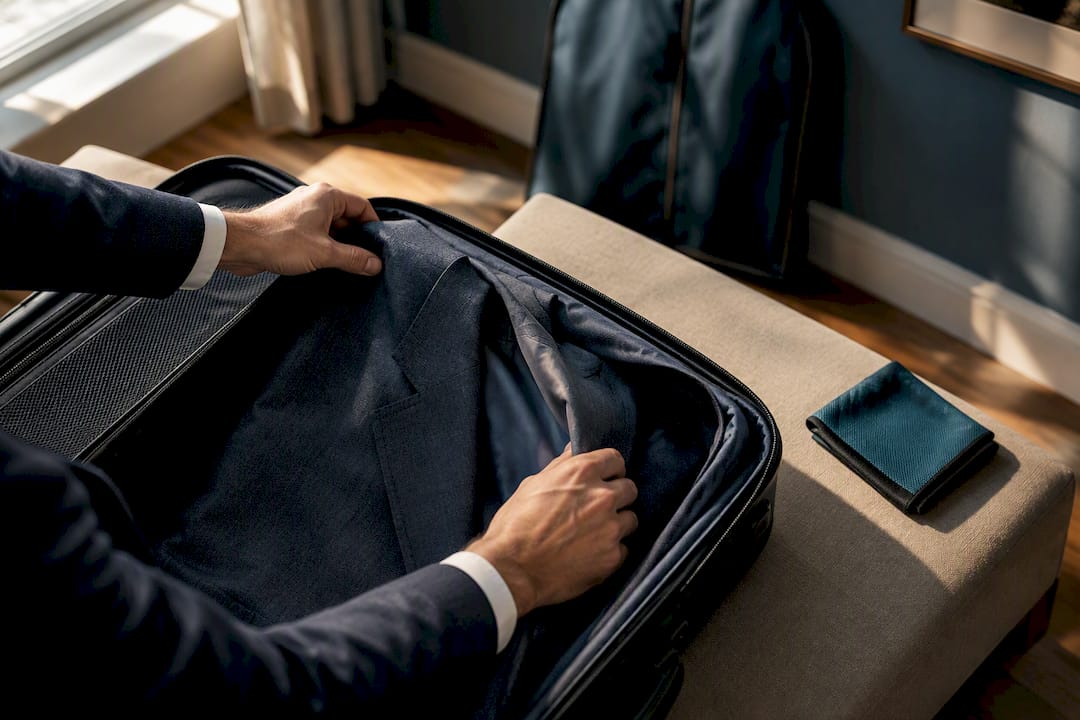
The most reliable carry-on method turns the jacket inside out before folding it in half, shoulder to shoulder, so the inner lining takes the crease rather than the visible wool. Trousers fold best over a trouser bar or along their natural crease, then rest flat rather than bunched. Tissue paper or a rolled shirt placed inside the fold gives the shoulders and lapels something to hold their form against, which softens the sharp crease line that forms when fabric presses directly on fabric.
Hard-shell suitcases protect against crushing from the outside but leave less room to manage internal pressure, since the case itself does not flex. A soft bag adapts around the suit but only if you resist overpacking. Forum-tested advice from frequent travellers consistently points to one culprit behind most travel wrinkles: a bag stuffed too tightly, leaving the suit no room to breathe.
A short checklist keeps the process consistent trip after trip:
- Garment bag or carrier sized for the jacket without folding the shoulders.
- Tissue paper or a soft shirt for internal fold support.
- A travel-sized fabric steamer or a folding travel iron.
- A lint roller and a small sewing kit for last-minute fixes.
- A spare hanger, since hotel hangers are not always suited to structured shoulders.
Before you zip the bag, run through this order:
- Empty jacket pockets completely to avoid uneven bulges.
- Turn the jacket inside out and fold shoulder to shoulder.
- Lay trousers flat along the crease, then fold once over the bar.
- Place both at the top of the case or in the garment bag’s dedicated sleeve.
- Add soft items such as shirts or knitwear around, never on top of, the suit.
Which fabrics travel best and how to treat each
Midweight wool, roughly in the range used for travel suit fabrics designed for frequent flyers, recovers from compression far more readily than lighter cloths. Wool fibres have natural memory: hang the jacket and let it rest overnight, and creases from folding tend to drop out on their own. This is why wool remains the benchmark fabric for anyone who packs a suit more than once a month.
Blends with a share of polyester or nylon resist wrinkling better in the case but sacrifice breathability, which matters on longer flights or in humid climates. They also carry a higher risk of shine under heat, since synthetic fibres respond to an iron very differently to natural wool. Pure synthetics hold a crease line poorly and can develop a slight sheen that no amount of steaming fully removes.
A few buying cues make a travel suit noticeably easier to live with:
- Choose a half-canvas or full-canvas construction, since fused linings tend to bubble after repeated compression.
- Favour a lighter half-lining or unlined jacket in warm climates, which reduces heat retention and creasing.
- Look for a fabric weight suited to your climate rather than the lightest cloth available, since very light wool creases more easily than a well-chosen midweight.
Pro Tip: Ask your tailor which cloth in the collection is woven specifically with travel in mind. Our suit fabric guide covers how weight and weave affect creasing across seasons.
Handling a suit in transit and on arrival
Keeping a suit presentable does not end once it is packed. What happens between check-in and your hotel room matters just as much.
- Store the garment bag in the overhead locker, laid flat if space allows, rather than folded into a smaller compartment.
- If cabin space is tight, ask cabin crew whether a closet is available. Many aircraft reserve one for suits and formal wear.
- At security, remove the suit from tight overhead bins only when necessary, and avoid pushing other bags against it while it is out of the carrier.
- On arrival, hang the jacket on a wide, shaped hanger rather than a wire one, since a wire hanger distorts the shoulders within hours.
- Unzip the garment bag as soon as you reach the room and let the jacket air for thirty minutes before doing anything else.
Most creases from a well-packed suit soften considerably once the jacket has hung for a few hours in a room with normal air movement. A gentle steaming session, held a few centimetres from the fabric, finishes the job without pressing anything flat. Save ironing for cases where hanging and light steam genuinely are not enough, since heat and pressure are far harder to undo than a crease.
Pro Tip: If your room has a bathroom with a door that seals well, run a hot shower for ten minutes with the suit hanging nearby. The ambient steam softens wrinkles gently, without direct contact.
Safe wrinkle removal methods and when to choose professional finishing
A handheld steamer is the safest home tool for a tailored jacket, provided you hold it slightly away from the fabric and let the steam do the work rather than pressing the head directly against the wool. Direct pressure with a steamer head can flatten the internal canvas that gives a jacket its shape, which is difficult to restore once compressed.

Ironing carries more risk and should follow the fabric’s own tolerance. Iron temperature dots correspond approximately to standard thermostat settings at low, medium, and high heat levels), and a damp press cloth between the iron and the fabric reduces direct heat transfer, which is what prevents the shiny “glazing” that ruins a jacket’s finish. Skipping the press cloth is the single most common way travellers damage a good suit while trying to fix it.
Bathroom steam works as a short-term fix for light creasing but has clear limits. It softens fibres without applying any shaping pressure, so it will not correct a sharply folded lapel or a deep crease across the back panel. It buys you a presentable suit for a meeting, not a full recovery.
For anything beyond light creasing, professional finishing does what no home method can. Cleaners use a damp-puppet or tunnel finisher, a padded form that applies steam and gentle pressure from the inside, re-inflating the fibres and restoring drape after cleaning. That inflation effect is why a professionally finished jacket feels noticeably different to one pressed at home, and it is generally a safer route than repeated home ironing for restoring shape.
- Use a steamer for light creasing and general refreshing between wears.
- Reserve ironing for flat panels such as trouser legs, always with a damp press cloth.
- Book professional finishing when a jacket has been heavily compressed or shows deep, set creases.
Care labels, stain triage and deciding between home and professional cleaning
Every suit carries its own instructions, and the care symbols on the label represent the manufacturer’s maximum tolerance rather than a rough suggestion. Care symbols specify the maximum tolerable treatment under ISO 3758, covering washing, ironing and professional cleaning, and a gentler approach is always acceptable even when the label permits more. Ignoring the symbols risks damage that cannot be reversed.
Most tailored suits with a high wool content are not designed for a washing machine at all. Guidance on men’s tailored trousers and suiting recommends professional dry cleaning rather than home washing, since water and agitation can permanently distort the fibres and the jacket’s internal structure.
For fresh stains, speed matters more than force:
- Blot sweat or coffee immediately with a clean, dry cloth rather than rubbing, which spreads the mark.
- Dab oil-based marks with a small amount of cornstarch to absorb before it sets, then brush off gently.
- Avoid tap water on wool stains, since it can leave its own ring once dry.
Professional solvent-based cleaning exists for good reason.
Chemical cleaning uses non-aqueous solvents specifically to avoid fibre swelling, which for many tailored garments prevents the deformation that water-based cleaning can cause. Chemische Reinigung
That distinction between solvent and water is the reason a good dry cleaner remains the safer long-term choice for a wool suit, particularly one that has been travelling.
Compact toolkit and five-minute fixes every traveller should know
A small kit, kept in a suit carrier or a jacket’s inside pocket, solves most problems before they become visible. Pack a travel-sized lint roller, a handful of safety pins, a small sewing kit with matching thread, stain-absorbing wipes and a folded press cloth.
For a spot press, lay a clean cotton shirt over the affected area as an improvised press cloth, then apply the iron briefly at the fabric’s rated temperature. A loose button or a dropped hem can be held with a safety pin from the inside, invisible once the jacket is on. Lint and pills lift off quickly with a roller run in one direction rather than back and forth, which can worsen pilling on wool.
- Keep the kit in the same pocket every trip so you are never searching for it under pressure.
- Treat a safety-pin fix as temporary and have it properly repaired once you are home.
- Never attempt to remove a set-in stain yourself. Blot it, then hand the garment to a professional as soon as possible.
A quick fix earns its keep before a meeting or a flight. It is never a substitute for proper repair or cleaning once you are back.
Tailor’s advice on preserving a bespoke suit’s structure
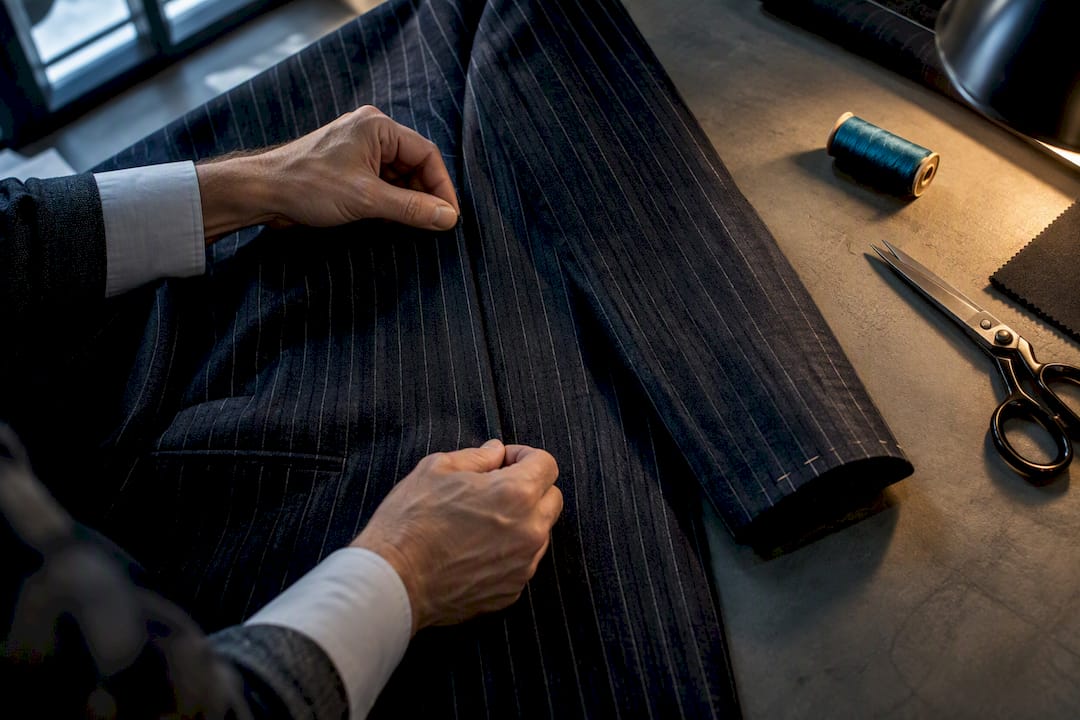
A bespoke jacket carries an internal canvas and hand-stitching that give it shape long before the outer cloth is added. Heavy pressure from an iron or an aggressive steamer head can compress that canvas, and once flattened it rarely regains its original loft. This is why we always advise clients travelling with a bespoke piece to favour light, vertical steaming over direct ironing, and to leave anything beyond a light refresh to a professional with proper finishing equipment.
A jacket’s shape lives in its canvas as much as in its cloth. Protect that first, and the crease will always take care of itself.
Pro Tip: Store a bespoke jacket on a wide, shaped hanger even between trips. A narrow or wire hanger reshapes the shoulders faster than most travellers realise.
A note from Ron & Rich on what matters most when you travel
If you take one thing from this guide, let it be this: protect the shape of the suit before you worry about a perfect crease. A soft wrinkle drops out with time and a little steam. A shoulder pushed out of shape by a bad hanger does not. We have spent decades correcting the second problem far more often than the first, and it is always the harder one to fix.
— Aaron Fan
Another option: travel-friendly fabrics and in-house finishing
If packing rituals feel like more than you want to manage on every trip, the more durable fix is starting with a suit built for it. We cut a number of our suits from cloths chosen for how well they recover from a folded case, and we talk clients through lining and canvas choices with travel specifically in mind.

Beyond the cut, we offer in-house finishing for clients who prefer professional care for their travel-worn jackets. You can browse our suits and pricing to see current options, or look at our tailored suit collection for pieces designed to hold their shape well beyond the wardrobe. It is simply another route to the same result: a suit that still looks like yours when you arrive.
Primary sources and technical references
The care guidance in this article draws on the following technical references:
- Chemische Reinigung, on solvent-based dry cleaning and fibre behaviour.
- Herrenhosen – Varianten und Pflegehinweise, on care recommendations for tailored trousers and suiting.
- If a steamer or iron soleplate needs attention before your next trip, this soleplate cleaning guide covers safe, quick methods.
Sources
FAQ
How do you keep a suit wrinkle free when travelling?
Use a garment bag or carrier where possible, fold with the jacket inside out if you must use a normal case, and avoid overpacking so the fabric has room to breathe. Hang the suit as soon as you arrive and let it air before steaming lightly.
Can you put a suit in the washing machine?
Most tailored suits with a high wool content should not go through a washing machine, since water and agitation can permanently distort the fibres and internal structure. Professional dry cleaning is the safer route for keeping the garment’s shape intact.
What is the best way to travel with a suit on an aeroplane?
Carry the suit in an in-cabin garment bag, laid flat in the overhead locker where space allows, rather than checking it. Ask cabin crew about a dedicated closet if one is available, since it protects the jacket far better than an overhead bin.
How do you pack a suit so it does not get wrinkled?
Turn the jacket inside out and fold it shoulder to shoulder, using tissue paper or a soft shirt to support the fold and reduce sharp crease lines. Fold trousers along their natural crease over a bar, and place both at the top of the case away from heavier items.
What do the care symbols on a suit label mean?
The symbols represent the manufacturer’s maximum tolerable treatment under ISO 3758, covering washing, ironing and professional cleaning. A gentler approach than the label allows is always safe, but exceeding it risks damage that cannot be undone.