Pinstripe Suits That Read Tailored: Bespoke Fit & Pattern Matching
Yes, a pinstripe suit belongs in a modern wardrobe, and the reason it works or fails comes down to one principle: precision fit and stripe integrity. Get the shoulder, chest and trouser break right, match the fabric to the season, and keep your accessories quiet. Do that, and the suit reads as tailored confidence rather than costume. The sections ahead cover the history, the stripe varieties, the tailoring checkpoints and the styling choices that bring it all together.
TL;DR:
- A pinstripe suit’s success depends on precise fit, especially across the shoulders and chest, and matching stripe continuity at seams to avoid visual flaws.
- Narrow, crisp pinstripes in dark worsted wool signal formality, while wider chalk stripes or bold patterns lean toward personality dressing or casual looks.
- Suit fabric, cut style, and stripe width must be coordinated to suit the occasion, with bespoke tailoring ensuring stripe alignment and overall fit are optimal.
- Keep accessories simple with solid ties, plain pocket squares, and dark leather shoes, and avoid pairing the suit with overly patterned or casual items to maintain elegance.
- Proper maintenance includes light brushing, air drying, and prompt minor repairs to keep stripes crisp, with tailored fitting from specialists like Ron & Rich providing the best results.
Table of Contents
- Where pinstripes come from and how connotations evolved
- How to tell pinstripes, chalk stripes and other stripe varieties
- The tailoring checks that make pinstripes look intentional
- Selecting colour, fabric and jacket cut for your pinstripe suit
- Concrete outfit formulas: business, events and relaxed styling
- Which accessories work and how to mix patterns safely
- How to care for pinstripe suits so stripes stay crisp
- Ron & Rich’s tailoring perspective and fit checklist
- Author view: when a pinstripe is right for you
- How Ron & Rich helps: bespoke pinstripe suits and next steps
- Sources
- FAQ
Where pinstripes come from and how connotations evolved
The pinstripe’s roots sit in daytime formal dress of the nineteenth and early twentieth centuries, when fine vertical lines distinguished business and professional attire from evening wear. One notable descendant of this tradition is the Stresemann), a formal daywear suit named after the German statesman Gustav Stresemann, which paired striped trousers with a darker jacket for occasions that called for gravity without the full weight of evening dress.
Cinema and corporate culture later reshaped how the world read the pattern:
- Hollywood’s mid-century gangster films borrowed the pinstripe to signal power and menace, a connotation that stuck for decades.
- Postwar banking and legal professions adopted the stripe as a uniform of authority, reinforcing the association with wealth and institutional seriousness.
- Late twentieth-century menswear began treating the pattern as a design choice rather than an occupational badge, freeing it from strict boardroom duty.
Today’s tailoring treats the pinstripe the same way it treats a herringbone or a birdseye weave: a texture and pattern to be chosen on its own merits, not a uniform inherited from a role.
How to tell pinstripes, chalk stripes and other stripe varieties
Not every vertical line is the same stripe, and mixing them up leads to the wrong suit for the occasion.
- Pinstripe: a fine, crisp line woven from contrasting threads on worsted wool, sharp enough to read as formal from across a room.
- Chalk stripe: a softer, fuzzier line that looks almost drawn on with chalk, a texture tied to milled or flannel cloth rather than the weave itself.
- Regimental and fashion stripes: bolder, wider bands borrowed from military and sailor traditions, including motifs echoed in the Matrosenanzug, which sit closer to casual or statement dressing than business formality.
Stripe width and spacing do most of the work in signalling formality: a narrow, tightly spaced pinstripe on dark worsted wool reads as conservative and boardroom-appropriate, while a wider chalk stripe or an irregular fashion stripe pushes the suit towards personality dressing. Knowing which category you are buying prevents an awkward mismatch between the suit’s message and the room you are wearing it into.
The tailoring checks that make pinstripes look intentional
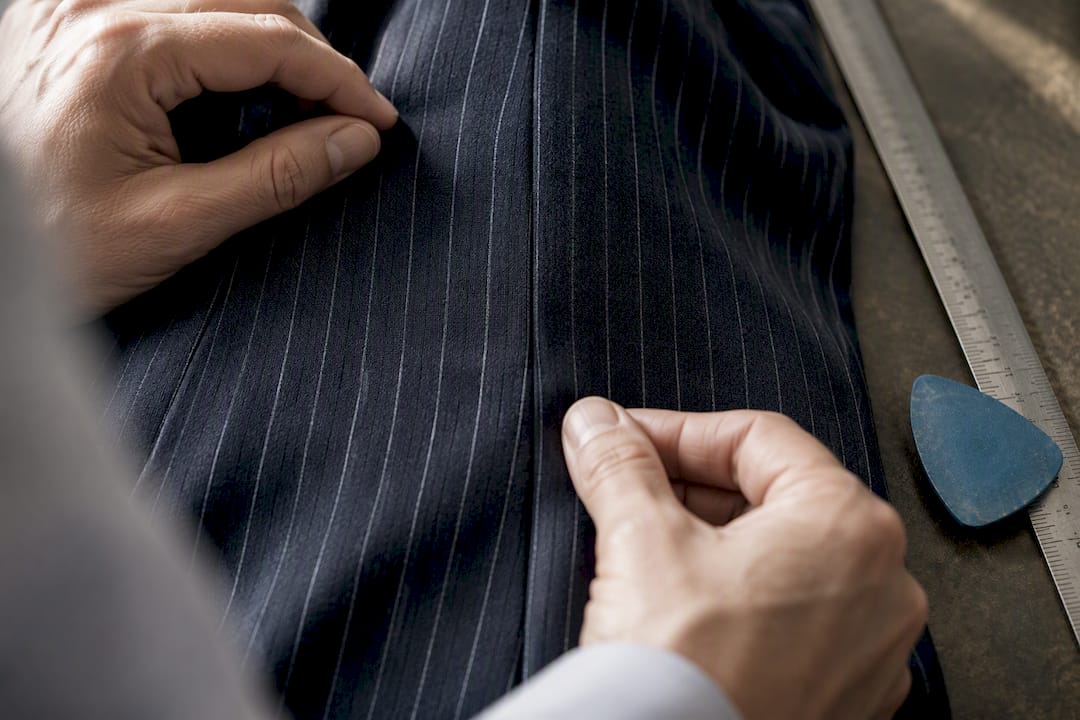
A pinstripe suit magnifies every fit flaw. Where a plain worsted wool jacket might hide a slightly off shoulder line, a vertical stripe draws the eye straight to it, which is why fit matters more here than on almost any other pattern.
- Shoulder fit first. The stripe should run straight and unbroken across the shoulder seam, with no pulling or divots that bend the line.
- Chest drape matters. A jacket that is too tight across the chest will curve the stripes outward instead of letting them fall vertically.
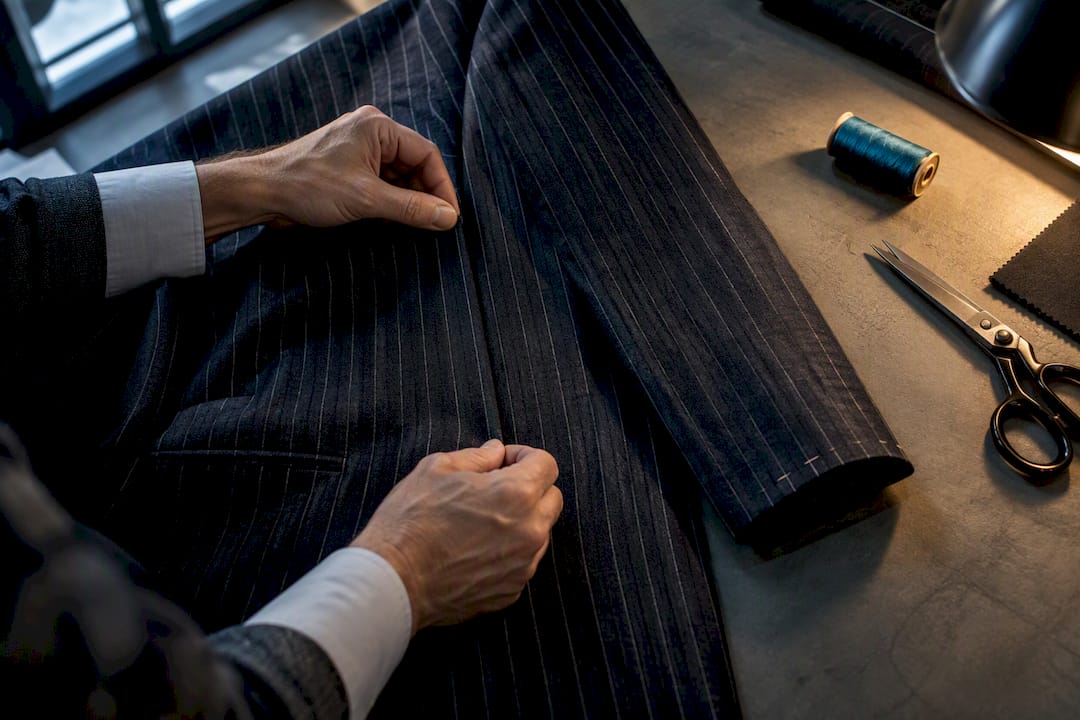
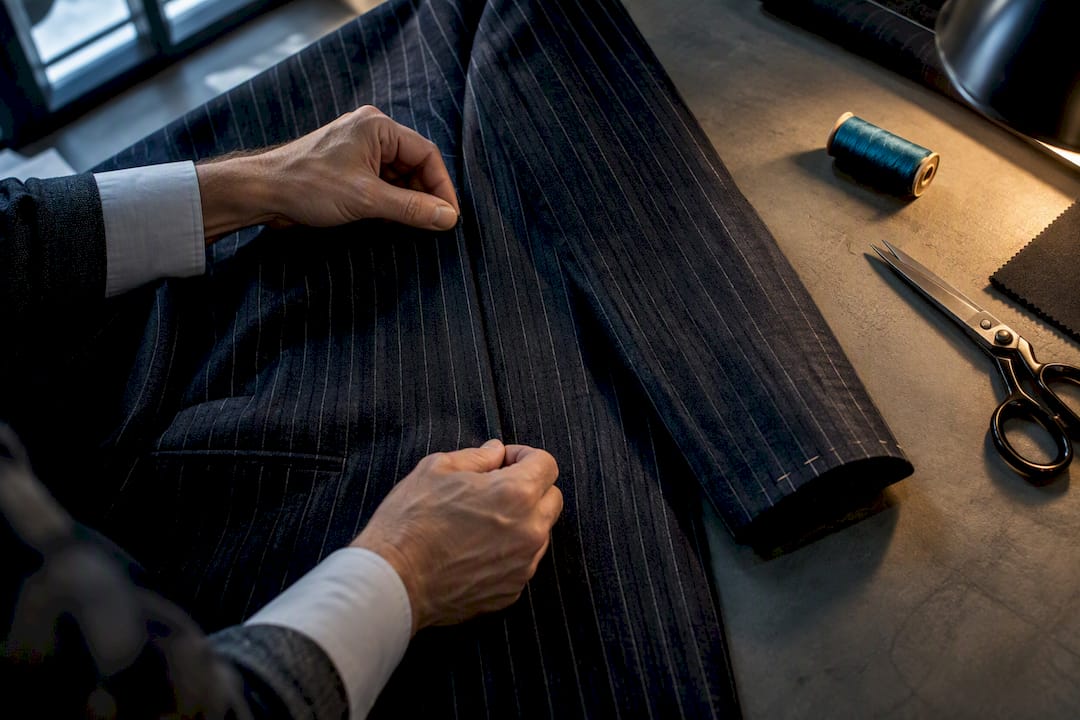
- Stripe matching at seams. Pattern continuity across the front seams and lapel is one of the clearest visible markers of construction quality, and it is worth checking before you commit to a suit.
- Trouser break and rise. A slightly shorter break keeps the vertical line uninterrupted down to the shoe, while a rise that sits correctly at the waist avoids bunching that distorts the stripe.
- Pattern continuity request. When commissioning a suit, ask the cutter to match stripe spacing across the jacket and trousers so the pattern reads as one continuous garment rather than two unrelated pieces.
Pro Tip: Stand in front of a full-length mirror and check whether the stripes on your left and right lapel run parallel; if they diverge, the jacket has not been cut with pattern matching in mind.
These checkpoints matter whether you are being measured for a bespoke piece or trying on something off the rack, and our own suit fit guide walks through the same vocabulary in more detail.
Selecting colour, fabric and jacket cut for your pinstripe suit
Colour and stripe width work together to set the tone of the suit. A navy or charcoal ground with a narrow, closely spaced pinstripe is the conservative choice for client meetings and interviews, while a wider chalk stripe on mid-grey or brown moves the suit towards a statement piece suited to creative industries or off-duty confidence.
Fabric choice affects how crisp the line reads:
- Worsted wool keeps the pinstripe sharp and is the natural choice for warm or humid climates, particularly in a tropical weave or a lightweight Super 100 to 120 cloth.
- Flannel softens the chalk stripe further and suits cooler-weather wardrobes where texture matters as much as pattern.
- Our suit fabric guide covers the seasonal logic behind these choices in full.
Cut decisions carry real weight too. A single-breasted jacket with a notch lapel keeps the stripe reading clean and versatile, while a double-breasted cut with peak lapels adds formality and works well with a bolder stripe on a man who wants the suit to command attention. Our guides on notch versus peak lapels and the double-breasted suit go further into fit and proportion. A waistcoat is worth adding for a three-piece formal look, though it should share the same stripe rather than introduce a second pattern.
Concrete outfit formulas: business, events and relaxed styling
The stripe does most of the visual work, which means the rest of the outfit should support it rather than compete with it.
- Classic business formula: a crisp white or pale blue shirt, a solid or subtly textured tie in navy or burgundy, and black oxford shoes. Avoid pairing the pinstripe with another patterned garment, since two competing patterns will fight for attention and undercut the suit’s clean line.
- Relaxed separates formula: wear the jacket alone over a fine-gauge knit and trousers in a plain colour, or the trousers alone with a soft-collared shirt and no tie. This works best when the stripe is narrow and the rest of the outfit stays deliberately plain.
- Smart-casual formula: a rollneck or crewneck jumper under the jacket, paired with clean leather trainers or loafers rather than trainers built for sport, keeps the look current without abandoning the suit’s formal roots. The shift towards relaxed tailoring in recent seasons has made this pairing far more acceptable than it once was.
Occasions to avoid matter as much as the ones to embrace. Traditional etiquette treats the pinstripe suit as daytime and business wear, and it generally has no place at a strict black-tie evening event, where the formality code calls for a dinner suit rather than a striped business pattern. Wearing a pinstripe to a black-tie function reads as a misunderstanding of the dress code rather than a stylish departure from it.
If you already own a benchmark navy or charcoal suit and are wondering whether a pinstripe deserves a place in a small rotation, our note on building a wardrobe around one strong suit is worth reading before you add a second, more distinctive pattern.
Which accessories work and how to mix patterns safely
The safest approach to accessories with a pinstripe suit is restraint. A solid tie in a deep, complementary colour, or a pocket square in a plain or subtly textured fabric, lets the suit’s own line carry the visual interest rather than adding a second competing pattern.
- Choose ties in solid colours or fine textures such as grenadine, which add depth without introducing a second stripe or check.
- Stick to black or dark brown leather shoes and a matching belt to preserve the vertical formality the stripe already signals.
- A coloured knit or a contrasting waistcoat can break up the suit for a more relaxed look, provided the knit stays solid and does not clash with the stripe’s own rhythm.
Pro Tip: If you want to introduce pattern elsewhere, choose a tie with a texture rather than a print, since two printed patterns together will almost always clutter the silhouette.
How to care for pinstripe suits so stripes stay crisp
Pinstripe suits reward a light, consistent care routine more than heavy intervention.
- Brush the jacket and trousers after each wear with a natural-bristle clothes brush to lift dust before it settles into the weave.
- Air the suit on a proper suit hanger for a day between wears rather than returning it straight to a crowded wardrobe.
- Avoid over-dry-cleaning, since the process gradually strips natural oils from wool and can dull the stripe’s contrast over time.
- Store on a broad, curved hanger to prevent crease memory that can distort the stripe’s straight line at the shoulder and sleeve.
- Take the suit to a tailor for minor repairs promptly rather than letting a loose seam or dropped hem worsen, since small issues left unattended can throw off pattern alignment at the next fitting.
Ron & Rich’s tailoring perspective and fit checklist
Founded in 1979 by master tailor Richard Fan, our house has spent nearly five decades refining the kind of precise, personalised fitting that a pinstripe suit demands. Stripe continuity is not a cosmetic detail to us. It is a test of whether a jacket has been cut and assembled with genuine care.
Request pattern matching at the front seams, ask for an extra inch of cloth allowance at the chest to preserve continuity during construction, and specify the fabric’s stripe repeat to your cutter so the spacing lines up across jacket and trousers alike.
When you sit for a fitting, bring these requests with you: shoulder construction that keeps the line unbroken, seam-by-seam pattern matching checked at the lapel, and a trouser finish that carries the stripe cleanly down to the break. Our note on why tailored investment pays off explains the broader case for bespoke construction in more depth.
Author view: when a pinstripe is right for you
If your wardrobe leans conservative, a narrow navy pinstripe on worsted wool is the one to own first, since it slots into business dressing without asking anyone to notice it too hard. If you already have a strong rotation of plain suits, a bolder chalk stripe is where the pattern earns its place, adding personality rather than repeating what you own. Choose based on what is missing from your rotation, not on what looks striking on a hanger.
Ron
How Ron & Rich helps: bespoke pinstripe suits and next steps
A pinstripe only works when the fit and the pattern matching are right, which is precisely where bespoke tailoring earns its keep. Ron & Rich builds each suit to your measurements, checking stripe alignment at every seam so the line stays true from shoulder to hem.
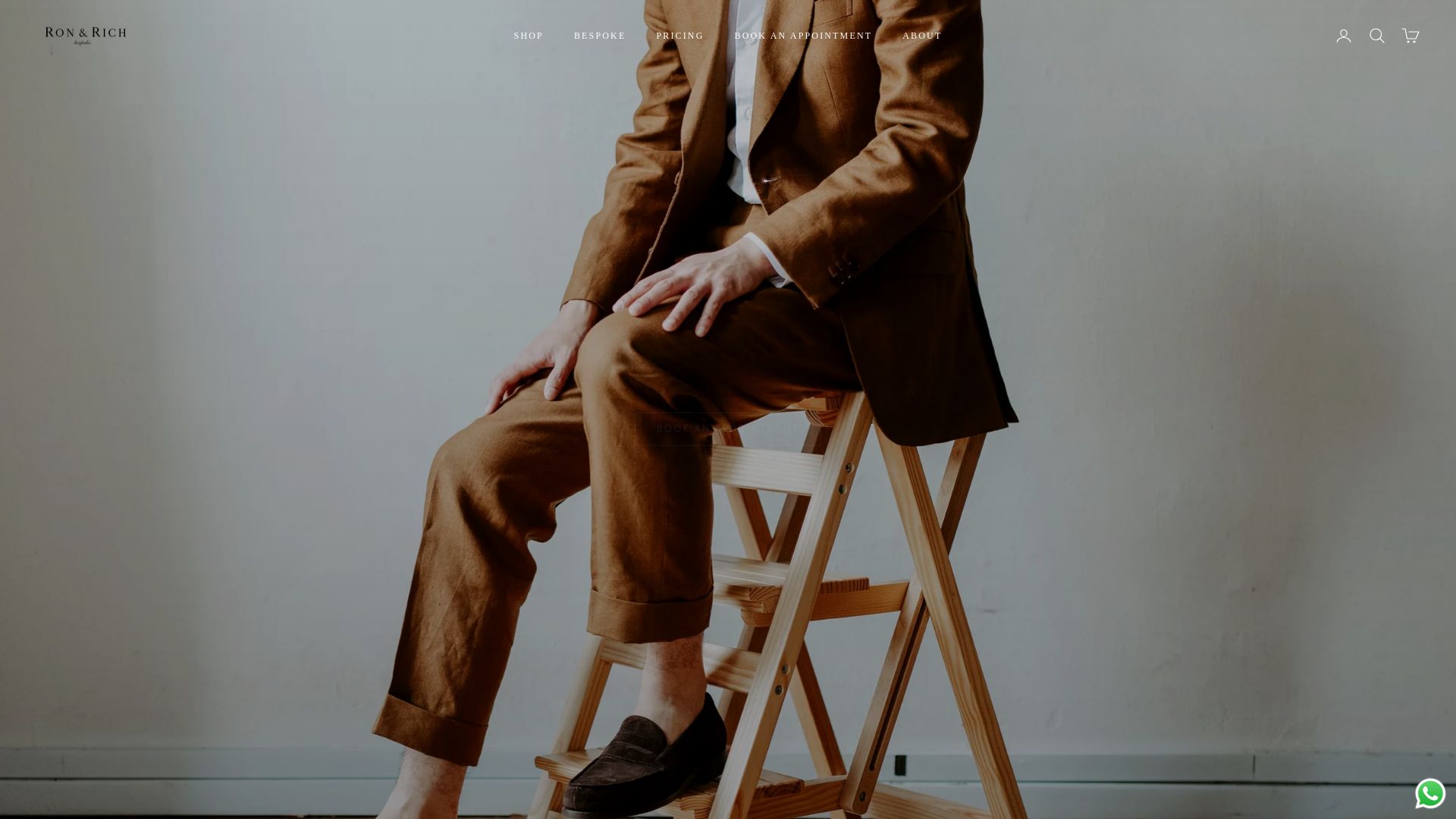
Explore our suits, sports jackets and tuxedos, starting from $2,170 for a suit, or browse our suit offerings and book a fitting to see the difference precision cutting makes on a striped cloth.
FAQ
What is the difference between pinstripe and chalk stripe?
A pinstripe is a fine, crisp line woven into worsted wool, while a chalk stripe has a softer, fuzzier appearance tied to flannel or milled cloth. The two patterns come from different fabric treatments, not just different line widths.
How do you wear a pinstripe suit without looking dated?
Keep the fit precise through the shoulder and chest, choose a narrow stripe on dark worsted wool for business contexts, and pair it with solid-coloured accessories rather than competing patterns. Relaxed styling, such as wearing the jacket over a plain knit, also helps the suit feel current.
Can you wear a pinstripe suit to a black-tie event?
No, traditional etiquette treats the pinstripe suit as daytime and business wear, and it is generally discouraged for strict black-tie functions, which call for a dedicated dinner suit instead. Save the pinstripe for business, interviews or daytime formal occasions.
What accessories go best with a pinstripe suit?
Solid-coloured ties, plain or subtly textured pocket squares, and dark leather shoes preserve the suit’s vertical line without adding competing patterns. A coloured knit or matching waistcoat can be used sparingly to break up the look for a more relaxed occasion.
How much does a bespoke pinstripe suit cost?
At Ron & Rich, bespoke suits start from $2,170, with the final price depending on fabric and construction choices made during your fitting.