Sleeve Pitch Adjustment: How a Suit Sleeve Should Hang
Sleeve pitch is the angle at which a sleeve is set into the armhole, and it should match the way your arm hangs naturally. When it does, the sleeve falls straight and quiet. When it does not, you see twisting, diagonal creases and fabric bagging at the front or back of the upper arm. Pitch is corrected by rotating the sleeve in the armhole, and it is best settled at the pattern and fitting stage, which is why a bespoke suit from our house is cut around your own posture rather than an average one.
TL;DR
- Sleeve pitch is the forward or backward rotation of the sleeve in the armhole, matched to how your arm hangs at rest.
- Diagonal creases running from the shoulder toward the elbow, or a sleeve seam that swings forward or back, point to a pitch problem.
- Correction is made by rotating the sleeve, in small steps: the pitch notches on the pattern move by about a quarter of an inch.
- Folds beneath the sleeve head when you lift your arm are usually an armhole matter, not pitch.
- In bespoke tailoring the pitch is set for your posture at the fitting, so it does not need to be rescued afterwards.
Table of Contents
- What sleeve pitch means
- How to recognise the wrong pitch
- Is it really pitch?
- How sleeve pitch is adjusted
- Posture and pitch
- Why bespoke settles pitch from the start
- A worked example
- Our perspective
- Bespoke for the way you stand
- What to tell us at your fitting
- Frequently asked questions
- Sources
What sleeve pitch means
A jacket sleeve is not a straight tube. It is cut with a curve and attached at a particular angle, and that angle is the pitch. According to The Parisian Gentleman, pitch is set by your neutral arm position and natural posture: a low pitch suits excellent, upright posture, while a high pitch suits a forward-curved one.
Think of it as the sleeve’s direction of travel. If your arms hang slightly forward of your sides, as most people’s do, a sleeve set perfectly straight will fight them and twist. Il Sartoriale notes that most arms hang slightly forward and slightly rotated, and that ready-to-wear jackets use an average pitch while a bespoke tailor sets it by eye at the fitting.
The average works for some men and not for others. That is the whole matter in one sentence, and the rest of this guide shows you how to tell which camp you are in.
How to recognise the wrong pitch
You do not need training to see it. You need a mirror, good light and a few seconds of stillness.
The side-on mirror check
Stand sideways to a mirror, let your arms hang naturally and look at the upper sleeves. The Parisian Gentleman advises looking for fabric gathering at the front or back of the upper sleeve while the arm is in its neutral position. A well-pitched sleeve hangs in a clean line with the seam falling toward the middle of the side of your body.
What the creases tell you
Put This On, writing in its piece on sleeve pitch, explains that when the curve and angle of the sleeve do not harmonise with how your arms hang, the result is bagging at the front or back of the sleeve, usually the back. Use the table below as a plain-language guide.
| What you see | What it usually means |
|---|---|
| Diagonal folds across the back of the upper sleeve | The arm hangs further forward than the sleeve is set |
| Diagonal folds across the front of the upper sleeve | The arm hangs further back than the sleeve is set |
| Sleeve seam or vent twisting toward or away from the body | The sleeve is rotated differently from your arm |
| Tight sleeve head at the front, spare cloth at the back | Pitch, rather than overall size |
| Creases radiating from the shoulder seam | A wrongly set sleeve, or a shoulder issue |
The second and fourth rows come from the same principle: the cloth is telling you where the arm wants to go. The Bespoke Patterns home test makes the same point, advising you to look for diagonal drag lines from the shoulder toward the elbow and to check whether the underarm seam swings forward or backward.
Moving the elbows
A useful extra test comes from Fashion Forward. Photograph yourself from the front, side and back at chest height, then move both elbows slowly backward and forward. If the twist releases as the elbows go back, the jacket was drafted for arms that sit farther back. If it smooths out as they go forward, the sleeve was pitched too far forward.
Is it really pitch?
Not every sleeve wrinkle is a pitch problem, and it helps to separate them before you decide anything.
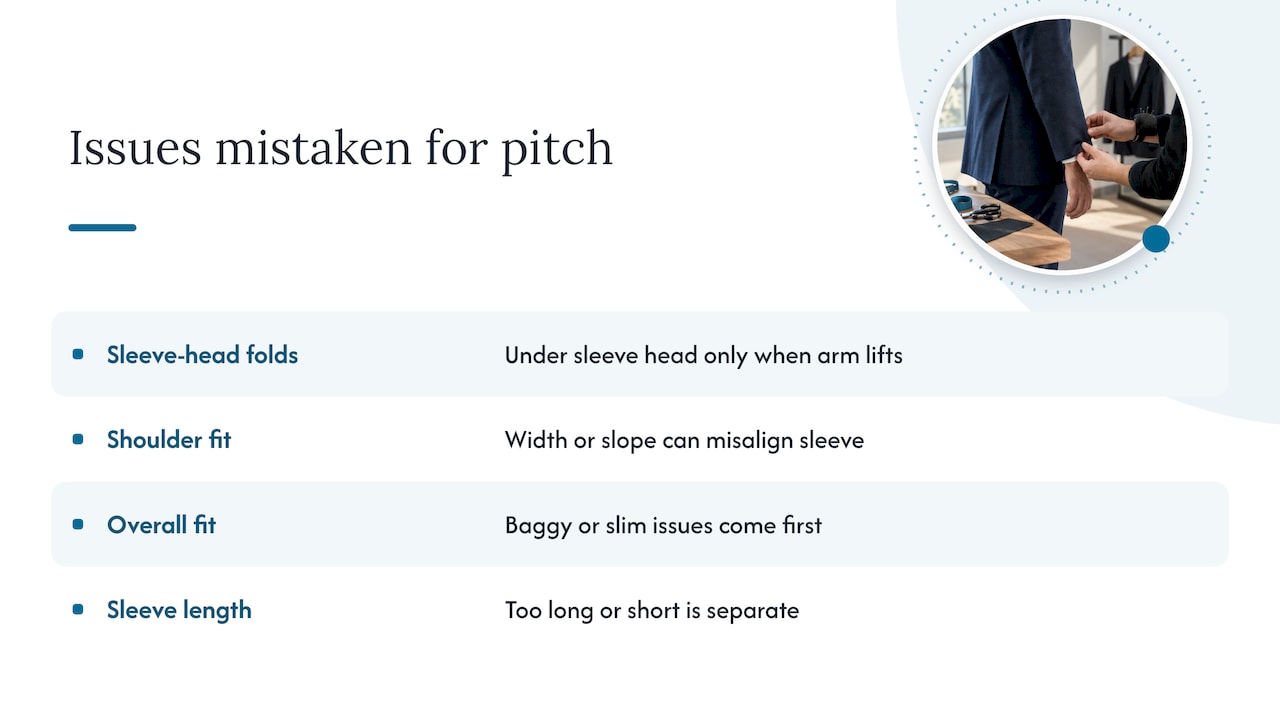
Sleeve head folds. If the folds appear beneath the sleeve head only when you lift your arm, that is a matter of the armhole and sleeve head, not of rotation. Our article on why men choose bespoke high armholes explains why a higher, closer armhole gives the arm more freedom to move without dragging the whole jacket.
Shoulder fit. If the shoulders themselves are too wide, narrow or sloped, the sleeve will misbehave however it is rotated. Threads magazine points out in its guide to the sleeve cap seam and the armscye that changing the shoulder slope or height means adjusting the sleeve cap by the same distance. Shoulder and sleeve are one system.
Overall fit. Derek Guy of Put This On has observed that for off-the-rack clothing, pitch is probably the last thing to worry about, as most problems come from a jacket that is too baggy or too slim. That is sound advice: settle the size and the shoulder first, and pitch comes next.
Length. A sleeve that is too long or short also looks wrong, but it is a separate matter. Our guide to suit sleeve length covers how much shirt cuff should show and how to measure it.
How sleeve pitch is adjusted
Pitch is corrected by changing the angle at which the sleeve meets the armhole. There are two points at which this happens: on the pattern before a garment is cut, and on a finished jacket.
On the pattern
The pattern carries pitch notches, small marks at the side front and back of the armhole that tell the tailor how the sleeve should meet the body. Threads magazine gives the standard correction in quarter-inch steps:
- A forward-hanging arm, with diagonal drag lines at the front: lower the front pitch notch by 1/4 inch and raise the back notch by 1/4 inch.
- An erect, arms-back posture, where the sleeve breaks at the back: raise the front notch by 1/4 inch and lower the back notch by 1/4 inch.
The sleeve is then basted, which means tacked together with temporary stitches, and checked on the body before anything is sewn permanently. The small size of those moves is the point. Pitch is a matter of fractions, and a fraction can be the difference between a sleeve you forget about and one you keep tugging.
On a finished jacket
The Parisian Gentleman states that for ready-to-wear jackets needing rotation, the sleeves can be removed and rotated to sync with the wearer’s neutral position, and that a treasured jacket can justify the work to remove puckering around the sleeve head. It is a considerable operation: the sleeve comes out of the armhole, the lining is disturbed, and everything is set back in. That is why many men, once they have worn a jacket that was pitched for them from the start, prefer to begin there.
Posture and pitch
Posture is the reason pitch varies from one man to the next. A desk-bound stoop, a military bearing and a naturally relaxed stance all put the arm in a different place.
Put This On reports that a military man’s erect stance, or a computer-related stoop, can call for sleeves to be rehung. The Parisian Gentleman suggests that a man with a forward hunch should embrace it rather than fight it: pitching the sleeve forward to match the body avoids fabric gathering at the front of the sleeve and excess fullness across the chest.
Fashion Forward puts the idea well: posture is not a fault to correct but information about which pattern will sit quietly on your body. For the executive who spends the day at a screen and the groom who stands tall for a wedding portrait, the right pitch is different, and neither is wrong.
Why bespoke settles pitch from the start
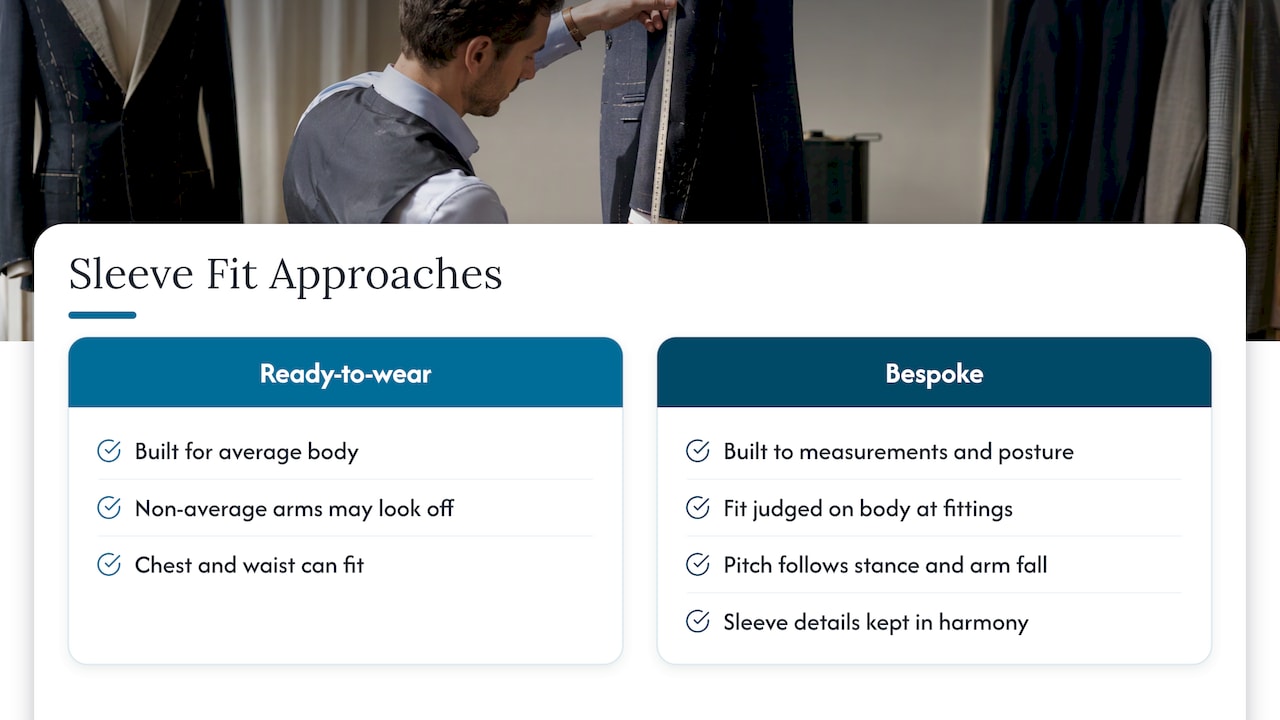
A ready-to-wear jacket is built on an average body. If your arms hang as the average arm does, you may never notice. If they do not, the jacket can look slightly off however well the chest and waist fit.
A bespoke suit starts from your measurements and your posture. Our founder, master tailor Richard Fan, established the house in 1979 on the principle that each garment is tailored to the exact measurements and preferences of the individual client, and our bespoke tailoring process is built around fittings in which fit is judged on the body. Pitch is exactly the kind of detail that only reveals itself in that setting, because it depends on how you stand and how your arms fall, not on a number from a tape measure.
The same logic applies to the rest of the sleeve. Length, armhole height, shoulder line and pitch each depend on the others, and a single maker working through them together keeps them in harmony. Our tailor’s checklist for sleeve harmony sets out how we look at the sleeve as a whole.
A worked example
Take a professional who works at a desk for ten hours a day. His shoulders have rounded forward a little, and his arms hang ahead of his sides. In an average-pitch jacket, he sees diagonal creases on the back of each upper sleeve and a sleeve seam that points slightly inward.
The remedy follows the Threads principle: the sleeve is pitched forward, with the front notch lowered and the back notch raised, by a quarter of an inch to begin with. The sleeve is basted, he stands naturally, and the tailor looks at the creases again. If they have eased, the change is confirmed. If a trace remains, it is moved a little further. This is a conversation between the man, the mirror and the maker, not a formula.
Our perspective
We have always believed that the sleeve is where a suit shows whether it was made for you. A good sleeve is not noticed. It falls from the shoulder, follows your arm and lets you reach for a pen, a door handle or a glass without the jacket following you.
Pitch is part of that quiet. It is not a flourish, and it cannot be judged from a photograph or an average. It is judged on the body, by eye, in the fitting room, and set with the same care as the shoulder and the armhole.
That is the tradition Richard Fan founded this house on in 1979, and it is the one we keep: traditional craftsmanship, applied to the way you stand today, with fabrics chosen for Singapore’s climate.
Ron
Bespoke for the way you stand
If you are a professional who wants a suit that moves with you, a groom planning wedding attire, or a man who simply notices when a sleeve is not right, a bespoke suit is the straightforward answer. Suits start from $2,170, sports jackets from $1,790, tuxedos from $2,270 and trousers from $290, as set out on our pricing page.

To see how a suit is made for you, read about our bespoke suits in Singapore and book a fitting.
What to tell us at your fitting
You do not need technical vocabulary. Describe what you feel and see, and the rest is our work.
- Say how you stand and work. Desk, driving, standing for long periods: each shapes where your arms rest.
- Bring the jacket you like, and the one you do not. Point out where the cloth gathers, front or back.
- Stand naturally in the mirror. Let your arms hang, rather than bracing. The sleeve should be judged in your real stance.
- Move. Reach forward, lift your arms, bend your elbows. Notice whether the creases ease or deepen.
- Wear the shirt you will wear with the suit. A fitting in a different shirt can mislead the eye, a point Fashion Forward also makes when it advises comparing sleeves in the same shirt used at the original fitting.
Frequently asked questions
What is the difference between sleeve pitch and sleeve length?
Length is how far the sleeve reaches down your arm, usually judged by how much shirt cuff shows. Pitch is the angle at which the sleeve is set into the armhole. A sleeve can be the right length and still twist, because its angle does not match your arm.
How can I tell if my jacket’s sleeve pitch is wrong?
Stand sideways to a mirror with your arms relaxed. Diagonal creases from the shoulder toward the elbow, or a sleeve seam that swings forward or back, suggest that the sleeve is rotated differently from your arm. Folds that appear only when you raise your arm usually concern the armhole, not pitch.
Can sleeve pitch be changed without altering the shoulder?
If the shoulder fits well and only the sleeve is misaligned, the sleeve can be rotated in the armhole without reworking the shoulder. The change is small, a quarter of an inch at the pitch notches on the pattern, which is why it is best judged on the body.
Does posture affect sleeve pitch?
Yes. A forward-curved posture calls for a higher, more forward pitch, and an upright, arms-back stance calls for a lower pitch. Posture is information for the tailor, not a fault, and a bespoke jacket is cut to it.
Sources
- How Sleeve Pitch Can Make or Break a Suit, The Parisian Gentleman
- Sleeve Pitch, Put This On
- The hand-set sleeve, Il Sartoriale
- Sleeves That Move With You: A Home Test for Pitch, Bespoke Patterns
- Your Jacket May Fit but Still Have the Wrong Sleeve Pitch, Fashion Forward
- The Sleeve-Cap Seam and the Armscye, Threads