Shirt Interlining Types: How Collars and Cuffs Keep Their Shape
Shirt interlining comes in two methods of attachment, fusible (bonded with heat) and sew-in (stitched between the layers), and three constructions: woven, non-woven and knitted. Each can be made light or heavy. The combination chosen decides whether a collar stands crisply, rolls softly or collapses by lunchtime. Below, we explain each type, where it sits in the shirt, and how to match it to your fabric and to Singapore’s heat.
TL;DR
- Interlining is the hidden layer inside collars, cuffs and plackets that gives a shirt its shape. It is classed by method (fusible or sew-in) and by base fabric (woven, non-woven, knitted).
- Woven interlining is generally regarded as the premium choice for dress shirts. Non-woven suits economical production, and knitted suits softer, business-casual shirts.
- Match the interlining weight to the shirt fabric: too heavy and the collar turns bulky, too light and it sags.
- In a humid climate, comfort and stability matter as much as crispness, so fabric and interlining should be chosen together.
- At Ron & Rich, we cut each bespoke shirt to your measurements, so collar structure can be set to your preference.
Table of Contents
- What shirt interlining actually does
- The two methods: fusible and sew-in
- The three constructions: woven, non-woven and knitted
- Weight: how much structure do you want?
- Matching interlining to your shirt fabric
- Where each type shows up in a shirt
- Interlining in Singapore’s climate
- Caring for a shirt with interlining
- Our perspective
- Your shirt, made to your measurements
- FAQ
- Sources
What shirt interlining actually does
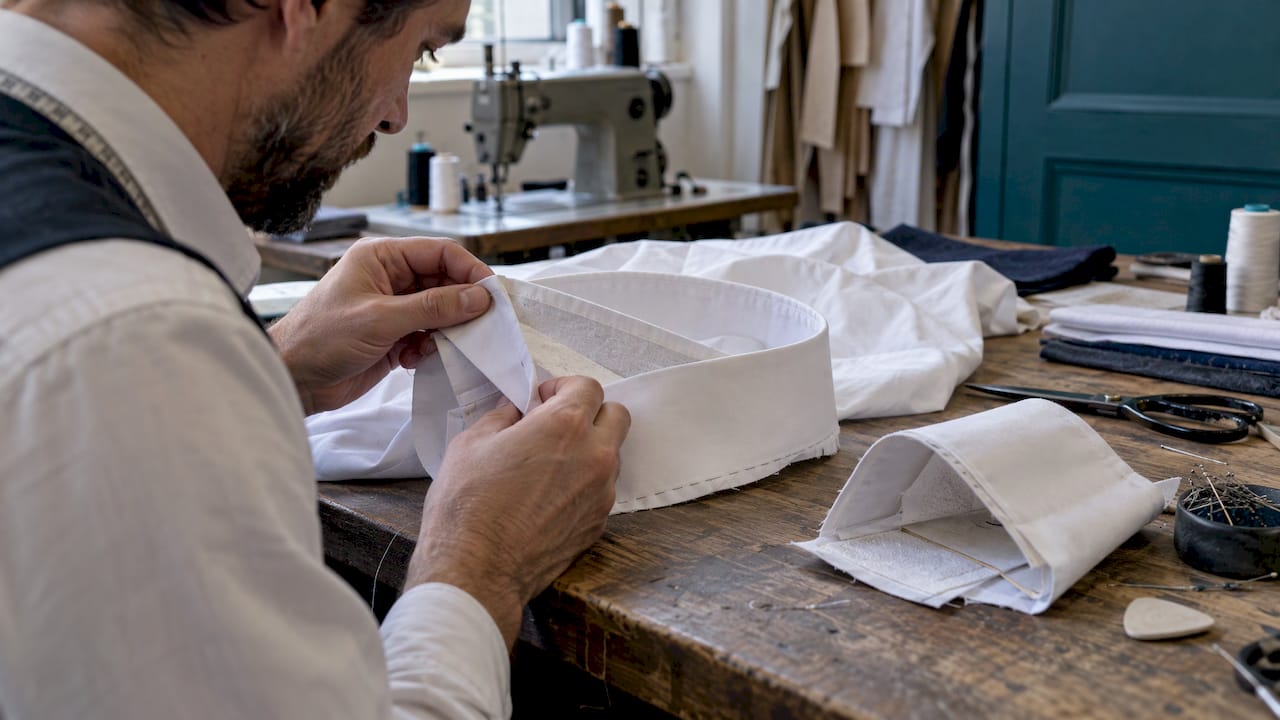
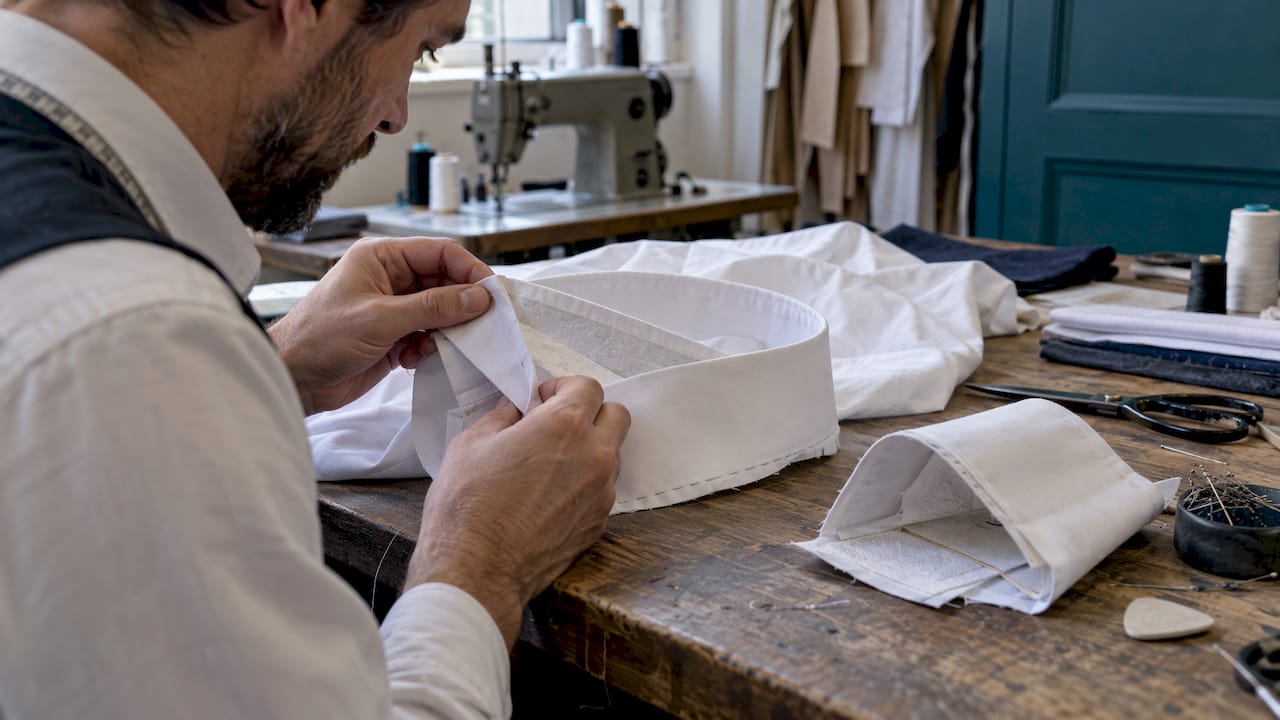
Interlining is a layer placed between the outer fabric and the inside of a garment to add body. In a shirt, it is found in the collar, the cuffs and the button placket. Tailors World describes shirt interlining as used in these three places on dress shirts, whereas the heavier hair interlining belongs in the front panels of suits and jackets.
Its work is twofold. Interlining gives shape formation and shape retention, and it also improves sewability. In plain terms: it lets a collar stand up, and it lets the collar remain that way after a hundred wears.
You never see it, yet you feel it. A cuff that stays flat under a jacket sleeve, a collar that frames the knot of a tie without drooping: that is interlining at work. When it is chosen poorly, the shirt looks either stiff like cardboard or limp, as Longhel Interlining puts it.
The two methods: fusible and sew-in
Researchers classify interlinings by application method into sewn and fusible, and by substrate into woven, non-woven, knitted and non-general types. So the first question is how the layer is attached. The second, which is a separate question, is what it is made of.
Fusible interlining
Fusible interlining carries a thermoplastic adhesive coating. It is bonded under controlled heat, pressure and time, so the layer becomes one with the shirt fabric. The result is an immediate, clean crispness, and it is the method used in most ready-made shirts because it is repeatable at scale.
When the bond is done well, it lasts. When it is not, the collar bubbles. Bubbling after washing is typically caused by adhesive failure during fusing, from insufficient temperature, inadequate pressure or mismatched thermal expansion. The lesson is that the quality of the fusing matters as much as the quality of the interlining itself.
Sew-in (non-fusible) interlining
Sew-in interlining is not bonded. It is stitched into the collar so that it floats between the layers. Because it floats, it keeps its suppleness and natural breathability and avoids bubbling from repeated washing. The trade-off is that a rigid collar takes more skill to achieve, since the crispness comes from construction rather than from the adhesive.
This is the older, hand-minded approach. It is particularly relevant to traditional tailoring, to delicate or heat-sensitive fabrics, and to constructions where the shell and the internal structure should move independently. That independent movement is what gives a well-made collar its soft, natural roll.
The three constructions: woven, non-woven and knitted
Fusible or sew-in describes attachment. Woven, non-woven and knitted describe the textile base. The two should not be confused, because a fusible interlining can be woven, knitted or non-woven.
| Construction | Character | Best suited to |
|---|---|---|
| Woven | Has lengthwise and crosswise grain, so it is stable and drapes like the shirt fabric | Formal dress shirts, a collar that must keep its form for years |
| Non-woven | Fibres bonded together, no grain, less drapable | Economical production, everyday shirts |
| Knitted | Soft and supple, with a little stretch | Business-casual shirts that need structure and movement |
Woven interlining
Woven interfacing has lengthwise and crosswise grains that are matched to the garment, which means it behaves like a true fabric layer. Interlining Factory regards woven interlining as the premium choice for high-end dress shirts because of its durability, breathability and natural drape. A peer-reviewed study also found that woven interlinings had higher linear tensile strength.
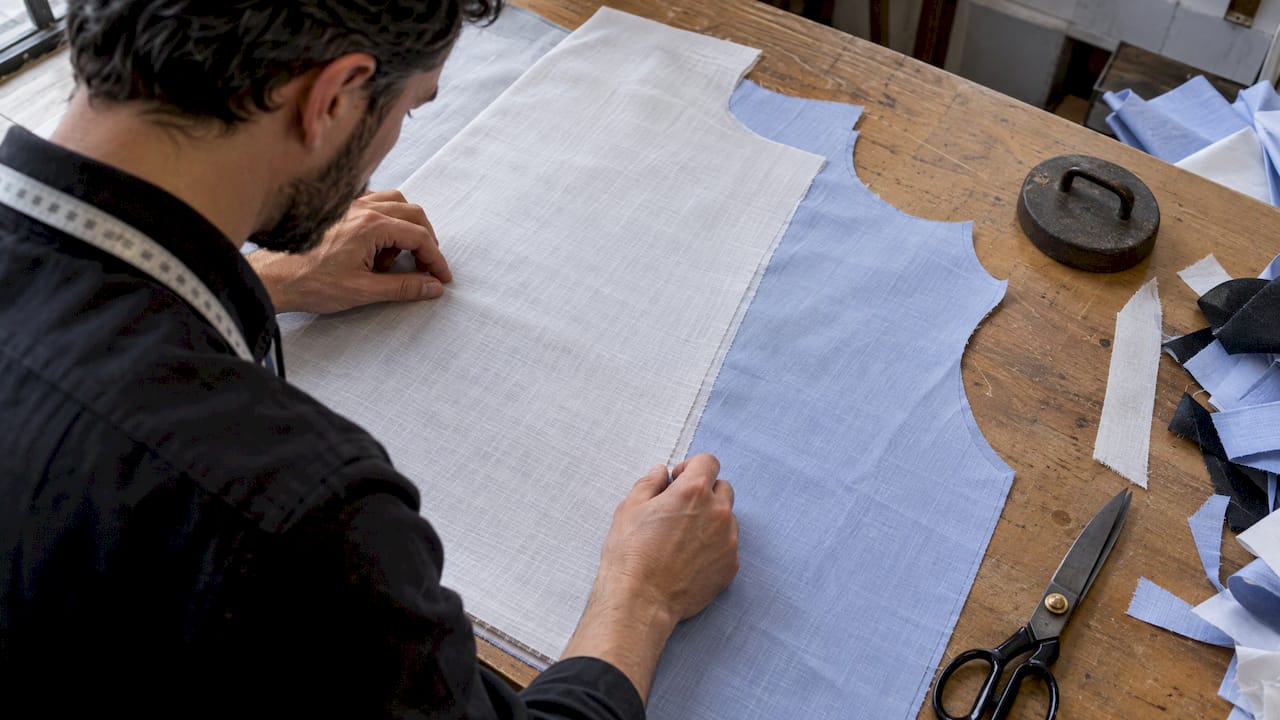
Because of the grain, it must be cut with care. For example, Vlieseline’s 55 g/m² cotton woven interlining is specified for collars and cuffs on light to medium-weight shirt fabrics and must be cut lengthwise, following the thread. Good tailors cut it on the same grain line as the shirt piece, so the two age together.
Non-woven interlining
Non-woven interfacing is made of bonded fibres. It has no grain and is less drapable than woven. Its origins lie elsewhere: non-woven interlinings used by clothing manufacturers came from the paper industry and are generally less expensive than woven or knitted fabrics.
That is why it is common in volume production. It does not ravel and can be cut in any direction, which saves time and fabric. For a shirt made one at a time, to your measurements, the argument for speed carries less weight than the argument for drape.
Knitted interlining
Knitted interlining sits in the middle. It is soft and supple and adds a hint of structure. It is considered essential for contemporary business-casual shirts that need both structure and movement. In the same study cited above, elastic warp-knit interlining had the highest bursting strength. It is a sensible choice for a soft-collared shirt worn without a tie.
Weight: how much structure do you want?
Weight, measured in grams per square metre (GSM), is the quiet variable behind the feel of a collar. Published guidance varies by manufacturer and by construction, so treat the figures as a map rather than a rule.
- Longhel Interlining suggests 30 to 50 GSM for plackets, 50 to 80 GSM for collars, and above 80 GSM for military collars.
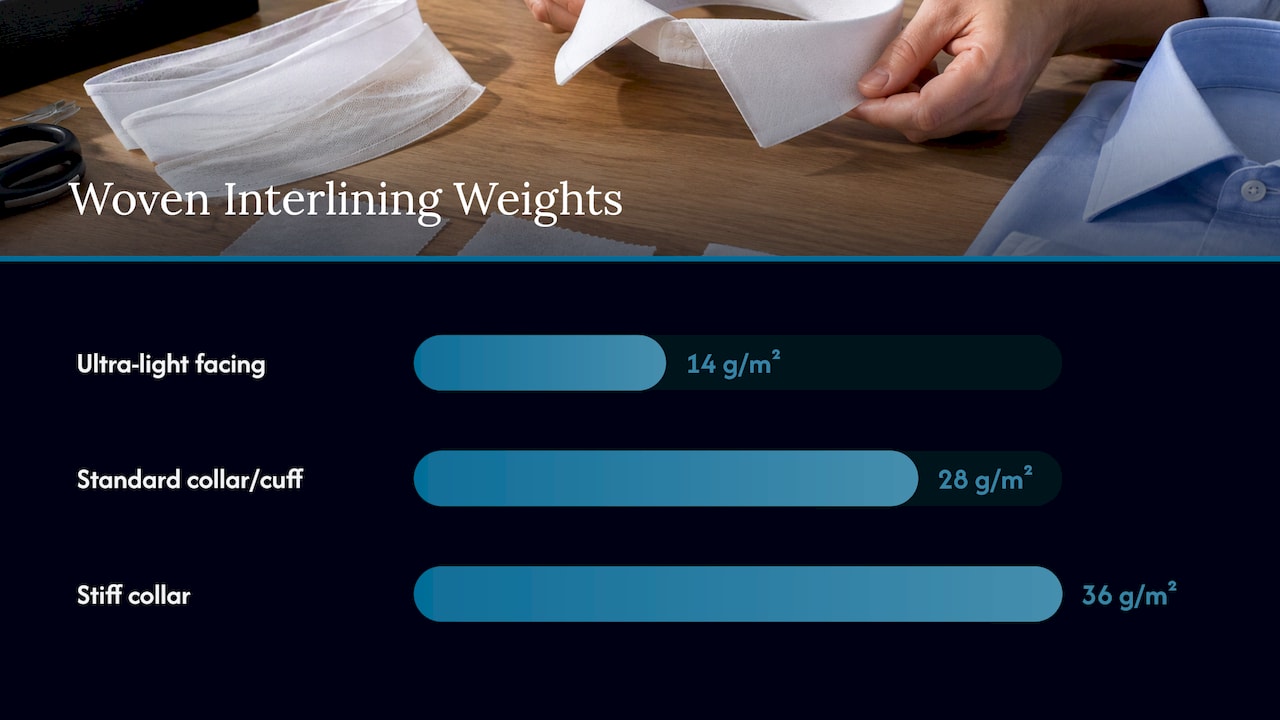
- For woven interlining, one technical guide lists 14 g/m² for an ultra-light collar facing on fine lawn shirts, 28 g/m² for a standard dress shirt collar and cuff, and 36 g/m² for a stiff collar on formal dress shirts.
- A European shirtmaking supplier ranges its interfacings from 105 g/m² for very light collars to 280 g/m² for dense collars that must stay perfectly stationary.
The numbers differ because the products differ: a woven cotton and a thermally bonded non-woven of the same GSM do not feel alike. What stays constant is the principle. A stiff interlining gives the collar an angle, while a softer one curves towards the collarbone. Decide on the silhouette first, then the weight.
This connects to how the collar is finished. A firm collar is often paired with removable stays; our guide to collar stays and what tailors choose for every shirt explains how the two work together.
Matching interlining to your shirt fabric
The rule of thumb is simple and consistent across sources. The interlining should be of a similar weight class to the shell fabric: too heavy and the collar becomes bulky, too light and the fabric sags. Another source advises choosing interlining of the same weight as the outer fabric or lighter, with slightly less drape.
A few practical pairings follow from this:
- Fine cotton poplin or lawn: a lightweight, flexible interlining, so the collar does not overpower the cloth.
- Mid-weight twill or oxford: a medium woven interlining, which gives the collar a defined but natural edge.
- Linen and linen blends: a cotton woven interlining, which has a natural hand compatible with cotton and linen shells.
- Soft, casual shirting worn open-necked: a knitted or very light interlining, for ease rather than height.
Fibre content and the adhesive
The base fibre changes the behaviour. Per the same buying guide, cotton woven interlinings offer breathability, polyester woven interlinings offer dimensional stability and shrinkage resistance, and polyester and cotton blends are widely used in shirting that is machine-washed at 40 to 60°C. For fusible types, the adhesive resin also sets the care rules. That guide pairs, for instance, CoPA resin with washing up to 40 to 60°C, and PES resin with dry cleaning.
Where each type shows up in a shirt
Not every part of the shirt needs the same layer. A thoughtful maker may use different weights in different places.
- Collar: the most visible structure, usually the heaviest layer. A separate, firmer piece may be used in the collar stand.
- Cuffs: a medium layer that keeps the cuff flat and the link or button seat neat. Interfacing generally supports areas needing stability, such as buttonholes, collars, cuffs and waistbands.
- Placket: lighter, since it needs only enough body to keep buttonholes clean.
Some details of fit work alongside interlining rather than within it. If you move a great deal, the shirt gusset deals with strain at the side seam, a different problem from collar structure, but part of the same construction thinking.
Interlining in Singapore’s climate
Singapore asks more of a shirt than a temperate city does. Under high humidity, sweat does not evaporate easily, and a layer that traps heat quickly becomes tiresome. One local retail guide notes that relative humidity frequently exceeds 80%, which compromises the body’s cooling. That guide concerns sportswear, but the physics is the same for a shirt worn from the MRT to the office.
For interlining, this has three practical consequences:
- Prefer breathability where the skin touches. Cotton interlining feels light on the skin and lets air pass through easily, which suits a collar that sits against the neck for hours.
- Value stability where humidity swings. Polyester interlining stays firm and keeps its shape in humid conditions, and polyester-based non-woven webs are hydrophobic, which limits moisture absorption and reduces the risk of delamination.
- Do not over-stiffen. A study of collar applications found that fusing under higher pressing parameters gave greater adhesion strength but reduced air and water vapour permeability, whereas sew-in offered more balanced comfort. In a warm climate, that balance counts.
The best result usually comes from the whole shirt: a breathable cloth, a light-to-medium interlining and a collar that is cut and sewn carefully.
Caring for a shirt with interlining
Good care protects the bond and the shape.
- For polyester interlining, one manufacturer recommends a gentle cycle with cold water, no bleach or fabric softener, and ironing inside out on low to medium heat.
- For cotton interlining, a gentle machine wash with warm water and ironing inside out on medium heat.
- Always check the care label of your own shirt first, as the fabric and the adhesive set the limits.
If a collar has begun to bubble, the cause lies in the bonding rather than in your washing. A tailor can often advise on whether the collar can be rebuilt.
Our perspective
We have made shirts and suits since 1979, when our founder, master tailor Richard Fan, opened the house. In that time we have learned that the collar is where a shirt is judged. Everyone sees it, yet few can say why one collar looks composed and another looks tired.
Our view is that interlining should serve the wearer, not the production line. That means choosing the layer for your fabric, your collar style and your climate, not for convenience. Our approach to bespoke tailoring preserves artisanal techniques while embracing modern design, and we apply the same thinking to what lies beneath the cloth.
This is also why we favour a personal fitting. Your neck, your posture and the way you wear a tie all influence how the collar should sit. We take your exact measurements and preferences and build the shirt around them, using premium fabrics suited to Singapore’s climate.
The same philosophy runs through our jackets and suits. If you are curious about structure inside a jacket, our guide to fused and canvassed suits sets out how construction affects durability and repair.
Ron
Your shirt, made to your measurements
If you would like a collar and cuff built to your own preference, our bespoke shirts start from $199. We take measurements in person, discuss the fabric and the collar style, and make the shirt to fit. You can see the range on our tailor-made shirts page.
For a full wardrobe, our pricing page lists suits from $2,170, trousers from $290 and waistcoats from $380. You can also browse custom tailored shirts at any time.
FAQ
What are the main types of shirt interlining?
By attachment, there are fusible (bonded by heat) and sew-in (stitched in). By base fabric, there are woven, non-woven and knitted. Each can be made in light to heavy weights, so the type and weight are chosen together for the collar, cuffs and placket.
Is fusible or sew-in interlining better for a shirt?
Neither is universally better. Fusible gives an immediate crispness and is well suited to repeatable production, while sew-in keeps more suppleness and breathability and suits traditional construction. The right choice depends on the fabric, the collar style and how the shirt will be worn and washed.
What is the difference between interlining and lining?
Interlining is a hidden layer that gives structure, such as inside a collar or cuff. Lining is a visible or semi-visible inner layer, as in a jacket, that helps the garment slide on and finish cleanly. In a shirt, it is interlining that shapes the collar.
Why does my shirt collar bubble after washing?
It is typically a bonding failure in a fused collar, caused by insufficient temperature, inadequate pressure or mismatched thermal expansion when the shirt was made. Gentle washing and ironing inside out help protect the bond. A tailor can advise whether the collar is worth rebuilding.
Which interlining suits a hot, humid climate?
A light-to-medium weight matched to your fabric is the safest starting point. Cotton interlining feels light on the skin and lets air through, while polyester stays firm in humid conditions. Choose with your tailor according to how structured you want the collar to be.
Sources
- A Review of Fusible Interlinings Usage in Garment Manufacture (Zhang and Kan, 2018)
- Effect of Different Interlining Types on the Mechanical and Comfort Properties (SCIRP, 2026)
- Under It All: A Guide to Interfacing (Sew Daily)
- What is Interlining? (TOHKAI THERMO)
- Essential Attachments for Jackets (Tailors World)
- Which interfacing to use for a shirt? (ALUMO)
- Fusible vs Sew-In Interlining (Fitinline)
- Professional Shirt Interlining Guide (Interlining Factory)
- Woven Fusible and Double Dot Fusible Interlining buying guide
- Woven Interlining for Shirts: A Technical Guide
- Non-Woven Interlining: A Complete Technical Guide
- Shirt Interlining Guide: Types, Materials, And How To Choose (Longhel)
- Woven Interlining B 710 (Vlieseline)
- What Is Interlining? Types, Uses, and Materials (ScienceInsights)
- Care instructions for shirts with interlining (Maoheng Textile)
- Choosing Breathable Running Apparel for Singapore’s Humid Climate (Lazada Sports)