Interview Attire for Men in Singapore: What to Wear
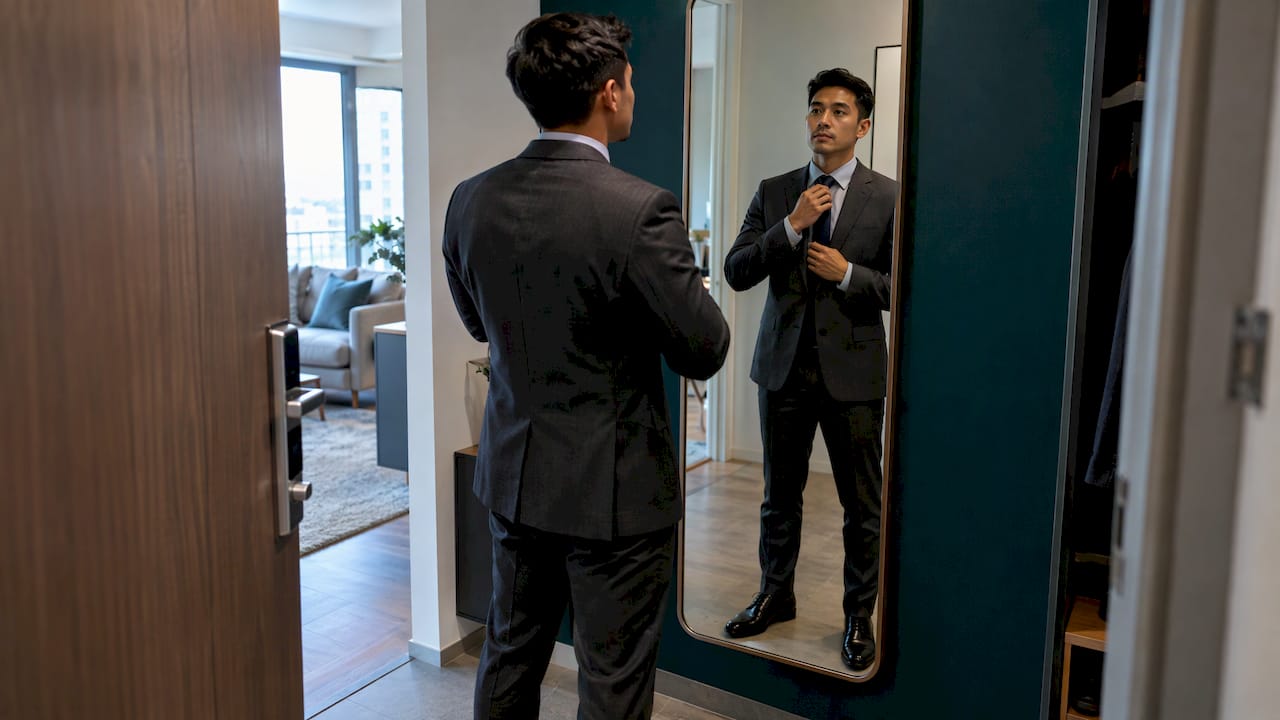
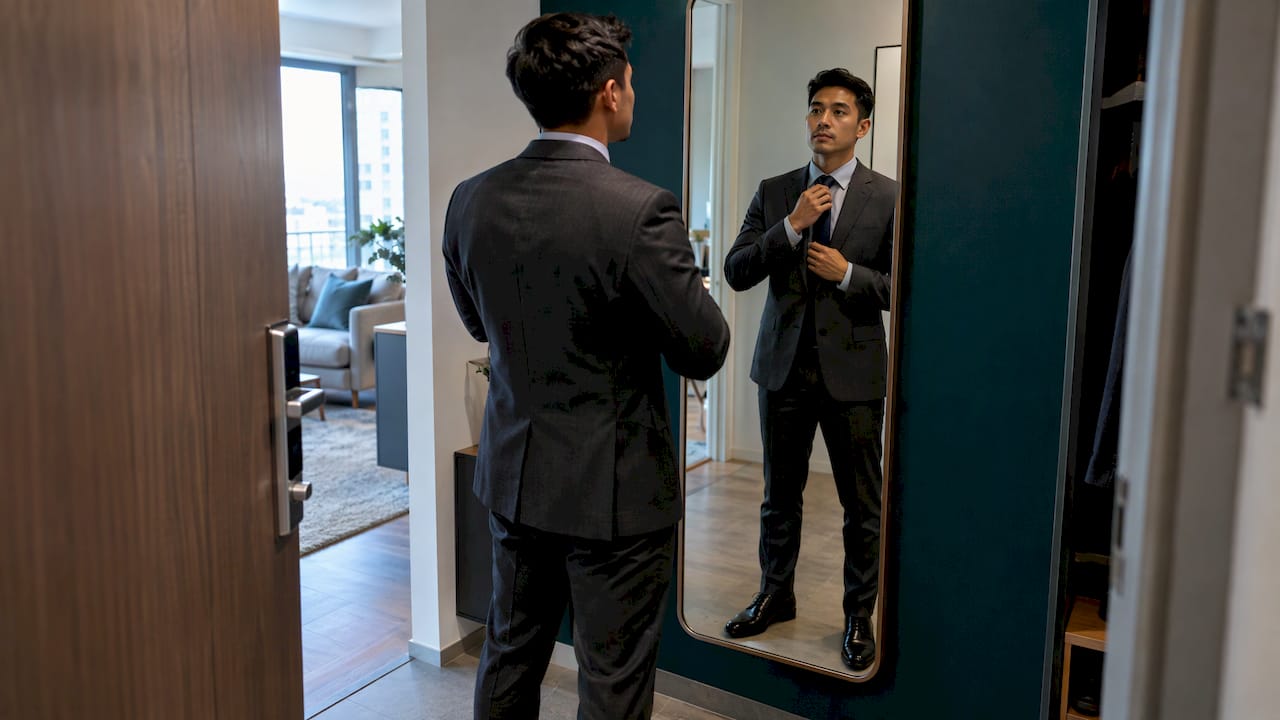
For most interviews in Singapore, a man should wear a well-fitted navy or charcoal suit, a crisp long-sleeved shirt in white or a pale neutral, and polished leather lace-ups. Banking, finance, law and the public sector expect it. Technology, creative and start-up employers accept smart casual, provided it looks deliberate. When you are unsure, dress one notch more formally than you expect the office to be.
This guide sets out what to choose for each situation, how to stay composed in a tropical climate, and what to leave at home. It draws on guidance from Singapore’s own career bodies, and on what we have learned in nearly five decades of dressing professional men.
TL;DR
- Banking, finance, law and Government: wear a navy or charcoal suit, a long-sleeved shirt, a conservative tie and polished dress shoes.
- Technology, creative and start-ups: a blazer with tailored trousers or chinos and a clean shirt is usually sufficient. Slight overdressing is safer than underdressing.
- Choose a breathable, lightweight wool, and an unlined or half-lined jacket. Fit matters more than price.
- Keep colours neutral, accessories minimal and fragrance light. Avoid sandals, graphic T-shirts and loud patterns.
- Research the employer first. Its website and LinkedIn page will tell you more than any general rule.
Table of Contents
- Suit or smart casual: how to decide
- The formal interview outfit, piece by piece
- The smart-casual interview outfit
- Staying composed in Singapore’s heat
- Colour, fit and grooming
- What to avoid
- Virtual interviews
- A note from our house
- A bespoke suit for the interview that matters
- A checklist for the night before
- FAQ
- Sources
Suit or smart casual: how to decide
The first decision is the register of the room you are walking into. The Centre for Domestic Employees’ career-coach guidance says business formal is the safer choice for banking, finance, law and Government, while smart casual is generally acceptable in creative fields, public relations, marketing, technology and start-ups, if the outfit looks polished and intentional.
Workforce Singapore’s MyCareersFuture guide, published in June 2024, advises researching the employer’s culture and position before choosing. For corporate roles it names formal business attire, a suit and tie for men, as best. It treats attire as something to adapt to the company, the industry and the role, not as a single uniform.
| Sector | Recommended attire | Notes |
|---|---|---|
| Banking, finance, insurance | Navy or charcoal two-piece suit, white shirt, conservative tie, black or dark brown lace-ups | Underdressing at a bank is rarely forgiven |
| Law and professional services | Dark suit, long-sleeved shirt, tie | A plain, quiet tie is enough |
| Government and statutory boards | Long-sleeved shirt, dark trousers, clean shoes; a jacket for senior roles | Avoid any conspicuous branding |
| Technology, start-ups, fintech | Blazer, tailored trousers or chinos, plain shirt or smart polo | Tie optional |
| Creative, marketing, public relations | Smart casual with one considered detail | Polished, never sloppy |
| Retail, hospitality | Collared shirt and dress trousers; a jacket if the role is managerial | Ask the recruiter about the dress code |
The business-professional standard in Singapore’s legal, banking and Government sectors, according to AEMorph’s overview of business attire, means tailored suits, long-sleeved shirts, ties and dress shoes for men. Smart casual in start-ups, fintech and creative industries means tailored trousers with polos or plain shirts.
When the dress code is unknown
Ask the recruiter. It is a perfectly ordinary question and it shows care. Failing that, look at the company’s website, its LinkedIn page and staff photographs. The Centre for Domestic Employees recommends exactly this kind of research, and adds that dressing slightly more formally is preferable to dressing too casually.
TailorCV’s Singapore etiquette guide makes the same point in practical terms: the safe default for a first interview is one notch more formal than you expect the office to be. Most offices are heavily air-conditioned, so you dress for the office and not for the walk from the MRT.
The formal interview outfit, piece by piece
Our own view on the Singapore business dress code is that a formal outfit succeeds through quiet correctness. Each piece should be unremarkable on its own and harmonious together.
The suit
JobStreet Singapore’s guide, updated in February 2024, recommends a well-tailored navy or charcoal suit for men’s formal interview attire, with a crisp long-sleeved shirt, a conservative tie and polished dress shoes. It also suggests a structured single-breasted jacket in navy, charcoal or grey, with tailored trousers in navy, charcoal or black.
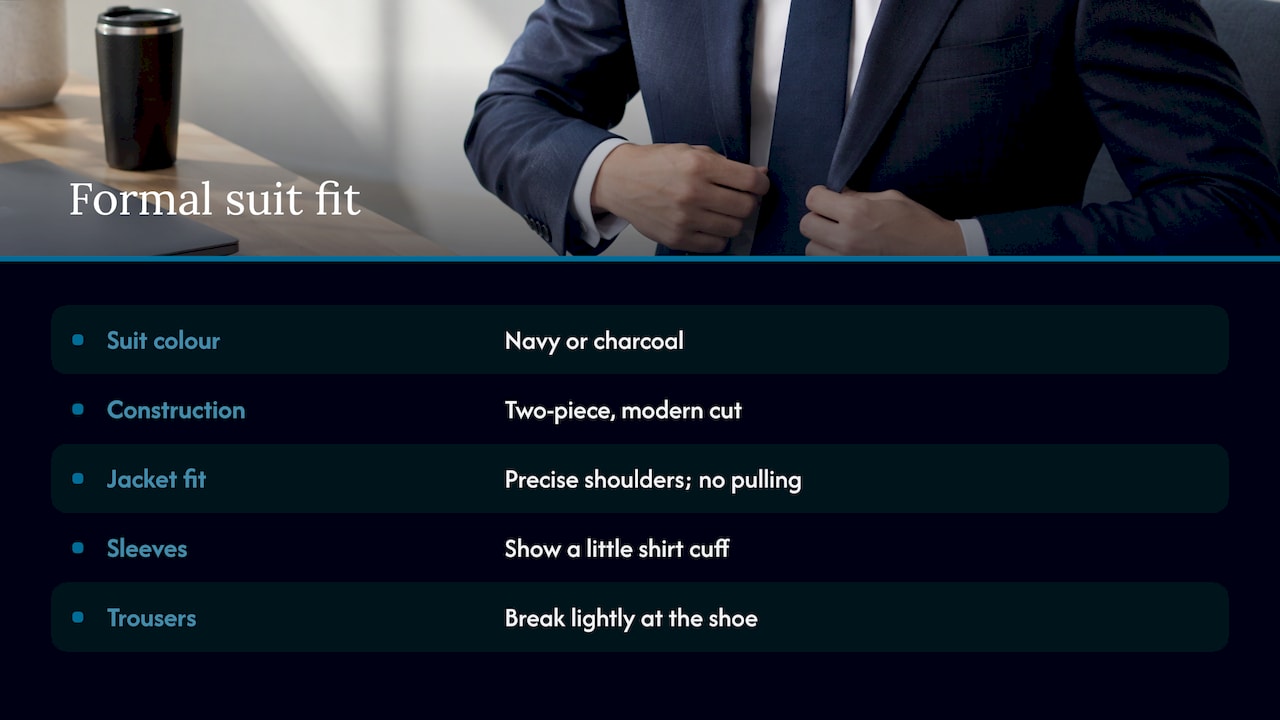
Choose a two-piece suit. A three-piece suit is warmer than Singapore requires, and The Singapore Handbook recommends a two-piece with a modern cut that allows movement.
The suit should fit the shoulders precisely, close without pulling at the button, and leave a clean line from collar to hem. Sleeves should show a little shirt cuff. Trousers should break lightly at the shoe. An off-the-peg suit rarely achieves all of this without alteration, which is why fit is the single most important variable in how you are perceived.
The shirt
Wear a long-sleeved shirt, in white or a pale neutral, ironed that morning. A long sleeve is the accepted standard for a suit interview in Singapore, and a short-sleeved shirt with a tie is best avoided. Lightweight cotton poplin or a linen-cotton blend breathes well. Take a spare shirt in your bag if the journey is long, and change before you enter the building.
The tie
The Centre for Domestic Employees notes that ties are optional unless the industry or company is very formal. For banking, law and Government roles, wear one. Choose a solid navy, burgundy or a fine, restrained pattern. Bow ties, novelty prints and bright colours draw attention away from you.
Shoes, belt and accessories
MyCareersFuture advises that footwear should be comfortable, simple, clean and professional. Dress shoes and other closed-toe options are appropriate, while flip-flops and sandals are not acceptable in business settings. Black or dark brown Oxfords or Derbys, polished the night before, are the sound choice. Match your belt to your shoes.
Keep accessories to a minimum. The Centre for Domestic Employees recommends a simple watch or tie clip rather than numerous accessories. Thin cotton or bamboo dress socks, in a dark colour that matches the trousers, keep the feet comfortable.
For more on this, see our notes on footwear, accessories and grooming in Singapore offices.
The smart-casual interview outfit
Smart casual is not a relaxed version of the suit. It is a separate, more personal discipline, and it is easier to get wrong because there is no template to follow.
For a business-casual interview, JobStreet Singapore suggests khaki trousers with a button-down or polo shirt, adding a blazer for a more formal touch. Indeed Singapore adds that business casual can look professional when it combines good fit, wrinkle control, neutral colours, structured trousers and polished closed-toe footwear.
A dependable formula:
- A navy or grey unstructured or lightly structured blazer.
- A plain white or pale blue shirt, open at the collar or with a knit polo beneath.
- Tailored chinos or lightweight wool trousers in stone, navy or charcoal.
- Leather loafers or Derbys with a belt to match.
Dark, well-kept denim can suit a very casual workplace, but only when it is clean and fitted, and only when you know the culture. If you have any doubt, choose trousers.
Staying composed in Singapore’s heat
A suit that sits well in an air-conditioned boardroom can be punishing on the walk from the station. The answer lies in fabric and construction.
The Straits Times reported in April 2026 that Beams creative director Tatsuya Nakamura recommends a breathable wool base for suits in Singapore, noting that linen and cotton wrinkle easily in the local climate. Colony Clothing founder Kozo Kawamura suggests unlined jackets and lightweight trousers for comfort.
That advice matters for interviews, where you cannot afford to arrive creased. The Singapore Handbook recommends lightweight tropical wool, linen blends, cotton or moisture-wicking blends for suits and advises avoiding heavy tweed or flannel.
| Garment | Sensible choice | Why it helps |
|---|---|---|
| Suit | Lightweight tropical wool, half-lined or unlined | Breathes and recovers from creasing |
| Shirt | Cotton poplin or linen-cotton blend | Light against the skin |
| Trousers | Lightweight wool | Holds a crease and allows airflow |
| Socks | Thin cotton or bamboo | Keeps feet cooler |
A few habits help as much as fabric. Travel with your jacket over your arm or in a garment bag, arrive with ten minutes to cool down, and use deodorant rather than a strong cologne. Our guide to staying polished in Singapore’s tropical climate covers the subject at greater length.
Colour, fit and grooming
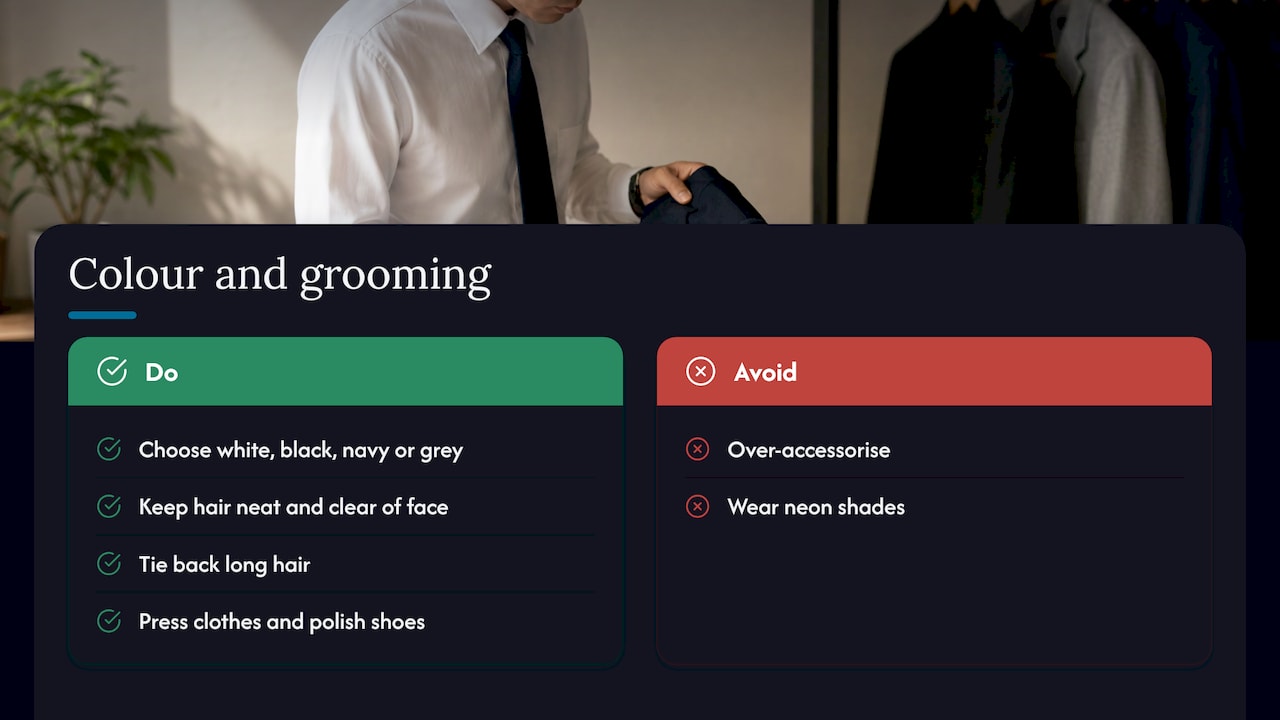
Workforce Singapore’s guide recommends white, black, navy or grey as safe, office-appropriate colours and cautions against over-accessorising. The NTUC-hosted career guidance similarly recommends black, navy, white and other neutral colours, and cautions against neon shades.
The interviewer should be listening to you, not studying your tie. That principle explains almost every rule in this guide.
On grooming, the same NTUC-hosted guidance says hair should be neat and clear of the face, long hair tied back, and facial hair trimmed and well kept. Natural-looking hair colours are generally the safer choice. Press your clothes, polish your shoes, and check your nails and breath before you go in.
What to avoid
A concise list, drawn from Singapore career guidance:
- Footwear: Randstad Singapore advises against flip-flops, sandals, shorts, athleisure and flashy clothing, as well as overpowering perfume or cologne.
- Unusual suit colours and poor fit: The SUTD Career Development Centre lists suits in white, red, purple, mustard or teal, ill-fitting suits, bow ties and excessive jewellery among the things men should not wear to an interview.
- Casual items: Indeed Singapore says to avoid oversized or tight clothing, baggy trousers, neon colours, bold patterns, graphics and slogans, as well as strong fragrances.
- Visible branding: keep logos and text out of sight, especially for Government interviews.
The common thread is distraction. Anything that invites a comment about your clothing takes attention from your answers.
Virtual interviews
For interviews on video, JobStreet Singapore says solid colours photograph better, and recommends attention to hair, posture and a tidy background. Dress fully, including trousers and shoes. It affects your posture and your confidence, and it protects you if you have to stand unexpectedly.
A note from our house
We have been making suits since 1979, when our founder, master tailor Richard Fan, opened the house. In that time we have seen the same pattern repeat: a man who feels at ease in his clothes interviews better than a man who is thinking about them.
The Singapore interview rewards the details that tailoring addresses. A jacket that sits cleanly on the shoulders, trousers cut to your own measurements, and fabrics chosen for our climate all signal care before you have said a word.
This is why we advise candidates for formal roles to consider a bespoke suit as an investment in more than one interview. Our approach combines traditional craftsmanship with a contemporary cut, and our fittings are designed to address your individual fit challenges. A navy or charcoal suit in a breathable fabric will serve you at the interview, at the first day, and for years afterwards.
Ron
A bespoke suit for the interview that matters
If you are preparing for a role in banking, law, consulting or Government, a suit made to your measurements removes the greatest source of doubt on the day. At Ron & Rich, each garment is tailored to your exact measurements and preferences, with premium fabrics suited to Singapore’s climate. You can read about our bespoke tailoring process before you book.
Our suits start from $2,170, trousers from $290 and shirts from $199, as published on our pricing page. Many candidates begin with a suit and two tailor-made shirts, which is enough to cover a full round of interviews. To see the range, visit our suits and jackets.
A checklist for the night before
- Confirm the dress code with the recruiter, or review the company’s website and LinkedIn page.
- Press the suit and shirt. Hang them where they will not crease.
- Polish your shoes and check the heels.
- Lay out belt, watch, socks and a spare shirt.
- Plan your route so that you arrive cool, with ten minutes in hand.
- Trim facial hair and keep fragrance light.
Our quick outfit checklist offers a longer version for the working week.
FAQ
Do I need to wear a tie to an interview in Singapore?
For banking, finance, law and Government roles, yes. In other industries a tie is optional unless the company is very formal. If you are unsure, wear one and remove it if the interviewer is plainly more casual.
Is a blazer enough, or do I need a full suit?
A blazer with tailored trousers suits technology, creative and start-up interviews. For corporate and professional-services roles, a full suit is the safer choice. Dressing slightly more formally than expected is better than dressing too casually.
What colour suit is best for an interview?
Navy and charcoal are the dependable choices, with grey as a close third. Avoid white, red, purple, mustard and other unusual colours, which can distract from you.
What should I wear to an interview if it is raining?
Carry a compact umbrella and keep your jacket in a garment bag or over your arm. Wear a lightweight wool suit that recovers from dampness and creasing, and carry a spare shirt to change into before you enter.
Sources
- Centre for Domestic Employees: First Job Interview Tips
- NTUC: First Job Interview Tips
- MyCareersFuture: Interview Outfit
- JobStreet Singapore: Dressing Right for an Interview
- JobStreet Singapore: Interview Mistakes
- Indeed Singapore: What to Wear for an Interview
- The Straits Times: Wool over linen
- The Singapore Handbook: Interview Attire in a Tropical Climate
- TailorCV: Singapore Interview Etiquette
- AEMorph: Business Attire Standards in Singapore
- Randstad Singapore: What Not to Wear to an Interview
- SUTD Career Development Centre: 10 Things Men Should Never Wear