Mildew on Suits: How to Treat It and Prevent It in Singapore
Mildew on a suit is a surface problem only when you catch it early. Act at the first faint musty smell: isolate the suit, brush it outdoors, air it somewhere dry and shaded, and then give it to a professional cleaner, because a tailored jacket should never be soaked at home. Then fix the storage that allowed it. In Singapore’s humidity, that second step matters more than the first.
At Ron & Rich, we have made suits since 1979, when our master tailor Richard Fan founded the house. A well-made suit is built from layers of cloth, canvas and lining, and those layers are exactly what make mildew difficult to treat. This guide explains what to do, what to avoid, and how to keep a suit safe in a wardrobe.
TL;DR
- Mildew shows as small dark or white spots, often with a musty smell. Do not wear the suit until the mildew is gone and the garment is fully dry.
- Brush off loose growth outdoors, air the suit in a dry, shaded, ventilated place, and keep it away from other garments.
- Do not soak or machine wash a tailored suit. Its canvas, interlining and lining can warp, so professional dry cleaning is the safer route.
- A smell that returns, pinholes or fabric that feels papery mean the damage may be deeper than the surface.
- Prevention is simple: dry the suit completely, let air circulate in the wardrobe and keep humidity down.
Table of Contents
- How to tell whether your suit has mildew
- Why suits are vulnerable in Singapore
- What to do first when you find mildew
- Removing the musty smell
- When the suit needs professional cleaning
- Preventing mildew in Singapore’s climate
- Mildew, moths and other storage problems
- Our view: a suit made for this climate
- A suit built to last in Singapore
- FAQ
- Sources
How to tell whether your suit has mildew
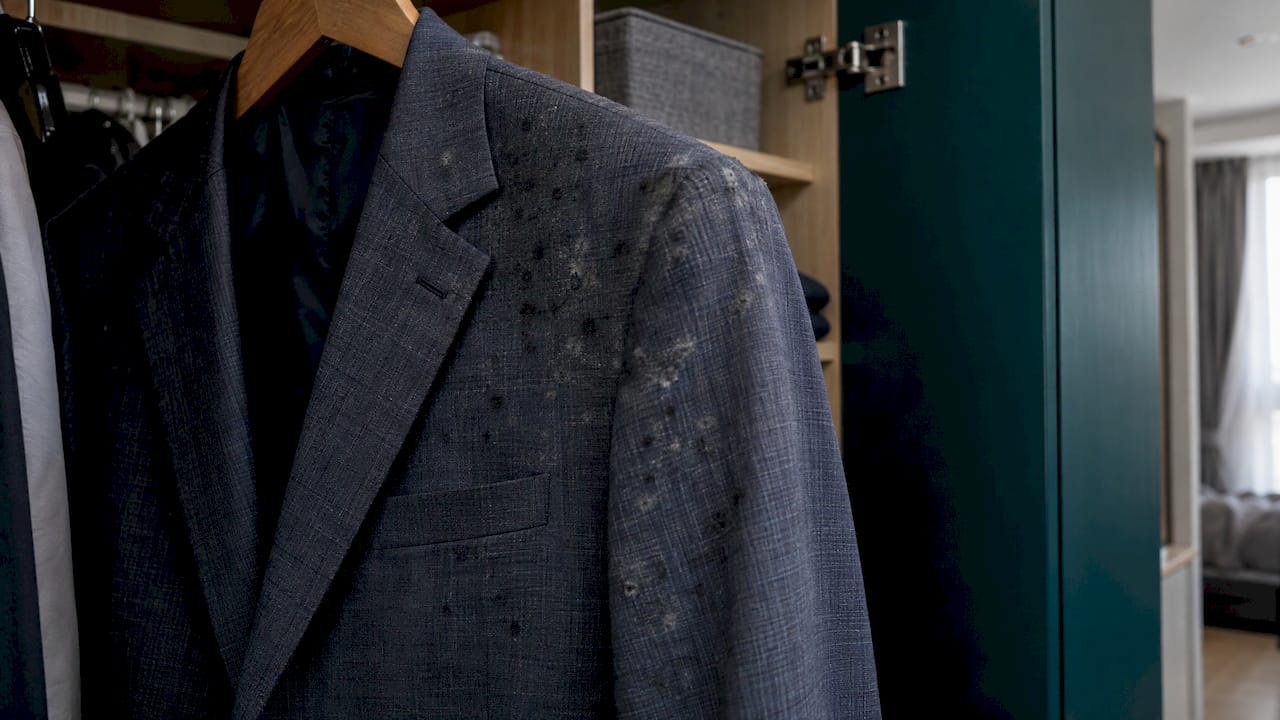
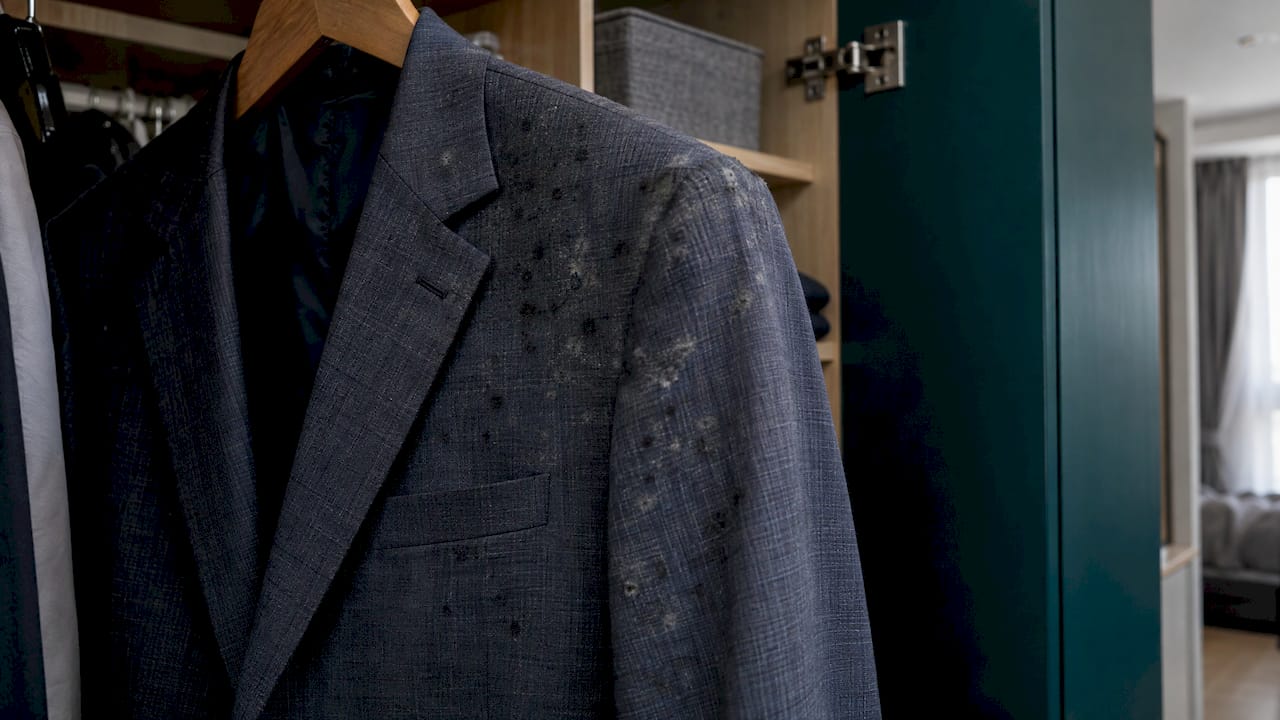
Mildew usually appears as small dark or white spots on the cloth. According to a professional cleaner, it tends to affect wool suits, silk garments, leather accessories and clothing stored for a season. The smell often arrives before the spots do: a stale, damp odour when you open the wardrobe or lift the suit from its bag.
Check the places where moisture lingers longest. Collars, cuffs, waistbands, shoulder seams and linings hold damp the longest, so look there first. Turn the jacket inside out and examine the lining, the pocket bags and the underside of the collar. Mildew often starts where you cannot see it.
Is it safe to wear?
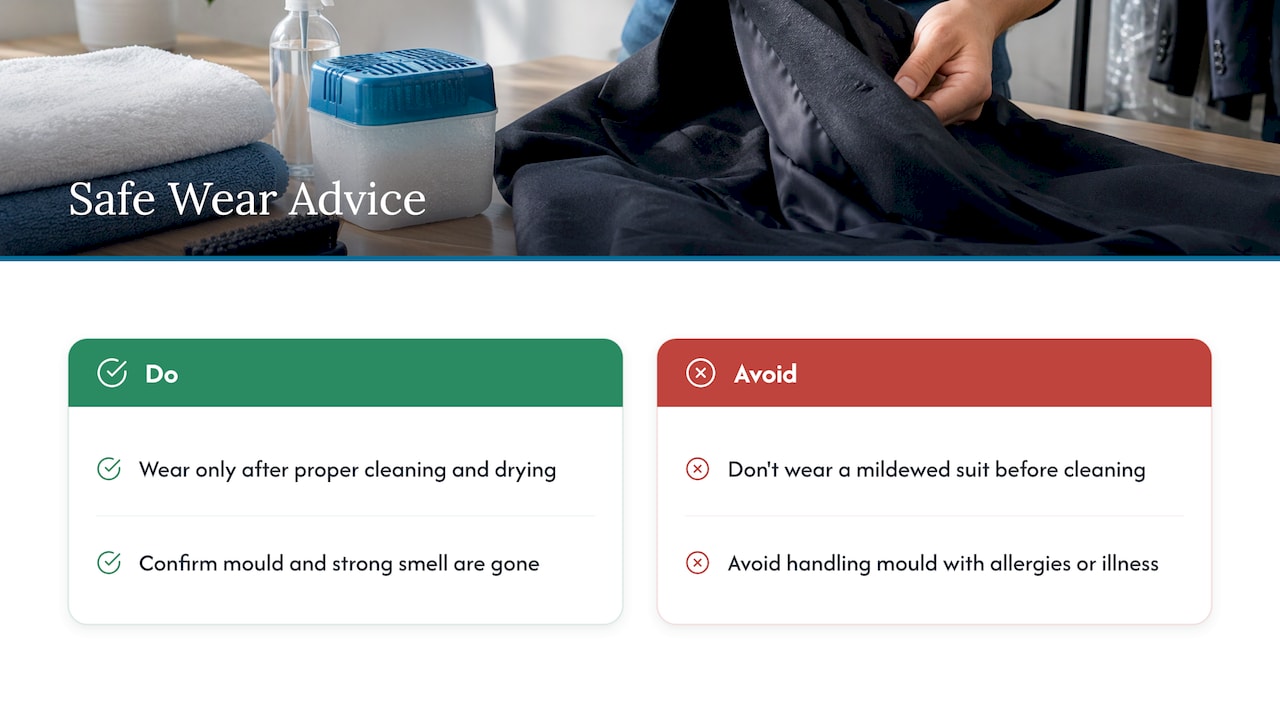
We advise against wearing a mildewed suit until it has been properly cleaned. Exposure can irritate the skin, eyes, nose, throat and lungs, especially for people with asthma, mould allergies, sensitive skin or a weakened immune system. A garment is fit to wear again only when the visible mould is gone, it has been cleaned properly, it is completely dry and no strong smell remains.
If you have a health condition or a serious allergy, do not handle the suit yourself. Singapore’s national heritage body, ROOTS, warns that mould can cause headache, rash, sore throat, cough and red, watery eyes, and in serious cases can trigger asthma attacks or infection. It advises that people with health issues or serious allergies leave mould to someone trained. If that describes you, ask someone else to bag the suit and take it for cleaning, and speak to your doctor if you develop symptoms.
Why suits are vulnerable in Singapore
The fibres in a fine suit are natural, and natural fibres are hygroscopic: they take in moisture quickly and release it slowly. High humidity, warm temperatures and poor ventilation then encourage mould. The same source explains that soiling from handling, such as skin oils and traces of food or perfume, lets mildew grow at lower humidity levels than clean cloth would.
The thresholds are worth knowing. The Smithsonian’s Museum Conservation Institute notes that stagnant air above 80% relative humidity supports mould on cotton and linen, and that wool and silk are affected above 92%. Synthetics such as polyester absorb little moisture. Singapore’s air is humid throughout the year, and a closed wardrobe can hold still, damp air for weeks. A suit worn for a long day and returned to that wardrobe unaired is the classic starting point.
This is also why fabric choice matters. We select premium fabrics suited to Singapore’s climate for every suit we make, so that the cloth is comfortable to wear and well matched to the conditions it will live in. Good cloth, however, still needs good habits.
What to do first when you find mildew
Speed counts. The first faint musty smell is the moment to separate the suit from its neighbours. Mould spreads, and a single affected jacket can transfer it to the garments hanging beside it.
- Isolate the suit. Move it out of the wardrobe at once. Check the neighbouring garments for the same smell or spots.
- Take it outdoors or to an open, ventilated space. Loose growth should not be shaken out in a bedroom. Brushing mildew off out of doors is the standard first step in textile care guidance, and a soft clothes brush is enough.
- Air it in dry shade. Hang the suit on a broad, shaped hanger in a ventilated space away from direct sun, radiators and hairdryers, turning it after a few hours so that every side is exposed. Strong sun can fade the cloth and heat can stress the lining and trim.
- Vacuum gently if the mildew has dried. The Museum Conservation Institute describes gentle vacuuming with a HEPA-filtered vacuum once mildew is dry, after testing the suction and brush on a small hidden area. HEPA filters trap fine particles rather than blowing them back into the room.
- Bag it for cleaning. Place the suit in a breathable garment bag or a clean cotton cover for the journey to the cleaner. A sealed plastic bag traps moisture.
What not to do
Most online guides to mould on clothes are written for washable cotton and denim: vinegar soaks, borax, baking soda, bleach, even lemon and salt left in the sun. We would not apply them to a tailored suit. Soaking can warp the interfacing, and a jacket is far more than a single layer of cloth.
A US cleaner explains the reason: the wool shell, canvas and linings of suits, blazers and tailored coats carry a high mildew risk, and the interfacing can warp if soaked. Bleach and acidic soaks can also strip colour or weaken wool. The conservation guidance adds that the mildewed portion of a textile is already weaker than the rest, so washing or agitation may increase rips, tears and holes.
Odour sprays deserve the same caution. Fragrance sprays mask rather than fix a smell caused by moisture, and they can mark silk, satin, velvet and dark tailoring. Commercial odour products containing ethanol may affect dyes and finishes, causing bleeding or loss of sheen. Activated charcoal or bicarbonate of soda in a separate open container can absorb some odour nearby, but neither removes dirt or treats mould.
Removing the musty smell
A musty smell comes from volatile compounds released by fungi or bacteria. The conservation guidance notes that warm, dry airing helps the smell dissipate, so patience is part of the treatment. Hang the suit for a day or two in a dry, airy room, then check the lining and underarms again.
If the smell fades fully, the problem was probably caught early. If it returns once the suit is back in the wardrobe, the growth has probably reached deeper than surface treatment can go. One dry-cleaning specialist explains that solvent penetrates fibres more thoroughly than water, which matters most on lined jackets, coats and anything with padding or interlining, where mildew hides.
When the suit needs professional cleaning
For a suit, professional dry cleaning is the sensible next step for any mildew beyond a faint, early smell. The reasons are structural. A bespoke jacket relies on canvas and interlinings that give the chest and lapel their shape, and these can be disturbed by water. A Singapore laundry’s own terms and conditions acknowledge that suits are prone to bubbling, known as de-lamination, of the interlining after cleaning, and that complete stain removal is not guaranteed. Tell the cleaner at drop-off that the problem is mildew, and ask them to treat the garment according to its care label.
We have written separately on how often a suit should be dry cleaned so that its construction is protected. Cleaning is a tool to use sparingly, but a mildewed suit is the clearest case for it.
Signs the damage runs deeper
Some mildew damage is more than cosmetic. A US cleaner suggests a simple fibre test: gently tug the affected area between two fingers. If the cloth tears, shreds or feels papery, the fibres have already been weakened. Other warning signs are:
- pinholes in the stained area;
- a black stain that has not moved after two careful treatments;
- a strong smell that survives repeated cleaning.
Some odours do survive. Bacteria- and mould-related smells can withstand the dry-cleaning process, and wool and silk hold odour more than synthetic fibres. Where a standard clean fails, an enhanced process such as ozone treatment or wet cleaning is sometimes used, and the same source advises airing a garment after cleaning rather than storing it immediately.
Where the damage is confined to a jacket lining, a pocket bag or a hem, the affected part can often be replaced, and a new lining costs far less than a new jacket. This is another argument for a suit made with a proper lining: it is a part that can be renewed without losing the garment.
Preventing mildew in Singapore’s climate
Most of the work is done before any mildew appears. Four habits protect a suit.
Dry everything completely before storing
The two habits that prevent most mould, according to a Singapore dry-cleaning service, are complete drying and dry storage. A suit worn on a humid day or caught in a shower should hang in open air until it is fully dry, ideally within 24 to 48 hours for any damp item. Do not return a freshly steamed or aired garment straight into a closed wardrobe, since even small amounts of moisture encourage musty smells. Our guide to steaming a suit explains how to do it without disturbing the structure, and how long to let it rest afterwards.
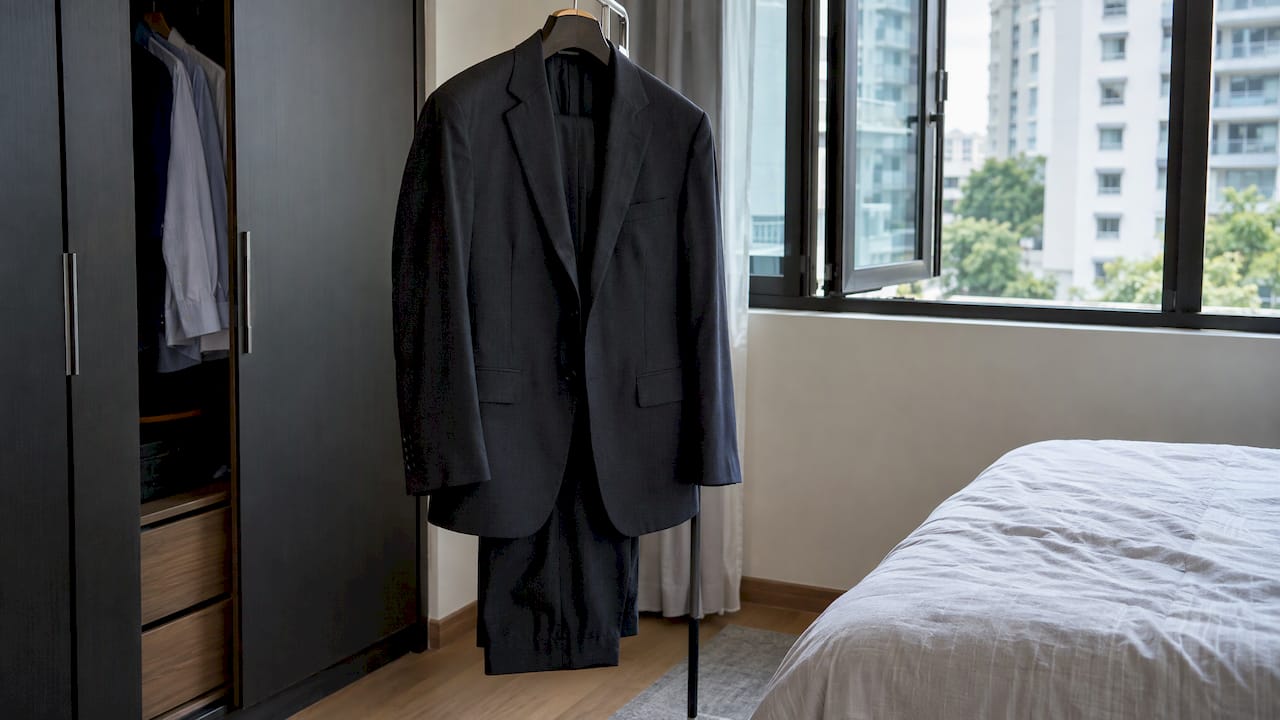
Let the wardrobe breathe
Guidance for Singapore homes recommends keeping indoor relative humidity below 60%, leaving space between stored items and the back wall, and opening wardrobe doors on dry days. In a small wardrobe, a dehumidifier or desiccant box helps.
For a stricter target, ROOTS recommends 22 ± 1°C and 55 ± 5% relative humidity for stable storage of collections, with dry cabinets and desiccants for localised moisture control. A suit is not a museum object, but the principle holds: stable, moderate humidity and moving air. A small hygrometer in the wardrobe costs little and tells you what is actually happening.
Clean before long-term storage
Soiling feeds mildew. For suits and formalwear stored for a long period, a professional clean beforehand removes the invisible soiling and moisture that mould lives on. This suits the wedding suit worn once and kept for an anniversary, or the dinner jacket brought out twice a year. Do not store any suit in a sealed, humid cupboard or a plastic cover.
Hang it properly
A broad, contoured hanger, a breathable cotton cover and room between garments let air move around the cloth. Our guide to storing a bespoke suit covers hangers, covers and rotation in more detail. Rotating suits rather than wearing one every day also gives each a rest, which our piece on making a suit last 5 to 15 years explores further. If you travel, our notes on travel suit care apply too, since a suit packed damp is a suit that arrives with a smell.
Mildew, moths and other storage problems
Damp and pests often arrive together. A wardrobe that holds moisture can also hold moths, and the two leave different marks: mildew leaves spots and a smell, moths leave holes. If you find small holes while checking for mildew, read our guide to identifying, mending and preventing moth holes. Small spills and marks are a separate matter again, and our advice on spot cleaning a suit explains why acting within the hour protects the structure.
Our view: a suit made for this climate
We have spent nearly five decades making suits for men who live and work in Singapore, and we have learned that a suit is only as good as the care it receives once it leaves our house.
A bespoke suit is made by hand, with canvas, linings and cloth chosen to work together. That craftsmanship is what gives it shape, and it is also why we ask our clients to treat it gently: no soaking, no shortcuts, no sealed cupboards. Mildew is rarely a failure of the suit. It is almost always a failure of air.
This is why we choose premium fabrics suited to Singapore’s climate, and why every garment is cut to your exact measurements and preferences. A suit that fits well is worn with comfort, aired more naturally and handled with less strain on its seams. Fit, cloth and care belong together.
Look after a well-made suit and it will serve you for many years. We would be glad to help you begin with one.
Ron
A suit built to last in Singapore
If a mildewed suit has made you reconsider your wardrobe, a fresh start can be a good moment to choose cloth and construction with the climate in mind. We make bespoke suits, tuxedos, wedding suits, trousers, shirts, sports jackets and more, each tailored to your measurements after a personal consultation and fittings. Suits start from $2,170, sports jackets from $1,790, tuxedos from $2,270, trousers from $290 and shirts from $199, as published on our pricing page.

You can see how a commission unfolds on our bespoke tailoring process page, or explore our bespoke suits and begin a consultation.
FAQ
Will the mildew smell go away once the suit is dry?
Sometimes, if it was caught early. Warm, dry airing helps the smell dissipate, and a faint odour may fade in a day or two. If the smell returns, or remains after a professional clean, the mildew has probably reached the canvas or lining, and the suit should be handled by a specialist cleaner.
Can I wash a mildewed suit at home?
We advise against it. Soaking can warp the interfacing and weaken fibres that mildew has already stressed. Brush off loose growth outdoors, air the suit in dry shade, and have it dry cleaned according to its care label.
Is it safe to wear a suit that has had mildew?
Only once the visible mould is gone, the suit has been cleaned, it is completely dry and no strong smell remains. Mould can irritate the skin, eyes, nose, throat and lungs, particularly for people with asthma or allergies. If you have either, ask someone else to handle the suit, and see your doctor if symptoms appear.
How do I stop mildew coming back?
Dry the suit fully after wearing, leave space around it in the wardrobe, and keep humidity down with a dehumidifier or desiccant box. Clean it professionally before long-term storage, and never put a freshly steamed suit straight into a closed wardrobe.
Does mildew only affect cheap suits?
No. Natural fibres such as wool and silk absorb moisture readily, so any suit can be affected if it is stored damp. A well-made suit simply gives you more to protect, which is why drying and ventilation matter.
Sources
- Your Collections, ROOTS Singapore (2023)
- Mold and Mildew on Textiles, Museum Conservation Institute
- Remove Stains From Mildew, Mold, University of Georgia Extension
- Signs moisture is damaging your wardrobe
- Should You Throw Out Moldy Clothes?
- Mildew on Clothes? What to Save and How to Clean It
- How to Get Mildew Smell Out of Clothes
- Why Do Clothes Still Smell After Dry Cleaning?
- Terms & Conditions, Duo Nini Pte Ltd
- How to Remove Musty Smells from Vintage Clothing
- Freshen dry-clean-only clothes between wears
- How to Get Rid of Mould on Clothes, Bags and Shoes
- Preventing Mould and Humidity