How Should Men Choose the Right Business Suit?
A good business suit does a lot of quiet work. In simpler terms, before you have even said a word in a meeting, your dressing style itself will speak about how you address the occasion and how much importance you are giving to it. Choosing a business suit for men isn’t about selecting the trendiest one or the most expensive fabric; it’s about getting the fundamentals right, like fit, fabric, colour, and style in that order.
This blog will guide you on how exactly you should dress, so you can show up with real confidence to any boardroom, client meeting, or interview.
Why the Right Business Suit Actually Matters
It’s tempting to treat a suit as just another item on your shopping list. But research on the workplace has said something very familiar to what tailors have been saying for decades: “What you wear changes how people read you and even how you perform.” A study published in Harvard Business Review has found that professional dressing shapes both perception and self-confidence in the workplace, and it also notes that clothing is a form of non-verbal communication, which explains a lot about the person.
In practical terms, this means that a well-chosen suit isn’t vanity; it’s a proper tool that signals preparation, attention to detail, and respect for the people you are meeting. On the other hand, a poorly fitted suit conveys the opposite, irrespective of its price.
Start with Fit, Not Fashion
If you remember one rule from this entire article, make it this: a great fit beats price every time. A $400 suit that’s tailored to your body will always look better than a $2,000 suit bought ready-made and worn as it is.
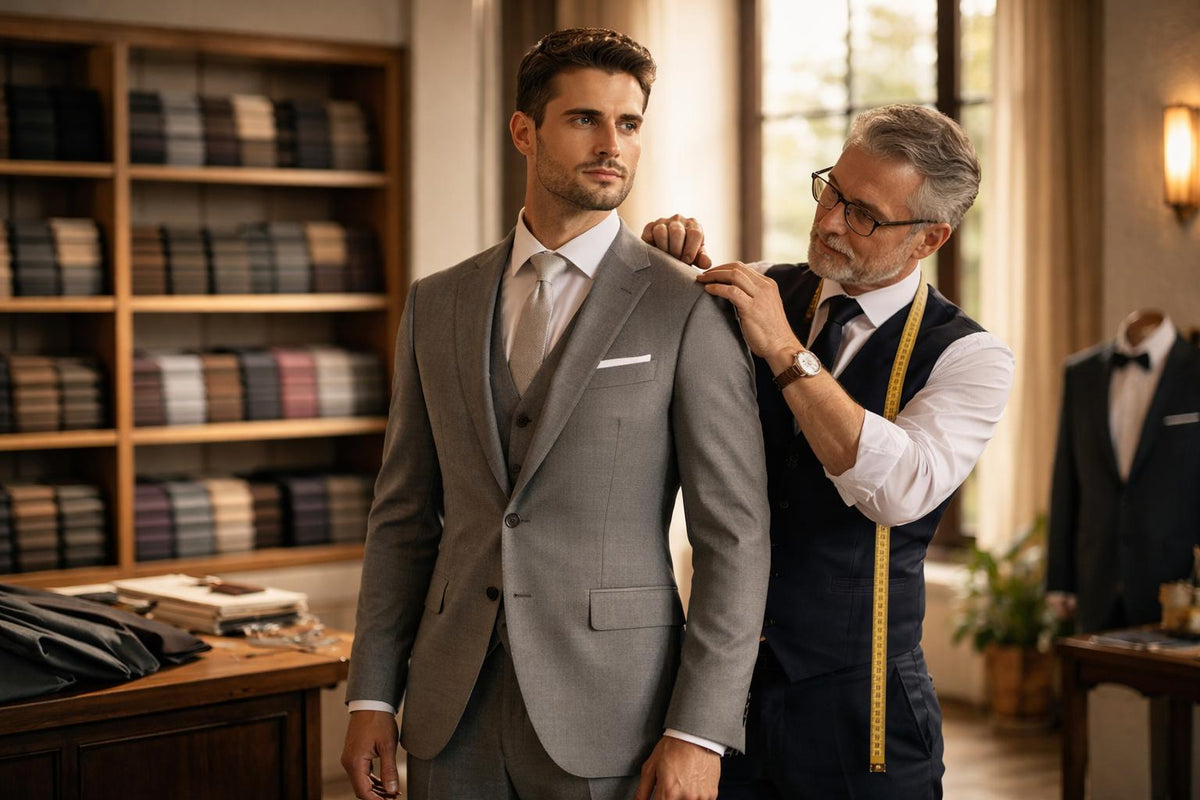
Here are a few things that you should always check before buying:
Shoulders: The seam should sit perfectly at the edge of your shoulder. This is one important thing that cannot be altered or fixed by a tailor, so be cautious at the time of purchase.
Chest & Buttoning: With the jacket buttoned, the fabric across the chest should be flat, with no pulling or gaping at the lapels.
Sleeve Length: Look for about half an inch of shirt cuff that’s showing beyond the jacket sleeve
Jacket Length: The hem should align with the curve of your palm when your arms hang naturally.
Trouser Break: A slight, clean break at the shoe is the safest modern choice for business settings.
Almost every ready-made suit requires at least minor tailoring, such as narrowing the waist, adjusting sleeve length, or tapering trousers. Keep them in accordance with the budget, not as an add-on.
Picking the Right Color for Your Role
Color is where a lot of men either play it too safe or take unnecessary risks. The table given below conveys information about each color and how it will fit in your wardrobe:
|
Suit Color |
Best For |
Formality Level |
Notes |
|
Navy |
Interviews, daily office wear, client meetings |
High |
The most versatile business color; works across almost every industry |
|
Charcoal Grey |
Boardroom meetings, law, finance, formal interviews |
Very High |
Reads as serious and authoritative; the standard for conservative industries |
|
Medium Grey |
Business casual, spring/summer office wear |
Medium |
More relaxed than charcoal, still professional |
|
Black |
Formal evening events/funerals |
Situational |
Generally too severe for daytime business use |
|
Light Grey/Tan |
Warm weather offices casual Fridays |
Low-Medium |
Not appropriate for interviews or formal corporate meetings |
So, if you’re building your first suit wardrobe, start with navy, and then add charcoal. Between the two, you will be dressed correctly for the overwhelming majority of professional situations you will face.
Choosing the Right Fabric
For business wear, wool is the ultimate standard, and for good reason. It breathes, resists wrinkles, and stays in shape as it is till the end of the day. You will see wool suits labelled with “Super” numbers, Super 100s, Super 130s, and so on. This number refers to the fineness of the wool fibre, not the actual fabric’s overall quality or durability. The higher super numbers produce softer, smoother fabric, but that can make it a bit difficult to handle every day.
So, if you’re looking for a suit to be worn multiple times a week, Super 100s to Super 130s wool is generally the best spot. They are more durable and are designed for client meetings and rough days. Save anything that’s above Super 150s for special occasions.
Setting a Realistic Budget
A business suit is a cost-per-wear investment, and not something of a one-off purchase. A well-made or well-designed suit in a classic colour and cut, worn twice a week, will cost you pennies per wear over a few years, which is far less than a cheap suit you gave up on in just a year. So, whenever preparing a budget, prioritise in this manner: fit and tailoring should come first, then fabric and at last the brand.
Conclusion
The best business suit isn’t the most expensive one; it’s the one that fits your body, suits your industry or profession, and holds up to regular wear. Get the fit right, then look for the fabric based on when and where you have to wear it, and lastly choose the most appropriate colour for the same. Everything else can be altered, apart from these, so choose wisely.
So, are you ready to find the suit that actually suits you well and fits naturally? Explore the premium collection at Ron & Rich and let our team give you the perfect consultation on how you can make your event brighter with the right clothing.
Frequently Asked Questions
Q1: How many business suits does a man actually need?
Two is enough to start: one navy, one charcoal. Add a third in a subtle pattern (like a fine pinstripe) once you're wearing a suit most days.
Q2: How often should a business suit be dry-cleaned?
Mostly, after every 4–6 wears, or a few times a season. Over-cleaning breaks down wool fibres faster than regular wear does. Brush and air the suit out after each use instead.
Q3: Should the suit jacket and trousers always match exactly?
For business wear, yes. Mismatched separates (sport coat and trousers) read as business casual, not business formal.
Q4: What's the difference between a business suit and a formal suit?
Business suits are built for repeated, practical wear with durable fabrics and versatile colours. Formal suits (like tuxedos) are occasion-specific and use finer, less durable materials.
Q5: Is it worth paying for a made-to-measure suit?
If you wear a suit regularly for work, yes. A made-to-measure suit corrects the fit issues that off-the-rack sizing can't, and it tends to outlast ready-made alternatives because it was built around your actual proportions.

Written by Digi Hawks Marketing