Bespoke Fitting Process: Every Step, Consultation to Collection
A bespoke suit is made in stages: a consultation, a detailed set of measurements, a first fitting on a rough, hand-basted jacket, one or two further fittings, then finishing and collection. In Singapore, plan on roughly eight to ten weeks and two to three rounds of intermediate fittings, a little more or less depending on the season. The fittings are where the garment stops being a pattern and becomes yours. This guide explains what happens at each one, what you should look for, and how to keep a fixed date, such as a wedding, safe.
At Ron & Rich, founded in 1979 by master tailor Richard Fan, every suit begins in person, with a consultation and fittings built around your own measurements and preferences. The steps below are the ones any serious bespoke house follows, and we point out where the fitting is won or lost.
TL;DR
- The bespoke fitting process runs in this order: consultation, measuring, pattern and cutting, basted fitting, one or two further fittings, finishing, collection.
- Allow about eight to ten weeks in Singapore, with two to three intermediate fittings. Weddings and festive seasons call for an earlier start.
- Come to each fitting with the shoes, shirt and belt you will actually wear, and say plainly what feels tight, loose or unlike you.
- Bespoke differs from made-to-measure in that the pattern is drawn for you and the garment is adjusted on your body several times.
- Starting with the occasion and the fabric makes every later decision easier.
Table of Contents
- The bespoke fitting process, step by step
- How long does a bespoke suit take?
- Ordering for a wedding or a fixed date
- Bespoke or made-to-measure: what changes in the fittings
- What to say at a fitting
- Our view: fit is a conversation
- Begin your bespoke suit with Ron & Rich
- FAQ
- Sources
The bespoke fitting process, step by step
1. The consultation: purpose, fabric and style
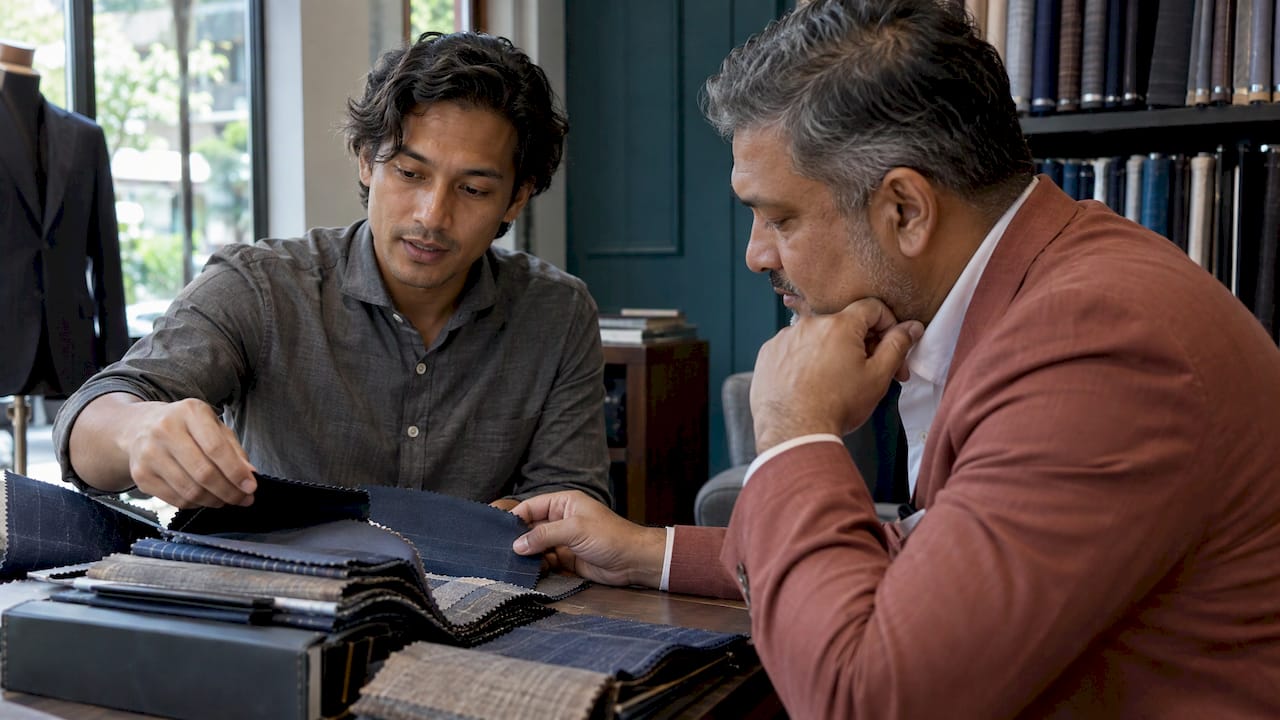
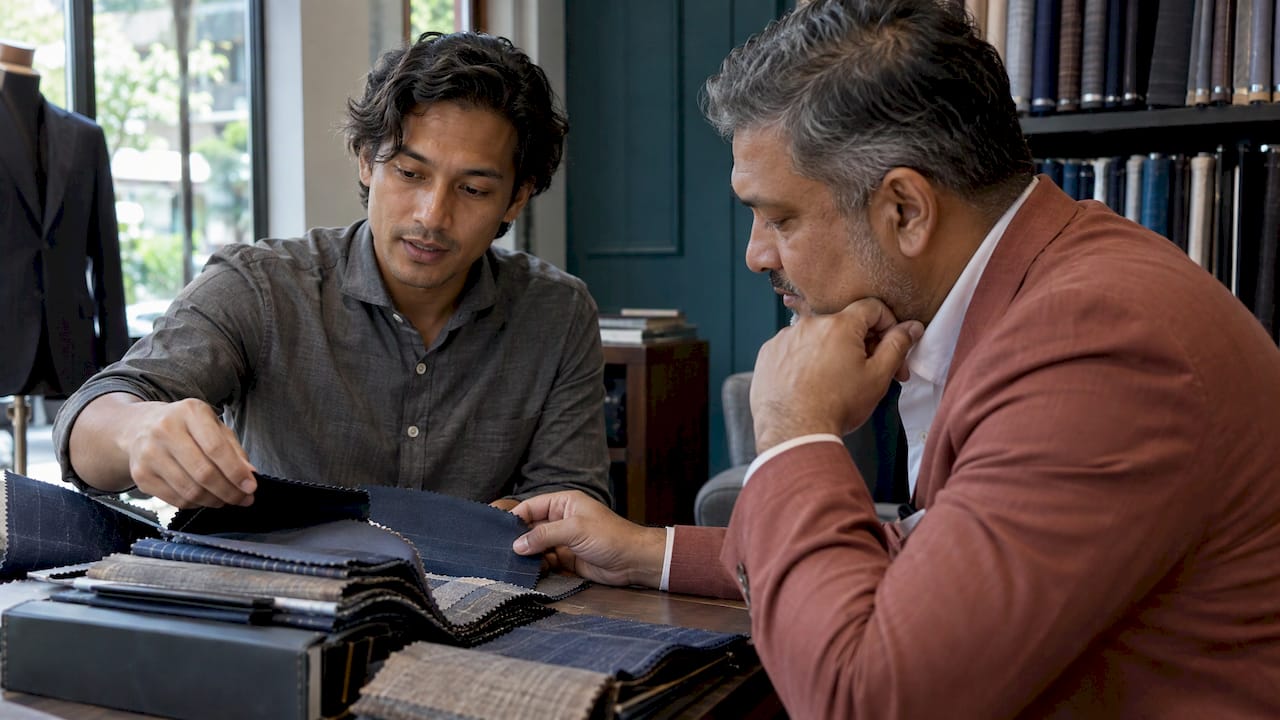
The first meeting is a conversation before it is a measurement. A good tailor asks what the suit is for, where you will wear it and how you move through your day. Javin They, a Singapore tailor interviewed by LUXUO, describes starting fabric selection from the suit’s purpose: work, an event, a wedding or leisure. Only then do working culture, venue, what other guests will wear, skin tone and your existing wardrobe come in.
Fabric deserves real time here. Kevin Seah, another Singapore bespoke tailor, has said that the ingredients matter most: good cloth changes the drape and the feel of the suit. For Singapore, weight and weave also decide whether you are comfortable in a humid, air-conditioned commute. Our suit fabric guide sets out how cloths behave across seasons, and we select premium fabrics suited to Singapore’s climate.
What goes wrong: choosing cloth from a swatch under shop lighting and never asking how it will wear. Ask to see the cloth in daylight, and ask how it creases.
2. Measuring and observing posture
Bespoke measuring goes well beyond chest, waist and sleeve. Kevin Seah has said he takes about 30 measurements to create a well-fitted suit. Just as important is what the tailor sees: whether one shoulder sits lower, whether you stand with your chest forward or your back rounded, how you hold your arms.
These observations shape the pattern. Two men with identical chest measurements can need very different jackets.
If you would like to understand the numbers beforehand, our suit measurement guide walks through nine key points. It is there to help you follow the conversation, not to replace the tailor’s tape, since the whole point of bespoke is that someone trained reads your body in person.
What goes wrong: standing stiffly or in an unusual posture. Stand as you normally do, with your phone in your pocket if that is your habit.
3. Pattern drafting and cutting
With your measurements and notes, the tailor drafts a pattern and cuts the cloth. This stage is invisible to you, but it is the main difference between bespoke and cheaper routes. The pattern belongs to you alone, and it is kept so that later suits can improve on the first.
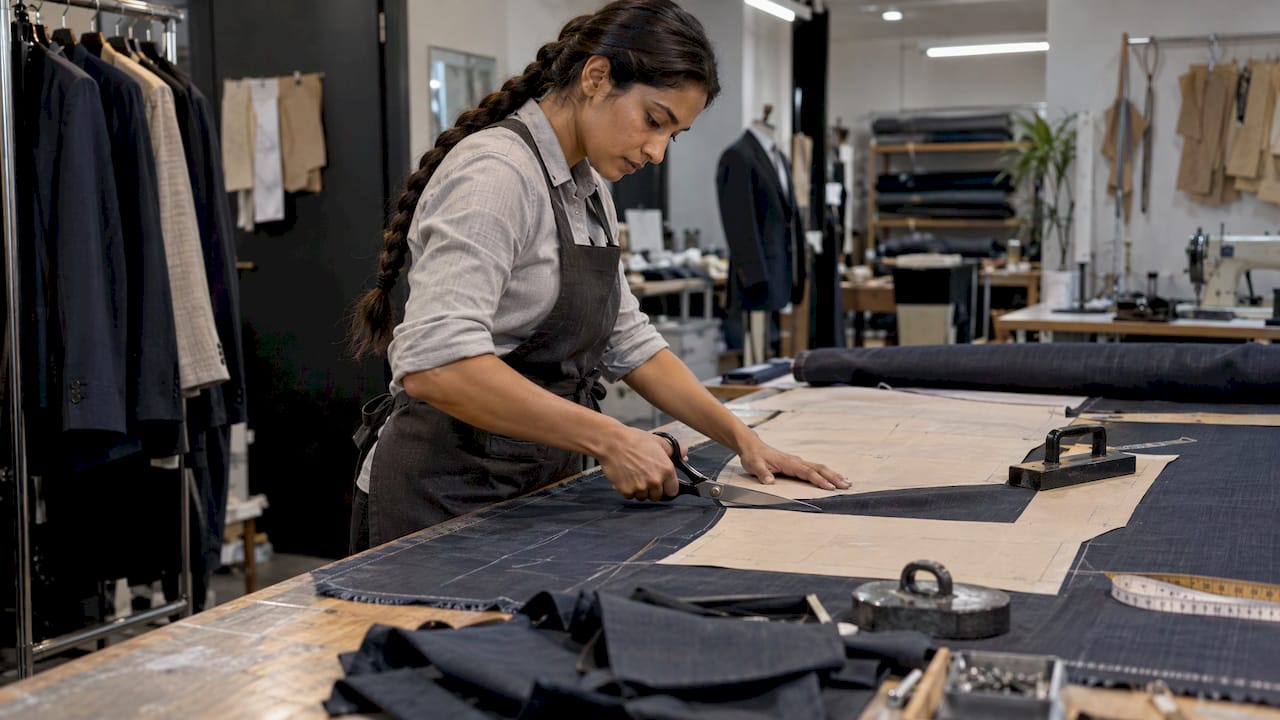
Construction choices are made here too. Kevin Seah has said he does not fuse his jackets and that up to 80% of a bespoke jacket is hand-stitched. Hand work and canvas construction are what let a jacket shape itself to the body and last for years.
4. The basted fitting
The first fitting is on a jacket that looks unfinished: the pieces are loosely held together with white basting thread, often without a lining or sleeves fully attached. It can look disappointing. It is in fact the most useful appointment of the process, because everything is still easy to change.
The tailor pins, chalks and marks the cloth, adjusting balance, shoulder line, collar and length. Our own guide to the basted fitting describes what it looks and feels like, and there is a section on how to prepare.
Check at this fitting:
- Shoulders: the jacket seam should end where your shoulder ends, with no dimpling and no overhang.
- Collar: it should sit against your shirt collar without a gap when you move your arms.
- Balance: the front should hang cleanly, without pulling or swinging open.
- Chest and waist: you should be able to breathe and sit comfortably, with the button closing without an X-shaped strain.
- Trousers: the rise should feel right when you sit, and the waist should not dig in.
5. Second and third fittings
The LUXUO tailor mentions two to three rounds of intermediate fittings, and a common pattern is a further fitting once the changes from the basted stage have been made, then a final check with the jacket largely complete. Sleeves, lining, buttonholes and the hang of the trousers are refined each time.
Sleeve length is the detail most people notice and the one most often misjudged. Our sleeve length guide explains how to judge it, and why shoulder and armhole fit matter more than the sleeve alone.
What to do: move. Raise your arms as if reaching for a seat belt, sit down, cross your legs, turn your head to check a blind spot. A suit that fits only when you stand still has not been fitted for your life.
6. Finishing and collection
Once the fit is agreed, the suit is pressed and finished by hand. At collection, wear the suit with the shirt and shoes you chose for it, and look at the whole picture in a full-length mirror. Small refinements are normal at this point.
If you want to compare the result with a standard, our guide to how a suit should fit lists the signs of a well-fitting jacket and trousers.
How long does a bespoke suit take?
The 5 to 12 week range often quoted online reflects how much the timeline depends on the workroom, the fabric and the season. In Singapore, the figure the LUXUO tailor gives is eight to ten weeks, varying a little with the time of year.
A practical way to picture the schedule:
| Stage | What happens | Your role |
|---|---|---|
| Consultation and measuring | Fabric, style and measurements agreed | Bring reference suits and your purpose in mind |
| Cutting and basting | Pattern drafted, first jacket assembled | None, you wait |
| Basted fitting | Structure, balance and shoulders checked | Try, move, speak up |
| Intermediate fittings (two to three rounds) | Sleeves, collar, trousers refined | Wear your own shirt and shoes |
| Finishing and collection | Hand finishing and final check | Check the whole outfit in a full-length mirror |
The time between fittings is the tailor’s working time, so treat the overall figure as a guide and confirm the schedule when you place the order.
What can lengthen the timeline
- Fabric availability. Cloth from European mills, such as the houses Kevin Seah names (Loro Piana, Harrisons of Edinburgh and Fox Brothers), may take longer to arrive than stock cloth.
- Seasonal demand. The LUXUO tailor notes that timing shifts a little with the season. Wedding peaks and the run-up to year-end are the busiest periods.
- Changes at fittings. Large changes, such as a different jacket length or a notably different silhouette, add a round.
- Your availability. Fittings you reschedule push everything back.
Ordering for a wedding or a fixed date
For a groom, work backwards from the wedding day. Finish the last fitting well before the date, leaving room for any final adjustment. Begin the consultation early enough to absorb two to three rounds of fittings plus a buffer, which in practice means starting several months ahead rather than weeks.
Two habits help:
- Bring the real outfit. Attend fittings in the shoes you will wear on the day, and bring the shirt, belt and waistcoat if you have chosen them. Trouser break and jacket length are judged against these.
- Test it in heat. Singapore’s humidity changes how a jacket feels. Wear it for an hour or more, sit, walk and raise your arms. It is the same principle as testing something properly before you commit: give it time in the conditions in which it will be worn, rather than judging in the first five minutes.
Our tuxedo and wedding suits follow the same process, so the groom’s fittings and the groomsmen’s can be planned together.
Bespoke or made-to-measure: what changes in the fittings
Both start from measurements, and both can produce a good suit. The difference lies in what happens after the tape comes out.
- Pattern: in bespoke, the pattern is drafted for you. Made-to-measure adjusts an existing block.
- Fittings: bespoke involves a basted fitting and further rounds on the garment as it is built. Made-to-measure typically has fewer.
- Construction: bespoke leans on hand work, such as the hand-stitching Kevin Seah describes.
- Fit problems: sloping shoulders, a pronounced posture or an uneven stance are corrected in the pattern itself, not adjusted afterwards.
If you have ever bought off-the-rack and been told the jacket “only needs a little taking in”, bespoke addresses the cause, not the symptom.
What to say at a fitting
The tailor can see the cloth but cannot feel how it sits on you. Useful feedback is specific:
- “It pulls across my back when I reach forward.”
- “I want the jacket to sit slightly shorter.”
- “I sit a lot at work and the trousers feel high at the waist.”
- “I carry a phone and keys, so I need pockets that stay flat.”
A tailor listens better to a precise description than to “it feels a bit off”. Equally, say what you like. Kevin Seah has said bespoke is, above all, about understanding what clients like and their personal style. If you prefer a softer shoulder or a sharper lapel, this is the moment to say so.
Our view: fit is a conversation
Our house was founded in 1979 by master tailor Richard Fan, and the lesson of those decades is that no two bodies are alike. A fitting is not a formality we move through on the way to a finished suit. It is the place where a client’s posture, habits and taste meet the tailor’s craft.
We approach every fitting as a conversation. We measure to your exact proportions, we listen to how you wear a suit, and we choose premium fabrics suited to Singapore’s climate so that the garment is comfortable as well as elegant. Traditional techniques give the suit its character, and modern design keeps it relevant to the way you dress today.
What we ask of you is simple: come as you are, bring the shoes and shirt you will wear, and tell us what you feel. The rest is our craft.
Ron
Begin your bespoke suit with Ron & Rich
We make bespoke suits, tuxedos, wedding suits, sports jackets, trousers, shirts and waistcoats through in-person consultations and fittings. Suits start from $2,170, tuxedos from $2,270, sports jackets from $1,790, trousers from $290 and shirts from $199, as published on our pricing page.
To see how the stages above work at our house, read our bespoke tailoring process, or explore our suits and jackets. For a full guide to what to expect at your first appointment, our suit fitting guide is a good companion.
FAQ
How many fittings does a bespoke suit need?
A Singapore tailor interviewed by LUXUO advises two to three rounds of intermediate fittings. The first is the basted fitting, and the later ones refine sleeves, collar and trousers. A more complex figure or a significant change of style can add a round.
What is the difference between bespoke and made-to-measure?
Bespoke means a pattern drafted for you and a garment adjusted on your body as it is built, often with substantial hand work. Made-to-measure alters an existing pattern to your measurements, usually with fewer fittings. Both begin with measuring, but bespoke gives the tailor more control over fit.
What should I wear to a bespoke fitting?
Wear or bring the shirt and shoes you will wear with the suit, and a belt if you use one. Trouser length and jacket balance are judged against them. Light, well-fitting clothing makes it easier for the tailor to see your posture.
How early should I order a wedding suit?
Start several months ahead. Allow for the eight to ten weeks Singapore tailors typically quote, plus a buffer for fabric delivery, a possible extra fitting and busy wedding seasons. Confirm the schedule with your tailor when you order.
Sources
- The suit is alive and well: Javin They represents the future of bespoke tailoring in Singapore, LUXUO
- Kevin Seah Interview, Luxurious Magazine