What a Waistband Curtain Does Inside Bespoke Trousers
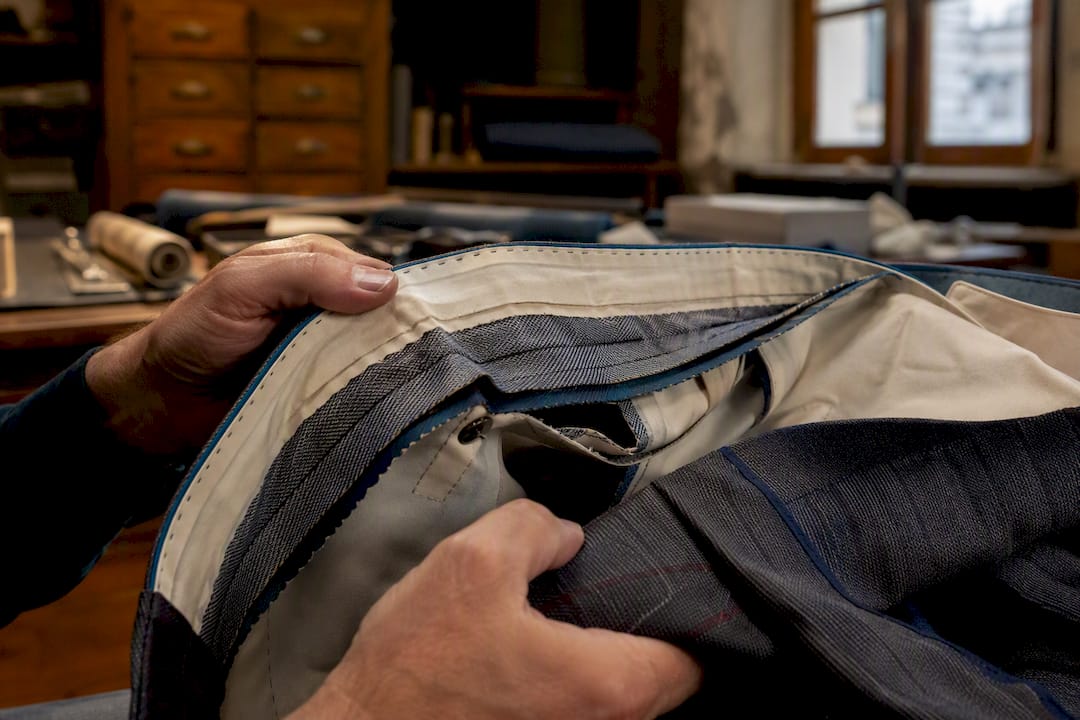
A waistband curtain is a pleated inner lining strip mounted behind the waistband of tailored trousers, sitting between the outer cloth and your shirt tail. It covers the raw seam allowances of the waistband construction, keeps the band from rolling or twisting as you move, and gives the pockets a stable shelf to hang from rather than sagging against loose fabric. Sartorial forums and bespoke houses describe it as a marker of higher-end construction, though it shows up on ready-to-wear trousers too, just built less carefully.
The curtain earns its place through three jobs:
- Covering the interior seamwork so nothing raw touches your shirt
- Reinforcing the waistband against the twisting force of a belt or braces
- Keeping the pocket bags flat and anchored instead of collapsing inward
What follows is a full workshop walkthrough: materials, drafting numbers, assembly order, and the finishing checks that separate a clean curtain from one that peeks out and ruins the line of an otherwise sharp pair of trousers.
Key Takeaways
A waistband curtain works because it combines three functions in one piece of lining: hiding seam construction, resisting roll under belt tension, and anchoring the pocket bag against sagging.
| Point | Details |
|---|---|
| Definition | A curtain is a pleated inner lining strip behind the waistband that covers seamwork and stabilizes the band. |
| Material choice | Pre-interfaced curtain rolls at 3 inches wide, or ban-rol tape with separate lining, both work depending on your setup. |
| Clearance standard | Leave about 1 millimeter between the curtain’s top edge and the finished waistband so lining never peeks through. |
| Pocket tacking matters most | Tacking the curtain’s lower edge to the pocket bag is the step that prevents shifting and bunching over time. |
| Bespoke application | Ron & Rich specifies curtained waistbands on tailored trousers with fly fronts and firm bands, matching lining to house cloth. |
Table of Contents
- Function and Benefits of a Curtained Waistband
- Materials and Tools for a Curtain Waistband
- How Do You Draft and Cut a Waistband Curtain?
- Assembling and Attaching the Curtain to the Waistband
- Finishing and Quality Checks for a Curtained Waistband
- Fixing Common Waistband Curtain Mistakes
- Workshop Notes: How Ron & Rich Approaches the Curtain
- Caring for Trousers With a Curtained Waistband
- Styling Waistband Curtain Trousers
- When I Specify a Curtain and When I Don’t
- Bring a Curtained Waistband to Your Next Pair of Bespoke Trousers
- Frequently Asked Questions
- Sources
Function and Benefits of a Curtained Waistband
Cut a waistband open on any well-made pair of trousers and you will find the seam allowances, interfacing edges, and pocket stitching all tucked behind a second layer of lining. That is the curtain’s first job: hiding construction. Without it, the inside of the waistband looks unfinished and the raw edges chafe against your shirt over a full day of wear.
The second job is structural. A waistband under tension from a belt wants to roll forward at the top edge, especially on trousers cut without a full canvas front. The curtain, usually stiffened with an interfacing strip like ban-rol, resists that roll and keeps the band standing at the height it was cut to.
Third, the curtain stabilizes the pocket bag. Trouser pockets take real stress from wallets, phones, and keys, and a pocket lining left to hang loose will eventually sag and distort the front of the trousers. Tacking the pocket bag to the curtain gives it an anchor point that carries that weight without pulling on the outer cloth.
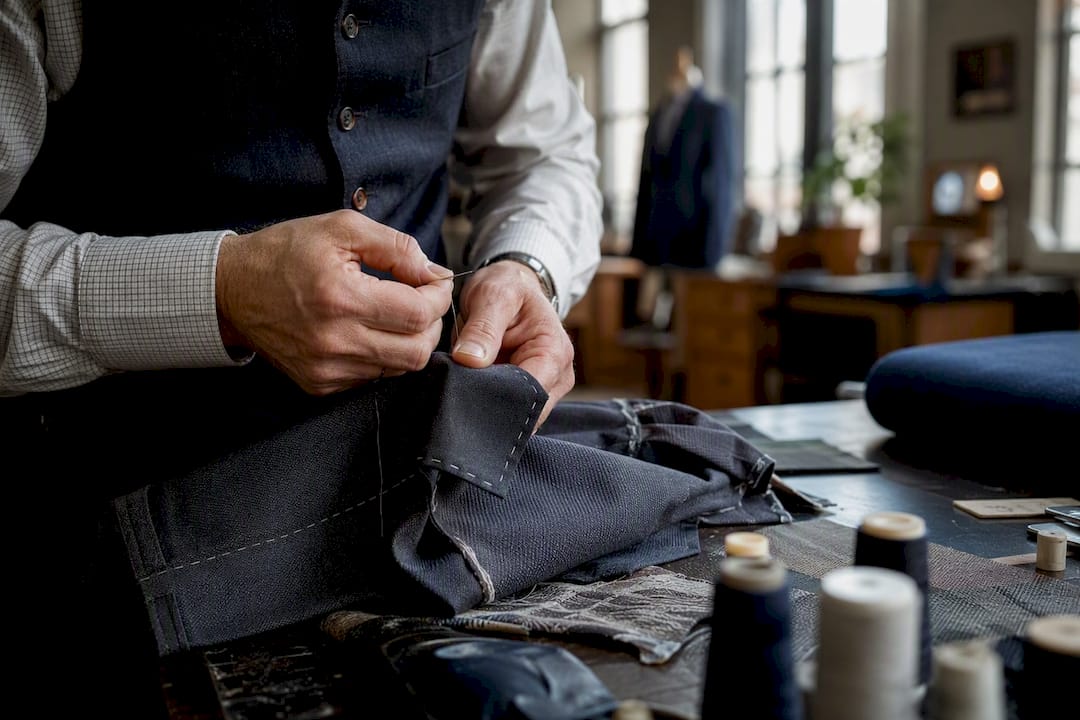
Bespoke houses treat the curtain as a finishing opportunity as much as a functional one. Striped or house-branded lining sewn into the curtain shows the moment you unbutton the waistband, a quiet signature that only the wearer and the tailor know is there.
Not every garment needs one. Casual chinos, elastic-waist trousers, and most soft-tailored separates skip the curtain entirely because there is no belt tension to resist and no structured waistband to reinforce. Reserve it for tailored trousers with a firm waistband, a fly front, and pockets that carry real daily weight.
Materials and Tools for a Curtain Waistband
You need four categories of material on the bench before you cut anything: curtain fabric, stiffening, thread, and pressing tools.
- Curtain fabric. Most tailors use a lightweight lining or twill, often in a striped or solid contrast that becomes a house signature. Pre-interfaced curtain rolls, typically sold at 3 inches wide by 25 yards, save you a cutting and fusing step and give consistent stiffness down the whole roll.
- Stiffening. Ban-rol tape or a woven canvas interfacing strip goes inside the curtain to resist rolling. Fusible interfacing is faster and works well for home sewing; non-fusible canvas gives a softer, more traditional hand favored in bespoke work but needs hand-basting to hold its position while you stitch.
- Thread and needles. A polyester or polyester-cotton core thread handles the layered bulk without breaking. Use a size 90/14 or 100/16 needle for the multiple layers of cloth, interfacing, and lining you are stitching through at once.
- Pressing tools. A tailor’s ham and a narrow pressing bar help you set the curtain’s fold without flattening the waistband’s shape.
A chain-stitch machine speeds up the repetitive tacking bespoke houses use, but a domestic machine with a straight stitch handles every step in this guide. For sourcing, local haberdasheries carry curtain tape in limited colors; industrial suppliers and mail-order rolls give you more width and stripe options if you want a distinctive lining.
How Do You Draft and Cut a Waistband Curtain?
Drafting a curtain starts with one measurement: the finished length of your waistband from center front to center back, following the same curve the waistband pattern piece uses. Everything else scales from that number.
- Measure the waistband length. Take the center-front-to-center-back measurement along the top edge of your waistband pattern, then add half an inch at each end for seam allowance and another inch and a half at the fly side to clear the fly shield. On a 30 inch waist sample, this typically lands around 16 to 17 inches per side before allowances, following the proportions used in a well-documented home-sewing drafting method.
- Set the curtain width. Cut the outer curtain strip roughly 3 inches wide to match standard curtain tape width, folding it in half lengthwise so the finished band sits at about 1.25 to 1.5 inches, matching the depth of most tailored waistbands.
- Cut the inner strip separately. The inner curtain, the piece that touches the pocket lining, can run slightly narrower since it never shows and only needs to anchor the pocket bag.
- Mark the fold line clearly. Chalk or thread-trace the fold before cutting so the finished edge sits exactly where the waistband’s top seam will land, not a fraction higher or lower.
- Decide on one continuous strip versus two panels. Many home sewists cut one long curtain strip and trim it to length after basting, which avoids a splice at center back. Bespoke workshops more often cut left and right panels separately to control grain and stripe placement on each side independently.
- Match stripes and grain before cutting. If your curtain lining is striped, lay both panels on the same stripe repeat so the pattern reads continuously once the two halves meet at center back.
Scale every measurement proportionally for larger or smaller waists rather than adding a flat inch or two, since the curve of the waistband pattern changes slightly with size.
Assembling and Attaching the Curtain to the Waistband
Building the curtain unit and mounting it to the trousers happens in a fixed order. Skip a step and you end up unpicking work later.
- Assemble the curtain unit first. Layer the outer curtain strip, the interfacing or ban-rol tape, and the inner strip, then baste them together along the top fold before any of it touches the waistband.
- Position the interfacing precisely. Center the ban-rol or canvas strip so it sits fully inside the fold, roughly 1/8 inch back from the finished top edge, which keeps it from creating a hard ridge you can feel through the cloth.
- Baste, don’t pin, through the layers. Pins shift under a machine foot when you are stitching three or four layers at once; a loose basting stitch holds everything flat and comes out cleanly afterward.
- Attach the curtain to the facing. Align the curtain’s top folded edge just behind the waistband’s finished top edge, so once the waistband turns over, the curtain’s fold is hidden and only the outer cloth shows from outside.
- Attach the waistband unit to the trousers. Bespoke houses generally use a closed method, sewing the waistband to the top of the trousers as one continuous operation with the curtain already basted in place, as shown in the workshop sequence at Henry Poole. Home sewers often find a flat method easier, attaching the waistband in stages and adjusting the curtain’s position before the final closing seam.
- Handle the fly opening with extra allowance. Leave the curtain unattached for the last inch and a half at the fly side so the fly shield and zipper tape have room to sit flat without extra bulk pressing against them.
- Choose your stitch type by equipment. Industrial chain-stitching lets a bespoke tailor tack the curtain quickly at multiple points; a domestic machine does the same job with a short straight stitch or a few hand tacks where a machine can’t reach.
- Tack the curtain to the pocketing. Sew the lower edge of the curtain to the pocket bag at two or three points. Skipping this step is the single biggest cause of a pocket lining that shifts and bunches after a few weeks of wear.
Pro Tip: Roll the curtain material between your fingers before you baste it. If you feel the interfacing edge as a hard ridge, it is sitting too close to the fold and will print through the outer cloth once pressed.
Finishing and Quality Checks for a Curtained Waistband
The difference between a curtain that reads as professional and one that looks amateur comes down to a handful of checks made at the ironing board and the fitting, not at the sewing machine.
- Set a clearance of about 1 millimeter between the curtain’s top edge and the finished waistband edge. Henry Poole’s workshop treats this margin as the standard that keeps lining from ever peeking above the cloth, and it is tight enough that most beginners overshoot it in either direction on the first attempt.
- Match any pleats behind the front darts so the curtain doesn’t pull the outer cloth out of alignment when the trousers are worn.
- Align stripes across the center back seam if your lining is striped, checking this before the final press rather than after.
- Press in sequence, working from the fold outward, to avoid trapping bulk at the fly and to get a topstitch line that sits flat rather than puckered.
- Place final bar tacks at the pocket mouth and fly edge, then check the hang of the trousers at the fitting with the wearer standing and seated, since a curtain that looks fine flat can still pull when the body moves.
Fixing Common Waistband Curtain Mistakes
Most curtain problems trace back to one of four causes, and each has a straightforward fix once you know where to look.
- Lining shows above the waistband. Unpick the top few inches of stitching, re-roll the curtain slightly deeper into the fold, and rebaste with a tighter clearance before restitching.
- Excess bulk at the fly. Trim the seam allowances on the curtain and interfacing where they cross the fly shield, or shift the ban-rol tape a fraction further from the fly edge so it doesn’t stack directly under the zipper tape.
- Curtain shifts or bunches after wear. This almost always means the lower edge was never tacked to the pocketing. Reinforce it now with a few discreet hand stitches rather than waiting for the problem to worsen.
- No access to industrial chain-stitching. A domestic machine with a short straight stitch, or a visible edgestitch finish as documented in home-sewing adaptations, gets you a stable result even without a chain-stitch machine on hand.
Some sewists argue the curtain is more decorative than functional, and that debate shows up regularly on sartorial forums. In practice, the pocket-stability and anti-roll benefits are real enough that we don’t treat it as optional on a tailored waistband.
Workshop Notes: How Ron & Rich Approaches the Curtain
Ron & Rich has built trousers by hand since Richard Fan founded the house in 1979, and the curtain is one of those details that separates a garment meant to last from one built to a price point. Our cutters specify it whenever a trouser carries a fly front, a firm waistband, and pockets meant to hold real daily weight.
In our workshop, the curtain is never an afterthought. We match the lining to the house stripe, tack it to the pocketing by hand at the same points every time, and check clearance at the top edge before a single fitting happens. That consistency is what a client is paying for, even in a part of the trousers they will rarely see.
The sequence rarely changes: baste the curtain unit, mount it to the waistband, hand-tack it to the pocket bag, then hold every check until the first fitting confirms the hang.
Caring for Trousers With a Curtained Waistband
A curtained waistband adds a layer of interfacing and lining, and that layer changes how you should clean and store the trousers. Dry cleaning is the safer default for tailored trousers with a curtain, since the interfacing and any non-fusible canvas can shift or soften if machine-washed repeatedly.
Most commercial curtain tape is rated as washable or dry-cleanable, but bespoke construction with hand-set canvas responds better to the gentler process.
Hang trousers by the cuff on proper trouser hangers rather than folding them over a hanger bar. Folding puts repeated pressure right across the waistband, the exact spot where the curtain and interfacing meet, and over months that pressure can flatten the roll-resistance the curtain was built to provide.
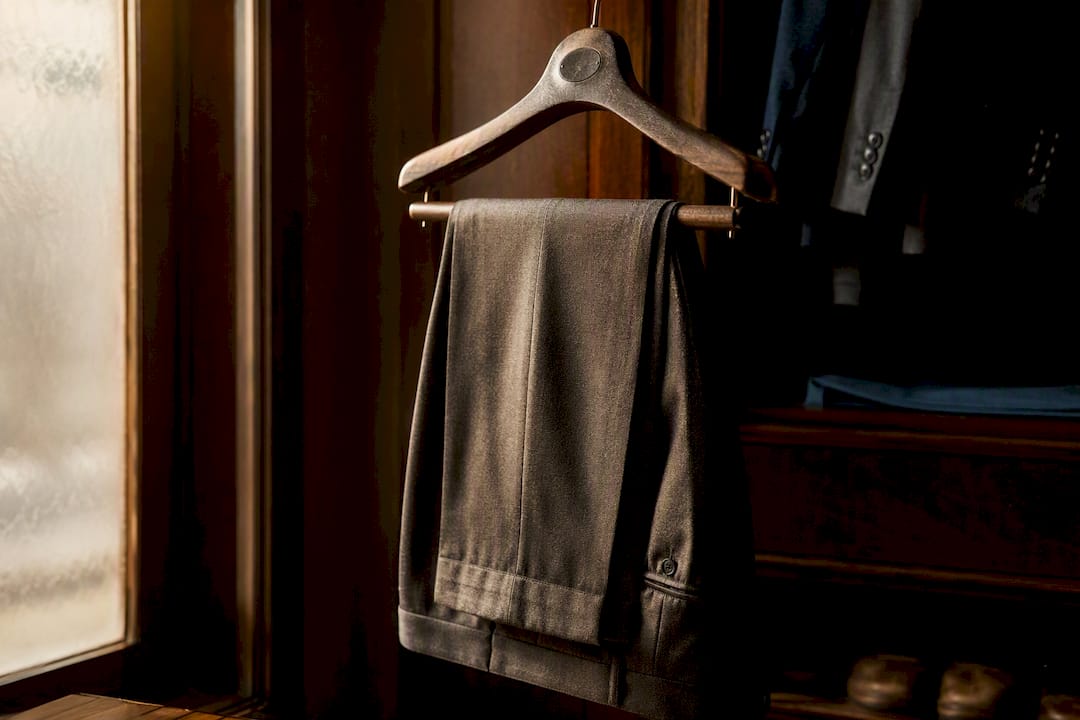
Press from the inside when you can, working the iron along the curtain’s fold rather than directly on top of it, since direct heat on the stiffened edge can eventually print a ridge through to the outer cloth. If the trousers see daily wear, rotate between two or three pairs rather than one, giving the waistband time to relax between wears instead of holding tension from a belt every single day.
Check the pocket tacking once a year on trousers you wear often. If the lower curtain-to-pocketing tack has loosened, a quick hand repair now prevents the sagging and bunching that shows up later as a visible fault in the trousers’ front line.
Styling Waistband Curtain Trousers
A well-finished curtained waistband is invisible from the outside, so styling these trousers comes down to the same principles that govern any tailored trouser: proportion, break, and how the waistband sits against what you tuck into it.
Trousers with a firm curtained waistband hold their shape against a belt better than soft-front alternatives, which makes them a strong match for tucked shirts, whether that is a dress shirt under a sports jacket or a casual oxford with a chore coat. The band won’t twist or roll as the day goes on, so the shirt front stays flat against it.
For business or wedding wear, pair curtain-waistband trousers with suspenders instead of a belt when the trouser is cut with buttons for that purpose. The curtain still does its job of covering seam work and keeping the pockets stable, and suspenders remove the rolling pressure a belt puts on the top edge entirely.
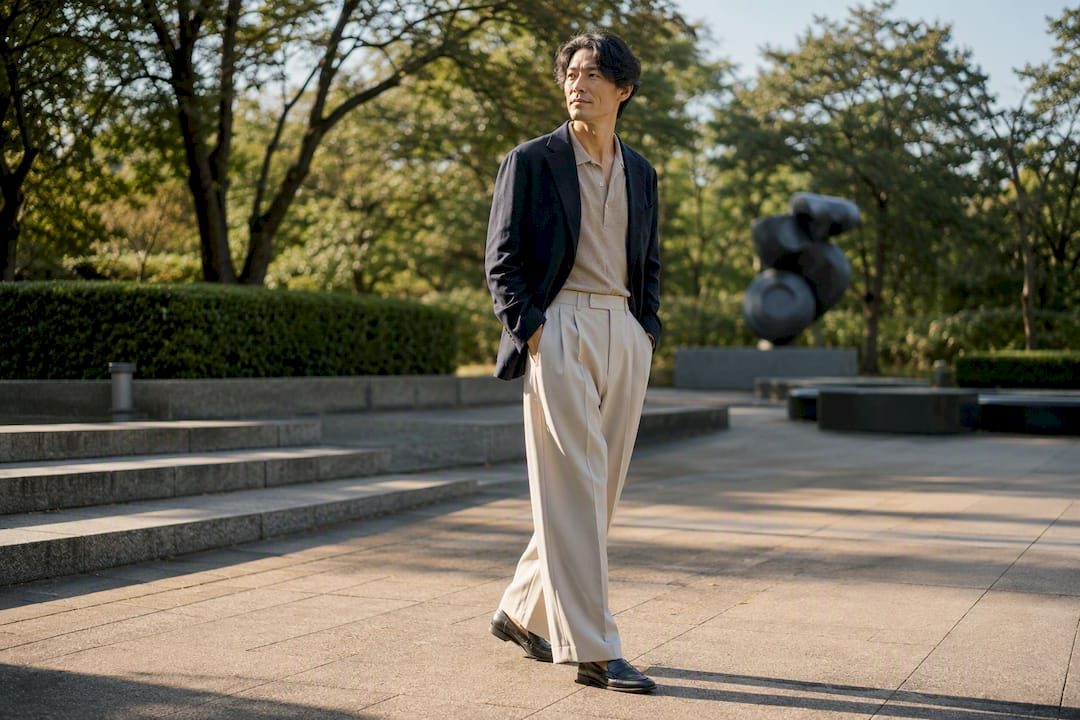
Casual pairing works just as well. Wide leg waistband trousers with a curtained band and a soft unstructured jacket give you a silhouette that reads relaxed on top and sharp at the waist, a combination that holds its shape through a full day of wear better than a trouser with no internal reinforcement at all. Keep the rest of the outfit simple, a loafer or a clean sneaker, and let the waistband do the quiet work of holding the whole line together.
When I Specify a Curtain and When I Don’t
I reach for a curtain any time a trouser has a fly front, a firm waistband, and pockets built to carry a wallet and keys daily. For soft-front chinos or elastic-waist casual pants, I skip it. In consultations, the quickest signal is the belt: if a client plans to wear one regularly, the curtain earns its place perfectly.
Bring a Curtained Waistband to Your Next Pair of Bespoke Trousers
Everything above works on a home sewing machine, but a curtained waistband done to bespoke standard takes the kind of hand-tacking and fitting precision that a workshop, not a pattern, delivers consistently. Ron & Rich builds this detail into our bespoke trousers as standard practice whenever the design calls for a structured waistband, matching the curtain lining to your chosen cloth and checking clearance by hand before the first fitting.
Booking starts with a consultation where we talk through fit, fabric, and finishing details like the curtain and pocket construction, followed by a basted fitting to confirm the hang before final stitching. If you already know you want a firm, roll-resistant waistband on your next pair, start with our bespoke tailoring process page and book a consultation to get your measurements and cloth selection underway.
Frequently Asked Questions
What are curtain trousers? Curtain trousers are tailored trousers built with a waistband curtain, an internal lining strip that covers seam construction, reinforces the waistband against rolling, and stabilizes the pockets from behind.
Do all trousers need a waistband curtain? No. Casual trousers with an elastic or unstructured waistband have no belt tension to resist and generally skip the curtain, while tailored trousers with a firm band and fly front benefit from one.
How wide should a waistband curtain be? Most pre-interfaced curtain rolls run about 3 inches wide, folded to a finished width around 1.25 to 1.5 inches to match standard tailored waistband depth.
Why does my curtain lining show above the waistband? The top edge was rolled too shallow into the fold. Unpick the stitching, re-roll it deeper so the clearance sits at roughly 1 millimeter, and rebaste before restitching.
Can I add a curtain waistband without industrial equipment? Yes. A domestic sewing machine with a straight stitch, or a visible edgestitch finish, produces a stable curtain even without chain-stitch equipment, though hand-tacking to the pocketing still matters for durability.
Sources
- What is the point of a curtained waistband? | StyleForum
- Sewing a waistband curtain, Victoria Martinez
- Prince of Wales at Henry Poole: Part 6 – Permanent Style
- Waistband Curtain Non-Elastic 3" x 25 yds. | WAWAK