Tuxedo Fit Problems: How to Spot Them and Put Them Right
Most tuxedo fit problems come from one cause: a garment cut for an average body is being asked to suit yours. The shoulders, the sleeve, the collar and the waist each tell you within a minute whether it works. A tuxedo made to your own measurements removes the guesswork at the source, which is why our house cuts every tuxedo to the individual client.
This guide walks you through each point of fit in the order a tailor reads it, shows what the usual faults look like, and explains what can and cannot be corrected afterwards.
TL;DR
- Check the shoulders first: the seam should end at your natural shoulder, and shoulder width is the one fault that is very hard to correct later.
- A jacket that creases when buttoned is too tight, and a visible gap between collar and shirt means it is too loose.
- Show roughly a quarter to half an inch of shirt cuff, and let trousers sit at the waist without a belt doing the work.
- A tailor can take fabric in, but cannot easily give it back, so a tuxedo that is too small is the costlier mistake.
- A bespoke tuxedo, cut to your measurements, avoids most of these faults before they appear. Ours start from $2,270.
Table of Contents
- Why a tuxedo shows fit problems more than a suit
- How a tuxedo should fit: the benchmarks
- The common tuxedo fit problems, point by point
- A five-minute fit check you can do at home
- What can be altered afterwards, and what cannot
- Tuxedo or suit: what changes in the fit
- Why a bespoke tuxedo avoids these problems
- Your bespoke tuxedo at Ron & Rich
- FAQ
- Sources
Why a tuxedo shows fit problems more than a suit
A tuxedo is worn at weddings, dinners and black-tie events, where you stand, pose for photographs and are looked at closely. The silhouette is clean and uncluttered: a single-colour jacket, a crisp shirt front and trousers with a plain line. There is little pattern or texture to distract the eye from a collar that gapes or a sleeve that rides up.
The satin facing on lapels and trouser seams, which separates a tuxedo from an ordinary suit, also draws attention to the lines of the garment. A lapel that lifts away from the chest is more noticeable when it is edged in satin. Fit problems are therefore not a minor detail on formal evening wear: they are the first thing a guest sees.
For a groom, there is a second reason to take care. The jacket will be photographed from every angle and worn for hours, often in Singapore’s heat and humidity, so comfort and movement matter as much as the look.
How a tuxedo should fit: the benchmarks
Stand straight, arms relaxed at your sides, and look in a mirror. Singapore tailor Cai Foong, quoted by The Straits Times in April 2026, gives cues that hold for a tuxedo jacket as much as for a business suit:
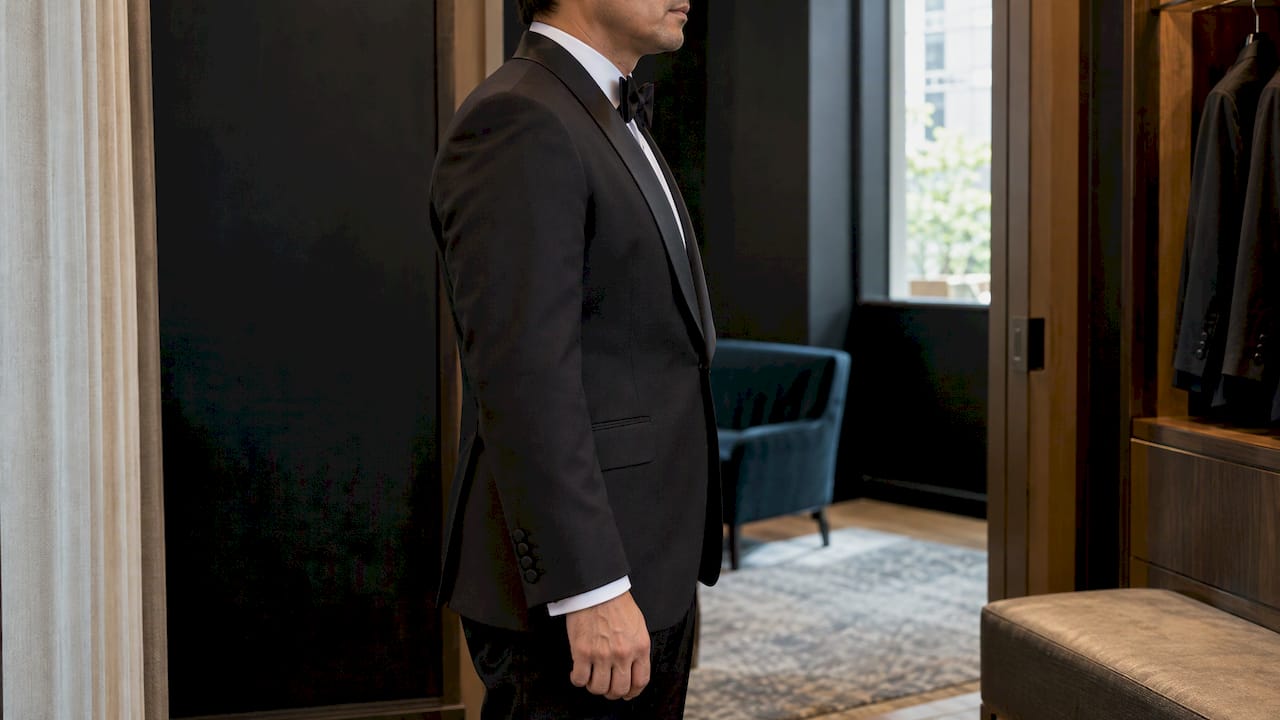
- The jacket sleeve sits a quarter to half an inch shorter than the shirt sleeve, so a little cuff shows.
- The shoulder line ends at, or just before, the shoulder bone.
- The lapels rest flat on the chest without popping outwards.
- The waist is snug but does not pull when the top button is fastened.
- The jacket follows the curve of the back and is long enough to cover the seat.
- The collar hugs the neck.
The goal is a sharp, structured look without restriction. If you can raise your arms, shake a hand and sit down without the jacket fighting you, you are on the right track.
For a fuller walk-through of the same principles on a business suit, see our complete suit fit guide.
The common tuxedo fit problems, point by point
Shoulders that are too wide or too narrow
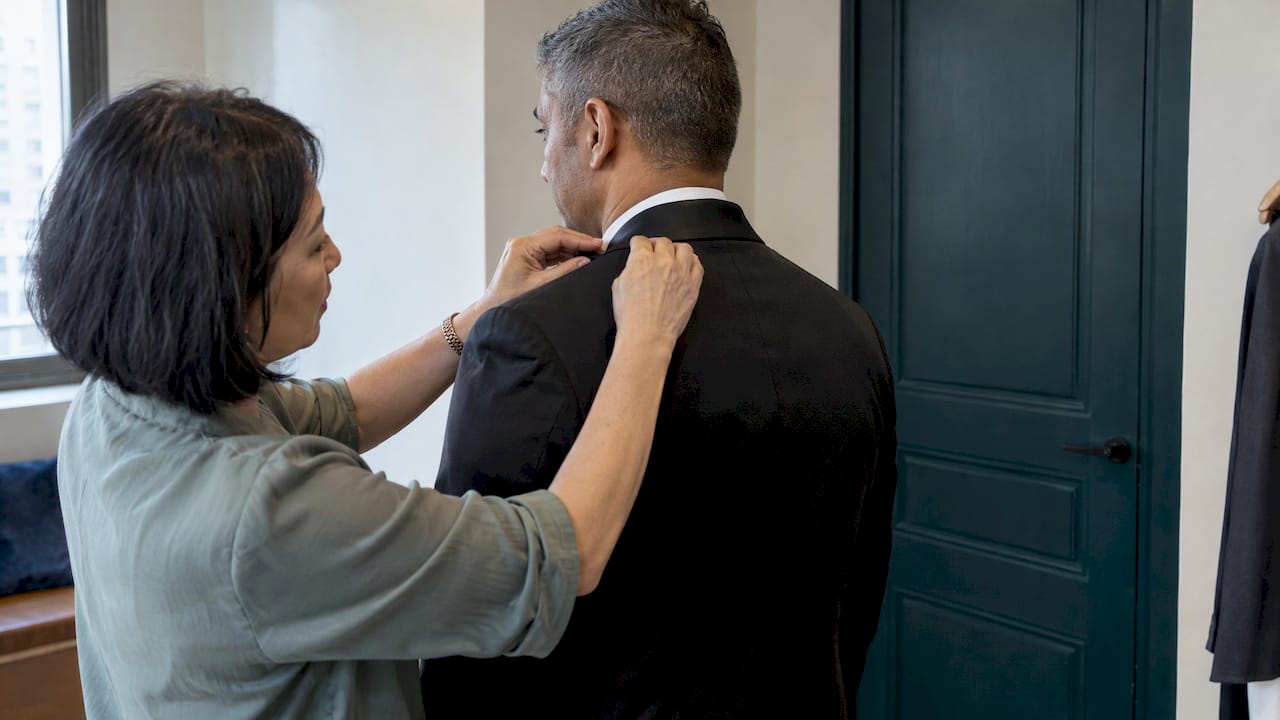
The shoulder is the foundation of a jacket. If the seam sits beyond your natural shoulder, you will see a ridge or a dimple where the sleeve begins, and the fabric will droop. If it sits inside, the sleeve head pulls and the jacket strains across the upper back.
This is the fault to look for first, because it is the hardest to correct. Gentleman’s Gazette states that changing shoulder width is not something a tailor can do, as the shoulder structure of a jacket is complex and reshaping it amounts to major surgery. We cover the signs in more detail in our piece on why shoulder fit matters, and on how a soft shoulder construction behaves on the body.
A jacket that is too tight
The clearest sign is creasing around the closed button. Fabric radiates outwards in an X, the button pulls, and the front of the jacket will not lie flat. Folds beneath the collar and a wrinkled shirt collar are further signs of strain, and so is a jacket that restricts your movement when you reach forward.
A useful self-test: button the jacket, then lift both arms and shake hands with an imaginary guest. If the whole jacket lifts with your arms, or you feel the back seam tighten, the chest or the armholes are too small.
A jacket that is too loose
Excess fabric has its own tell-tale signs. A visible gap between jacket collar and shirt collar, extra cloth around the shoulders, and a front that hangs away from the stomach all point to a jacket cut too generously. A loose tuxedo looks borrowed, even if it is expensive.
So is it better for a jacket to be a touch big or a touch small? Neither is the aim, but a slightly large jacket can sometimes be taken in, whereas a small one has little spare cloth to release.
Collar gap
When the jacket collar stands away from the back of your neck, it exposes the shirt collar and spoils the line from neck to shoulder. It can come from a jacket that is too large, from posture, or from a cut that does not follow your back. Our six tailor checks for a collar gap explain how to tell which one applies to you.
Sleeves too long or too short
A quarter to half an inch of shirt cuff should show at the wrist. If a lot of cuff is visible, the jacket sleeve is too short. If none shows, it is too long. Sleeve length is one of the easier corrections, because there is usually fabric to shorten. Our guide to sleeve length and when to alter gives the measurements in millimetres.
Trousers that pinch or sag
Formal trousers should sit at your natural waist, stay up without a belt, and be comfortable when you sit. Business Insider reports experts saying trousers should not hug the seat, and that discomfort when sitting or a pinched waistline signals they are too tight. Formal trousers are traditionally worn without a belt, so a waistband that cannot hold position unaided is a fit problem, not a styling choice.
For length, the hem should rest lightly on the front of the shoe, with a clean, unbroken line and the heel never covered.
Shirt and waistcoat
A tuxedo shirt is seen more than any shirt you own, since the jacket opens low. A collar that is too tight pushes up under the chin; one that is too loose lets the bow tie wander. Cuffs should reach the wrist bone, and a shirt that billows at the waist will bunch under a waistcoat or cummerbund. Our shirt guides cover three tailor checks for shirt fit and fixes for a shirt that billows at the waist.
A five-minute fit check you can do at home
- Dress completely. Put on the shirt, trousers, waistcoat if you wear one, and the shoes you will wear on the day.
- Stand naturally. Do not hold your breath or pull your shoulders back.
- Button the jacket. Look for creasing at the button, then for a gap between the button and your stomach.
- Check the shoulders and collar. Look from the side and from behind, using a second mirror or a phone camera.
- Move. Raise your arms, cross them, sit, and reach forward as if to pick up a glass.
- Check the details. Note sleeve and cuff length, trouser length and waistband comfort.
If you want to compare your own measurements with a garment before ordering, it helps to understand which body measurements to take and how to use them. For a bespoke order, our guide to measuring nine suit points at home shows the points a tailor works from.
What can be altered afterwards, and what cannot
The general rule among tailors is that fabric can be removed far more easily than it can be added. Gentleman’s Gazette says that, as a rule of thumb, a garment can be taken in by two sizes at most, though a jacket is safer to alter when it is only one size too large, and that oversized shoulders are harder to correct.
In practice, this gives a simple order of difficulty:
| Fault | Usually correctable? |
|---|---|
| Sleeves too long | Generally yes |
| Trouser length | Generally yes |
| Waist slightly loose | Often yes |
| Jacket one size too large | Often, with care |
| Shoulders too wide or too narrow | Very difficult |
| Jacket too small | Limited by seam allowance |
The lesson is to start with the shoulders and the chest, the two points that set the garment’s character. Everything else can be refined around them. This is also why a tuxedo cut to your measurements from the beginning is a more reliable route than hoping to correct a standard size later.
Tuxedo or suit: what changes in the fit
A tuxedo differs from a suit chiefly in its formal details: satin on the lapels and buttons, a satin stripe along the trouser seam, and a more refined overall finish. The fit principles are the same, but the margin for error is smaller. The jacket is usually worn closed over a clean shirt front, and the trousers are worn without a belt, so waist and seat must be right without help from accessories.
Satin also reveals what wool hides. A satin lapel will catch the light if it rolls or lifts, and the contrast with the body of the jacket makes every curve of the lapel visible. For the details around the jacket front, see our note on suit button rules and why the bottom button can warp the fit.
Why a bespoke tuxedo avoids these problems
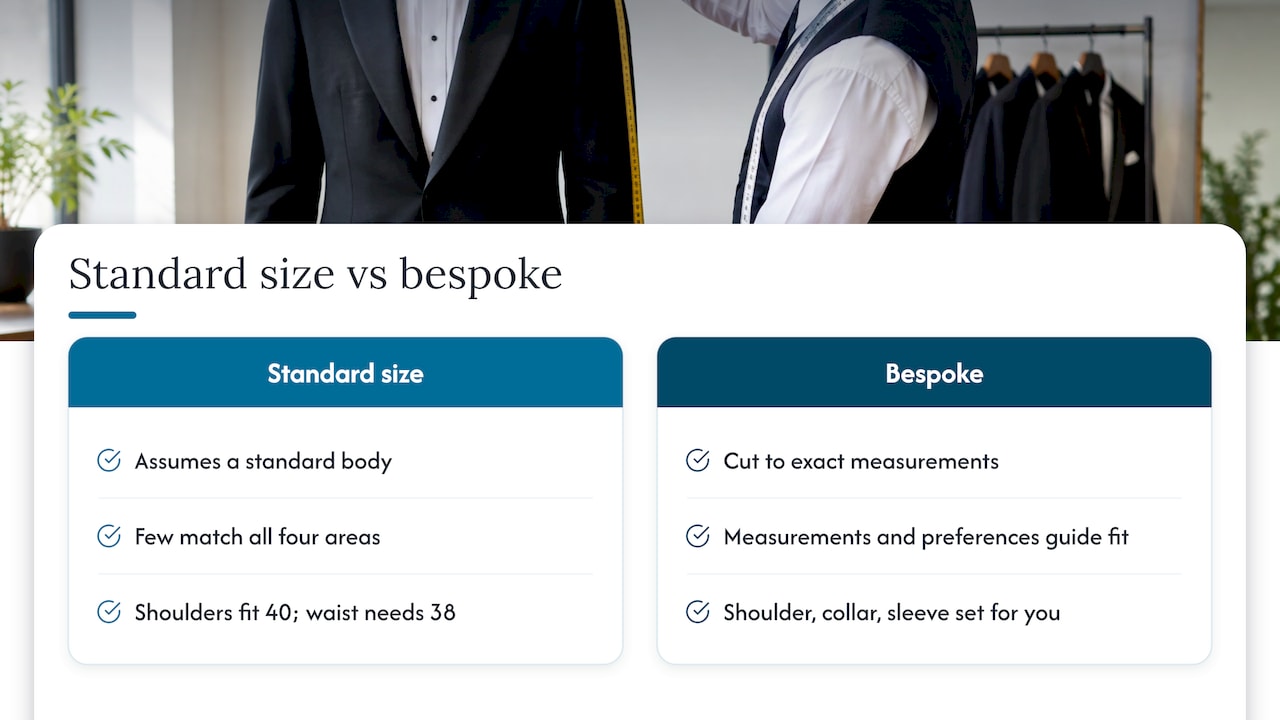
Every fault above has a common root. A standard size assumes a standard body, and few men match it in the shoulders, the chest, the waist and the arms at the same time. You may fit the shoulders of a 40 and need the waist of a 38, or stand with a forward neck that lifts the collar from your shirt.
A bespoke garment begins from your measurements and your preferences rather than from a size. Our clients are fitted individually, and each garment is tailored to their exact measurements, which means the shoulder seam, the collar and the sleeve are set for you instead of being adjusted afterwards. We also work in premium fabrics suited to Singapore’s climate, because a tuxedo that fits well on the hanger still has to be comfortable through a long evening in the tropics.
What we have learned from fitting tuxedos
In our house, fit begins with the shoulder, because everything else hangs from it. Our founder, master tailor Richard Fan, started the company in 1979, and in the decades since we have held to a simple principle: a tuxedo should look as though it belongs to the man wearing it.
That is why we prefer to cut for the individual rather than adapt a standard size. A groom’s tuxedo, an executive’s black-tie jacket and a first dinner suit all ask the same thing of us: clean lines, comfort in movement, and a quiet confidence that does not need adjusting through the evening.
We combine traditional craftsmanship with a contemporary eye. The result is a garment made to your measurements and your taste, in fabrics chosen for our climate.
Ron
Your bespoke tuxedo at Ron & Rich
Our bespoke tuxedos begin at $2,270, and are tailored to your measurements through in-person consultations and fittings. If you need the full black-tie set, our trousers start from $290, waistcoats from $380 and shirts from $199, all listed on our pricing page. You can also read how our bespoke tailoring process works from first consultation onwards.
If you are choosing wedding attire, it is worth booking your fitting well before the date, so that there is time to refine every detail calmly.
FAQ
How should a tuxedo fit properly?
Standing straight with your arms relaxed, the shoulder seam should end at your natural shoulder and the jacket should button without creasing. A little shirt cuff should show at the wrist, the collar should hug your neck, and the trousers should sit comfortably at the waist.
Is it normal for a tuxedo to feel tight?
A tuxedo should feel structured but not restrictive. If you cannot raise your arms, shake hands or sit comfortably, or the button creases the fabric around it, the jacket is too tight. A garment cut to your measurements should let you move freely from the first fitting.
Is it better for a jacket to be too big or too small?
Tailors generally find it easier to take fabric in than to let it out, so a slightly large jacket has more options than a small one. The shoulders are the exception: if they are wrong in either direction, the jacket is very hard to correct, so judge them first.
What is the difference between a tuxedo and a suit?
A tuxedo carries satin on the lapels, buttons and trouser seams, while a suit uses the same matte cloth throughout. It is worn for black-tie occasions such as weddings and formal dinners. We make both, along with bespoke suits, cut to the same standard of fit.
Sources
- ‘Wool over linen’: 5 tips on wearing suits in Singapore, The Straits Times
- Suit Alterations: What A Tailor Can (& Can’t) Do, Gentleman’s Gazette
- Signs Your Clothes Don’t Fit You Well, According to Experts, Business Insider