Trouser Seat Wrinkles: What They Mean and How to Fix Them
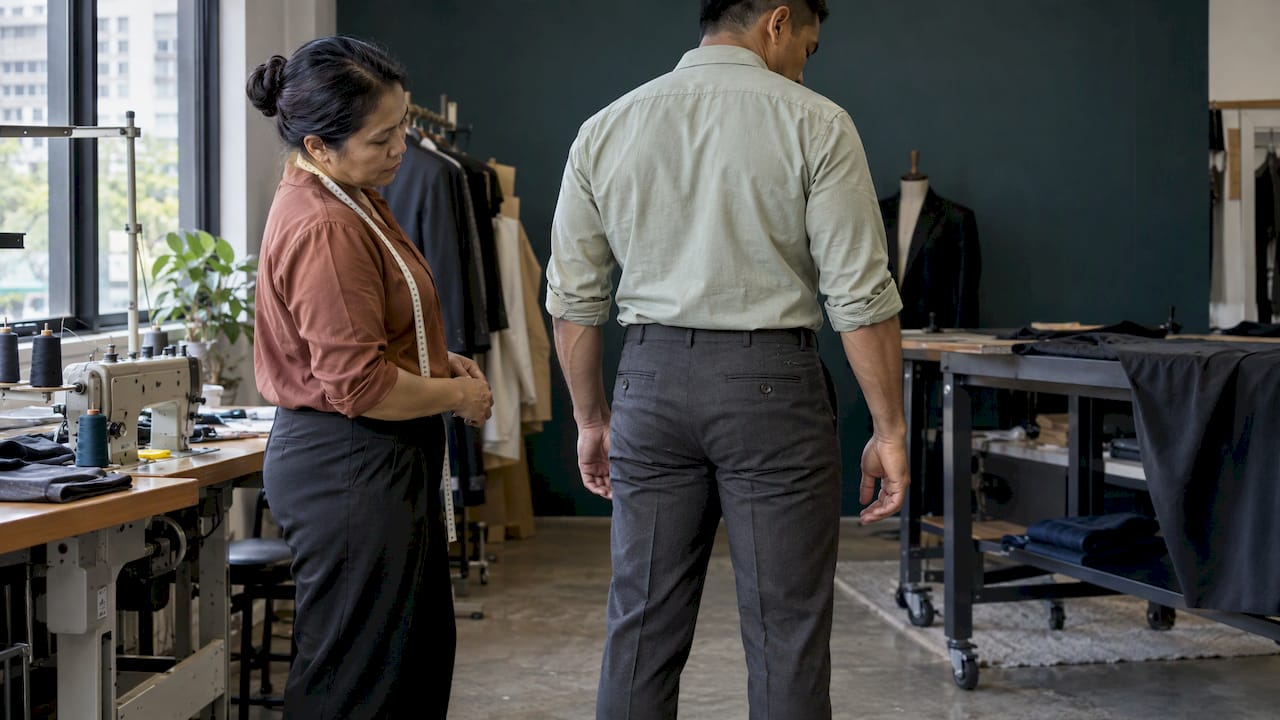
Wrinkles across the seat of your trousers are a message from the cloth. Soft horizontal folds under the buttocks usually mean the back crotch is too long. Taut lines radiating towards the hips usually mean it is too short or the seat lacks width. Once you know which one you have, the remedy is a small, specific adjustment, not a new wardrobe.
This guide shows you how to read the lines, what causes them, what posture and fabric add to the picture, and what a tailor can change.
TL;DR
- Soft horizontal folds under the seat point to excess length in the back crotch, according to PatronIA.
- Taut, diagonal or spoke-like lines from the crotch mean the cloth is under strain: the rise or seat width is too tight.
- Sitting, posture and cloth choice change how visible the folds are, so judge the fit standing, sitting and walking.
- A tailor can often shorten or let out the seat seam. Starting from your own measurements avoids most of the problem.
Table of Contents
- How to read wrinkles across the seat
- The two most common causes
- What posture, sitting and cloth add
- Fit problem or ordinary creasing?
- What a tailor can do about seat wrinkles
- Our perspective
- Trousers made to your seat
- Choosing the right rise to avoid seat wrinkles
- FAQ
- Sources
How to read wrinkles across the seat
Two rules explain most of what you see. Minerva Patterns describes them simply: diagonal drag lines point towards the area that needs more room, while horizontal folds mean excess length and vertical folds mean excess width.
Stand in front of a mirror, turn your back to it (or use a second mirror or a phone camera), and look at the cloth from the waistband down to the top of the thighs. Match what you see to one of these patterns.
| What you see | What it usually means | Typical direction of the fix |
|---|---|---|
| Soft horizontal folds just under the buttocks, like an accordion | Back crotch too long: the trousers carry more depth through the seat than your figure needs | Shorten the back rise or crotch extension |
| Taut folds radiating from the crotch towards the hips, worse when you sit or walk | Back crotch too short, or not enough width across the seat | Lengthen the back crotch point, add width |
| Tight horizontal pulling right under the seat | Trousers too tight through the seat and thigh | Let out the seat, widen the side seams |
| Loose, U-shaped sagging on the backs of the thighs | Trousers too loose | Take in the seat and leg |
| Diagonal lines from the hip towards the inner knee | Tight thigh | Add room at the thigh |
| Vertical folding along the seat seam, a roped look | Seam pulled tight up the centre | Release the seam, reconsider the rise |
The sources do not all agree on every detail, which is why it helps to look at the whole picture. Ourlette notes that horizontal pulls under the seat can point to a back crotch extension that is too short, while the same guide’s trouser-fitting advice says soft horizontal folds collecting under the seat mean the back has too much length. The difference is in the word soft versus pulling. Folds that hang loose are excess. Lines that look stretched are shortage.
The classic good fit
As The Art of Manliness puts it, a well-fitted seat lies loosely against the underwear, without pulling tight against the buttocks or draping down the thighs. Horizontal wrinkles just under the buttocks signal too tight. Loose, U-shaped sags on the backs of the thighs signal too loose.
The two most common causes
A back crotch that is too long
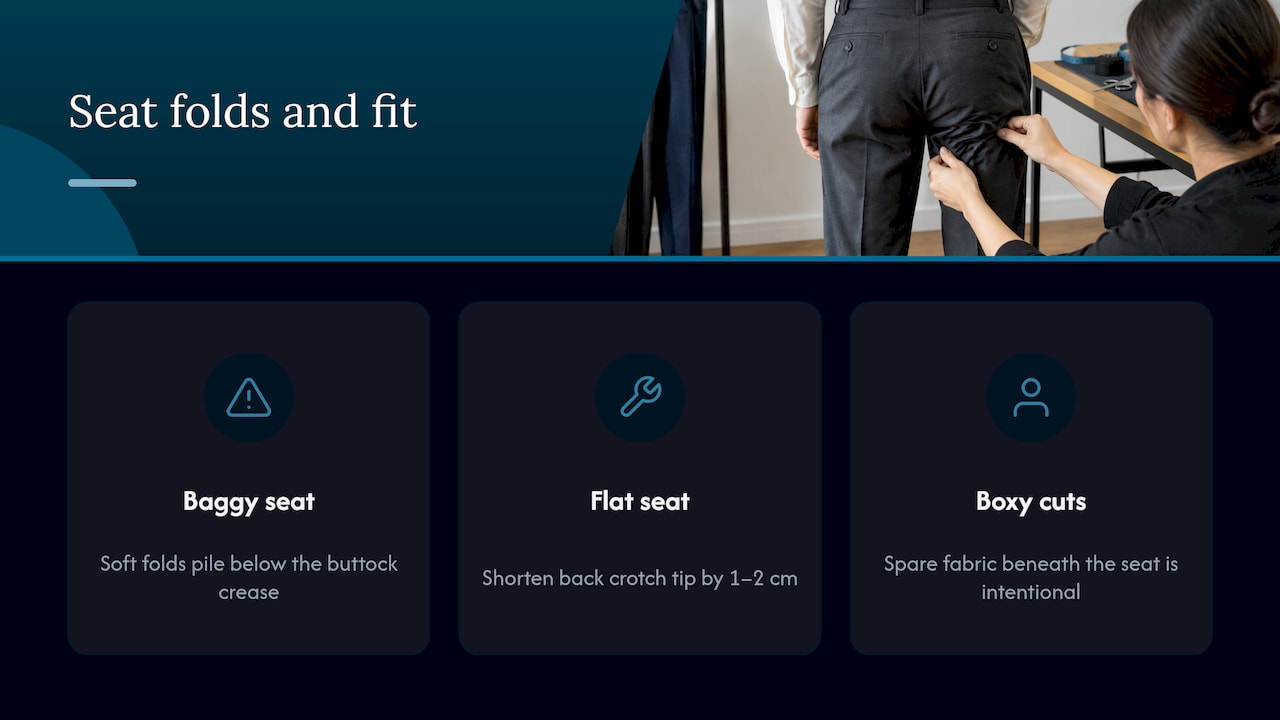
This is the baggy seat. PatronIA explains that it is the most common fault: soft folds pile up just below the crease of the buttocks because the pattern allows more depth than the figure needs, and the extra fabric drops into an accordion.
It is especially frequent on a flat seat. Ourlette’s guide says that for a flat-seat figure the back crotch extension is too long and should be shortened by 1 to 2 cm at the tip.
Intentional fullness is a different matter. Oversized and boxy cuts, such as straight leg vintage wash jeans, are made to carry spare fabric, so some folding beneath the seat belongs to the design. In tailored trousers, you want a cleaner line.
A back crotch that is too short or a seat that is too narrow
Here the cloth is pulled towards the point under most strain. PatronIA describes taut folds fanning out from the crotch like spokes or whiskers, and notes that they worsen as soon as you walk or sit down. Minerva Patterns adds that horizontal pulling across the seat can indicate insufficient back width.
The Put This On guide to how pants should fit lists related symptoms: roping along the seat seam, where tightness draws the seam up the centre, and horseshoe folds near the fork where there is too much material. It also notes that several things can be behind these defects: seat angle, the room in the trunk or fork, how open or closed the leg seams are, and where the legs sit relative to the fork.
What posture, sitting and cloth add
Not every fold is a measurement error. Three everyday factors change what you see.
Posture
A forward-tilted pelvis lets the fabric at the back collapse slightly, producing folds under the seat. Ready To Sew documents that when the pelvis is straightened, the folds largely disappear. Their conclusion is the one a good tailor shares: the aim is to adapt the garment to the way your body naturally stands and moves, not to make you stand differently.
Sitting
Sitting lengthens the back crotch and uses up crotch depth, so a seam that is fine standing can show its problem when you bend, as Ourlette observes. This is why a fitting should always include sitting down. In Singapore, where many of us spend long hours at a desk, Her World names sitting as the biggest culprit for creases, and suggests smoothing clothing flat against thighs and chair, avoiding crossed legs and avoiding pressure from bags or arms.
A small habit helps as well: lift both trouser legs slightly at the thigh before you sit, so the seat is not dragged tight.
Cloth
Cloth matters as much as cut. Permanent Style names three attributes worth seeking in trouser cloth: crease resistance, shape resistance and natural stretch that lets the cloth spring back after pressure. Very dense cloths can feel stiff and dead, while open weaves lose shape over a day. Mr. Linen adds that wool recovers well from wrinkles, whereas linen and cotton do not.
In our climate that is a real consideration. We favour premium fabrics suited to Singapore’s heat and humidity, and we choose the weight and weave with how you sit and move in mind.
Fit problem or ordinary creasing?
A wrinkle that appears only after a long sitting, and falls away when you stand and walk for a minute, is ordinary creasing. A fold that is present the moment you put the trousers on and stays put is a fit matter.
There is a third category. Minerva Patterns cautions that cloth cut off-grain can twist whatever the pattern, and that cloth too stiff or too soft can create folds no fitting will cure. So when the same trousers fold oddly in one leg only, or twist at the seat, consider the cloth and the cutting before the measurements.
A simple routine tells you where you stand:
- Put the trousers on with your usual belt or braces and shoes.
- Stand naturally, not at attention, and check the back in a mirror.
- Walk a few steps, then check again.
- Sit in a chair, stand, and look once more.
- Note whether the lines are soft and loose, or tight and pulling.
If you need to understand how the waist position interacts with all of this, our guide to trouser rise shows how to check it at home.
What a tailor can do about seat wrinkles
Many seat problems are solvable at the alteration stage, provided the cloth has the allowance. A tailor works in a sensible order. Ourlette recommends fitting waist first, then crotch, then hip and thigh, then leg, because an early fix often removes a wrinkle lower down. Dart suggests dealing with one issue at a time: rise, then curve, then width.
For a baggy seat
On finished trousers, M. Mueller & Sohn describe extending the seat seam upwards by 2 to 3 cm, reducing the width added there at the side seam in an arc, and shortening the waistband height at the seat seam by about 1 to 2 cm, lowering it towards the side seam. PatronIA’s correction table gives 1 to 2 cm of shortening for soft folds under the seat.
For a tight seat
PatronIA suggests lengthening the back crotch point by 1 to 1.5 cm where fabric digs in when sitting, and adding 0.5 to 1 cm per seam at the side seam and inside leg where cloth pulls across the thighs. The Art of Manliness notes that seats can be let out only as far as the spare cloth inside allows, which is why seam allowance matters so much when a garment is made.
Balance, and what each change affects
Adjustments at the back are never isolated. Ready To Sew points out that back-crotch changes affect the front-crotch balance, so fitting should proceed one adjustment at a time. Tailor Devens, quoted by Put This On, explains that when you shorten the rise you have to let out the crotch by about the same amount, so the seam drops properly and does not ride uncomfortably.
The same article reports that rise alterations in the United States can be costly, giving a figure of $85 for lowering front and back rise plus $35 for the crotch. That is a US price from an older piece, so treat it as an indication of the work involved, not a Singapore quote.
Our own guide explains what a tailor can and cannot change about rise, and the same logic applies to the seat.
About darts under the seat
Some tailors take excess out with a dart at the back. Ready To Sew cautions that a dart under the seat involves far more variables than an ordinary one: posture, pelvis position, seat shape, muscle tone and movement. Positioned badly, or taken too deep, it makes trousers uncomfortable. This is work for a hand that fits many seats, with you present to move and sit in the garment.
Our perspective
We have been cutting trousers since 1979, when our master tailor Richard Fan founded the house, and the seat remains the part we watch most closely. It is the place where a pattern meets a real body: its slope, its fullness, the way a man stands at his desk and the way he climbs into a car.
Most seat wrinkles are not a flaw in the wearer. They are the cloth telling us where the pattern and the person differ by a centimetre or two. In bespoke work we take the measurement of your seat, rise and thigh directly, we fit in the cloth, and we ask you to sit, walk and bend before we finish. That is how the line is resolved before it ever becomes a wrinkle.
The cloth is part of the answer. We choose weights and weaves with Singapore’s climate and your working day in mind, so that the trousers hold their shape through the afternoon.
Ron
Trousers made to your seat
If you recognise your own wrinkles in the table above, a fitting is the quickest way to settle them. At Ron & Rich we cut tailored trousers from your measurements, adjusting the rise, the seat curve and the width in the fitting so the back falls cleanly whether you stand, walk or sit. Trousers start from $290, and suits from $2,170. You can see the full range on our pricing page.
For an overview of how we approach cut and proportion, explore our tailored trousers, or read how a suit should fit from shoulder to hem.
Choosing the right rise to avoid seat wrinkles
The rise decides much of what happens at the seat, so it deserves a moment before you order or buy. A rise that sits too low for your body leaves the back crotch with nowhere to go, and the cloth gathers or pulls. A rise that suits your proportions lets the seat seam sit naturally.
Our cheat sheet for every rise type sets out how each behaves, and how to shop by rise lists what to test in the fitting room. If you are still choosing between ready-made and custom, when bespoke or made to measure is worth it covers that decision.
What to bring to a fitting
- The trousers that trouble you, so the tailor can see the folds on your own figure.
- The shoes and belt you usually wear.
- A note of when the wrinkles bother you most: sitting at your desk, walking, or driving.
FAQ
Why do my trousers wrinkle under the seat only when I sit?
Sitting lengthens the back crotch and uses up crotch depth, so a seam that looks fine standing can fold or pull when you bend. If the lines disappear once you stand and walk, it is ordinary creasing. If they stay and look taut, the seat may need more length or width.
Do horizontal wrinkles under the buttocks mean my trousers are too tight or too loose?
It depends on how they look. Soft, loose horizontal folds suggest a back crotch that is too long. Tight horizontal lines just beneath the buttocks suggest the trousers are too tight through the seat. Judge by whether the cloth is hanging or pulling.
Can a tailor fix baggy fabric under the seat?
Often, yes. A tailor can shorten the back rise or crotch extension by a centimetre or two and reshape the seat seam, as the alteration methods above describe. The amount depends on the seam allowance and how the pockets and waistband sit, so a fitting is the way to learn what is possible on your trousers.
Does fabric choice affect seat wrinkles?
Yes. Wool recovers from creasing well, while linen and cotton do not. Cloths with crease and shape resistance keep the seat cleaner through a working day, and an off-grain cut can twist regardless of fit.
Should I change how I stand to avoid seat wrinkles?
No. Good tailoring adapts the trousers to the way you naturally stand and move. A fitting that includes standing, walking and sitting lets the tailor account for your posture.
Sources
- Trousers Wrinkling at the Back? Diagnose and Fix It, PatronIA
- Diagnosing Fit Problems by the Wrinkles, Minerva Patterns
- How Should a Suit Fit? The Art of Manliness
- How to read drag lines, Ourlette
- Fitting trousers: the five most common problems, Ourlette
- How Pants Should Fit, Put This On
- A Bespoke Tailor Explains How Trousers Should Fit, Put This On
- Custom trouser fitting: refining balance and posture, Ready To Sew
- Pants Fit Diagnosis, Dart
- Fitting Errors: Too much Length in the Buttock Area, M. Mueller & Sohn
- The Guide to Trouser Cloths, Permanent Style
- The Ideal Trouser Length, Mr. Linen
- How you can prevent your clothes from wrinkling, Her World Singapore
- Men’s Vintage Wash Straight Leg Jeans, Tyler Long Studios