Tea Ceremony Attire for Men in Singapore: A Groom's Guide
For a Chinese tea ceremony in Singapore, a man can wear either a traditional outfit (a ma kua or a changshan) or a well-tailored suit with a touch of red or gold. Both are accepted today. What matters is that the outfit is respectful, allows you to kneel and serve tea comfortably, and suits the customs of both families. Below we explain the options, the colours, the fit and the questions to settle before you choose.
TL;DR
- Two routes are widely accepted: a traditional Chinese outfit such as a ma kua, or a suit worn with a red tie or pocket square.
- Choose navy, charcoal or dark grey rather than black, and let red or gold carry the symbolism.
- Ask both families what they expect first, because customs differ among dialect groups.
- Test kneeling, sitting and lifting your arms at the fitting, and choose breathable cloth for Singapore’s heat.
- Guests should dress smartly and avoid white and all-black outfits.
Table of Contents
- What men wear to a tea ceremony in Singapore
- Traditional or suit: how to decide
- The traditional options explained
- Wearing a suit to the tea ceremony
- Fit, comfort and movement
- What guests and groomsmen should wear
- A simple timeline for the groom
- Our perspective
- Tailored for the day: Ron & Rich
- Practical details to settle before choosing
- FAQ
- Sources
What men wear to a tea ceremony in Singapore
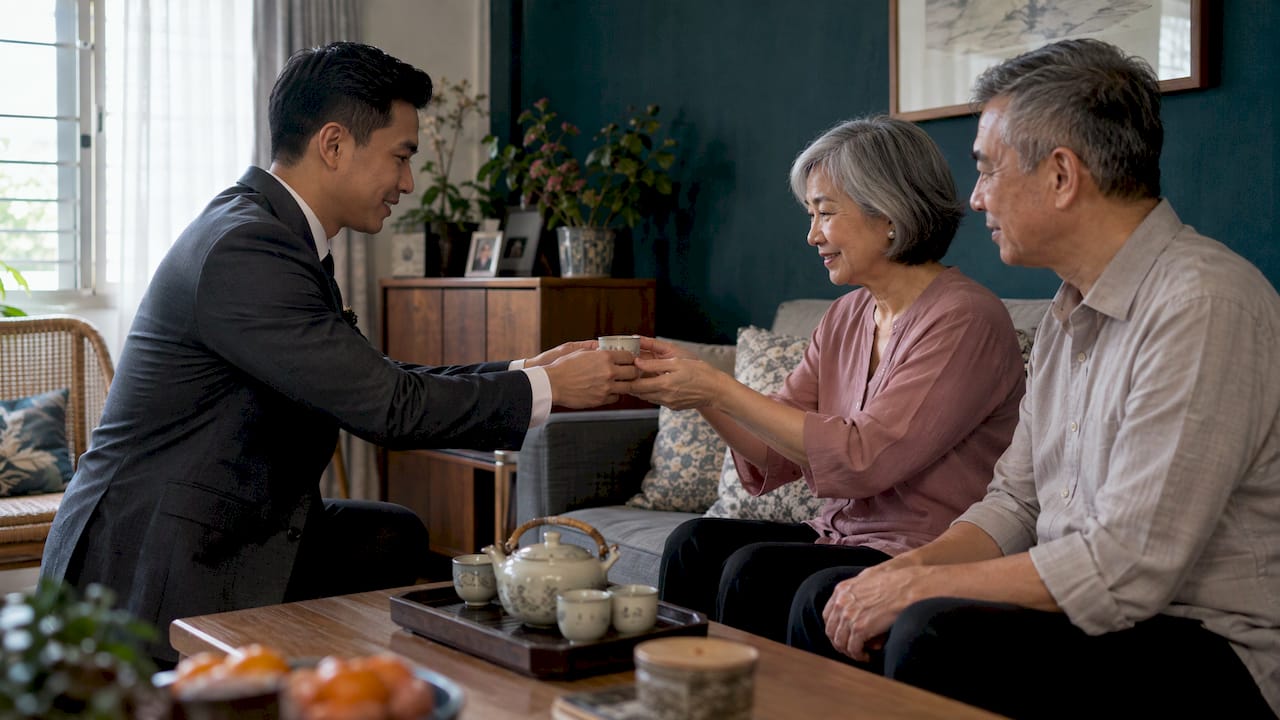
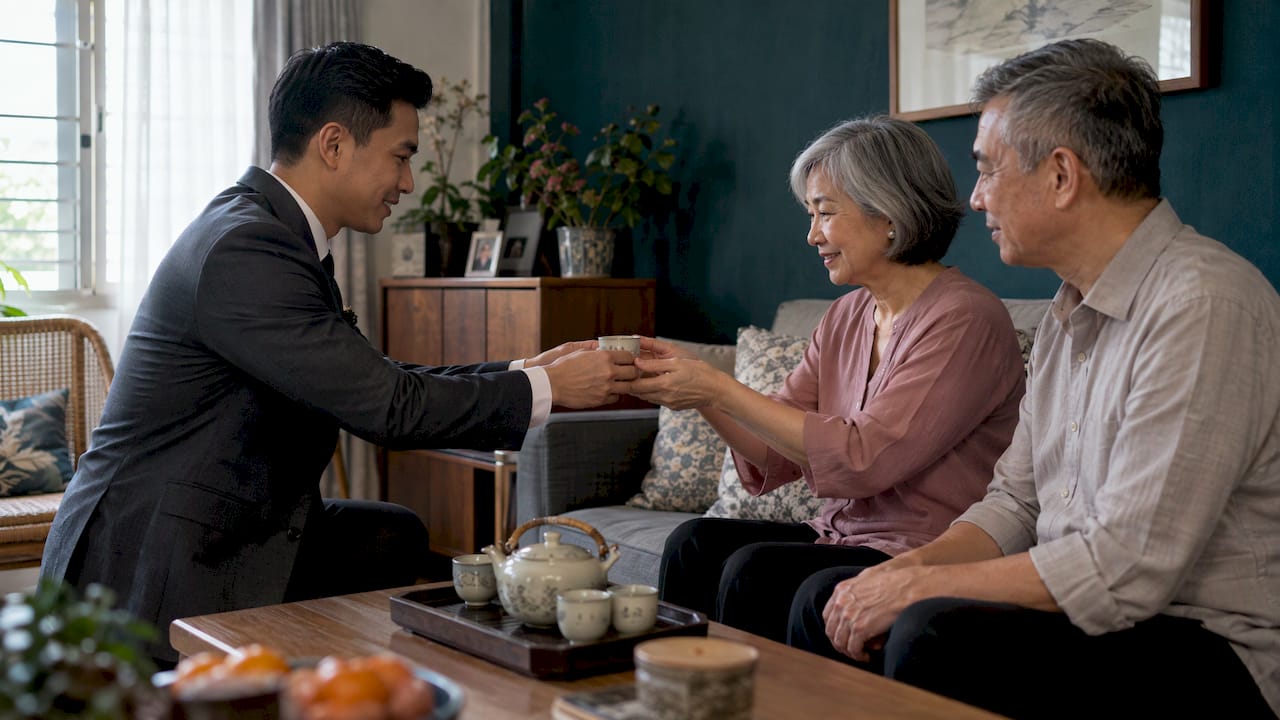
The tea ceremony (敬茶, jing cha) is the moment the couple serves tea to parents and elders and receives blessings in return. It is one of the more intimate parts of a Chinese wedding, and the clothes are chosen with that in mind.
According to the National Heritage Board’s Roots.gov.sg entry on Chinese weddings, many Singapore couples now wear Western suits and gowns for the wedding itself, while some keep traditional Chinese outfits for rituals such as the tea ceremony, including a ma kua for the groom and a red qun kua for the bride. That is the whole picture in one sentence: tradition remains available, and the suit is a normal modern choice.
In practice, a groom has three routes:
- A traditional outfit, such as a ma kua or a changshan.
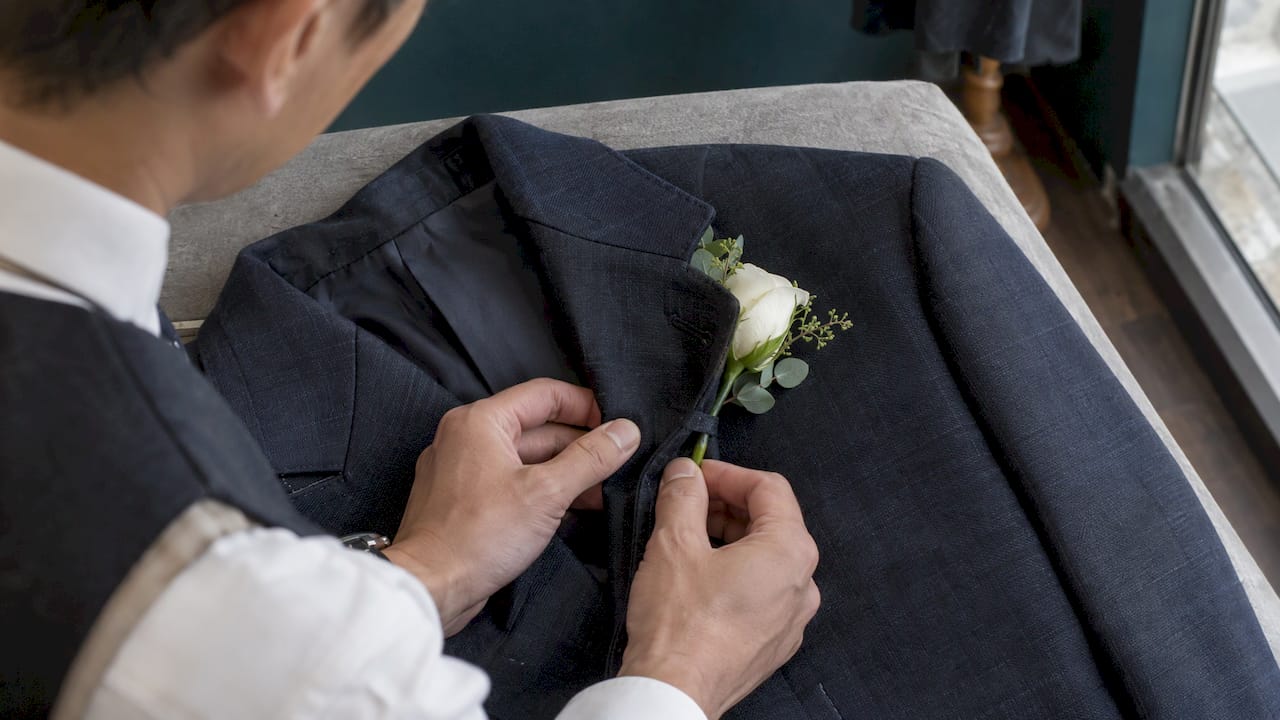
- A tailored suit in a dark, calm colour, with red or gold added through a tie, pocket square or boutonniere.
- Two looks in one day: a traditional outfit for the ceremony at home, then a suit for the banquet.
One Singapore wedding guide lists a changshan, or a suit with a red tie or pocket square, as standard groom options for the tea ceremony. A local ceremony planner adds that traditionally a kua is worn, and today the groom may wear his wedding suit with the bride in her gown.
Traditional or suit: how to decide
Neither route is more correct than the other. The choice usually comes down to four things.
The families’ expectations
The Roots.gov.sg entry notes that wedding practices differ among dialect groups, and it advises seeking the families’ knowledge of the traditions to follow. If a grandparent expects a kua, a quiet conversation weeks ahead is better than a surprise on the day. If the families are relaxed, a suit will be welcomed.
The bride’s outfit
The ceremony photographs best when the couple looks as though they belong together. Some grooms choose a traditional outfit to match the bride’s qun kua, and the same guide supports a look that is either matching or deliberately complementary. If she wears a gown, a suit is the natural partner. If she wears a red qun kua, consider a traditional outfit or a suit in a deep tone with red accents so that neither of you is out of place.
Heat and duration
Singapore is warm and humid all year, and the ceremony can involve several rounds of serving, kneeling and standing, often indoors with a crowd. Heavy embroidered outfits can be hot, and so can a thick wool suit. We return to cloth below.
What you will wear again
A rented or one-use garment ends its life after the day. A well-made suit continues into your working life, which is why many grooms treat the wedding suit as the first serious piece of tailoring they own.
The traditional options explained
Ma kua (马褂). A short jacket traditionally worn over a long gown. Roots.gov.sg names it as the groom’s counterpart to the bride’s qun kua. It signals respect for custom and photographs well beside a red qun kua.
Changshan (长衫). A long gown with a mandarin collar. It is a standard traditional choice for grooms, and it reads as dignified rather than costume-like when the cloth and fit are good.
Tangzhuang (唐装). A jacket with a mandarin collar and frog buttons. One Singapore wedding publication calls it a bold but stylish choice for a Chinese wedding, and a food and culture site recommends a Tang suit for a traditional look at a tea ceremony.
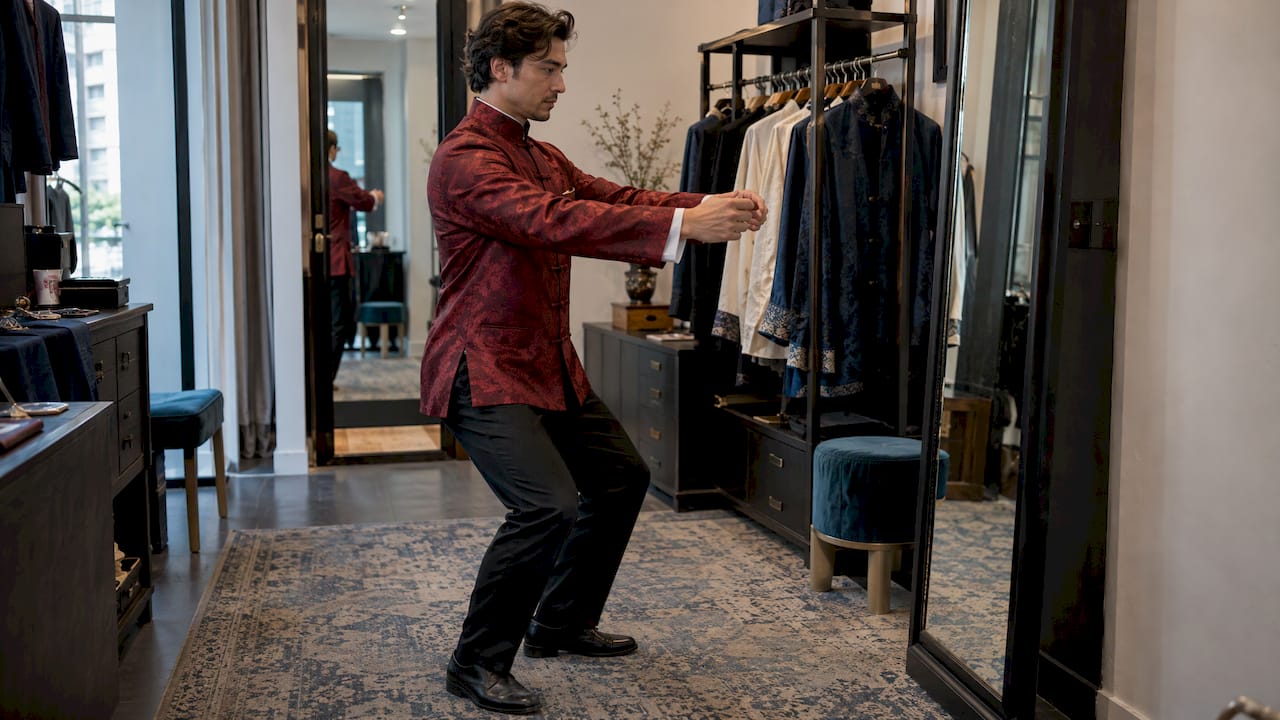
If you go this way, the usual advice applies: confirm the cut allows you to bend your knees and lift both arms, since you will serve tea with both hands.
Wearing a suit to the tea ceremony
A suit is now an accepted choice, and it is the one we are asked about most. The question is how to wear it so that it respects the occasion. Three decisions do most of the work.
Pick the colour with care
For guests, one Singapore guide suggests a smart suit in navy or grey with a crisp shirt, and warns against black unless you want to look as though you are heading to a corporate meeting. Another source points out that black is associated with funerals, so dark grey gives similar formality without the connotation.
For a groom, that translates into a simple palette:
| Colour | Suitability | Notes |
|---|---|---|
| Navy | Excellent | Formal, flattering in photos, works with red accents |
| Charcoal or dark grey | Excellent | Formal without the funeral association of black |
| Mid grey | Very good | Lighter and cooler, sits well beside a red qun kua |
| Light colours such as stone or sand | Good for the banquet | See our guide to wedding suit colours for Singapore grooms |
| Black | Best avoided | Heavy associations for older relatives |
| White | Avoid | Not suitable for this ceremony |
Let red and gold speak
Roots.gov.sg explains that red symbolises good fortune and happiness in the qun kua. You can borrow the same meaning in a quiet way. A silk red tie or a gold pocket square can bridge Western tailoring and Chinese colour symbolism. Keep it to one or two accents. A red tie with a red pocket square and a red boutonniere is too much.
Keep the cut classic
A two-piece or three-piece suit in a plain or very fine pattern is the safest. Our bespoke three-piece suits suit grooms who wish to remove the jacket for the banquet and still look complete in a waistcoat. If you need a longer overview of fabrics and tailoring for Chinese weddings, we have written a separate guide to Chinese wedding suits (in Chinese).
Fit, comfort and movement
This is where tea ceremony attire differs from ordinary wedding attire. You will kneel or bend repeatedly, hold a tray, and stay in the room for a good while. The Singapore guide from Vows.sg says to make sure your outfit allows kneeling and to test it during your fitting. We would add a short checklist for the fitting:
- Kneel on both knees, then rise without using your hands. The trousers should not pull at the thigh or the knee.
- Raise both arms as though offering a cup. The jacket should not ride up at the back or pinch at the armhole.
- Sit for ten minutes. A waistband that is comfortable standing may be tight sitting.
- Button and unbutton the jacket several times. Do it with the cuffs and sleeves you will wear on the day.
- Wear the shirt and shoes you will wear on the day, so the length of the trouser break is judged correctly.
Cloth for Singapore’s climate
Lightweight, breathable wool, or wool blended with linen or silk, is more comfortable than a heavy flannel. Half-lined or unlined jackets reduce heat. A shirt in fine cotton helps too. We speak more about this in our post on choosing wedding suit colours and lighter cloth for Singapore, and about custom shirts, which are cut for your frame so that the collar and sleeves stay put when you move.
What guests and groomsmen should wear
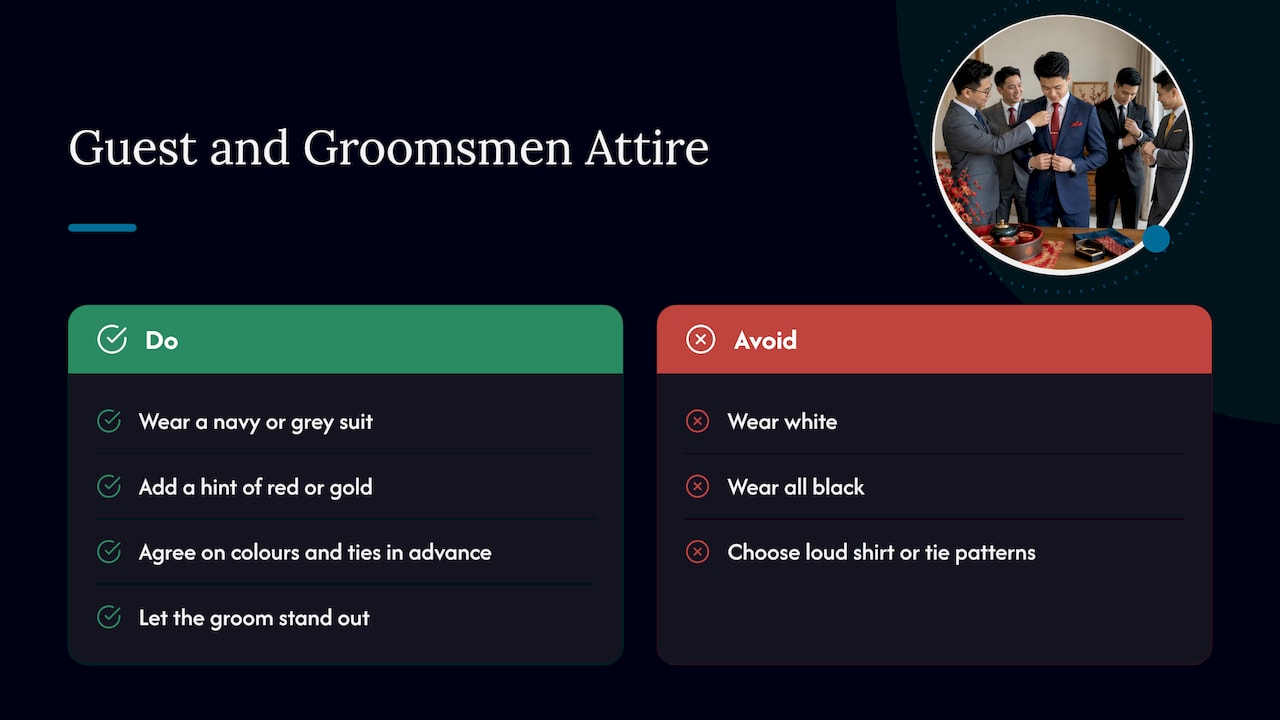
Male guests can follow a simple rule: dress as for a smart family occasion. A dark suit in navy or grey, a crisp shirt, and a tie with a hint of red or gold is enough. A traditional jacket is also fine for those who like it. Avoid white, avoid all-black, and keep shirts and ties free of loud patterns. Singapore’s guides on what to wear to a Chinese wedding are consistent on these points, including the advice to skip black.
Groomsmen are a slightly different case, since they often stand in photographs with the couple. Agree on a colour family and a tie colour in advance, and let the groom’s outfit be the most distinguished. Our practical guide to groomsmen attire in Singapore covers this in detail.
A simple timeline for the groom
Bespoke tailoring needs time for measurements, fittings and adjustments. The exact schedule depends on the garment and the workload, so speak to the tailor early. As a guide to the order of things:
- Talk to both families about the ceremony and what they expect.
- Agree the plan with your partner: matching, complementary or two looks.
- Choose the cloth and colour with the heat and the venue in mind.
- Measurements and first fitting, followed by at least one more to check movement.
- Kneeling test in the nearly finished garment.
- Final pressing and a check of accessories, such as shoes, belt, tie and pocket square.
If you want to understand what working with a tailor involves, see our guide to the wedding suit tailor process in Singapore.
Our perspective
We founded our house in 1979 under master tailor Richard Fan, and in that time we have seen many grooms ask the same question: should I honour the tradition, or wear the suit I have always imagined?
Our answer is that a well-made suit can honour both. The tea ceremony is about respect for parents and elders, and respect shows in how a man carries himself: a jacket that sits cleanly on the shoulders, trousers that allow him to kneel without a thought, and a colour that is dignified rather than showy. A red tie or a gold pocket square adds the symbolism that the occasion calls for.
This is where bespoke work serves a groom best. Each garment is cut to your own measurements, so you can rise from a kneeling position and lift a cup with both hands without the jacket pulling. We choose premium fabrics suited to Singapore’s climate, because a ceremony in a crowded living room is no place to be overheated.
Most importantly, a suit made for the wedding is not a garment for one day. It becomes the suit you wear to your first anniversary dinner, to the christening, to the boardroom. That is the legacy of tailoring we believe in.
Ron
Tailored for the day: Ron & Rich
If you would like a suit for your tea ceremony, we can cut one to your measurements, with fittings that test the movements the ceremony asks of you. Our bespoke suits start from $2,170, and tuxedos from $2,270. Shirts begin at $199, trousers at $290 and waistcoats at $380, all as published on our pricing page.
You can browse our suits and jackets or arrange a consultation through our website. If you plan to change into evening wear for the banquet, our tuxedos are made in the same way.
Practical details to settle before choosing
Venue and time of day. A morning ceremony at the family home is warmer and more crowded than an afternoon one in a hotel suite with air conditioning. Plan the cloth accordingly.
Photographs. Mid-tone navy and grey photograph well against red backdrops and tea sets. Very light colours can wash out under bright indoor lighting.
Shoes. You will kneel, so choose leather-soled or rubber-soled shoes in which you feel stable, and polish them.
Accessories. A watch, a pocket square and possibly a lapel pin are enough. Take off anything that could catch on the tea tray.
Two outfits. If you change between the ceremony and the banquet, bring a steamer or arrange for someone to carry the garment so that it does not crease in transit.
Cost. Renting a traditional outfit is a short-term answer. A tailored suit costs more at first, but it is worn many times, and this is the reasoning many of our clients give for choosing tailor-made suits in Singapore.
FAQ
Can a groom wear a suit to a Chinese tea ceremony in Singapore?
Yes. Many Singapore couples wear Western wedding attire for the wedding and keep traditional outfits for particular rituals, as Roots.gov.sg records. Choose a dark, classic colour and add red or gold through a tie or pocket square. If either family is strongly traditional, speak to them first.
What colours should men avoid at a tea ceremony?
Avoid white and all-black. Black is associated with funerals, and a dark grey or navy offers the same formality without that connotation, according to one Chinese tea ceremony attire guide. Loud patterns also draw attention away from the couple.
What should the groom wear if the bride wears a qun kua?
You can either match her with a traditional outfit such as a ma kua, or choose a suit that complements her colours. Both are supported by Singapore wedding guidance, which notes that some grooms coordinate with the bride. A navy or charcoal suit with a red tie sits well beside a red and gold qun kua.
How do I stay comfortable in the heat?
Choose lightweight, breathable cloth and a light lining or half-lining, and have the garment cut so it does not restrict your movement. Test kneeling and arm raises at the fitting. Keep the number of layers to what the ceremony requires.
What should male guests wear?
A smart suit in navy or grey with a crisp shirt is appropriate, and a red or gold tie adds a respectful touch. A traditional jacket is also welcome. Avoid white and black, and ask the couple if you are unsure.
Sources
- Chinese Weddings, Roots.gov.sg
- Chinese Tea Ceremony Guide Singapore, Vows.sg
- What to Wear to a Chinese Wedding in Singapore, Bridely.sg
- What to Wear to a Chinese Tea Ceremony, CookStation
- Tea Ceremony Complete Guide, Emcee Cheng