What Suit to Wear as a Wedding Guest in Singapore
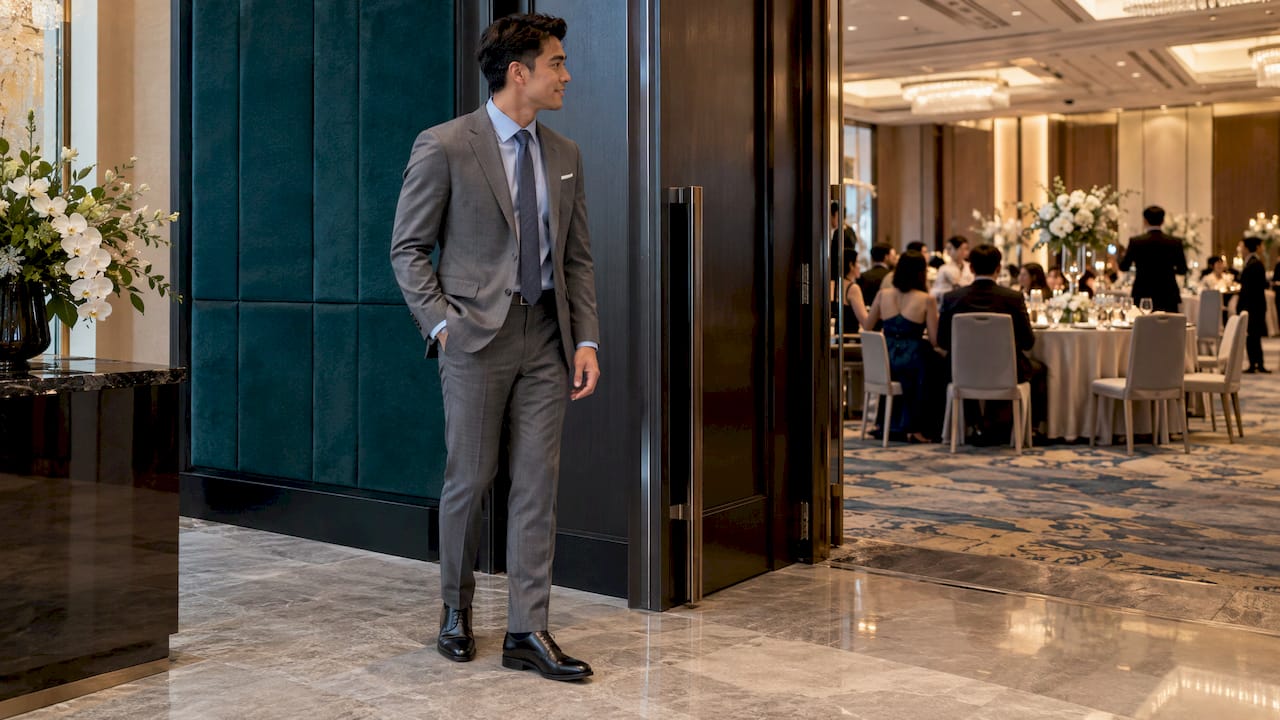
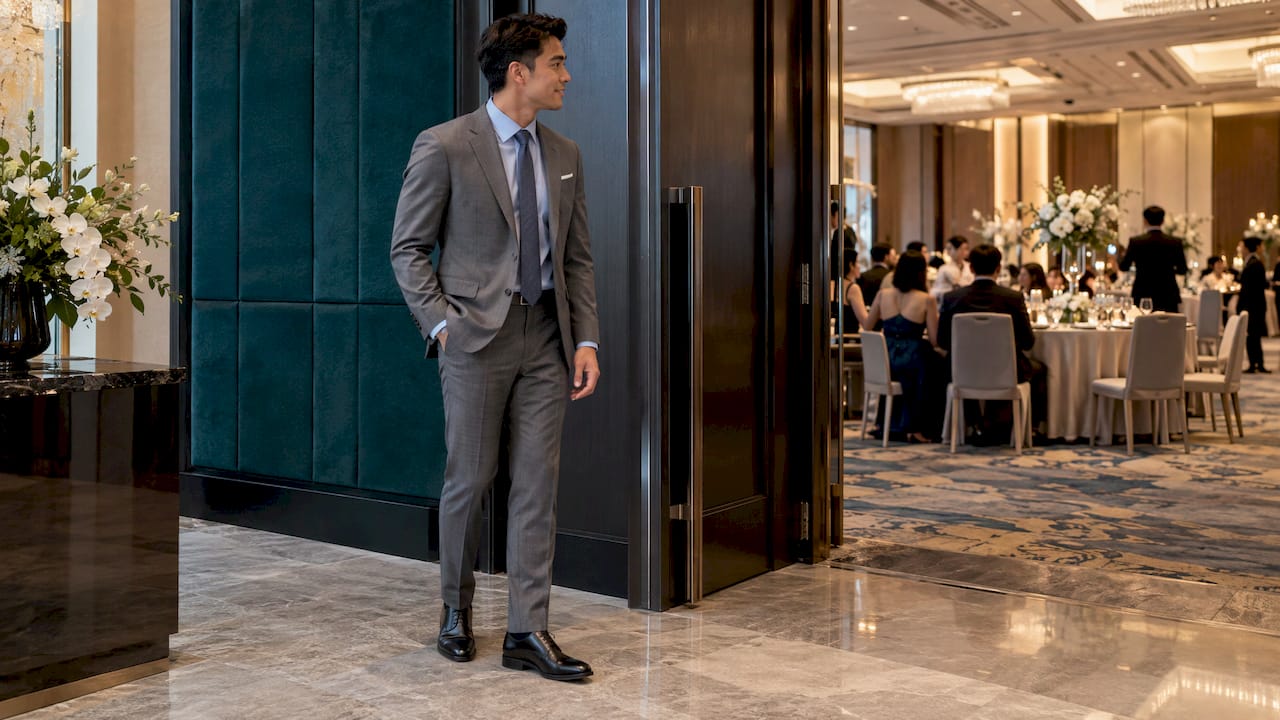
The right suit for a wedding guest in Singapore is a navy, charcoal or mid-grey suit in a breathable, tropical-weight wool, cut to fit you properly and worn with a white or light blue shirt. It respects the couple, survives a humid walk from the car and still looks composed in an air-conditioned ballroom. At Ron & Rich, we make suits to your exact measurements and preferences, which is the surest route to a jacket that sits correctly for a long evening of toasts, photographs and handshakes.
Below, we set out how to read the dress code, choose colour and cloth, check the fit and finish the look.
TL;DR
- Navy, charcoal and mid-grey are the safest colours. Avoid head-to-toe white and black, which carry unfortunate associations at many Singapore weddings.
- Tropical-weight wool, around 200 to 250g, in an unlined or half-lined jacket copes best with Singapore’s heat and its cold ballrooms.
- Dress one rung up from the invitation, never one rung down. A hotel ballroom calls for a full suit.
- Fit matters more than price: sleeve length, shoulder line and waist are what people notice in photographs.
- A two-piece suits most weddings; a waistcoat suits formal or traditional ceremonies.
Table of Contents
- Reading the invitation: dress code, venue and formality
- Colours that work, and two to avoid
- Fabric: dressing for 33°C outside and 19°C inside
- Why fit matters more than anything on the label
- Is a cheap suit worth it for a wedding?
- Two-piece or three-piece?
- Styling: shirt, tie, shoes and finishing touches
- Our perspective
- Commissioning your wedding guest suit with us
- FAQ
- Sources
Reading the invitation: dress code, venue and formality
Singapore weddings range from solemnisations in a garden to banquets in a hotel ballroom, and the invitation rarely says more than “smart casual” or “formal”. The venue is the better guide.
According to Suave Asia’s guide to Singapore weddings, a hotel ballroom calls for at least a blazer, with a suit the safe choice and the tie optional. A restaurant banquet suits a pressed shirt, trousers and loafers, adding a blazer if the crowd is formal. A garden or beach solemnisation allows a linen-blend shirt and chinos.
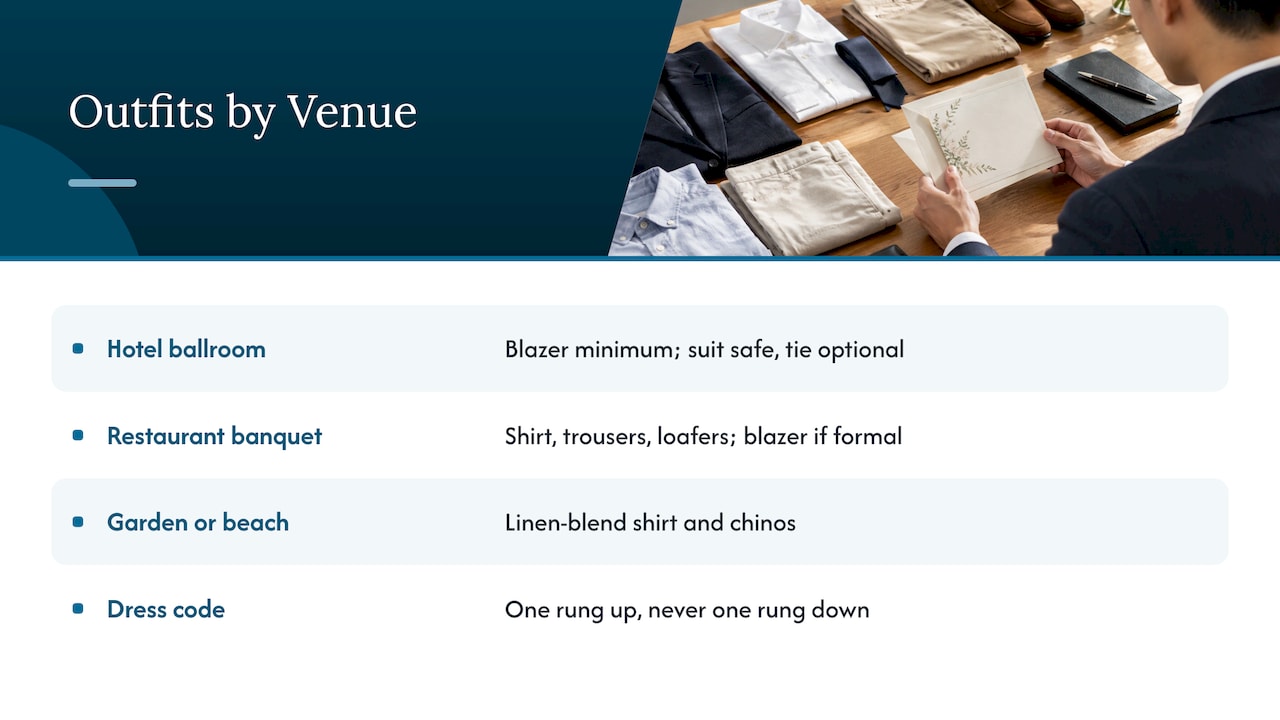
The same publication’s dress code guide gives a rule worth remembering: dress one rung up, never one rung down. Being slightly overdressed at a wedding reads as respect. Being underdressed reads as indifference.
If you are unsure, ask the couple or a member of the wedding party. They will be glad you asked, and it is quicker than guessing.
Which suit for which setting
| Setting | What to wear |
|---|---|
| Hotel ballroom dinner | Full suit in navy, charcoal or grey; tie recommended |
| Church or traditional ceremony | Two-piece or three-piece suit; a waistcoat is appropriate |
| Restaurant banquet | Suit or blazer with trousers; tie optional |
| Garden or beach solemnisation | Lightweight suit or blazer; open collar acceptable |
Colours that work, and two to avoid
Most Singapore weddings bring together several generations and traditions, so colour carries more weight than it would at a purely Western wedding.
Navy and charcoal are dependable in every setting. Mid-grey is a little lighter and suits daytime events. For a Chinese wedding, Bridely’s etiquette guide notes that white is reserved for the bride and also carries associations with mourning, while black can be linked with bad luck. It suggests a smart navy or grey suit with a crisp shirt and a red or gold tie. Dark green is another option the same guide mentions.
Suave Asia likewise advises against full white and full black, as older guests may read them as funereal. If you love a black suit, soften it with a coloured tie and pocket square. Otherwise, choose navy: it is the colour that looks right from a morning solemnisation to a late banquet.
Seasonal and fashion colours have their place. British GQ’s 2026 guide names a navy double-breasted suit and beige houndstooth among current favourites for winter weddings in the United Kingdom. In Singapore, with no winter, take the idea rather than the cloth: a double-breasted jacket in a lightweight navy wool is a confident choice that is still entirely appropriate.
Fabric: dressing for 33°C outside and 19°C inside
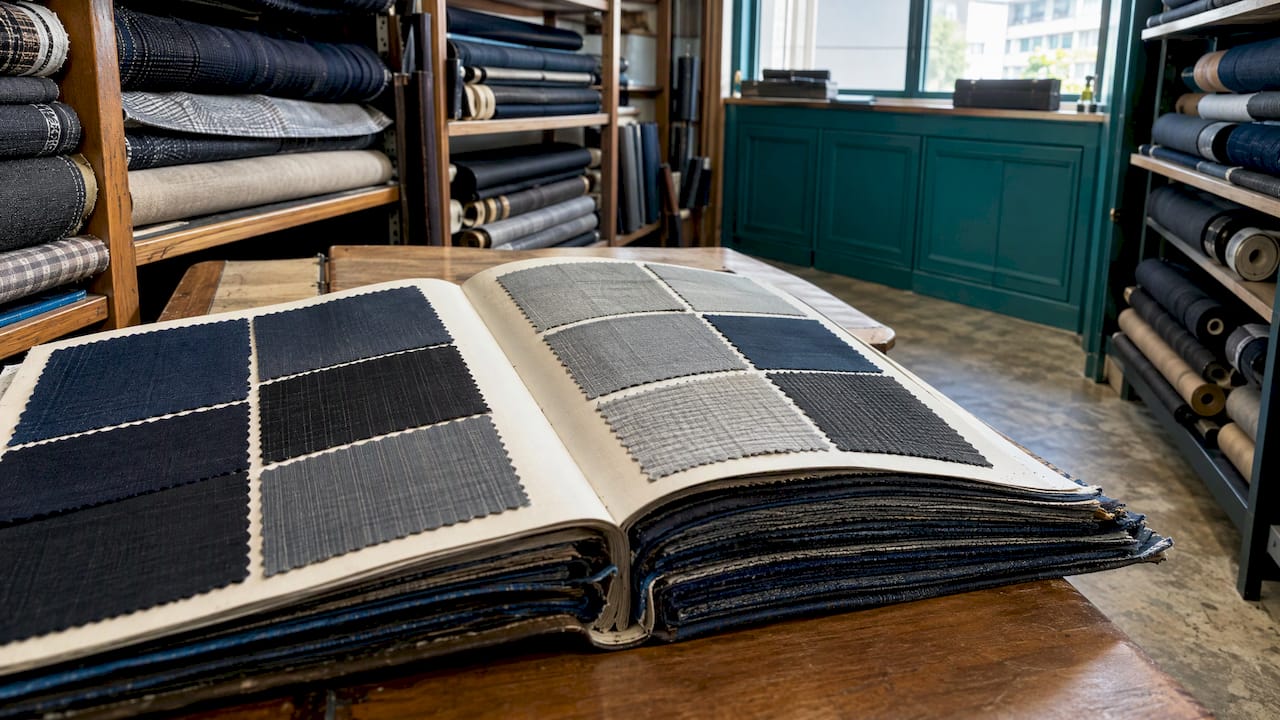
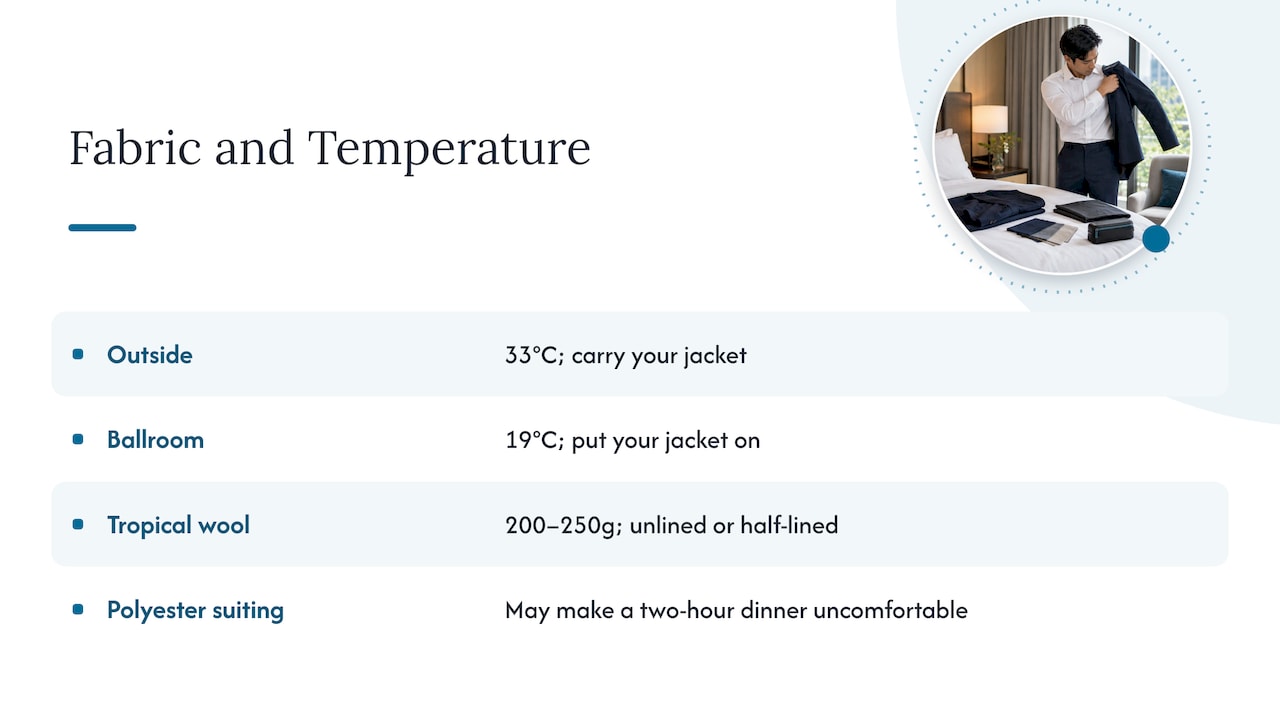
This is where Singapore differs most from the usual wedding guest advice. Suave Asia describes a day in which it is 33°C outside and 19°C inside a ballroom. Its advice is to carry your jacket until you reach the air-conditioning and put it on there, and to choose tropical-weight wool of 200 to 250g with an unlined or half-lined jacket.
Fabric decides whether a dress code is wearable at all. The same guide notes that cotton, linen blends and tropical-weight wool work, whereas polyester suiting can make a two-hour dinner uncomfortable.
Linen is often the first idea for a hot country, but it needs thought. Tatsuya Nakamura, creative director of Beams, told The Straits Times that linen and cotton wrinkle easily in Singapore’s climate, and that wool needs less frequent cleaning. For a wedding where you will sit, stand, embrace relatives and be photographed, a fabric that recovers its shape is a real advantage.
British GQ points to linen or cotton seersucker as the most breathable summer options for a single or double-breasted suit. They suit a garden or beach occasion, where a little creasing is part of the charm. For a ballroom, light wool is the more polished answer.
At Ron & Rich, we use premium fabrics suited to Singapore’s climate, and our tailors can guide you toward a weight that suits the occasion you are attending.
Why fit matters more than anything on the label
A well-fitting mid-range suit looks better than an ill-fitting expensive one. Wedding photographs are unforgiving: the shoulder, the sleeve and the waist are what the eye catches.
Local tailor Cai Foong, quoted in The Straits Times, gives a clear checklist:
- Jacket sleeves a quarter to half an inch shorter than the shirt sleeves.
- A shoulder line that ends at or slightly before the shoulder bone.
- Lapels that sit cleanly without popping out.
- A snug waist that does not pull when the top button is fastened.
- A jacket that follows the natural curve of the back and covers the whole seat.
- A collar that hugs the neck.
The Knot’s fit guide adds two practical tests. With the jacket buttoned, you should be able to slide two fingers comfortably between shirt and jacket. And the shoulder seam should fall right around the edge of your own shoulder, hanging off by no more than about a quarter of an inch.
The shoulder is the hardest point to fit, because very few men have perfectly symmetrical shoulders. This is the strongest argument for a garment made to your own measurements: a jacket cut for you takes account of one shoulder sitting lower than the other, a posture you hold, or a chest and waist that do not match a standard size. Our personalised fittings are designed to address exactly these individual fit challenges.
Construction: what lies beneath the cloth
The inside of a jacket decides how it drapes and how it ages. Jackets are either fused, with an interlining glued to the cloth, or canvassed, with a layered structure that moulds to the chest over time. Our guide to fused versus canvassed suits explains the difference, and our note on half canvas versus full canvas shows how each jacket is built. If a suit will be worn to many weddings over the years, this is worth understanding before you commission it.
Is a cheap suit worth it for a wedding?
Many guests search for an inexpensive suit because they attend only a few weddings a year. That is reasonable, but consider the cost per wear. A suit that fits and is made of a proper wool can serve at weddings, dinners, interviews and business meetings for years. It also carries your own shape, which no stock size can promise.
If you expect to wear the suit beyond one season, think of it as a wardrobe foundation. A bespoke suit from us starts from $2,170, and a made-to-measure shirt from $199, so the occasion can be the start of a considered wardrobe rather than a single outfit.
Two-piece or three-piece?
For most weddings, a two-piece suit is right. British GQ’s view is that for casual nuptials a two-piece works without looking underdressed, while a waistcoat at a town hall can look like overkill.
A waistcoat does make sense for a traditional wedding, perhaps in a place of worship, for black tie or for a very prestigious venue. In Singapore’s heat, a waistcoat adds a layer, so keep it in a light cloth and fully lined only where you need it. We make waistcoats from $380 for guests who want the formality without committing to a full three-piece.
If the invitation says black tie, a tuxedo is the correct answer, and we offer tuxedos from $2,270.
Styling: shirt, tie, shoes and finishing touches
Anatole’s 2026 style guide offers a sound framework, and our own view agrees with it.
Shirt. White is the safest choice, with light blue a versatile alternative. A tailored shirt matters as much as the jacket, because the collar and cuffs frame the face and hands. Our shirts start from $199.
Tie. Match the width to the lapel: 2.5 to 3 inches for slim lapels, 3 to 3.5 inches for broader peak lapels. The Knot’s guide makes the same point about proportion, noting that standard lapels run 3 to 3.5 inches wide. At a Chinese wedding, a red or gold tie is a gracious touch.
Shoes. Black cap-toe oxfords suit formal occasions. Brown or burgundy brogues and whole-cut oxfords suit semi-formal or cocktail dress, while loafers suit casual or beach weddings. Match your belt leather to your shoes.
Pocket square. Choose one that complements the tie rather than matching it exactly.
Dressing down with intent. Kozo Kawamura, founder of Colony Clothing, told The Straits Times that a suit need not always be worn with a formal shirt and tie, and that unlined jackets and lightweight trousers are great for comfort. For a relaxed daytime wedding, that is a useful licence: a knitted polo or open collar can sit well under a soft-shouldered jacket.
Our perspective
Since Richard Fan founded our house in 1979, we have held to one belief: a suit should be made for the man who wears it, not adjusted to approximate him.
A wedding is a day that is photographed and remembered. The guest who arrives in a jacket that sits cleanly on the shoulder, with sleeves that show a sliver of cuff, is quietly honouring the couple. That is not a matter of spending the most. It is a matter of care in measurement, cloth and cut.
In Singapore, that care begins with the climate. We choose premium fabrics suited to the heat, and we blend traditional craftsmanship with a contemporary line, so that your suit looks timeless in the album and feels comfortable at the table.
Come with the invitation, and we will help you decide the colour, the cloth and whether a waistcoat belongs.
Ron
Commissioning your wedding guest suit with us
Our suits are made with traditional tailoring techniques and a focus on perfect fit and modern design. Each one is made to your exact measurements and preferences through in-person consultations and fittings. Prices are published on our pricing page: suits from $2,170, sports jackets from $1,790, trousers from $290 and shirts from $199.
If your wedding calls for a more formal silhouette, our double-breasted suits are a distinguished option. A well-made navy double-breasted jacket works for both a ballroom and a garden.
Book a consultation at Ron & Rich, and bring your invitation with you. Allow enough time before the wedding for the fittings, so that nothing is rushed.
FAQ
What suit should a man wear as a wedding guest?
A navy, charcoal or mid-grey two-piece suit in tropical-weight wool is the dependable choice in Singapore. Pair it with a white or light blue shirt, a tie in a complementary colour and leather shoes. Check the venue: a ballroom wants a full suit, while a beach solemnisation allows something lighter.
Can I wear black or white to a wedding in Singapore?
It is wiser not to. White is traditionally the bride’s colour, and both white and black can carry associations with mourning or bad luck for some guests, especially at Chinese weddings. Navy, charcoal or dark green are safer, and a red or gold tie adds a festive note.
Do I need to wear a tie?
At a hotel ballroom or traditional ceremony, a tie is the better choice, although Suave Asia notes it can be optional in a ballroom if you wear a suit. At a garden or casual event, an open collar is acceptable. If in doubt, wear the tie and remove it later.
Should I wear my jacket outside?
In Singapore, it is more comfortable to carry it. Outdoor temperatures can reach around 33°C while a ballroom is chilled to about 19°C, so put the jacket on when you arrive indoors. An unlined or half-lined jacket in a light wool makes this easier still.
Sources
- The Ultimate Singapore Wedding Guide for Men
- Every Dress Code Decoded, From Smart Casual to Black Tie
- What to Wear to a Chinese Wedding in Singapore
- British GQ: Best wedding guest suits for men 2026
- The Straits Times: Wool over linen, 5 tips on wearing suits in Singapore
- The Knot: How Should a Suit Fit?
- Anatole: Wedding Guest Outfits for Men