Suit Button Stance: Where the Waist Button Should Sit
Suit button stance is the vertical position of the waist button on your jacket, and it matters more than the number of buttons. It decides how deep the V of the lapels falls, where your jacket appears to cinch, and how much shirt and tie show beneath it. In our house, we treat it as one of the first decisions made at a fitting, because every other line of the jacket is drawn around it.
TL;DR
- Button stance is the height of the waist button, not how many buttons the jacket has.
- A high stance gives a narrower V and longer-looking legs. A low stance gives a longer V and a longer-looking torso.
- The waist button generally works best at or close to your natural waist, around the navel or an inch or two above it.
- Check the stance in the mirror: the jacket should close without pulling, and little or no shirt or tie should show beneath the button.
- In bespoke tailoring, the stance is set to your own proportions rather than to a fashion of the season.
Table of Contents
- What suit button stance actually means
- High, natural and low stance
- How stance changes the way you look
- Choosing a stance for your proportions
- Single-breasted and double-breasted stance
- How to check that a stance is right
- Can a stance be altered?
- Our perspective
- Have your stance cut to your proportions
- FAQ
- Sources
What suit button stance actually means
Stance describes where the key button sits on the jacket front. Button stance is the vertical position of the waist button, regardless of how many buttons the coat has, and it affects both the V-shape and the perceived waistline.
This is why two jackets with two buttons can look entirely different. One may close just above the navel and give a tidy, balanced line. The other may close several centimetres higher or lower and change how the whole body reads.
Stance versus button count
The number of buttons tells you how many fastenings the jacket has. The stance tells you where the one that matters sits.
The two do interact. A three-button jacket packs more buttons into the same length, and a three-button jacket has a shorter lapel roll, which can make you look shorter. A three-roll-two is a two-button jacket with a third button hidden beneath the lapel roll, so it keeps a two-button silhouette while retaining the look of a softer, classic lapel.
For a fuller view of which buttons to fasten and which to leave, see our guide to suit button rules and why the bottom button can warp the fit.
High, natural and low stance
There are three broad positions, and each has its own character.
| Stance | Where the waist button sits | Visual effect |
|---|---|---|
| High | Above the navel | Narrower V, can make the lower body look longer |
| Natural | At the natural waist | Balanced V, jacket moves with the body |
| Low | Slightly below the natural waist | Elongated V, can make the torso look longer |
The descriptions come from a widely read breakdown of button stance: a high stance places the button above the navel, a natural stance at the natural waist, and a low stance slightly below it. The same source notes that a higher stance narrows the V and can lengthen the appearance of the lower body, while a lower stance creates a longer V and can lengthen the torso.
How to find your natural waist
You do not need a tailor to get a rough idea. Bend to one side: the crease that forms is near your natural waist. Alternatively, locate the narrowest point of your torso. Both methods are suggested in the same guide.
Note that the natural waist is generally not where your trousers sit. Trousers can sit lower or higher depending on the rise, which is why a jacket and trousers are best considered together.
Why the number of centimetres is less useful than the position
You will find tailors quoting measurements for the buttoning point. One Paris house’s navy suit, for instance, was documented with a buttoning point of 18¾ inches. That figure is specific to that suit and that wearer. It is a reminder that stance is measured on the individual, not read from a chart.
How stance changes the way you look
The waist button is the anchor of the jacket. One experienced menswear writer describes how the structure is built off the waist button and the shape of the shoulders, with the lapels curling down to it. In other words, move the button and you move the whole line from armhole to skirt.
Three effects are worth understanding.
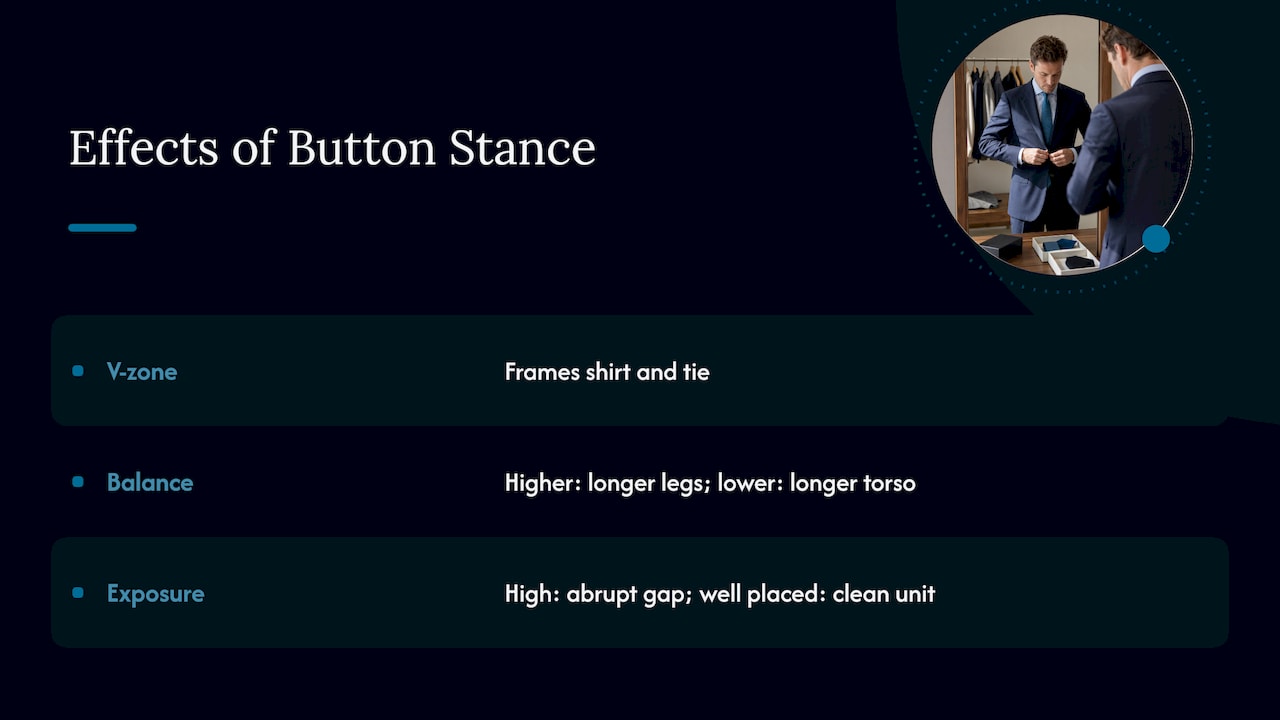
The V-zone. The opening of the jacket frames your shirt and tie. The V-zone created by the button stance acts as the primary focal point of a suit, so its proportion should be weighed against your tie knot and collar style. A wide spread collar with a full knot suits a slightly longer V. A narrow collar and slim tie sit comfortably in a shorter one.
Leg and torso balance. A higher stance visually lifts the waist and lengthens the legs. A lower one lengthens the torso. Neither is better. It depends on what you wish to balance.
Shirt and tie exposure. The stance determines how much shirt and tie show below the button. When the button is too high, the gap below it can look abrupt. When it is well placed, the jacket reads as one clean unit.
The wider silhouette
Stance never works alone. It works with coat length, pocket placement, cut style and design to shape the overall silhouette. A short jacket with a high button and high pockets creates a compact, youthful line. A longer jacket with a natural stance and slightly lower pockets reads as more classic and more formal.
Fashion has moved the button
Stance is also a matter of period. One study of a screen character’s suits found that button stances were lower in the 1970s and 1980s and raised above the waist in the second half of the 2000s. The same writer cautions that fashionably short jackets often place the button too high, in the middle of the jacket.
This is a good reason to choose by proportion rather than by trend. A stance that suits your body will look right in ten years. A stance that follows the season may look dated within two.
Choosing a stance for your proportions
Start with your torso and legs, then consider the jacket’s length and the lapel you favour.
Shorter men and long torsos
A shorter man with a long torso and short legs may benefit from raising the natural waistline slightly to lengthen his legs. This is the advice in the button stance guide we have been citing, and it is consistent with what we see at fittings: a modest rise in the button, together with a jacket length that does not swallow the seat, brings balance.
Broader chests and triangle shapes
For men with a triangle body shape, narrower at the shoulders than at the hips, a natural or low stance may vertically elongate the upper body, while a high stance may accentuate the lower body. If that describes you, avoid pushing the button upward.
Taller men
Taller men with a long upper body generally carry a natural or slightly lower stance well, since the jacket has the length to support it. Restrain the extremes: a very low button on a long jacket can look heavy.
Lapels and stance move together
The lapel rolls down to the waist button, so a wide peak lapel and a very high button can feel cramped, while a slim notch lapel and a very low button can look unfinished. If you are weighing the two, our notch versus peak lapel guide explains what a lapel does for the silhouette.
A starting rule
One practical guideline holds up well: the waist button works best around the natural waist, usually at the navel or an inch or two above, where the body pivots. Begin there, then adjust for your proportions.
Single-breasted and double-breasted stance
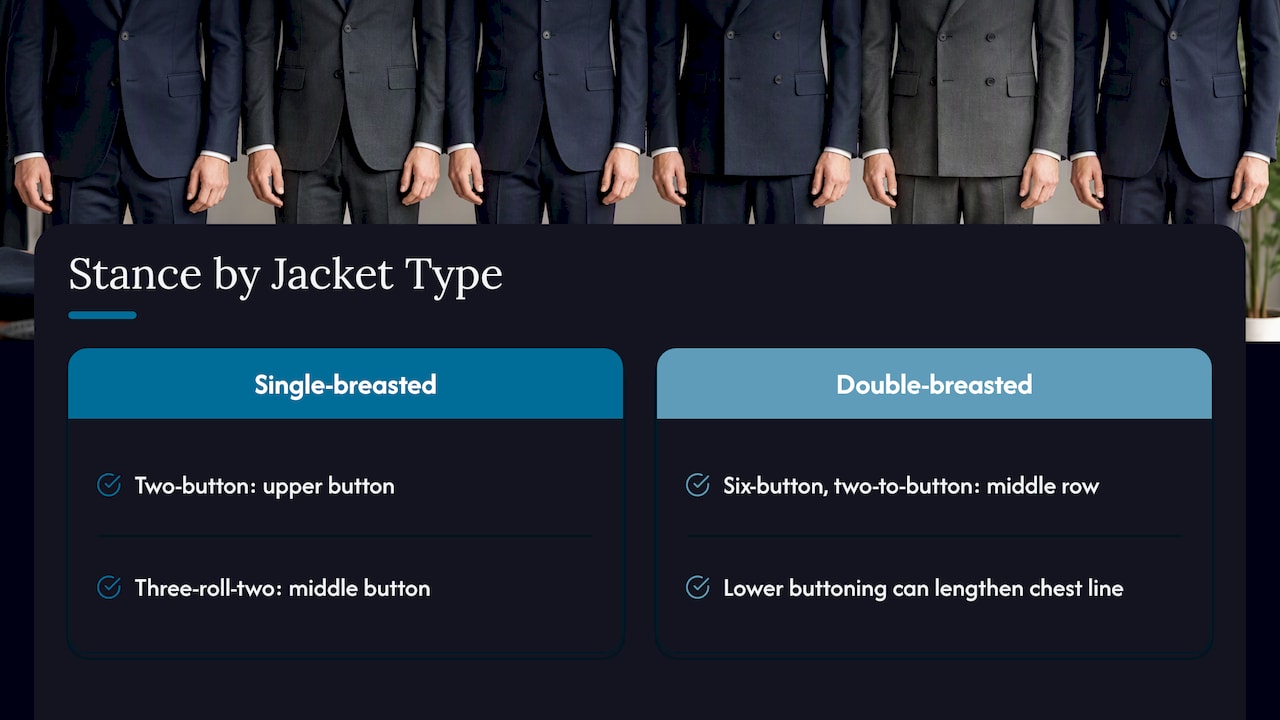
On a single-breasted jacket, the stance is the position of the key button. For a two-button jacket it is the upper button, the one you fasten. For a three-roll-two, it is the middle button.
Double-breasted jackets follow a different logic. On a traditional six-button double-breasted jacket with two to button, the stance is at the middle row. The same source observes that a lower-buttoning double-breasted jacket with a long, sweeping lapel can flatter shorter men, because it lengthens the line of the chest.
If you are considering one, our double-breasted suits are cut with the button position and lapel sweep worked out to the wearer.
Business and wedding wear
For business, a natural stance is the safest and most enduring choice. It sits well on an executive who is seated through long meetings and standing to present, because the jacket closes without pulling.
For weddings, grooms often favour a slightly more elongated line for photographs. A natural to slightly low stance, with a clean lapel roll, tends to photograph well from every angle. If you are planning formal evening wear, our tuxedos follow the same principle of balance.
How to check that a stance is right
Put the jacket on, fasten the key button and stand naturally. Then run through the following.
- Does the button feel in the right place? It should feel as though it is in a natural place, and placing it at the natural waist helps the jacket move with the body.
- Does the jacket close flat? There should be no X-shaped creasing around the button and no flaring at the hem.
- How much shirt and tie show? A well-balanced jacket shows little between the button and the trouser waistband.
- Do the three waist points agree? A harmonious suit is achieved when the jacket’s fastening button, the trouser waistband and the bottom of a waistcoat align at a common waist, which avoids showing shirt or tie beneath the jacket.
- Does it still work seated? Sit down, lean forward, reach for a pen. The button should not pull or the lapel gape.
For the broader picture of shoulders, sleeves and length, see how a suit should fit.
Can a stance be altered?
It is a fair question, and the honest answer is that it depends on the jacket. A jacket’s front is built around the button position: the lapel roll, the canvas and the front edge all follow it. Moving the button a few millimetres may be possible on some jackets. Moving it a few centimetres is a restructuring job that most tailors will advise against, because it disturbs the lapel roll.
Signs that a jacket needs more than a simple adjustment include a lapel that does not lie flat, creasing that radiates from the button, a front that flares open, or a stance that sits visibly far from your waist. In those cases, we would suggest a different jacket, or better, one made to your measurements. Take the jacket to a tailor you trust and ask for an assessment before committing to any work.
This is one of the strongest arguments for bespoke: the stance is set before the cloth is cut, so there is nothing to undo.
Our perspective
We have cut jackets for nearly five decades, and we regard the waist button as the place where a jacket is either resolved or compromised. It is rarely noticed when it is right. It is always noticed when it is wrong.
Ready-made jackets place the button according to an average body and a prevailing fashion. Our approach, rooted in the craft of our founder, master tailor Richard Fan, begins with the man. We observe where your waist truly falls, how your torso and legs divide, how you stand and how you move. Only then do we decide where the button belongs and draw the lapel, the pockets and the length around it.
This is what we mean by artistry: not novelty, but proportion. A stance that suits you will look timeless, whether the season favours a short jacket or a long one. We would rather give you a line that endures than one that follows a trend, and we select fabrics suited to Singapore’s climate so that the jacket stays comfortable and keeps its shape through the working day.
If you are unsure where your own stance should sit, come in. A fitting will tell you more in ten minutes than any chart.
Ron
Have your stance cut to your proportions
At Ron & Rich, the button position is decided at your fitting, alongside your measurements, your preferred lapel and the way you wear a suit. Our bespoke suits and jackets begin from $2,170, and our sports jackets from $1,790, as published on our pricing page.
If you are preparing for a wedding, an important promotion or simply wish to build a wardrobe that fits as it should, book a consultation and we will walk you through the options. You may also wish to read why a tailored business suit is worth the investment.
FAQ
What is a good button stance for a suit?
For most men, a natural stance is the most dependable choice, with the waist button at or close to the natural waist, around the navel or an inch or two above. From there you can adjust for your build: slightly higher to lengthen the legs, slightly lower to lengthen the torso. A tailor can judge this in person far better than a rule can.
Does a higher button stance make you look taller?
It can make your legs look longer, since a higher stance narrows the V and lengthens the appearance of the lower body. Push it too high, though, and the jacket looks short and the proportions turn abrupt. A modest rise, paired with the right jacket length, is more convincing than an extreme one.
Is button stance the same as the number of buttons?
No. The number of buttons is how many the jacket has, while stance is the height of the waist button. A two-button and a three-button jacket can share the same stance, and two two-button jackets can have very different ones. The count affects the lapel roll, but the stance sets the V.
Which button do I fasten on a two-button jacket?
Fasten the top button and leave the bottom one open. This keeps the jacket’s line clean and prevents the front from warping. Our article on suit button rules explains the reasoning.
Sources
- The Skinny on Suit Button Stance
- How Many Buttons Should Your Suit Have?
- The Moving Button Stance
- Seeking Harmony in Dressing Well
- The rules and how to break them 4: The waist button
- Cifonelli navy suit: Style breakdown
- Button Stance, Menswear Glossary