
5 Tailor Approved Shirt Monogram Placements and Exact Marking
The most tasteful monogram placements sit on the left chest between the second and third buttons, the left cuff over the watch, the pocket’s top corner, the inside collar, or just above the trouser line. The guiding rule across all five: keep letters small, thread tonal, and let a professional tailor confirm the exact stitch point before anything touches the needle.
TL;DR:
- Monograms placed on the left chest between the second and third buttons are the most versatile and discreet, especially under a jacket.
- Cuff monograms should be centered over the watch and kept small to avoid drawing excessive attention during handshakes.
- Size should stay between 0.25 and 0.35 inches for standard initials, with traditional formats favoring a larger middle initial for formal shirts.
- Tonal thread creates the most subtle and versatile look, while contrast thread suits casual and deliberately eye-catching designs.
- Proper measurement and fitting are essential beyond preferences, with bespoke tailoring offering precise placement confirmation before embroidery.
Table of Contents
- Where should you place a monogram on a shirt?
- How do you choose the right placement for your shirt?
- What size, letter order and thread colour work best?
- How do you measure and mark the exact placement?
- What mistakes should you avoid?
- How does a bespoke tailor handle placement and finishing?
- A tailor’s honest view on modern monogramming
- Bring your monogram to a fitting, not a guess
- Sources
- FAQ
Where should you place a monogram on a shirt?
Each placement carries its own logic, and the right one depends on how much visibility you want and how the shirt gets worn.
Left chest, between the second and third buttons, remains the classic choice for dress shirts. Positioned there, initials sit roughly level with the breast pocket line, whether or not the shirt actually has one. Worn under a jacket, this spot stays almost entirely hidden, which is precisely why it has endured as the standard. Worn without a jacket, on a golf day or a relaxed Friday, it reads as a quiet flourish rather than a statement.
Left cuff placement puts the monogram over the watch, so it catches the eye only when you check the time or extend your hand. Mark it centred on the cuff face, sized to sit comfortably within the fabric without crowding the buttonhole. This location works well for men who layer jackets often, since a cuff monogram peeks out at the sleeve edge rather than disappearing entirely. Avoid it on shirts you wear mostly under a suit with no intention of showing cuff, since the effort goes largely unseen.
Pocket, top corner offers a practical middle ground on shirts that actually have a chest pocket. The monogram sits just inside or along the top edge, small enough not to compete with the pocket’s own lines. Pocket-size and shape vary by shirt style, so a boxier pocket calls for a slightly different letter arrangement than a slim, angled one.
Inside collar is the most discreet option available, stitched where only the wearer or a tailor ever sees it. Men who want personalisation without any public display, or who simply dislike visible embroidery, tend to gravitate here. It suits dress shirts with a structured collar stand particularly well, since the stand gives the embroiderer a stable, flat surface to work with.
Waist, just above the trouser line, or the left forearm suit casual shirts and men who want a personal touch that a jacket or waistband conveniently covers. These spots suit weekend shirts, safari jackets, or chore coats more than formal dress shirts, where the classic chest and cuff positions still dominate.
- Left chest: subtle under a jacket, a light accent without one.
- Left cuff: visible on handshake and glance, ideal for men who layer.
- Pocket corner: works only on shirts with an actual pocket.
- Inside collar: entirely private, best for structured collars.
- Waist or forearm: casual shirts, easily hidden by outerwear.
How do you choose the right placement for your shirt?
Start with the garment itself, not a general preference. A shirt’s construction limits your options before taste even enters the conversation.
- Check the construction first. Note whether the shirt has a chest pocket, a French or standard placket, or front pleats, since each detail changes where a monogram will actually sit cleanly.
- Think about how often a jacket covers the shirt. If you’re rarely without one, chest placement stays private nearly all day. If the shirt sees plenty of open-collar, no-jacket wear, cuff or pocket placement earns more visibility.
- Match placement to formality. Business shirts favour left chest or cuff. Smart-casual shirts tolerate pocket-corner monograms. Evening and black-tie shirts, especially tuxedo fronts, are usually better left unmarked or reserved for the inside collar only.
- Respect handshake etiquette. The right cuff greets a handshake directly, so keep monograms on the left. It is also the side that naturally sits nearer a watch, which is partly why convention settled there.
- Coordinate with the rest of the outfit. One monogram per outfit is the rule; a monogrammed shirt paired with monogrammed cufflinks and a monogrammed pocket square starts to look like a branding exercise rather than a personal touch.
Non-standard shirts, tuxedo fronts, unusual placket styles, heavily pleated fronts, benefit from a second opinion before committing. A bespoke tailoring consultation settles these questions in minutes rather than guesswork.
Pro Tip: If you wear a jacket for most of the working week, put your money on the cuff rather than the chest. It is the only placement guaranteed to show, however buttoned up the rest of the outfit is.
What size, letter order and thread colour work best?
Restraint is the theme, and the numbers back it up. Equal-sized three-letter monograms typically run between 0.25 and 0.35 inches, while designs built around a larger centre initial can stretch to 0.5 to 0.75 inches. Beyond that range, a monogram starts to compete with the shirt itself rather than sitting quietly within it.
Letter order follows two conventions. The traditional centre-initial format places the surname’s first letter largest in the middle, flanked by smaller first and last-name initials on either side. The modern equal-size format simply runs first, middle, last, left to right, with no letter given visual priority. Dress shirts intended for formal or business wear tend to look better with the traditional format; casual and sport shirts suit the modern version.
Font and colour follow the same formality logic:
- Script lettering suits dressier shirts and smaller sizes.
- Block or sans-serif lettering suits casual shirts and slightly bolder placements.
- Tonal thread, matched a shade darker than the shirt fabric, gives the most discreet and versatile result across nearly every occasion.
- Contrast thread works only on casual shirts where a deliberate accent is the point, not an accident.
Whatever you choose, keep the stitch point clear of seams, buttonholes, and topstitching. Placing letters too close to any of these invites puckering and makes the smallest irregularity in the fabric obvious.
How do you measure and mark the exact placement?
Precision here separates a monogram that looks intentional from one that looks like an afterthought.
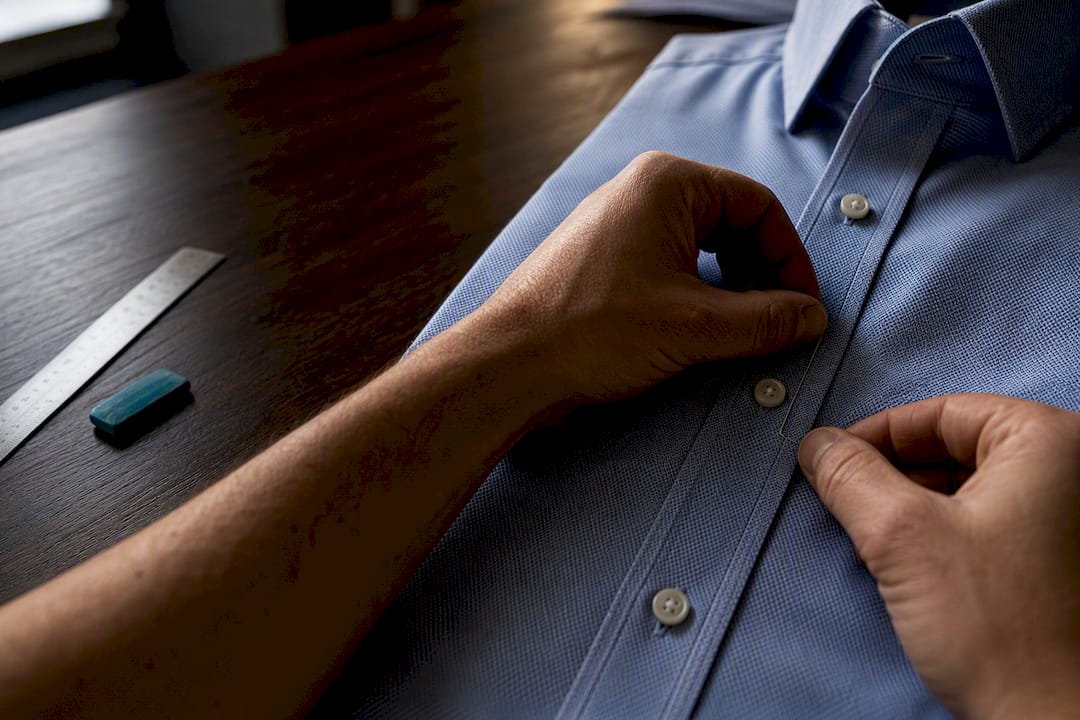
- For left chest: measure from the edge of the placket outward, then centre the design vertically between the second and third buttons, following exact measurements that work to ensure perfect placement. Check the mirror image on the other side of the placket to confirm the letters sit level, not angled toward the shoulder or waist.
- For the cuff: button and fold the cuff as it will be worn, then mark the starting point roughly 1/8 inch above the topstitching, centring the letters so they land over the watch face. Never stitch directly on the topstitch line itself, since any unevenness there transfers straight into the embroidery.
- For pocket corners and the inside collar: mark a point that clears any seam allowance, keeping a consistent margin from the pocket’s finished edge or the collar stand’s stitch line.
- Test before you commit. Pin or chalk-mark the position, try the shirt on, and check it in a mirror under normal light before the embroiderer starts.
The most common pitfall is measuring from a fabric fold rather than a fixed structural point, buttons, placket edge, topstitching, which shifts slightly every time the shirt is worn or washed.
Pro Tip: Mark placement on a shirt that has already been laundered once. Fabric shrinks and settles slightly after the first wash, and a mark taken on brand-new fabric can drift once the shirt has been worn a few times.
What mistakes should you avoid?
A monogram loses its charm the moment it starts working too hard for attention. The most common errors are easy to avoid once you know to look for them.
- Wearing more than one monogram at once, on the shirt, cufflinks, and pocket square together, reads as excessive rather than considered.
- Placing the monogram on the right cuff puts it directly in the path of every handshake, which draws far more attention than most men intend.
- Oversized letters or bright contrasting thread on a business shirt undercut the quiet effect a monogram is meant to have.
- Stitching over or beside uneven topstitching magnifies the flaw rather than disguising it.
- Positioning letters too near gussets or side seams risks pulling and distortion as the shirt moves.
If any of this feels like too much personalisation for your taste, the inside collar or a spot above the trouser line lets you keep the sentiment without any public display at all.
How does a bespoke tailor handle placement and finishing?
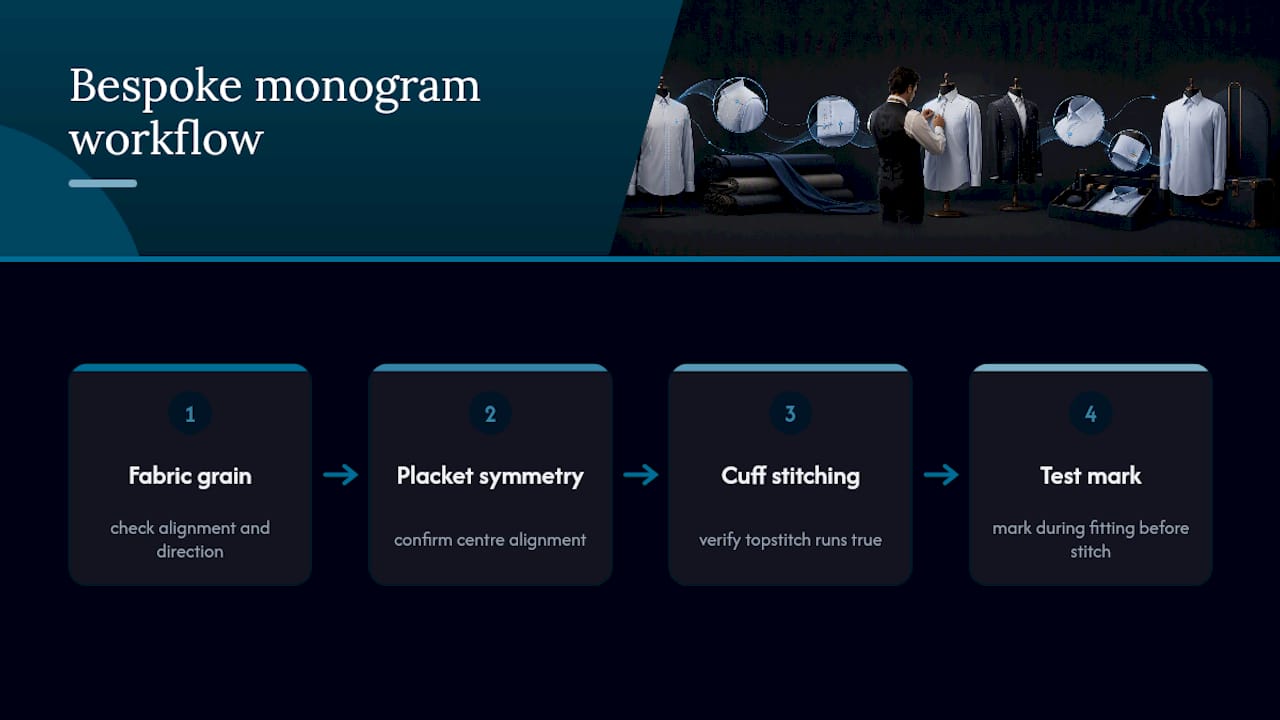
Placement is never guesswork. Before a needle touches the fabric, tailors check the fabric grain, confirm placket symmetry, and verify that cuff topstitching runs true, then test-mark the exact spot during a fitting so it can be seen before it’s permanent.
We favour tonal thread and modest letter heights on dress shirts for the same reason most bespoke houses do: smaller, closer-matched monograms simply age better than bold ones. Clients requesting an unusual placement, a tuxedo front, a heavily pleated shirt, work through thread swatches and sample stitching with us first. Hand-finishing on bespoke pieces remains something many tailoring houses still favour for the subtlest personal work, and it is a standard we hold ourselves to.
A tailor’s honest view on modern monogramming
Chest placement is the safer default for anyone building a first bespoke shirt wardrobe. Cuff placement suits the man who already knows he wants the detail seen, not just felt.
What matters more than the spot itself is restraint: a monogram should read as finishing, not decoration. Get the size and thread right and it lasts the life of the shirt.
— Ron
Bring your monogram to a fitting, not a guess
This is an alternative to picking a placement off a template and hoping it lands right; bespoke fittings let you see the exact stitch point marked on your own shirt before any embroidery begins, so there is no second-guessing once it is done.
Our bespoke shirting range gives you a proper canvas to work from, cut to your measurements rather than adjusted from a stock size, and every fitting includes a look at thread swatches so you can compare tonal against contrast before committing. If cuff style is part of your decision, our guide to French cuffs versus barrel cuffs is worth a read beforehand. When you’re ready, book a bespoke tailoring consultation and we’ll confirm your monogram placement, size, and thread colour together, in person, before a single stitch goes in.
Sources
- Monogram Rules | Embroidered Initials On Men’s Dress Shirts
- Where To Place A Monogram On A Shirt Cuff
- How to Monogram - Monogramming Etiquette for Men
FAQ
Where is the best place to put a monogram on a shirt?
The left chest, between the second and third buttons, is the traditional and most versatile spot, since it stays discreet under a jacket and offers a light accent without one.
In what order should the letters in a monogram go?
Traditional centre-initial monograms place the surname’s first letter largest in the middle, flanked by the first and last name initials; modern equal-size versions simply run first, middle, last.
Where should embroidery generally sit on a dress shirt?
Beyond the chest and cuff, embroidery can sit on the pocket’s top corner or the inside collar, with pocket and collar shirts each dictating slightly different placement based on their construction.
What are the main etiquette rules for men’s monograms?
Keep it to one monogram per outfit, avoid the right cuff since it sits in the path of a handshake, and favour tonal thread and modest letter sizes over bold, contrasting ones.
Can a bespoke tailor help decide placement?
Yes. A bespoke tailoring fitting lets you test-mark placement on your own shirt and check fabric grain and topstitching before any embroidery is permanent.


