Shirt Fabric Weights: A GSM Guide for Singapore
Shirt fabric weight is the mass of a fabric over a set area, stated in grams per square metre (GSM) or ounces per square yard. For shirting, most lengths sit between roughly 120 and 160 GSM. In Singapore’s heat and humidity, the lower and middle part of that band is usually the most comfortable choice. Weight is only part of the picture, though: weave, yarn fineness and fibre decide how a shirt wears.
Below, we explain how the figures are measured, what each band feels like on the body, and how to choose a weight for the office, a wedding or a weekend.
TL;DR
- GSM is grams per square metre. One oz/yd² equals about 33.9 GSM, so a 4 oz fabric is roughly 136 GSM.
- Dress shirting typically runs 120 to 160 GSM. Under about 140 is light and airy, 140 to 160 is crisper and more structured.
- In Singapore, a lighter to mid weight in a breathable weave is the practical starting point. Heavier cottons suit air-conditioned rooms.
- Weight alone does not tell you whether a shirt is sheer or cool. Yarn count, weave density and colour matter as much.
- A bespoke shirt lets you set the weight, weave and colour together, rather than accept a compromise off the rack.
Table of Contents
- What shirt fabric weight actually means
- Light, medium and heavy: where shirting sits
- What weight changes on the body
- Choosing a shirt weight for Singapore
- How to read a swatch properly
- The question of 200 GSM and 400 GSM
- Our perspective
- Have the weight chosen for you
- FAQ
- Sources
What shirt fabric weight actually means
Fabric weight describes how much a fabric weighs for a given area. Two units are in common use. Threads magazine explains that ounces are normally quoted per square yard, while metric weights are quoted in grams per square metre.
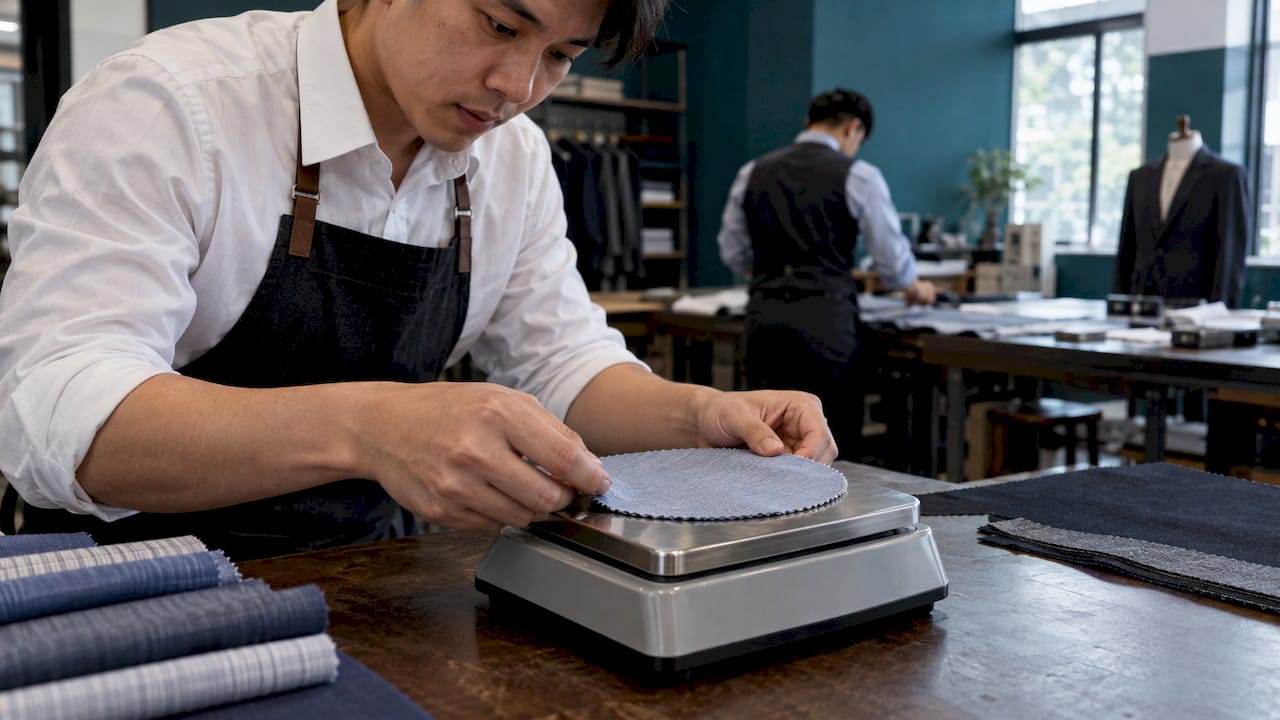
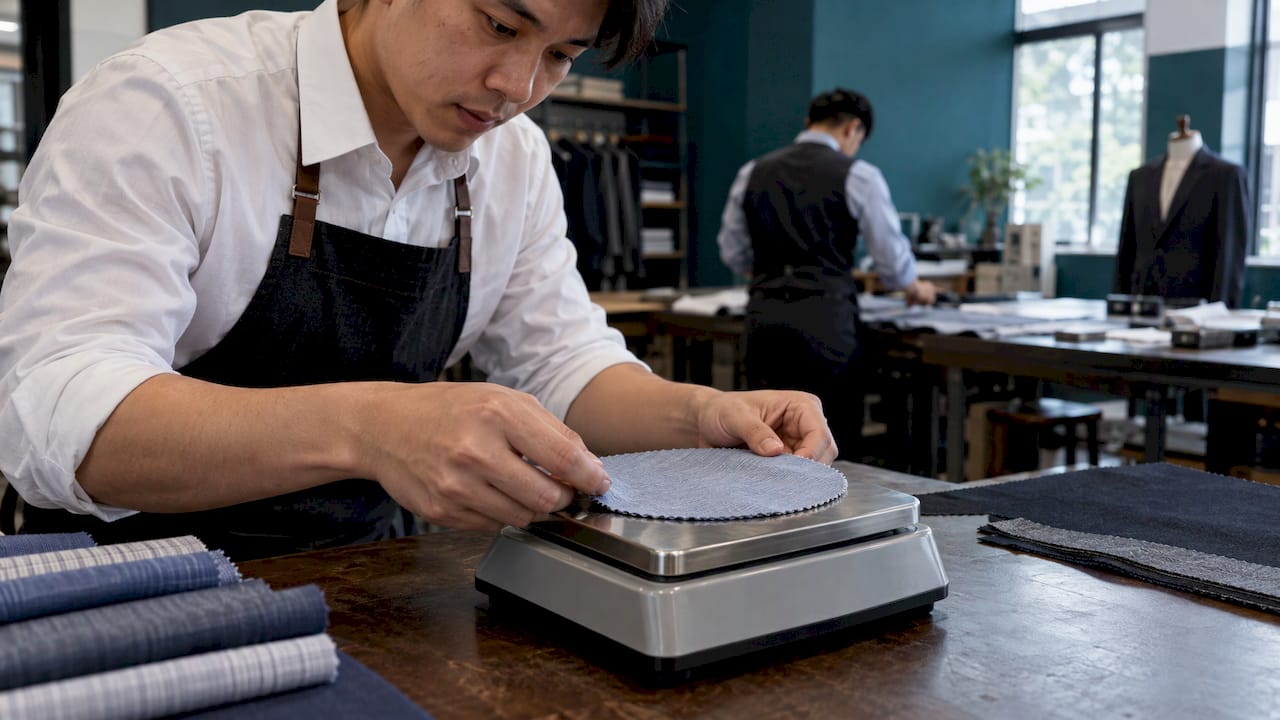
To find GSM in a laboratory or workshop, a cutter takes a circle of exactly 100 square centimetres from the cloth. The circle is weighed and the result is multiplied by 100, as Threads describes.
Converting between GSM and ounces
The conversion is fixed: one oz/yd² equals 33.906 g/m². Multiply ounces by about 34 to reach GSM, or divide GSM by 34 to reach ounces.
| Ounces per square yard | Approximate GSM |
|---|---|
| 3 oz | 102 |
| 4 oz | 136 |
| 5 oz | 170 |
| 6 oz | 203 |
| 8 oz | 271 |
One caution when reading mill or supplier sheets: some quote weight per linear yard, which changes with the width of the cloth. Mekan Textile advises confirming whether a figure is per square yard or per linear yard whenever numbers look inconsistent.
Light, medium and heavy: where shirting sits
The bands differ slightly from one source to the next, because each trade uses them for its own garments. A general ruling from Drapers Fabrics treats anything up to 150 GSM as lightweight, up to 270 GSM as midweight, and anything above that as heavyweight. A workwear-focused guide from Ecojersey places lightweight fabric under 180 GSM, medium-weight at 180 to 280, and heavy at 280 to 400.
Shirting is a narrower world. D Badami notes that shirting typically runs 120 to 160 GSM, and breaks it down as follows:
| Weight band | Character | Typical use |
|---|---|---|
| About 120 to 140 GSM | Light, good drape, breathable | Formal and summer shirts |
| About 140 to 160 GSM | Mid-weight, more structure and crispness | Business shirts, oxford cloth |
| 160 GSM and above | Heavier, holds a crisp shape | Cooler weather, casual overshirts |
In short, a shirt in the 100 to 150 GSM range is what most men think of as a dress shirt. Once you pass roughly 200 GSM you are moving towards a casual shirt-jacket or overshirt, and by 400 GSM you are in the territory of heavy outerwear and fleece. A fabric supplier’s weight chart describes 400 GSM as premium hoodie weight, which is far heavier than any dress shirt.
What weight changes on the body
Weight shapes four things you notice every day: airflow, opacity, drape and structure.
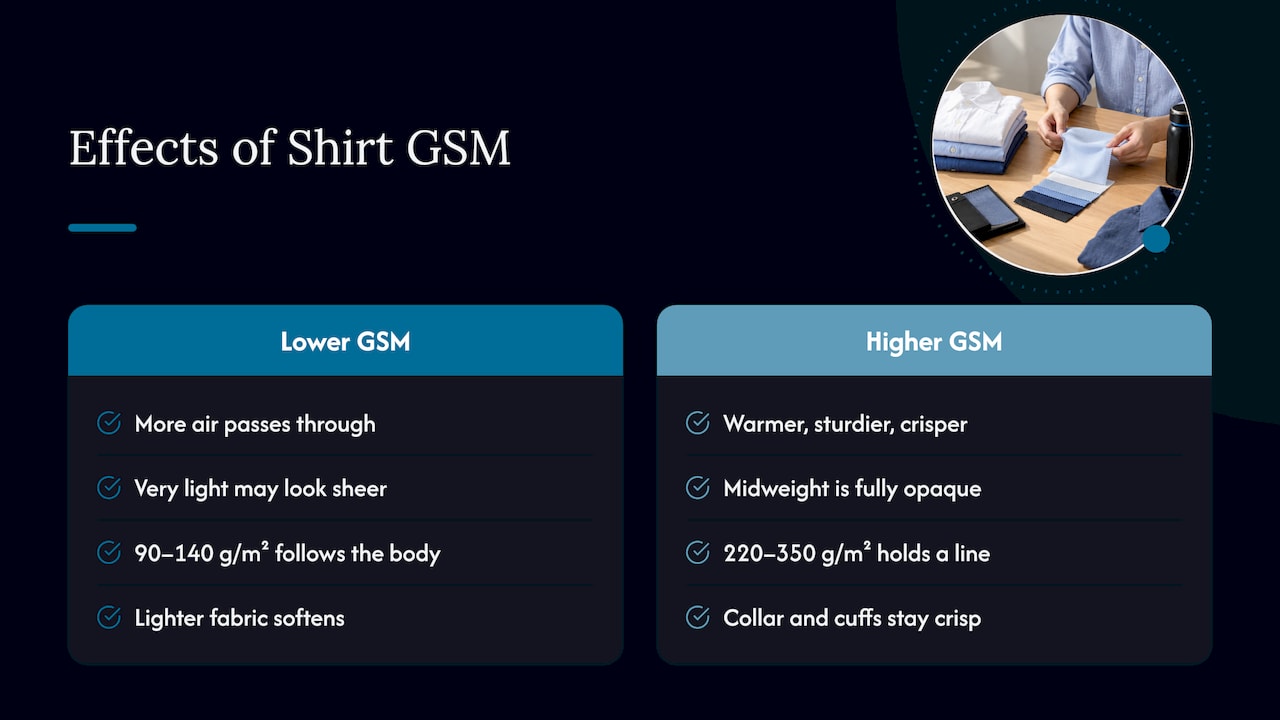
Breathability. According to D Badami, a lower GSM lets more air through and falls more softly, while heavier fabrics are sturdier, warmer and crisper.
Opacity. Very light fabrics can be slightly sheer, while midweights are fully opaque and hold a pressed look for longer, as the same guide explains.
Drape. A lightweight cloth of roughly 90 to 140 g/m² follows the body and floats, while one of 220 to 350 g/m² brings presence and holds a line, according to Misciano.
Structure. A heavier shirting keeps its collar and cuffs crisp through a long day. A lighter one softens, which many men prefer in warm weather.
Why GSM alone can mislead
A single number does not describe a cloth. Stitch Authority points out that GSM measures mass per unit area and does not by itself determine thickness, warmth, drape, durability or the right use.
See-through shirts are the clearest example. Benny Cotts explains that show-through is a distribution problem more than a weight problem: two shirtings at the same GSM can behave very differently depending on yarn count and the number of threads per inch. A fine, dense shirting in the 120 to 170 GSM band can be more opaque than a coarse one at 180 GSM. Going heavier is the wrong fix, because it makes the shirt hot and stiff without necessarily closing the gaps.
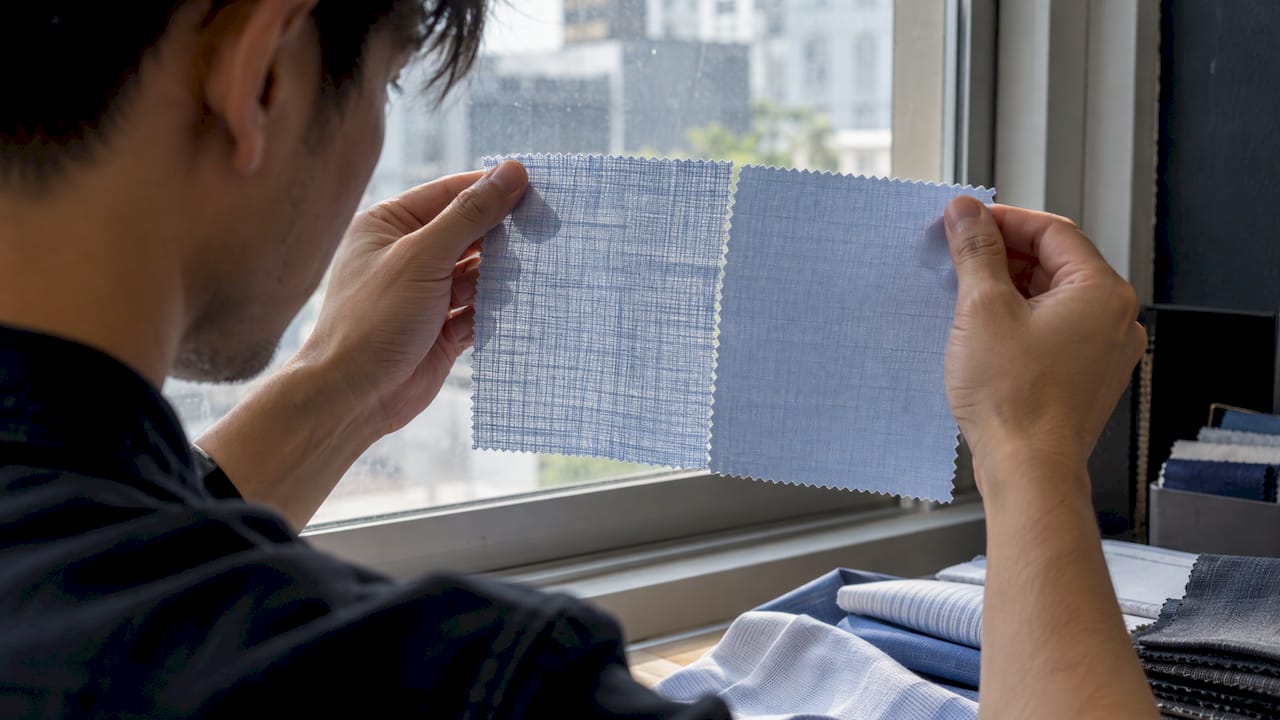
Fibre matters too. Misciano cautions that a combed wool at 240 g/m² can stay breathable, while a synthetic at 180 g/m² can feel stifling. It also notes that a fabric can look opaque laid flat and turn sheer once worn, especially across the chest, hips and thighs. Use weight to frame the level, then judge the fibre and weave.
Choosing a shirt weight for Singapore
Singapore is the hardest test a shirt can face. One local supplier guide puts year-round temperatures at about 27 to 34°C with relative humidity of 70 to 90%. The same page observes that cotton of 200 GSM and above begins to feel warm outdoors and suits air-conditioned offices or low-exertion roles better. That guide concerns T-shirts, but the principle carries over to dress shirting.
For tropical climates, one buying guide recommends 120 to 150 GSM in percale, voile or poplin weaves, and adds that in humidity above 60%, cotton-linen blends tend to manage moisture better than pure cotton.
Here is how we would translate that into a wardrobe.
The office and the boardroom
Most Singapore offices are air-conditioned, but the commute is not. A fine poplin or twill in the 120 to 150 GSM range gives a crisp collar and a clean front without trapping heat on the walk from the MRT. If you wear a jacket most days, a slightly firmer cloth in the upper part of that range keeps the shirt neat beneath it. For suit-weight choices, our guide to travel suit fabrics of 210 to 310 GSM shows how the same logic applies to the jacket.
Weddings and formal evenings
A groom spends hours in a jacket, often outdoors for photographs. A light, fine poplin in white or ivory is the sensible foundation. Because pale colours show more through the cloth, ask for a dense, fine weave and judge it against skin. If you are choosing evening wear, our tuxedo service covers the full outfit.
Weekends and smart casual
Here you can go either way. Linen and cotton-linen blends in light weights suit warm afternoons. A heavier oxford or brushed cotton is pleasant for cinemas and restaurants where the air-conditioning runs cold. If you favour an outer layer, our comparison of safari jacket fabrics shows how linen, cotton drill and wool behave.
A quick guide
| Occasion | Sensible starting point | What to look for |
|---|---|---|
| Daily office wear | About 120 to 150 GSM | Fine poplin or twill, crisp collar |
| Wedding or formal evening | About 120 to 140 GSM | Dense, fine weave in white or ivory |
| Weekend smart casual | Light to mid-weight | Linen blend or soft cotton |
| Cold, air-conditioned spaces | About 140 to 170 GSM | Oxford or a firmer twill |
These are starting points, not rules. Your own build, how much you perspire and how long you stay outdoors will move the figure up or down.
How to read a swatch properly
A number on a label is only the first step. When you are comparing cloths, ask three questions.
- What is the weave? Poplin is smooth and crisp, twill has a diagonal texture and a softer hand, oxford is more textured and sturdy, and voile is open and airy.
- How fine is the yarn? Finer yarns with a dense construction give a smooth surface and better opacity at a modest weight.
- How does it look on you? Benny Cotts advises holding a swatch over your own forearm rather than over paper, which is the honest test of show-through for a white, sky or pastel shirt.
Colour also plays a role. Darker colours hide the structure of the cloth, so a light fabric in navy or charcoal rarely looks thin. Pale shades are less forgiving and reward a denser weave.
The question of 200 GSM and 400 GSM
Two figures come up often in searches. At 200 GSM, a woven cotton is a substantial fabric for a shirt: closer to a casual overshirt than a dress shirt, and warmer than most men want in Singapore’s climate. In knitwear, though, 200 GSM is an ordinary weight. For reference, Shopify notes that standard retail cotton T-shirt fabric usually falls between 150 and 180 GSM, with very lightweight fashion tees at about 120 to 150 GSM.
At 400 GSM you are well beyond shirting. That weight belongs to fleece, heavy sweatshirts and outerwear. It is not a shirt weight, and in Singapore it would be uncomfortable outside a very cold room.
Our perspective
Since 1979, when our founder, master tailor Richard Fan, opened our house, we have judged a cloth by how it behaves on a particular man, not by one figure on a swatch card.
A gram count tells you where a fabric sits on the scale. It does not tell you how it falls across your shoulders in a humid afternoon, or whether a pale blue remains discreet under office lights. That is why we prefer to discuss weight alongside weave, yarn and colour, and to fit each shirt to the individual.
Our approach rests on traditional tailoring techniques and on premium fabrics suited to Singapore’s climate. In a bespoke shirt, you decide how crisp or soft the garment should feel, and we shape the cloth and the cut around your measurements and preferences. Details such as gussets in our bespoke shirts work together with the right fabric to keep movement comfortable.
A well-chosen weight is quiet luxury: you stop noticing the shirt, and only notice how well you feel in it.
Ron
Have the weight chosen for you
Choosing between a light poplin and a firmer twill is far easier with cloth in your hands and a tailor at your side. At Ron & Rich, we take your measurements, discuss how and where you wear your shirts, and make each one to your preferences. Our shirts start from $199, and you can see the full range on our pricing page.

Browse our custom tailored shirts or learn more about our made-to-measure shirt service.
FAQ
How is fabric measured by weight?
Fabric weight is measured as mass per area. A circle of exactly 100 square centimetres is cut and weighed, and the result is multiplied by 100 to give grams per square metre, as Threads describes. In the imperial system the figure is given in ounces per square yard.
Is a 200 GSM shirt thick?
For a woven dress shirt, yes: 200 GSM is noticeably heavier than the typical 120 to 160 GSM of shirting. It feels sturdy and warm, which suits cool, air-conditioned rooms more than Singapore’s outdoors. For a knitted T-shirt, 200 GSM is a fairly ordinary weight.
What does 400 GSM mean in fabric?
It means each square metre of the cloth weighs 400 grams. That is heavy fabric typical of hoodies and outerwear, not shirting. It would be far too warm and stiff for a shirt in Singapore.
What shirt weight is best for Singapore’s humidity?
A light to mid weight of about 120 to 150 GSM in a breathable weave such as poplin, voile or a fine twill is a sound starting point. Linen blends can help in very humid conditions. Your tailor can then adjust for how you work and how much time you spend outdoors.
Does a lighter shirt always look see-through?
No. Opacity depends on yarn fineness and weave density as well as weight, so a fine, dense cloth can be more opaque than a coarser, heavier one. Pale colours show more than dark ones, so choose the weave with care for white and pastel shirts.
Sources
- A Matter of Fabric Weights, Threads
- GSM and oz/yd²: how fabric weight is measured and converted, Mekan Textile
- Fabric Guide, Drapers Fabrics
- GSM for Workwear Fabric, Ecojersey
- GSM in Shirting Fabric, D Badami
- Fabric Weight (GSM): Which g/m² for Each Garment, Misciano
- What Does Fabric GSM Mean?, Stitch Authority
- Shirting GSM and Show-Through in Light Shirts, Benny Cotts
- T-Shirt Fabric Types Singapore, Aquaholic Gifts
- Breathable Cotton Fabric Buying Guide 2026, Alibaba.com Seller Blog
- How Much Does a Shirt Weigh?, Shopify
- What GSM Means: Fabric Weight Chart, Whitecotton