Six Pocket Square Folds to Master in Under a Minute, With Tailor Tips
Six folds cover nearly every occasion a gentleman faces: the presidential (flat) for boardrooms, the one-point for smart-casual polish, the two-point for weddings, the puff for relaxed evenings, the three-point crown for formal events with flair, and the rose for statement moments. Learn the presidential and puff first. Between them, they answer most dress codes you’ll ever meet.
TL;DR:
- Mastering the presidential and puff folds covers most dress codes from boardrooms to evening events, requiring only a minute to perfect each once learned.
- Suitable fabrics include linen or cotton for sharp structures like the presidential fold, while silk is best for soft, decorative shapes such as the puff or rose.
- The size of a square influences its foldability; 30 to 33cm for linen or cotton and at least 40cm for silk helps folds hold their shape.
- The formality of a fold depends on occasion, with structured folds like the presidential suited for formal events and softer shapes like the puff for casual wear.
- Pocket fit is affected by pocket shape and seat depth, which can be adjusted by tailors to better support larger or more intricate folds.
Table of Contents
- Six essential pocket square folds at a glance
- How do you fold each pocket square style?
- Which fabric and size work best for each fold?
- How do you choose the right fold for the occasion?
- What mistakes ruin a pocket square, and how do you fix them?
- What do tailors know about pocket fit that folding guides miss?
- A tailor’s closing thought on pocket squares
- Sources
Six essential pocket square folds at a glance
Most style guides agree that mastering a handful of folds well beats knowing dozens badly. The six below cover boardroom to black tie, and each takes under a minute once your fingers know the moves.
- Presidential (flat fold): A crisp, single straight edge peeking above the pocket. Beginner. Boardrooms, job interviews, black tie.
- One-point fold: A single diagonal peak. Beginner. Smart-casual blazers, client meetings.
- Two-point fold: Two offset peaks for visual balance. Intermediate. Weddings, cocktail events.
- Puff fold: A soft, gathered bloom with no defined points. Beginner. Smart-casual jackets, evening drinks.
- Three-point (crown) fold: Three layered peaks in a fan. Intermediate. Formal dinners, festive occasions.
- Rose (flower) fold: A twisted bloom that mimics a flower in the pocket. Advanced. Weddings, statement dressing.
The pattern holds across most authoritative guides: structural, geometric folds like the presidential read as formal, while soft, rounded shapes like the puff sit comfortably in smart-casual territory. The more architecture a fold has, the more occasion it demands.
How do you fold each pocket square style?
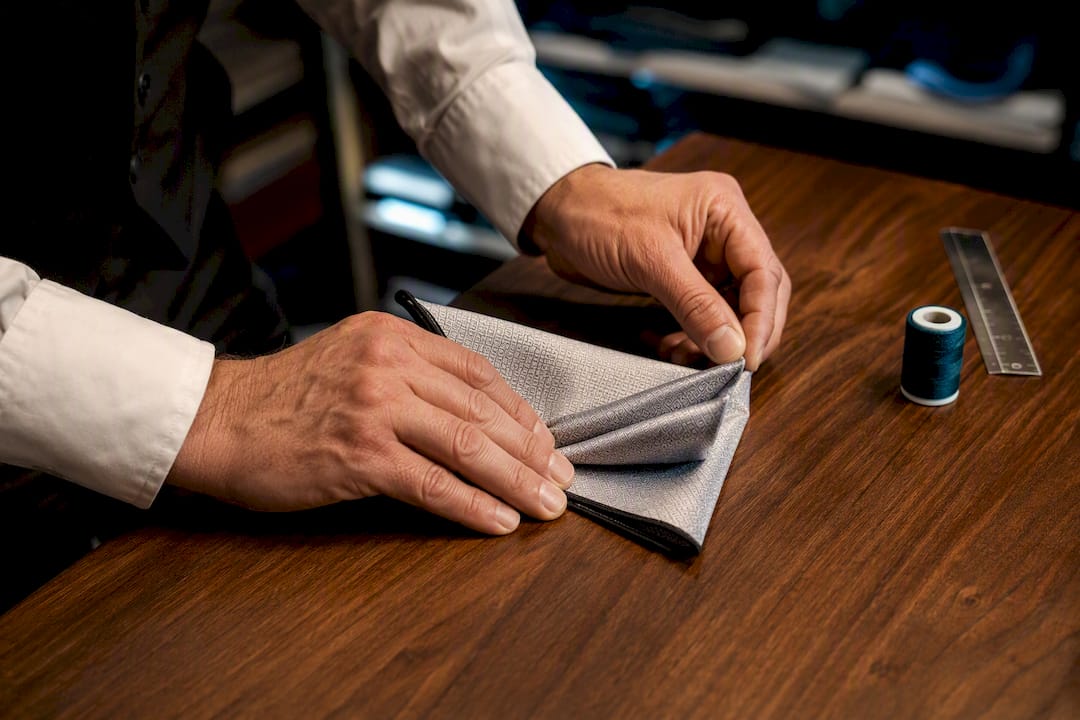
Each fold below assumes a square laid flat, right side down, on a clean surface. Work slowly the first few times. Muscle memory arrives faster than you’d expect.
Presidential (flat) fold, beginner
- Lay the square flat and fold it in half lengthwise.
- Fold in half again to create a long rectangle.
- Fold the rectangle into thirds so it matches your pocket width.
- Tuck it into the pocket, leaving a straight edge of half a centimetre to one centimetre showing.
Use a crisp linen or cotton square here. The fold needs body to stay flat, and a floppy silk square will slouch within minutes.
One-point fold, beginner
- Fold the square in half diagonally to form a triangle, point facing up.
- Fold the left corner in towards the centre, then the right, tapering the base.
- Fold the bottom edge up until the folded width fits your pocket.
- Position the single point slightly off-centre for a less rigid look.
Two-point fold, intermediate
- Fold diagonally into a triangle, then fold that triangle in half to create two layers of point.
- Offset the top layer so one peak sits slightly higher and left of the other.
- Fold the base up to size and tuck, letting both points show above the pocket line.
Offsetting the peaks is what separates a two-point from a sloppy one-point. Symmetry looks accidental; a deliberate stagger looks tailored.
Puff fold, beginner
- Pinch the centre of the square and lift, letting the fabric cascade around your fist.
- Gather the loose fabric at the base with your other hand.
- Fold the gathered base into a rough triangle and tuck it in, leaving the puffed top loose and irregular.
Pro Tip: Never iron a puff fold. The whole point is a soft, imperfect bloom, and a crease along the top kills the effect instantly.
Three-point (crown) fold, intermediate
- Fold into a triangle as with the one-point, then fold each side corner up separately rather than together.
- Stagger the three resulting points at slightly different heights.
- Fold the base up and tuck, fanning the points gently with your fingers before settling the square in the pocket.
Linen or a linen blend holds the three peaks far better than silk, which tends to collapse under its own weight.
Rose (flower) fold, advanced
- Lay the square face down and pinch the centre, twisting it clockwise into a tight coil.
- Continue twisting until the fabric spirals into a rosette shape.
- Fold the twisted tail underneath the bloom and seat the whole shape into the pocket, bloom facing out.
This one takes practice. Expect a lopsided rose the first few attempts before the twist tension becomes intuitive.
Which fabric and size work best for each fold?
Fabric choice decides which folds are even possible. A linen square holds a crisp edge for presidential and peaked folds, while silk drapes too loosely to hold sharp architecture but excels at soft, decorative shapes.
- Silk: Fluid drape, ideal for puff and rose folds. Go no smaller than 40cm x 40cm (16 inches) or it will slide down inside the pocket.
- Linen or cotton: Holds a crease well, best for presidential folds and multi-point peaks. Hemmed or hand-rolled edges both work; look for a size around 30 to 33cm.
- Wool or wool blends: Adds texture to winter tailoring but avoid anything undersized, since thicker fabric needs more surface area to fold cleanly.
- Pre-fold checklist: Confirm size against your jacket pocket depth, check the fabric suits the fold you intend, and keep any motif or monogram centred so it isn’t lost in the fold.
How do you choose the right fold for the occasion?
Match the fold to the room before you match the colour. A structural fold signals formality; a soft one signals ease.
- Identify the formality level first. Boardroom or black tie calls for the presidential; a wedding suits the two-point or rose; a relaxed blazer evening suits the puff.
- Choose colour and pattern to complement, not match, your tie or shirt. A useful rule is to pick up one secondary colour from elsewhere in the outfit rather than mirroring it exactly.
- Consider your lapel and pocket shape. A peak lapel with a structured jacket pairs naturally with sharper folds, while a softer notch lapel suits the puff.
- Ask two questions before you fold: What’s the strictest dress code element of the event, and does my jacket’s pocket depth actually suit a multi-point fold?
For genuinely casual pairings, a smart-casual outfit formula gives a useful starting template before you decide which fold finishes the look. White linen remains the standard for the most formal contexts, black tie and funerals included, while colour and pattern are fair game for nearly everything else.
What mistakes ruin a pocket square, and how do you fix them?
- Too much fabric showing: Aim for half a centimetre to one centimetre on a presidential fold; a puff can show more, but should never spill past the pocket edge.
- Slipping during the day: Undersized silk squares slide. Switch to a larger square or add a discreet fold-friendly insert.
- Wrinkled storage: Roll silk loosely; iron linen at medium heat with steam.
Pro Tip: Refold before any event lasting more than a few hours. A puff fold especially loses its shape after sitting through dinner.
What do tailors know about pocket fit that folding guides miss?
Pocket shape and seat depth change how a fold actually sits, not just how it looks folded on a table. A shallow-seated pocket flattens a puff fold within minutes; a well-cut, slightly deeper seat lets the same fold hold its bloom for hours.
A bespoke pocket can be opened wider or seated deeper specifically to hold a fuller fold in place. It’s a small adjustment, but it’s the difference between a pocket square that looks intentional and one that looks like it’s fighting the jacket.
Since 1979, Ron & Rich has built tailored jackets around exactly this kind of detail. If your ready-to-wear jacket pocket never quite holds a fold the way you want, that’s worth raising at a fitting.
A tailor’s closing thought on pocket squares
A pocket square is the fastest way to look deliberate without saying a word. Learn the presidential and puff, and you’ve already covered most of your wardrobe’s needs with real confidence. A bespoke jacket, cut with the right pocket depth for your favourite folds, makes the whole habit effortless rather than fiddly. If you’d like that fitted properly, book a consultation with us and we’ll talk it through.
Aaron Fan