Notch vs Peak Lapel: Which to Wear and When
Choose a notch lapel for everyday versatility and a peak lapel when the occasion calls for a sharper, more formal silhouette. That single rule covers the majority of wardrobe decisions most men face. The exceptions are worth knowing, though.
- Work and interviews: A notch lapel on a single-breasted suit reads as polished without being theatrical. It lets the conversation lead, not the jacket.
- Weddings and black-tie events: A peak lapel on a tuxedo or formal suit is the historically correct choice and the one that photographs best. For less formal weddings, a notch lapel in a refined fabric holds its own.
- Casual blazer wear: The notch lapel is the default here. It transitions from the office to dinner without effort.
Pro Tip: Lapel width should scale with your frame. A wider chest and broader shoulders carry a wider lapel naturally; a slimmer build reads better with a narrower cut. When in doubt, a width of around 3.25 inches flatters most men.
Table of Contents
- What a lapel actually does for your suit’s silhouette
- Notch lapel: the workhorse of tailored menswear
- Peak lapel: the mark of a considered wardrobe
- Notch vs peak lapel: a side-by-side comparison
- How to choose the right lapel for your next suit
- Can a tailor convert a peak lapel to a notch, or vice versa?
- Where to start building a lapel-first wardrobe
- Key Takeaways
- The lapel choice most men get wrong
- Ronandrich bespoke: your lapel, built right from the start
What a lapel actually does for your suit’s silhouette
The lapel is the folded flap of fabric that runs from the collar down to the first button of a jacket. Where the collar meets the lapel, you find the gorge — a seam line that sits higher on more formal jackets and lower on casual ones. The shape of the lapel at that junction is what defines the style: notch, peak, or shawl.
Lapel shape does more visual work than most men realize. It frames the face, signals formality before you say a word, and can add or subtract perceived height and shoulder width. A wider lapel draws the eye outward and creates a broader, more commanding presence. A narrower one keeps the silhouette contained and understated.
Key anatomy terms worth knowing:
- Gorge: The seam where collar and lapel meet; its height affects perceived formality.
- Notch: The V-shaped cut at the gorge junction, characteristic of the notch lapel.
- Peak: The upward-pointing tip that extends toward the shoulder on a peak lapel.
- Facing: The interior fabric layer that gives the lapel its structure and roll.
- Lapel roll: The natural curve of the lapel as it folds back from the chest.
Typical lapel widths run from about 3 to 3.5 inches on most jackets, with slimmer cuts occasionally going narrower. Lapel width should match overall jacket proportions — narrower for slim frames, wider for larger ones.
**
Notch lapel: the workhorse of tailored menswear
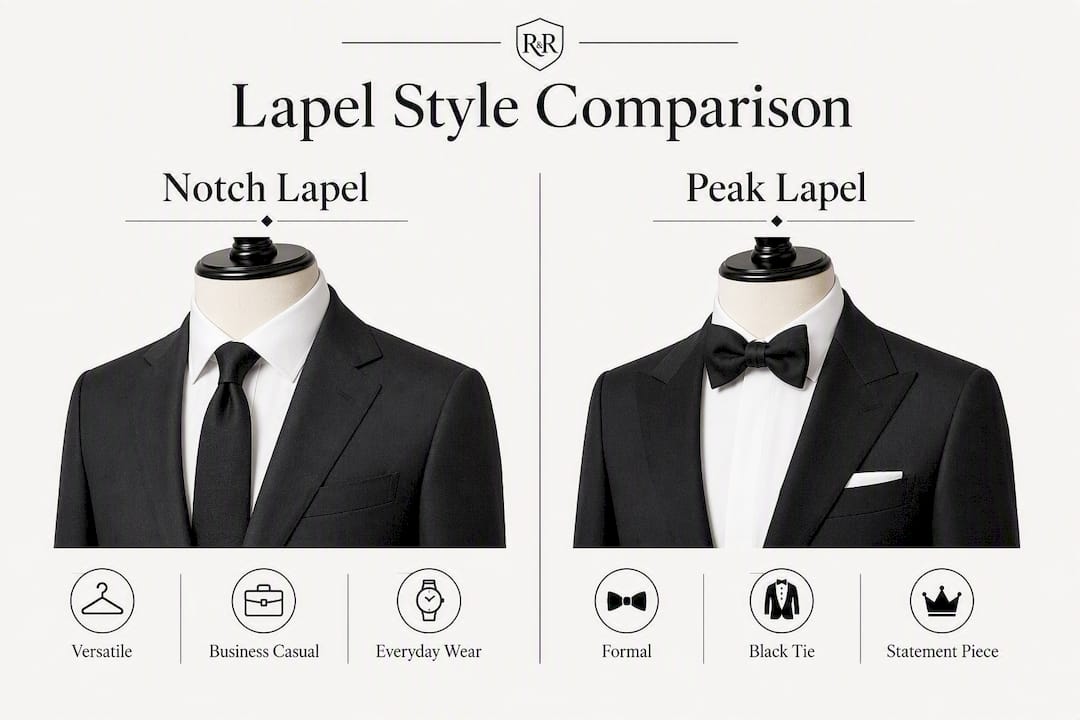
The notch lapel takes its name from the V-shaped triangular cut where the collar meets the lapel, typically set at a 60–90 degree angle. It is the most common and versatile lapel style, the default on virtually every single-breasted suit sold in America. There is a reason for that dominance: it works.
Visually, the notch lapel is understated. It does not demand attention, which makes it appropriate across a wide range of settings. The shape tends to slim the chest slightly and keeps the overall silhouette clean. Width typically runs around 3 to 3.5 inches on most notch lapels, though slimmer cuts can go narrower.
Where notch lapels belong:
- Business suits for the office, client meetings, and interviews
- Everyday tailored separates and blazers
- Less formal weddings and daytime events
- Smart casual looks where a tie is optional
Styling the notch lapel well:
- Match your tie width to your lapel width. A 3-inch lapel pairs with a tie of roughly the same width.
- A pocket square in a simple fold (flat or TV fold) keeps the look refined without competing.
- Button stance matters: a higher button stance shortens the lapel visually and suits shorter men.
Pro Tip: Avoid going too narrow on the lapel if you have a broad chest or wide shoulders. A lapel under 2.5 inches on a larger frame creates an imbalance that no amount of tailoring elsewhere can fully correct.
Common mistakes to avoid:
- Pairing a very slim lapel with a wide, Windsor-knotted tie. The proportions clash immediately.
- Choosing a notch lapel in a heavy, structured fabric (like a stiff wool flannel) without ensuring the lapel roll is soft enough to drape naturally.
- Wearing a notch lapel tuxedo when the dress code specifies black tie. Notch lapels appear on off-the-rack rental tuxedos but are considered less formal than peak or shawl options.
Peak lapel: the mark of a considered wardrobe
The peak lapel is defined by its upward-pointing tips, which extend toward the shoulders rather than folding downward at the gorge. That upward angle is what gives the peak lapel its sharper, more assertive character. Traditionally, it appeared almost exclusively on double-breasted jackets and formal eveningwear. That convention has relaxed considerably. Peak lapels on single-breasted suits are now a common, intentional choice for men who want added presence without going double-breasted.

The visual effect is distinct. Peak lapels elongate the torso and create the illusion of broader shoulders, which benefits shorter men and those with a fuller build. They draw the eye upward and outward, adding stature and structure to the silhouette.
Where peak lapels belong:
- Tuxedos and black-tie events, where they are the historically correct, more sophisticated choice
- Formal weddings, especially as the groom or a member of the wedding party
- Double-breasted suits, where the peak lapel is structurally standard
- Single-breasted suits worn as a deliberate style statement at work or social events
Styling the peak lapel well:
- A tie is almost always appropriate with a peak lapel. The formality of the shape calls for it.
- For tuxedos, fit, fabric finish, and lapel width drive the overall formality. Satin or grosgrain facing on the lapel is the correct finish for black tie; the same fabric as the suit body works for business peak lapels.
- Peak lapels project a sharper, more structured look and pair well with wool or velvet in formal contexts.
Pro Tip: If you are wearing a peak lapel suit without a tie, choose a fabric and construction that reads as intentionally casual — a linen or cotton blend, for instance. A peak lapel in heavy worsted wool without a tie creates a visual tension that rarely resolves well.
Common mistakes to avoid:
- Choosing an overly wide peak lapel on a slim frame. The tips extending past the shoulder seam look unbalanced.
- Wearing a peak lapel tuxedo with a cheap satin facing. The finish photographs poorly and undermines the formality the shape is meant to convey.
Notch vs peak lapel: a side-by-side comparison
| Factor | Notch Lapel | Peak Lapel |
|---|---|---|
| Formality | Casual to business formal | Business formal to black tie |
| Typical jacket type | Single-breasted suits, blazers | Double-breasted suits, tuxedos, single-breasted formal suits |
| Visual effect on body | Understated, slightly slims the chest | Elongates torso, broadens shoulders visually |
| Best body types | Most body types; especially versatile for average builds | Shorter frames, fuller builds; adds height and structure |
| Versatility | High — works across nearly all settings | Moderate — occasion-specific or intentional style choice |
| Lapel width guidance | 3–3.5 in typical; narrower for slim frames | Match to jacket scale; avoid oversized tips on slim frames |
| Styling notes | Tie optional; flat or TV pocket square; tie width matches lapel | Tie strongly recommended; satin/grosgrain for tuxedo; coordinated pocket square |
Most men building a suit wardrobe should default to the notch lapel first. Add a peak lapel piece when a specific occasion demands it or when you are ready to make a deliberate style statement.
How to choose the right lapel for your next suit
Run through these questions before you commit to a lapel style at a tailor or in a store.
- What is the primary use? Office and everyday wear points to notch. Formal events, tuxedos, and weddings point to peak.
- How often will you wear it? A suit worn three times a week needs the versatility of a notch lapel. A suit reserved for occasions can carry a peak lapel with confidence.
- What is your body type and height? Shorter or fuller frames benefit from the elongating effect of a peak lapel. Average and taller builds have more flexibility.
- Is it single-breasted or double-breasted? Double-breasted jackets conventionally take a peak lapel. Single-breasted suits can take either.
- Check the lapel point position. The outer point of the lapel should not extend past the midpoint of your collarbone when viewed from the side. If it does, the lapel is too wide for your frame.
- Match tie width to lapel width. A 3-inch lapel pairs with a tie of roughly the same width. Mismatched proportions are the most common styling error in tailored menswear.
- Consider the fabric and finish. A notch lapel in a soft wool flannel drapes beautifully for everyday wear. A peak lapel in satin-faced wool is the correct choice for a tuxedo.
Pro Tip: When visiting a tailor, bring the tie you plan to wear most often with the suit. Holding it against the lapel in the mirror immediately reveals whether the proportions work — no guesswork required.
Can a tailor convert a peak lapel to a notch, or vice versa?
The honest answer is: sometimes, but rarely without significant work. Altering lapel shape depends on available fabric and seam allowances; when those are insufficient, the job becomes a partial rebuild of the jacket’s front panels.
What limits a lapel conversion:
- Seam allowances: If the original construction left little spare fabric at the lapel edges, there is nothing to work with.
- Facing construction: The interior facing is cut specifically for the original lapel shape. A different shape often requires a new facing, which means sourcing matching fabric.
- Lapel roll: The roll is set during construction. Changing the lapel shape can disrupt it, requiring the tailor to re-press and re-shape the entire front.
- Fabric match: On an older suit, finding matching fabric for a rebuilt facing is rarely straightforward.
When conversion is practical: if the jacket has generous seam allowances, a relatively simple lapel shape, and the tailor has access to matching fabric, a conversion from peak to notch (or the reverse) is achievable. Expect it to take time and to cost meaningfully more than a standard alteration.
When replacement is the better call: if the jacket is a rental, a heavily structured garment, or a suit where the facing fabric is distinctive, buying or commissioning a new jacket is almost always the more sensible path.
Pro Tip: Before authorizing any lapel alteration, ask your tailor to check the seam allowances and show you the facing fabric. If either is marginal, the cost of conversion will likely exceed the value of the garment.
Bespoke tailoring sidesteps these constraints entirely. When a jacket is built from scratch, the lapel shape, width, and facing are chosen at the outset, and there is no conversion to manage. That is one of the clearest practical advantages of commissioning a bespoke suit over altering an existing one.
Where to start building a lapel-first wardrobe
The practical recommendation is straightforward: start with a notch lapel suit in a versatile fabric, then add a peak lapel piece when a formal occasion or a deliberate style upgrade calls for it.
- Buy first: A single-breasted notch lapel suit in mid-weight wool. It covers business, interviews, less formal weddings, and most social events. Notch lapels are the safest first purchase for men building a suit wardrobe.
- Add next: A peak lapel tuxedo or formal suit when a wedding, gala, or black-tie event is on the calendar. This is where the peak lapel earns its place without compromise.
- Always: Match lapel width to your frame and your tie width to your lapel. Those two rules, applied consistently, keep every suit looking considered rather than accidental.
If you are unsure which lapel suits your frame and lifestyle, trying on both styles at a tailor’s fitting is the most reliable way to decide. The mirror tells you more than any guide can.
Key Takeaways
The notch lapel is the right default for most men; the peak lapel earns its place at formal events and as a deliberate style statement.
| Point | Details |
|---|---|
| Default to notch | Notch lapels suit business, everyday wear, and most social settings with minimal styling effort. |
| Choose peak for formal occasions | Peak lapels are the correct choice for tuxedos, black-tie events, and formal weddings. |
| Width governs proportion | A lapel width that flatters most frames should always be matched by the tie width to the lapel width. |
| Alteration has real limits | Converting lapel shape requires adequate seam allowances and matching fabric; a rebuild is often more practical. |
| Ronandrich bespoke | Ronandrich builds the lapel shape and width into each commission from the start, removing the need for costly conversions. |
The lapel choice most men get wrong
There is a tendency, especially among men new to tailored clothing, to treat the notch lapel as the “safe” choice and the peak lapel as the “bold” one. That framing misses the point. The notch lapel is not safe because it is conservative; it is the right choice for everyday wear because it is genuinely versatile. The peak lapel is not bold because it is unusual; it is the right choice for formal occasions because it carries the visual weight those occasions demand.
Where men go wrong is in applying the wrong lapel to the wrong context — wearing a notch lapel tuxedo to a black-tie event because it was cheaper to rent, or wearing a peak lapel on a heavy worsted suit to a casual Friday office. The lapel is a signal, and the signal should match the setting.
The other mistake is ignoring proportion entirely. A lapel that is too narrow for a broad frame or too wide for a slim one undermines the rest of the suit, regardless of how well it fits elsewhere. Width is not a detail. It is the foundation of how the jacket reads.
At Ronandrich, the lapel conversation happens at the very first consultation, before fabric or lining or button choice. That order of priority reflects something Richard Fan understood when he founded the house in 1979: the shape of the jacket’s front is what the wearer sees every time they look in the mirror, and it is what everyone else sees first.
Ronandrich bespoke: your lapel, built right from the start
When you commission a suit through Ronandrich, the lapel is not an afterthought. It is the first design decision, made in consultation with your tailor based on your frame, your lifestyle, and the occasions you are dressing for.

Ronandrich has offered bespoke menswear since 1979, with every garment built to the client’s exact measurements and preferences. Whether you want a classic notch lapel suit for the office or a peak lapel tuxedo for a formal event, the construction begins with the right choice for you, not the easiest one to produce.
What Ronandrich bespoke gives you:
- A lapel shape, width, and roll chosen for your specific frame and primary use
- Fabric and facing selected to match the formality of the occasion
- No alteration limits, because the jacket is built to your specification from the first pattern
For those who prefer a shorter lead time, Ronandrich’s ready-to-wear collection offers refined notch and peak lapel options in quality fabrics. Either way, the starting point is the same: a clear conversation about what you need the suit to do.
Book a consultation with Ronandrich to discuss your lapel choice and begin the process of a suit built precisely for you.