Notch, Peak, or Shawl: How to Choose Your Lapel Style
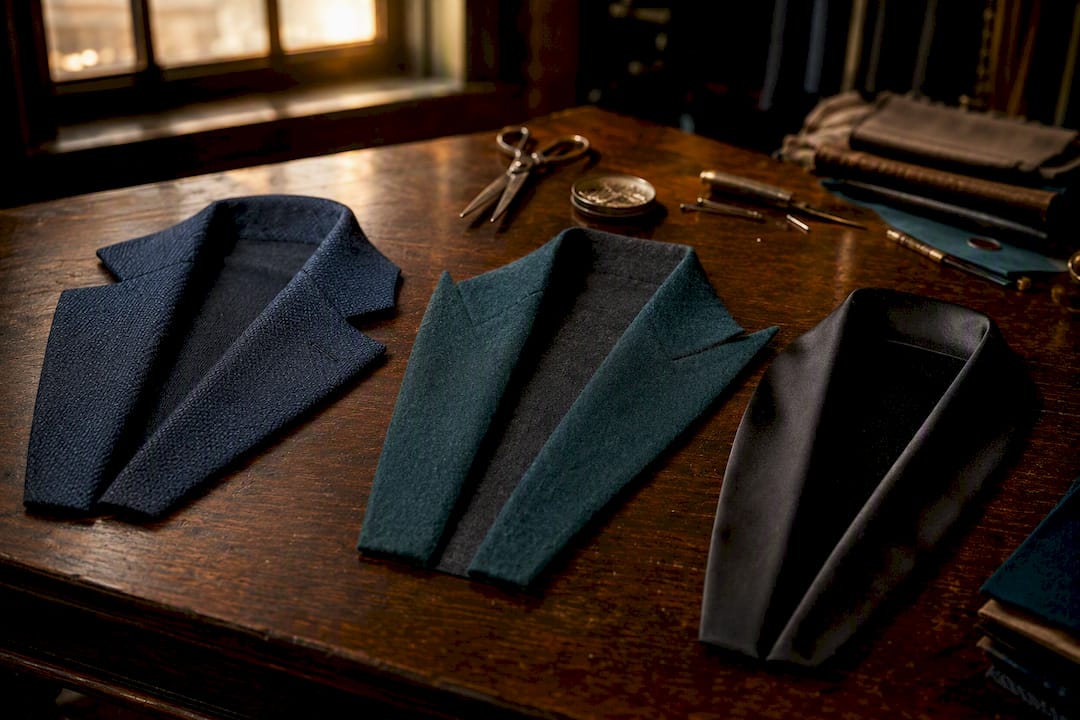
There are three lapel styles worth knowing: notch, peak, and shawl. Notch lapels belong on single-breasted business suits and blazers. Peak lapels suit double-breasted jackets and formal single-breasted suits where you want a sharper shoulder line. Shawl lapels belong almost exclusively to tuxedos and dinner jackets, per Wikipedia’s overview of the lapel. At Ron & Rich, we confirm this hierarchy in nearly every fitting.
Each style carries its own visual grammar, and getting it wrong reads as a mismatch even to people who couldn’t name the parts of a jacket. A notch lapel on a black-tie tuxedo looks like you borrowed the wrong jacket. A shawl lapel on a Monday-morning suit looks like you’re headed to a party nobody invited you to.
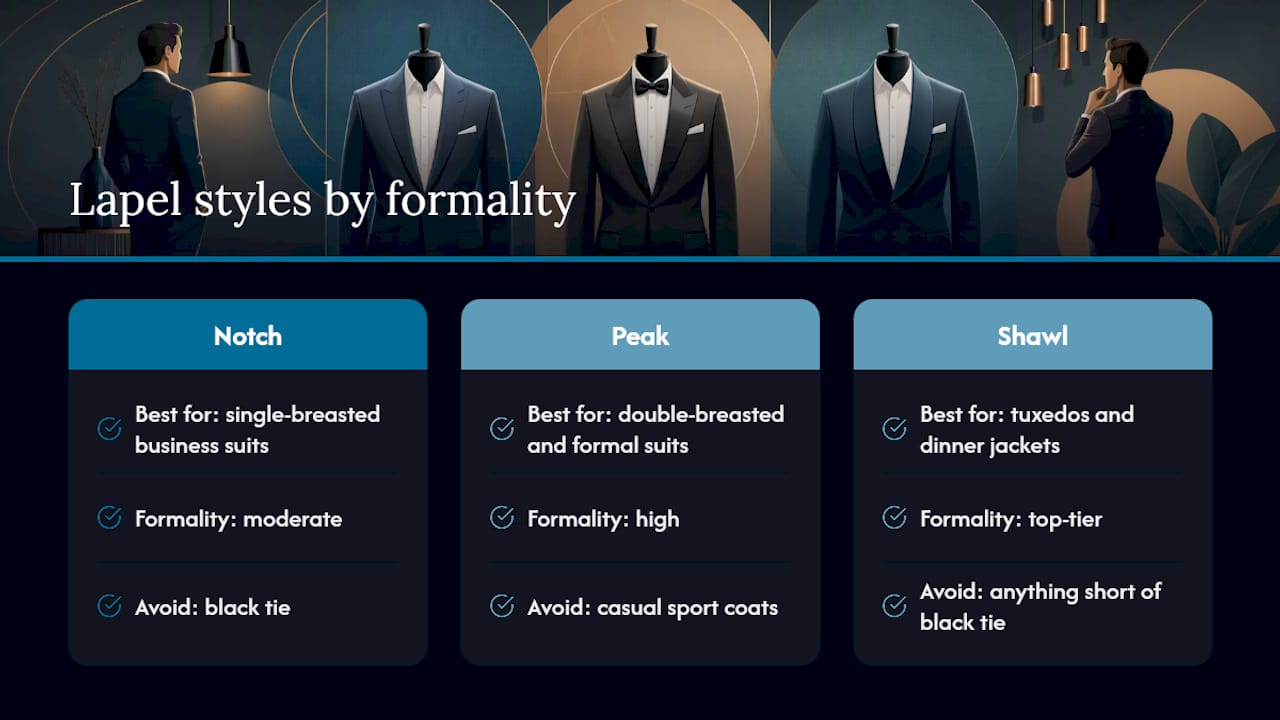
Notch: best for business and daily wear, moderate formality, avoid for black tie. Peak: best for double-breasted jackets and formal events, high formality, avoid on casual sport coats where it can look overdressed. Shawl: best for tuxedos and dinner jackets, top-tier formality, avoid for anything short of black tie.
Key Takeaways
Lapel choice works best when style, formality, and body proportion are decided together rather than one at a time.
| Point | Details |
|---|---|
| Three canonical lapel styles | Notch fits business wear, peak fits double-breasted and formal jackets, shawl belongs to black tie. |
| Width is proportional, not fixed | Match lapel width to shoulder scale, tie width, and shirt collar size, not to a single ideal number. |
| Peak lapels demand more skill | A well-cut peak lapel on a single-breasted jacket signals a higher level of tailoring craft. |
| Fabric changes formality | Satin facing signals black tie, wool facing suits business wear, and pick-stitching should match the occasion. |
| Bespoke fittings fine-tune the fit | Ron & Rich adjusts gorge height and lapel width incrementally across fittings so the final proportions suit your frame. |
Table of Contents
- What Are the Different Lapel Styles?
- A Closer Look at Notch, Peak, and Shawl Lapels
- Choosing the Right Lapel Width for Your Frame
- How Do You Pick a Lapel Style Before Buying?
- Fabric and Construction Change How a Lapel Reads
- Notes from the Fitting Room
- Lapel Mistakes That Are Easy to Fix
- An Editorial Take on Choosing Lapels
- Get Your Lapel Right the First Time
- Frequently Asked Questions
- Sources
What Are the Different Lapel Styles?
“Lapel styles” is the everyday phrase, but tailors talk about “suit lapel types” or “lapel construction,” and you’ll hear both used interchangeably in a fitting room. All three phrases point to the same thing: the folded, turned-back section of fabric that extends from the jacket’s collar down toward the first button.
The lapel isn’t decorative filler. It’s structural. It shapes how the collar sits, how the jacket opens across the chest, and how the eye reads your shoulders and torso, according to GQ’s tailoring guide. Understanding the vocabulary below will help you speak clearly with a tailor instead of pointing vaguely at a lapel and saying “make it more like that.”
- Gorge: the seam where the collar meets the lapel, and where its height sits changes how tall or wide the chest appears.
- Roll line: the soft break where the lapel folds away from the body instead of lying flat.
- Lapel face: the visible outer surface of the lapel, sometimes finished in a contrasting fabric.
- Facing: the material applied to the lapel face, such as satin on a tuxedo.
- Pick stitching: small, visible hand or machine stitches along the lapel edge that reinforce the roll and add texture.
- Canvas: the internal structure beneath the cloth that gives the lapel its shape and spring.
- Buttonhole: the functional or decorative slit on the lapel, sometimes designed to actually button closed.
A labeled photo of a jacket front, with arrows marking the gorge and roll line, does more to teach this than paragraphs of description ever will. If you’re studying a jacket in a mirror or a catalog image, start there.
A Closer Look at Notch, Peak, and Shawl Lapels
Notch lapels: the everyday standard
The notch lapel is defined by the small V-shaped notch where the collar meets the lapel edge, a clean gap rather than a continuous line. It’s the default on single-breasted suits and sport coats, and for good reason: it’s versatile, unassuming, and reads as competent without trying to make a statement.
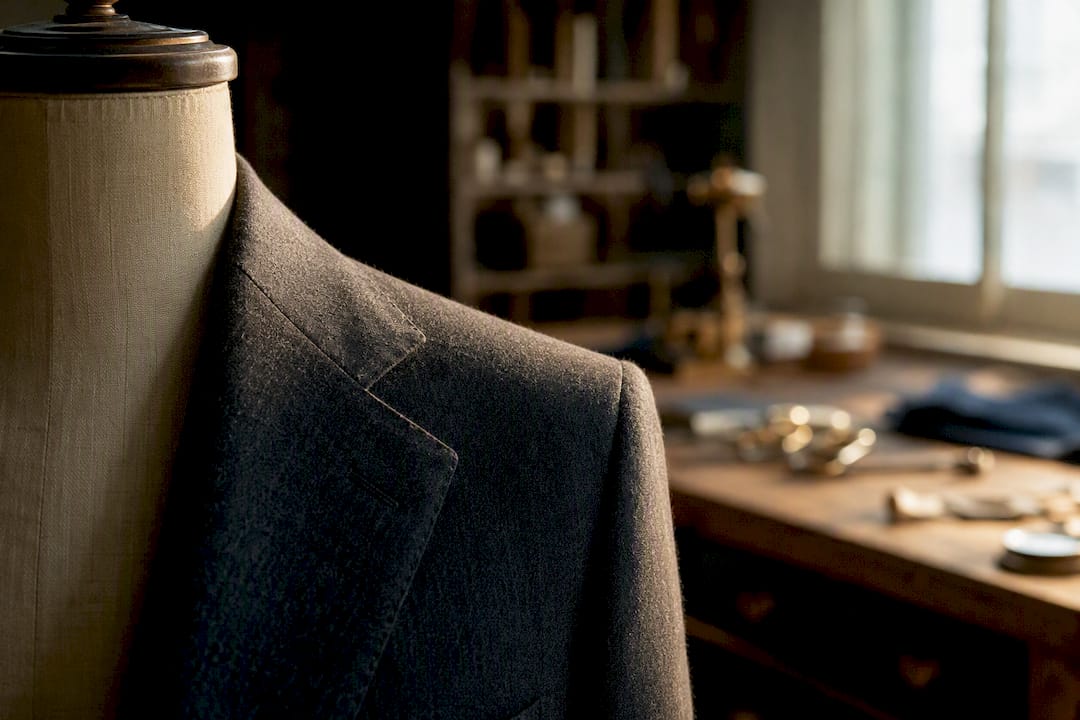
Notched lapels average around 3 to 3.5 inches in many ready-to-wear examples, according to Paul Smith’s guide to lapels, though the exact width shifts with era and cut. A slimmer notch, closer to 2.5 inches, feels contemporary and works well on a leaner frame. A fuller notch closer to 3.5 inches adds visual weight to the chest, which flatters a slighter build but can overwhelm someone already broad-shouldered.
Three tips for wearing one well: pair it with a tie of roughly matching width so the proportions don’t fight each other, keep the gorge moderate rather than dramatically high or low, and reserve the notch for business and social settings rather than formal evening events, where it will look underdressed next to peak or shawl lapels.
Peak lapels: sharper, more assertive, harder to cut
A peak lapel points upward toward the shoulder, its top edge rising above the collar seam rather than sitting flush with it. That upward line visually widens the shoulders and adds a sense of command, which is exactly why peak lapels are the traditional choice for double-breasted jackets. They’re also common on formal single-breasted dinner jackets and morning coats.
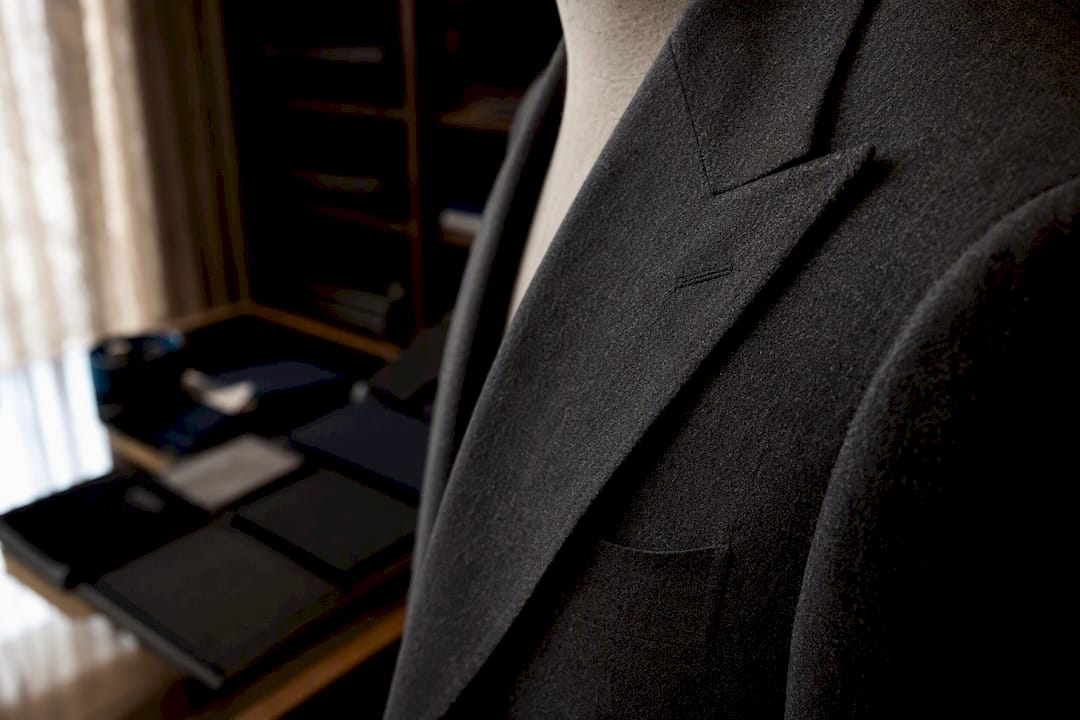
Here’s the detail most guides skip: a peak lapel is genuinely harder to cut well on a single-breasted jacket than a notch is. Getting the peak’s angle, symmetry, and roll to sit correctly against a single-breasted front takes more pattern skill and handwork, which is one reason Wikipedia notes that a well-executed peak often signals a higher level of tailoring craft. A cheap peak lapel tends to look flat or slightly off-kilter; a well-made one has real dimension.
Peak lapels typically run a touch wider than notch lapels, often extending closer to shoulder width for maximum visual impact. Pair a peak lapel with a slightly wider tie, avoid it on relaxed sport coats where the formality clashes with a casual fabric, and consider it seriously if you’re building a double-breasted suit where the peak is practically part of the silhouette’s identity.
Shawl lapels: eveningwear’s smoothest line
The shawl lapel curves continuously from the collar down to the button, with no notch or peak breaking the line. It’s the smoothest, most rounded of the three, and it’s reserved almost exclusively for eveningwear, according to Wikipedia. You’ll see it on tuxedos and dinner jackets, almost always faced in silk satin or grosgrain.
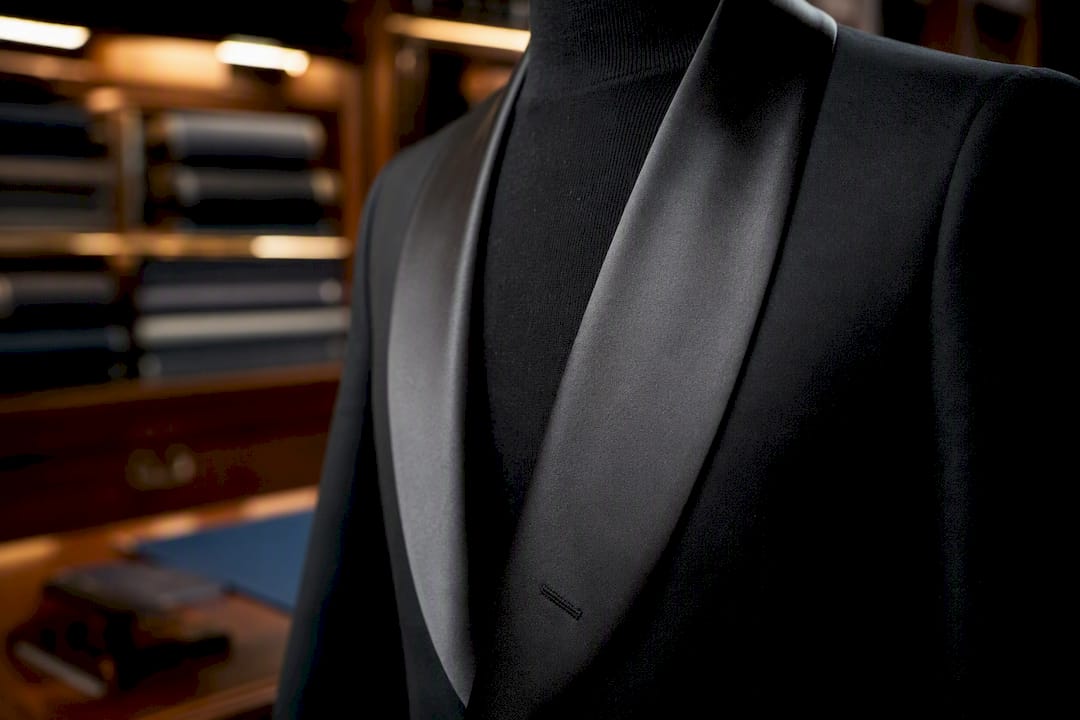
That satin facing isn’t just decorative; it’s a formality marker. A shawl lapel on a tuxedo tells the room, before anyone reads your face, that you understand black-tie convention. Width matters less here than on notch or peak styles because the curve itself is the visual statement. A narrower shawl looks more contemporary and slightly less formal; a fuller shawl leans traditional and old-Hollywood.
Style tips: never pair a shawl lapel with a busy pattern beneath it, since the smooth curve is meant to be the focal point. Skip a shawl lapel entirely outside black-tie or formal evening contexts; it will look costume-like on a business suit. And if you’re building out formal accessories to match, a piece like a statement cufflink or stud set rounds out the look without competing with the lapel.
Choosing the Right Lapel Width for Your Frame
Lapel width isn’t an isolated decision. It’s one part of a proportional system that includes your shoulder width, the gorge height, and your tie width, and changing one without the others throws the whole jacket off balance, per GQ. A wide lapel on narrow shoulders looks borrowed. A narrow lapel on a broad frame disappears.
As a starting reference, a slim single-breasted jacket typically works well with a narrower lapel size. A classic business suit usually sits in a moderate lapel width range. Wider, more period-inflected styling reads as a deliberate style statement rather than a default.
Three proportion rules worth memorizing: match your tie’s width roughly to your lapel’s width so neither looks out of scale, keep your shirt collar size in balance with lapel width rather than treating them as separate decisions, and lean wider on double-breasted jackets since the extra fabric across the chest calls for a bolder lapel to match.
Pro Tip: Lay your favorite tie flat against a jacket lapel before a fitting. If the tie looks noticeably narrower or wider than the lapel face, that’s the mismatch a tailor should fix first.
Lapel width also runs in cycles. Wider lapels tend to signal a more traditional, assertive style, while slimmer ones read as modern and understated, but the smarter approach is choosing proportion for your frame rather than chasing whatever width is trending that season, a point GQ makes clearly.
How Do You Pick a Lapel Style Before Buying?
Run through these checks before you commit to a jacket or sit down with a tailor.
- What’s the occasion? Business and daily wear point to notch. Weddings and formal events point to peak. Black tie points to shawl.
- Single-breasted or double-breasted? Double-breasted jackets almost always call for peak lapels; single-breasted jackets work with notch or, for more formal pieces, peak.
- What impression do you want? A notch lapel is quietly competent. A peak lapel projects authority. A shawl lapel signals formal-event fluency.
- What’s your frame? Broader shoulders can carry a slightly narrower lapel without losing presence; narrower frames often benefit from a touch more width to build visual structure.
- Is the jacket for one event or years of wear? If it’s a long-term wardrobe piece, favor classic notch proportions over a trend-driven width.
When you’re actually in a consultation, a few precise questions get you further than vague preferences. Ask about gorge height, since that single seam placement changes how the whole chest reads. Ask what facing material they’d recommend for the formality level you need. Ask whether pick-stitching fits the garment’s intended formality or would undercut it. And ask about button stance, since where the front button sits interacts directly with how the lapel rolls.
Fabric and Construction Change How a Lapel Reads
The same lapel shape can look completely different depending on what covers it and how it’s built. Silk satin facing on a shawl lapel is the tuxedo standard; grosgrain offers a slightly more matte, textured alternative for the same formal context. Wool-faced lapels, matching the jacket’s own cloth, are the default for suits and keep the formality moderate.
Construction matters just as much as fabric choice. A full-canvas jacket lets the lapel roll naturally and hold its shape for years, while a fused jacket tends to look flatter and can bubble over time. Pick-stitching, when done by hand, adds a visible texture along the lapel edge that signals real workmanship, though it’s worth applying selectively: heavy pick-stitching on an ultra-formal tuxedo can make the garment read less dressy than the occasion calls for.
As a practical checklist: match satin or grosgrain facing to black-tie events, keep wool facing for business and social suits, request hand-finishing when you want that artisanal edge, and accept machine finishing on more casual pieces where the difference is invisible from arm’s length.
Notes from the Fitting Room
Clients often ask us to make a jacket’s lapel “a little sharper” without knowing exactly what that means structurally. Usually the fix is raising the gorge slightly, which pulls the eye upward and adds definition to the shoulder line. When someone asks for a bolder look, we’ll often move to a peak lapel rather than simply widening a notch, since the shape change does more visual work than width alone.
In a bespoke fitting, we prototype the gorge position and lapel roll during basted fittings, then adjust width in small increments so the final line reads balanced on that specific client, not just on the pattern. A hand-rolled lapel with proper canvas holds its shape season after season, which is part of why bespoke construction outlasts fused alternatives.
Lapel Mistakes That Are Easy to Fix
- Mismatched lapel and tie width: a slim tie against a wide lapel (or the reverse) throws off the whole proportion.
- Wrong lapel for the occasion: a shawl lapel outside black tie, or a notch lapel at a black-tie event, both look like a wardrobe miscalculation.
- Chasing trend widths: buying the season’s widest or narrowest lapel without checking it against your own frame.
- Pick-stitching on ultra-formal tuxedos: a textured hand-stitched edge can undercut the smooth formality a tuxedo is supposed to project.
Three quick fixes: ask your tailor directly about gorge height before any width changes, carry a reference tie in your bag so you can compare widths on the spot, and swap the facing material rather than the lapel shape when you need to shift formality up or down. If a lapel already feels wrong on a jacket you own, a skilled tailor can often narrow it through re-stitching, though a jacket cut with an overly wide lapel usually can’t be widened back.
An Editorial Take on Choosing Lapels
Choosing a lapel starts with listening, not measuring. A client’s brief, their build, and the formality of the event they’re dressing for all matter more than any fixed rule about ideal width. I’ve seen clients arrive convinced they need a peak lapel because it looks commanding in photos, only to realize during a fitting that a well-proportioned notch suits their frame and their calendar of business meetings far better.
One fitting stands out: a client wanted a double-breasted jacket with a dramatically wide peak lapel for his wedding. Once we mocked it up on his frame, the width overwhelmed his shoulders instead of sharpening them. We brought the lapel in by a modest margin and raised the gorge slightly, and the jacket went from looking borrowed to looking built for him. The takeaway for anyone reading this before their own fitting: the right lapel isn’t the boldest one, it’s the one that fits your particular shoulders, your event, and the life the jacket will actually lead after that first wear.
Get Your Lapel Right the First Time
A tailoring consultation takes the guesswork out of every decision covered here. At Ron & Rich, a first meeting typically walks through gorge height, lapel width against your shoulders, facing material for your event, and a tie pairing test right there in the fitting room, so you see the proportions before a single stitch goes in.

That’s the real advantage over guessing from a rack: a jacket built off-the-shelf is cut for an average frame, while a bespoke suit is cut for yours, lapel width and all. If you’re weighing a notch lapel for a new business suit or a peak for a double-breasted piece, bring the details from this guide to your first sitting. Browse our suits and jackets to see finished examples of each style, or book a consultation directly to start the fitting process.
Frequently Asked Questions
What’s the difference between a notch lapel and a peak lapel? A notch lapel has a visible V-shaped gap where the collar meets the lapel. A peak lapel has no gap; instead, the lapel’s top edge points upward toward the shoulder, which adds visual width and formality.
Can you wear a shawl lapel on a regular business suit? It’s best to avoid it. Shawl lapels are built for eveningwear, and their satin facing looks out of place in a daytime business context.
How wide should my lapel be? It depends on your frame and jacket type, but a classic business suit generally works well with a lapel between 2.75 and 3.5 inches, adjusted to match your tie and shoulder width.
Is pick-stitching worth requesting on a suit? Hand pick-stitching adds a textured, artisanal look and generally signals better workmanship, but it’s worth skipping on ultra-formal black-tie garments, where a smoother finish reads more appropriately dressy.
Why do double-breasted jackets almost always have peak lapels? The peak lapel’s upward line balances the additional fabric across a double-breasted front and reinforces the broader, more formal silhouette the style is known for.
Sources
- Lapel
- How to Choose the Right Suit Lapels, According to Tailoring Experts | GQ
- Pick Stitching on Suits: Is it Worth It for Your Wardrobe?
- How To Speak Suit: A Guide To Lapels