How to Choose the Right Tailor-Made Business Suits in Singapore?
Just walk into any random conference hall at a business meeting, and you will take just a few seconds to confirm whether someone is wearing a ready-made jacket or not. It’s not about the price, but about the accurate fit, drape, and how it moves when you sit, stand, or shake hands with someone. So, if you’re also investing in tailor-made business suits in Singapore, making the correct choice will save you money, fitting-room frustration and give you a wardrobe of “almost right” suits.
This detailed blog will guide you through what to look for, from fabric to fitting, to find the best and most reliable tailor in Singapore
Why Tailor-Made Beats Off-the-Rack for Business Wear?
Off-the-Rack or ready-made suits are built according to an average body type or shape, which statistically not every person has. A made-to-measure or bespoke suit is built around your shoulders, posture, and proportions instead of the other way around.
For business wear specifically, this matters in the long run because you aren’t just standing or sitting in it; you are presenting, commuting, sitting in meetings for hours, and moving between air-conditioned offices and Singapore’s outdoor heat. A well-made or prepared business suit is cut in a manner that allows the passage of air without creating bunching at the back, gaping at the collar, or pulling across the chest when you sit down.
Off-the-Rack vs Made-to-Measure vs Bespoke: What’s the Difference
These three terms are used together many a time, but they don’t mean the same thing, and the actual difference affects both the price and fit quality:
|
Suit Type |
How it’s made |
Fit Quality |
Typical Price Range (SGD) |
Best For |
|
Off-the-Rack |
Pre-made in standard sizes, altered slightly |
Generic fit, limited adjustment |
$300 – $800 |
Budget-conscious buyers, quick needs |
|
Made-to-Measure |
Standard pattern adjusted to your measurements |
Good, personalised fit |
$800 – $2,000 |
Most business professionals |
|
Pattern drafted from scratch and multiple fittings |
Exceptional, fully individual fit |
$2,000 & above |
Those wanting the highest level of craftsmanship |
For most working professionals in Singapore, the made-to-measure option is a good choice between cost and fit, though many of them go on to invest in a bespoke piece for their most important suit.
Key Factors to Consider When Choosing a Tailor-Made Suit
Some of the important factors that one should consider when choosing a tailor-made suit are as follows:
1) Fabric Suited to Singapore’s Climate
Singapore’s heat and humidity aren’t a small or minor detail; they actually shape the fabric choice. Official climate data shows that the country has high humidity and consistently warm temperatures year-round, with just a little seasonal relief, as claimed by the Meteorological Service Singapore. That rules out heavy, insulating fabrics that work extremely well in temperate countries.
Here wool remains the standard for business suiting even in the tropics, but the weight and weave matter more than the fibre itself. Wool is naturally breathable, which means it can move significantly more moisture away from the skin compared to synthetic fabrics, which is exactly what you need in a humid climate, as stated by the Woolmark Company. Look for lightweight, open-weave wools (around 220-260 gsm) or wool blends with a bit of mohair for structure without extra heat.
2) Understanding “Super” Numbers on the Fabric Label
You will most often see fabrics that are labelled as Super 100s, Super 130s, or even higher. This number refers to the fineness of the wool fibre, standardised by the International Wool Textile Organisation, where a higher number means a finer, softer fabric, as claimed by Wikipedia. It’s important to note that Finer isn’t always better for Singapore, though very high Super numbers (180s and above) feel luxurious but wear out faster and crease more easily in daily humid-climate use.
For a business suit that is worn several times a week, Super 100s and 130s usually offer the best kind of balance between comfort and durability.
3) Fit & Silhouette
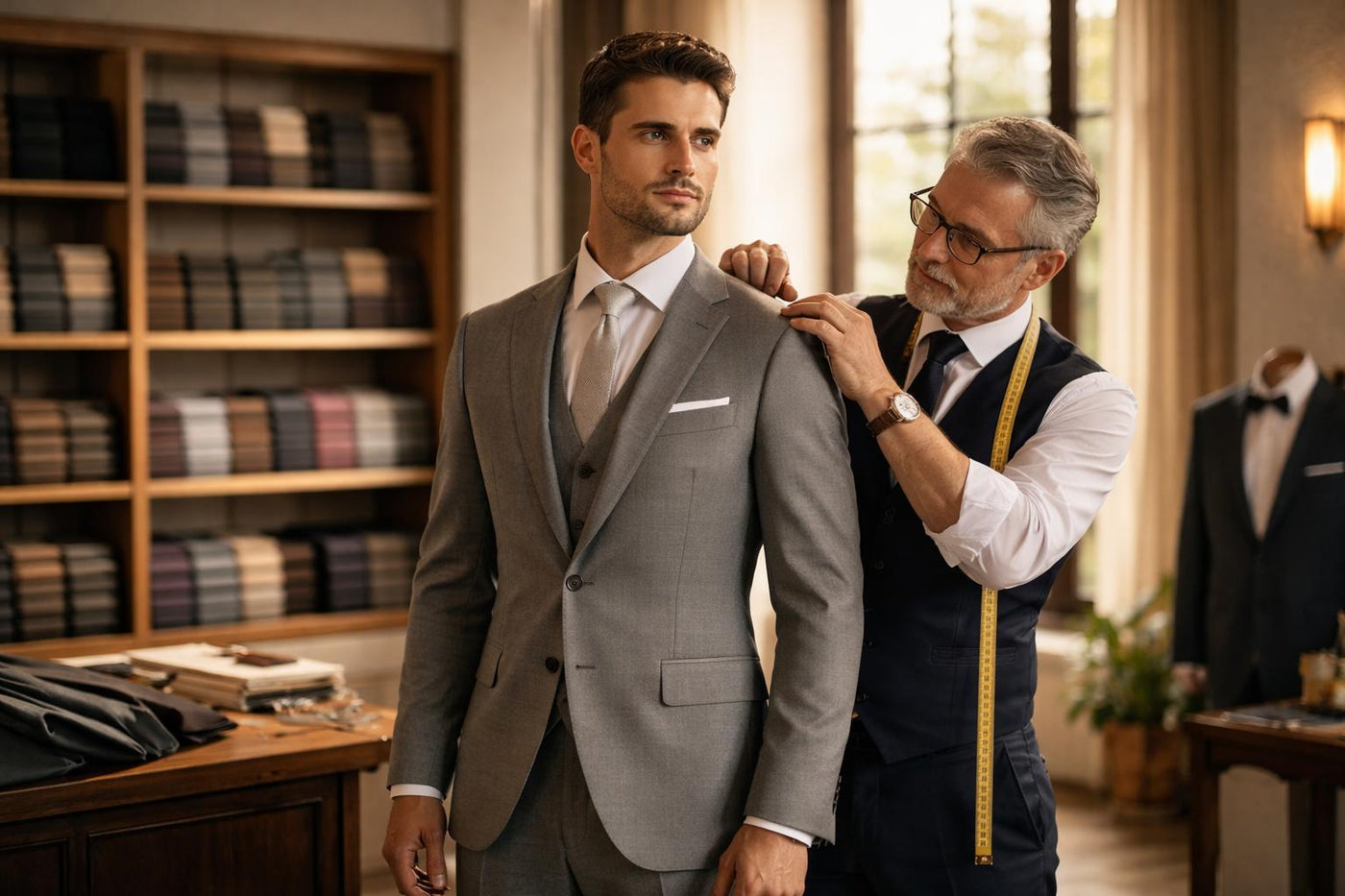
A good tailor will always make sure to discuss your preferred silhouette, such as structured or traditional, softer or more contemporary, before cutting anything. Some of the important fit points to check during your first fitting are as follows:
- Shoulders sit flat with no divots or bulging
- Jacket closes without pulling across the chest or back
- Trouser break suits your preferred style (full, half, or no break)
- Sleeve length shows a small amount of shirt cuff
4) The Tailor’s Experience or Reputation
Ask about how long the business has operated, who’s actually cutting and hand-finishing your suit, and whether you can see their previous work or samples. Tailoring houses that have decades of continuous operation, rather than a shop opened just last year, tend to have a proper and refined pattern drafting and fitting process.
5) Turnaround Time & Number of Fittings
A rushed suit is rarely the one with a perfect fit. The made-to-measure ones mainly require one to two fittings; bespoke requires 3 or more, with hand-finishing done for each. If a tailor promises a full bespoke suit in a single fitting, that’s a red flag and an unworthy shortcut option.
Common Mistakes to Avoid
Some common mistakes that you should avoid in this process are as follows:
- Choosing Fabric Weight Based on Looks Alone: A beautiful, heavy flannel photographs well but will be an uncomfortable option for daily wear in Singapore.
- Skipping the Second Fitting: Most fit problems only become obvious when the canvas and lining are in.
- Prioritising Price Over Pattern Accuracy: A cheap made-to-measure service that skips proper measurements is really just off-the-rack with a longer wait time
- Ignoring Trouser Fit: Buyers often focus entirely on the jacket and treat trousers as something not very important.
Conclusion
Choosing the right, tailor-made business suit depends on several factors, but mainly on the choice of fabric. While doing so, you should be completely aware of what you’re paying for and work with a tailor who takes fitting seriously rather than rushing it.
Ron & Rich has been crafting bespoke and made-to-measure suits in Singapore since 1979, combining traditional tailoring techniques with a fit built for how you actually work and move. Book a fitting appointment to see the process first and explore our premium collection to find the most suitable choice for you.
Frequently Asked Questions
Q1: How much does a tailor-made suit cost in Singapore?
Made-to-measure suits generally range from SGD 800 to SGD 2,000 depending on fabric and finishing, while bespoke suits with hand-cut patterns typically start above SGD 2,000.
Q2: How long does it take to get a tailor-made suit made in Singapore?
Made-to-measure suits usually take two to four weeks. Bespoke suits, with multiple fittings and hand-finishing, can take four to eight weeks.
Q3: What's the real difference between made-to-measure and bespoke?
Made-to-measure adjusts an existing pattern to your measurements. Bespoke drafts an entirely new pattern from scratch and involves several in-person fittings to refine the fit as the suit is built.
Q4: How many suits does a working professional in Singapore actually need?
Two to three well-made suits in versatile colours (navy, charcoal, mid-grey) will cover most business needs better than five suits in trend colours you'll wear rarely.
Q5: What fabric works best for Singapore's climate?
Lightweight wool or wool-blend fabrics between roughly 220–260 gsm, in an open or tropical weave, offer the best balance of breathability and structure for year-round humidity.