How to Choose the Perfect Business Suit in Singapore?
A well-chosen business suit does more than just complete an outfit; it shapes your personality. The kind of impression you create on your clients, colleagues, and interview panels depends majorly on what you wear and how you carry yourself. But choosing a business suit in Singapore comes with its own set of considerations, such as a tropical climate, a business culture that ranges from boardroom-formal-to smart-casual, and a market completely flooded with both fast-fashion suiting and genuine bespoke craftsmanship.
This detailed guide will take you through the requirements of a business suit and how you can choose the best one for you, especially when you live in a humid country like Singapore.
Why your Business Suit Matters More than You Think?
In Singapore’s competitive corporate landscape, a suit represents a form of nonverbal communication. It shows attention to detail, respect for the occasion, and, when properly fitted, it shows genuine confidence. A cheap or ill-fitting suit undercuts all of that, no matter how sharp your presentation or resume is. People are able to spot a poorly fitted suit.
The challenge is that “good suit” doesn’t mean the exact same thing everywhere. A suit that is built for a London winter will leave you completely drenched and uncomfortable in Raffles Place by mid-morning. Choosing correctly for Singapore means understanding the climate, the fabric, the fit, and the finer construction details that separate an off-the-rack purchase from a place that actually earns its place in your wardrobe.
1) Start with Fabric Suited to Singapore’s Climate
Singapore’s heat and humidity aren’t a minor inconvenience; they’re a genuine engineering problem for suiting. According to Singapore’s National Environment Agency, the country’s relative humidity stays high year-round with little month-to-month variation, and daytime temperatures regularly climb to the low 30s degrees Celsius. A suit that isn’t built keeping this requirement in mind will feel heavy, trap moisture, and lose its shape fast.
A few fabric options that hold up well in this climate are:
Tropical Wool Blends: Lightweight, open-weave wool woven specifically for warm-weather wear, the industry standard for hot, humid climates.
Wool-linen or wool-silk-linen blends: Excellent breathability with a natural drape, though they wrinkle more easily than pure wool.
High-twist wool: Open-weave construction that allows air to circulate, keeping you cooler through longer meetings.
Contrary to common assumption, wool itself isn’t an enemy to hot weather. The Wool Mark Company, the global authority on wool fiber research, notes that wool is a naturally breathable material and actively responds to changes in body temperature, absorbing moisture vapor and releasing it gradually rather than trapping it against the skin the way synthetic fibers do. It’s the weave and weight that determine whether a wool suit performs in heat or not.
Where possible, avoid heavier worsted wools or high polyester blends. They trap heat and often look shinier and cheaper under office lighting.
2) Get the Fit Right: It Changes Everything
Fit is the single biggest factor separating an expensive-looking suit from a forgettable one, regardless of the price. A few fundamentals to check are:
Shoulders: The seam should sit exactly at the edge of your shoulder bone. This is difficult to alter after purchase, so get it right from the start
Jacket Length: Should cover your seat and end roughly where your thumb knuckle sits when your arms are relaxed.
Sleeve Length: A quarter to half an inch of shirt cuff should show beyond the jacket sleeve.
Trouser Break: A slight break at the shoe, or a clean no-break for a more modern look
Chest & Waist: You should be able to fasten the jacket button comfortably with a flat, non-strained drape, no pulling, no excess fabric bunching.
If you’re choosing between off-the-rack and made-to-measure or bespoke tailoring, keeping in mind that off-the-rack is built for an average body shape, while bespoke construction is built around your exact measurements and posture, a meaningful difference if you build doesn’t match the standard sizing.
3) Choose a Color That Works for Singapore’s Business Environment
Color affects both versatility and how appropriate the suit is for the different settings:
Navy: The most versatile choice, professional, flattering under most skin tones, and appropriate for nearly every business setting from client meetings to formal dinners.
Charcoal Grey: A close second in versatility, slightly more formal and ideal for interviews and presentations
Mid-Grey: Softer and more approachable, works well for everyday office wear
Black: Best reserved for formal events rather than daily business wear, as it can read as overly severe in most Singapore corporate settings.
For a first or primary suit, navy or charcoal is the safer, more strategic investment.
4) Understand the Cut & Silhouette
Singapore’s business culture has shifted towards slimmer, more contemporary silhouettes, but “slim” should never ever mean “tight”. A well-cut suit follows your body without restricting movement. Let’s understand this by the table below:
|
Cut Style |
Best For |
Notes |
|
Slim/Modern Fit |
Younger professionals, creative and tech industries |
Tapered waist, narrower lapels, shorter jacket length |
|
Classic/Regular Fit |
Traditional corporate, finance, and legal sectors |
Balanced proportions, moderate lapel width, comfortable movement |
|
Made-to-measure |
Non-standard body types, professionals wanting a personalized fit |
Adjusted to individual measurements while using a standard pattern base |
|
Bespoke |
Executives, special occasions, long-term wardrobes |
Fully custom pattern built from scratch, highest level of fit precision |
If you aren’t sure which dress code tier your workplace or event falls under, it's worth reading our blog on business attire standards across Singapore’s industries before you commit to any cut.
5) Pay Attention to Construction Details
The details you can’t always see at a glance are often what separates a quality suit from a mediocre one:
-
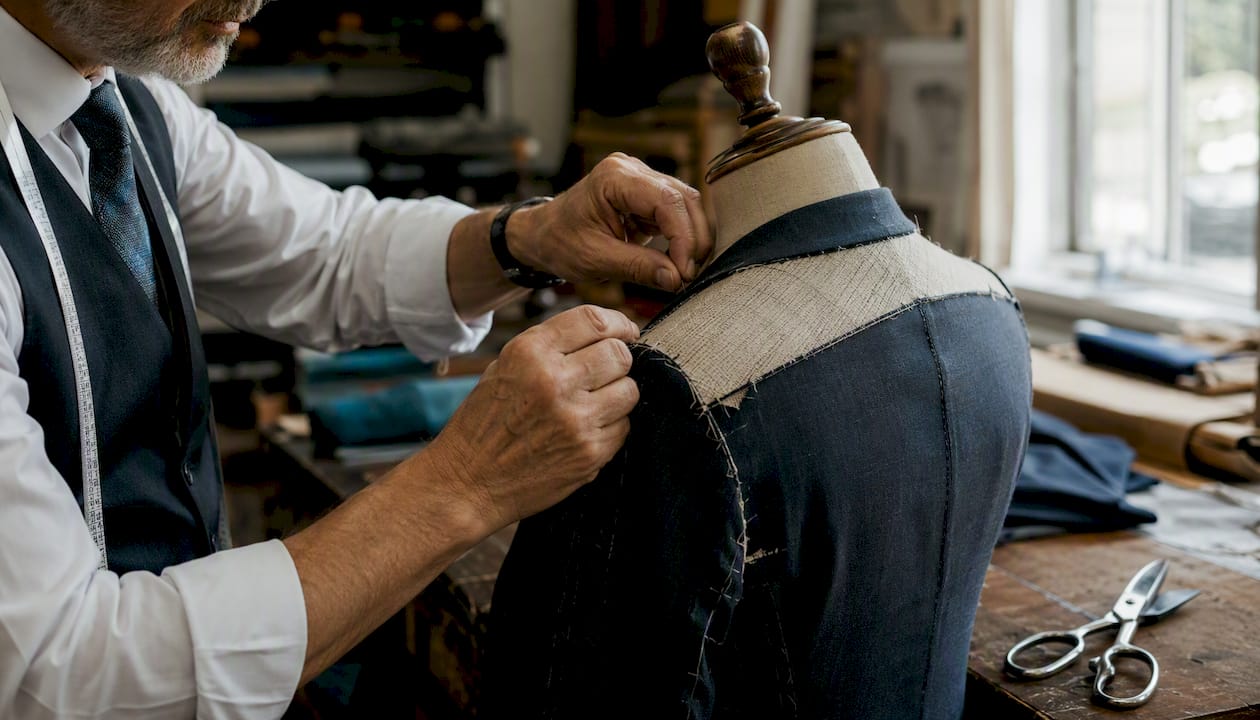
Canvassing: A full or half-canvassed jacket, where an interlining is sewn rather than glued in the chest and lapel, drapes better over time and holds its shape considerably longer than a fused jacket.
-
Stitching: Even, tight stitching with no loose threads is a sign of quality control
-
Buttonholes: Hand-finished buttonholes, particularly working “surgeon’s cuffs”, are a hallmark of higher-end tailoring.
-
Lining: Breathable lining (such as Bemberg or cupro) is preferable to fully synthetic lining in a humid climate.
6) Match the Suit to the Occasion
Not every business suit needs to serve any purpose. Consider building a small, versatile rotation:
-
A navy or charcoal suit for daily office wear and client meetings
-
A darker, more formal suit for interviews, presentations, or high-stakes negotiations
-
A lighter fabric or subtly patterned suit for networking events or smart-casual settings
7) Decide Between Off-the-Rack, Made-to-Measure, and Bespoke
|
Option |
Turnaround |
Fit Precision |
Best For |
|
Off-the-Rack |
Immediate |
Standard sizing, may need alterations |
Budget-conscious buyers, urgent needs |
|
Made-to-Measure |
1-3 Weeks |
Adjusted to your measurements on an existing pattern |
Most professionals want a reliable, personalized fit |
|
4-8 Weeks |
Fully custom pattern, highest precision |
Executives and those seeking a long-term wardrobe investment |
Conclusion
Choosing the perfect business suit in Singapore comes down to matching fabric to climate, prioritizing fit above every other element, and investing in construction quality that holds up over years of wear, not just seasons. A suit that fits well and breathes properly in the heat will consistently be better than a more expensive suit that wasn't built with the tropics in mind.
If you're ready to move beyond guesswork, working with an experienced tailor who understands both classic construction and Singapore's climate is the most reliable way to get it right the first time.
Frequently Asked Questions
Q1 What is the best suit fabric for Singapore's climate?
Lightweight, open-weave fabrics, tropical wool, high-twist wool (fresco), or wool-linen blends perform best. They allow air to circulate close to the skin, which matters given how consistently high humidity stays across the year in Singapore.
Q2 Is a wool suit too hot to wear in Singapore?
Not necessarily. Wool woven in a lighter, tropical-weight construction is genuinely breathable and moisture-responsive. The fiber isn't the problem; a dense, heavy weave or a synthetic blend is.
Q3 How much should a business suit cost in Singapore?
Off-the-rack suits typically start lower but may need alteration to fit well. Made-to-measure and bespoke suits cost more upfront but are built to your exact measurements, which usually means better long-term value and fewer alteration costs.
Q4 How long does a bespoke suit take to make in Singapore?
Bespoke suits generally take between four and eight weeks from initial fitting to final delivery, depending on the tailor and the number of fittings involved.
Q5 How can I tell if a suit is good quality before buying?
Check the canvassing (a floating chest panel rather than a stiff, glued one), even stitching with no loose threads, natural fiber lining, and a lapel that rolls rather than lies flat.
For the office and client meetings, see our bespoke business suits, cut in lightweight cloth for Singapore.