1–3 Suits for Most Men: Start With One Benchmark Suit
Most men need far fewer suits than they think. An occasional wearer does well with a minimal number, a working professional should aim for a moderate number, and only men in daily formal roles need a larger collection. Start with a single, well-fitted benchmark suit in a versatile colour, then expand the wardrobe as your calendar and career actually demand it, not before.
TL;DR:
- Most men need between one and four suits depending on their frequency of wear, with occasional wear requiring only one or two suits.
- Building a wardrobe should prioritize getting the first three suits right, focusing on navy, charcoal, and a seasonal pattern or lighter grey.
- Suits should be cleaned every four to six wears and rotated at least 24 to 48 hours apart to maintain fabric quality and appearance.
- Proper fit is crucial; invest in a benchmark suit with tailoring to ensure future purchases are measured against a standard.
- For versatility, two shirts and two ties per suit are sufficient, and a good-quality suit can often last longer and look better than multiple poorly fitting ones.
Table of Contents
- How many suits does a man need for his lifestyle?
- What suits should you buy first?
- How do you build a suit wardrobe progressively?
- How often should you clean and rotate your suits?
- What should you budget for at each stage?
- How many shirts, ties and shoes do you need per suit?
- What resources help you find your benchmark suit?
- Why one good suit beats five average ones
- Ready to build your suit wardrobe around one that actually fits?
- Sources
How many suits does a man need for his lifestyle?
The right number depends entirely on how often a suit leaves the wardrobe, not on what looks impressive hanging in it. Style authorities have converged on a fairly narrow range for most men, and the Gentleman’s Gazette notes that many style authorities place the practical need for most men between one and three suits. That’s the baseline. From there, the number climbs with frequency of wear, not ambition.
Break it down by how often a suit actually gets worn:
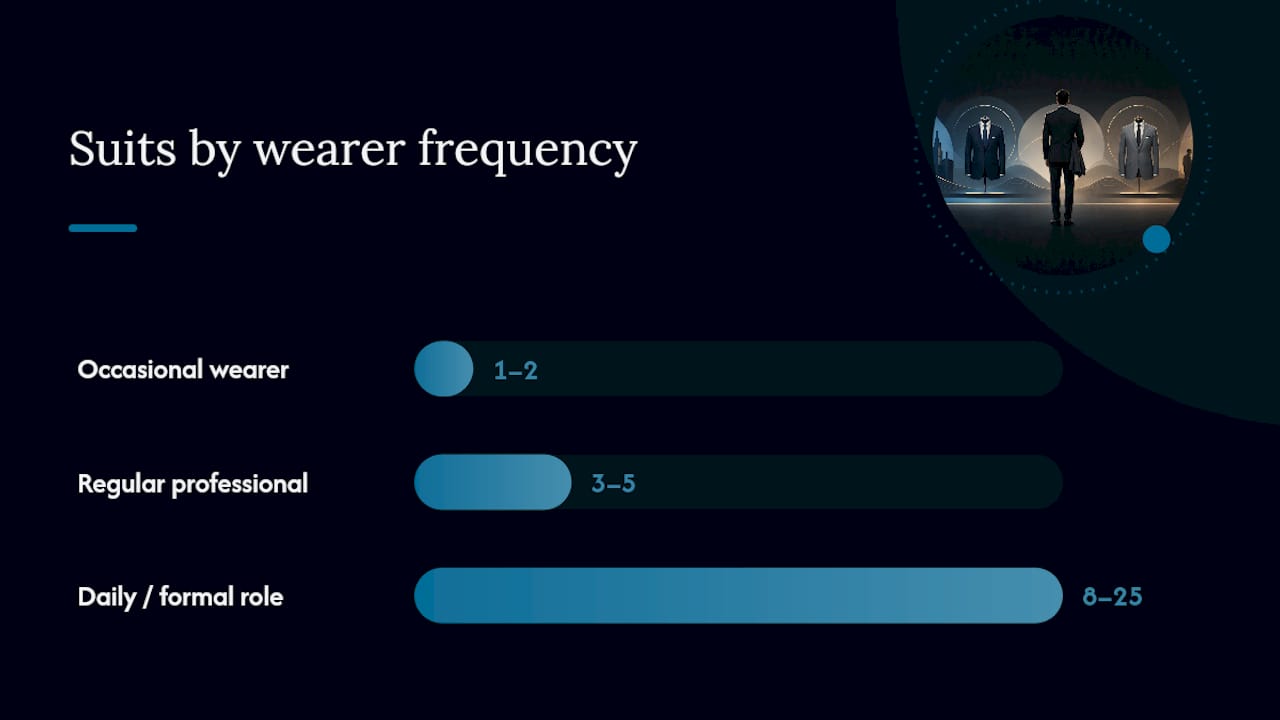
- Occasional wearer (weddings, funerals, the odd client dinner): one to two suits. A navy suit handles almost everything; a second, in charcoal or black, covers the more sombre occasions.
- Regular professional (suits two to four days a week): three to five suits. This is where most working men should sit, and where a three-suit foundation of navy, charcoal and a third seasonal option earns its reputation as the sensible middle ground.
- Daily or formal-role wearer (bankers, lawyers, front-of-house executives): eight or more suits, sometimes stretching towards a full monthly rotation. The Manual outlines staged wardrobes running up to 25 suits for men who need minimal repeats across a working month.
The trade-off is maintenance, not just money. A two-suit rotation means more frequent cleaning and faster wear on the fabric, because there’s no rest between outings. A larger wardrobe spreads that wear thin but ties up considerably more capital sitting in a wardrobe. There’s a useful shortcut here: multiply your weekly suit days by how many weeks you want between repeats. Wear a suit twice a week and want a month before it reappears? You need roughly eight suits, plus spares for cleaning days.
Context matters more than the number itself. Personal style, your office’s dress code, and how often formal events land on your calendar will always shape the answer more than a generic rule, a point UrbanMenStyle makes well when it argues there’s no single universal figure. Treat the ranges above as a starting position, then adjust once you know your own rhythm.
What suits should you buy first?
Before adding a fourth or fifth suit, get the first three right. Navy and charcoal form the foundation almost every guide agrees on, and for good reason: both work under artificial light and daylight, both pair with black or brown shoes, and neither reads as flashy in a boardroom or at a funeral.
- Navy: the most versatile colour in menswear. It works for interviews, weddings, and everyday office wear without ever looking out of place.
- Charcoal: slightly more formal and forgiving of colour clashes elsewhere in the outfit, making it the natural second suit.
- Third option: a subtle pattern, such as a fine pinstripe or birdseye weave, or a lighter grey for warmer months. This is where personality starts to show.
- Blazer as a fourth piece: a well-cut navy blazer often earns its place ahead of a third full suit, because it pairs with chinos or flannel trousers for smart-casual settings a matching suit jacket never quite suits.
Fabric weight matters as much as colour, particularly for readers in warmer, humid climates. A year-round option, typically a mid-weight wool around 260 to 300 grams, handles most conditions without turning into a sauna. For genuinely tropical heat, tropical wool or a wool-and-mohair blend breathes far better than standard suiting cloth. Linen looks wonderful for a single summer wedding but creases within the hour and rarely survives daily office wear, so treat it as an occasional-wear fabric rather than a workhorse. Ron & Rich’s fabric guide for every season breaks down which weights suit which climates in more detail.
Pro Tip: Buy the blazer before the third suit if your calendar has more casual Fridays than black-tie dinners. It multiplies your outfit options far more than a suit that only matches itself.
The three-suit-plus-blazer combination isn’t a rigid formula so much as an editorial consensus. Several recent menswear guides describe navy, charcoal and a seasonal third as the recurring “magic number” for men building a wardrobe from scratch, and it’s a sound place to plant your flag before branching out.
How do you build a suit wardrobe progressively?
The mistake most men make is buying several suits at once, hoping quantity solves the problem fit and quality should have solved first. Build it in stages instead.
- Get one suit exactly right. Treat your first purchase as a benchmark, not a placeholder. A well-fitted suit gives you a reference point for shoulder line, sleeve length, and trouser break that every future purchase can be measured against, and personal styling guidance backs starting with one genuinely well-fitted suit before adding shirts and ties around it.
- Add by colour and fabric, not repetition. Your second suit should extend what the first can’t do, not duplicate it. Move from navy to charcoal, or from a solid to a subtle texture, rather than buying a second navy suit that solves nothing new.
- Introduce seasonal fabrics once the core is covered. Once navy and charcoal are settled, a lighter tropical wool for the warmer months or a heavier flannel for cooler ones adds genuine range rather than overlap.
- Order an extra trouser before a whole new suit. A spare pair of trousers in the same cloth as your most-worn suit costs a fraction of a full suit and effectively doubles how long you can go between cleans, a tactic The Manual specifically recommends for stretching wardrobe rotation.
Each stage should answer a real gap in your week, not a hypothetical one. If you can’t name the occasion the next suit is for, you probably don’t need it yet.
How often should you clean and rotate your suits?
Suits fail early far more often from over-cleaning than from age. Dry-cleaning solvents break down natural fibres over time, so a suit worn once and sent straight to the cleaners will look tired long before one that’s spot-cleaned and steamed between wears. As a rule, dry-clean only every four to six wears, or when there’s a visible stain, and rely on a clothes brush, a hand steamer, and airing overnight for everything in between.
Rotation matters as much as cleaning frequency. Wearing the same suit two days running gives the fabric no time to release moisture and recover its shape, which is why a minimum of 24 to 48 hours’ rest between wears keeps a suit looking sharp for years rather than months. This is precisely where an extra trouser earns its keep: buying one extra pair per heavily worn suit is a low-cost way to widen the rotation without adding another jacket to the wardrobe.
- Brush and air every suit after wearing, before it goes back on the hanger.
- Use wide, shaped wooden hangers, never wire, to preserve the shoulder line.
- Store suits with breathing room between garments, ideally in breathable cotton bags rather than plastic.
- Take trousers to a tailor for a hem or seat adjustment at the first sign of fit drift, rather than waiting until the suit no longer works at all.
Pro Tip: Keep a small notebook or phone note of your last clean date for each suit. It stops the guesswork and usually reveals you’re cleaning far more often than the fabric actually needs.
What should you budget for at each stage?
Suiting spans a wide price range, and the difference usually shows up in construction, not appearance on a hanger. At the entry level, expect fused canvassing, a limited fabric selection, and a fit that will need some tailoring to look genuinely sharp. Mid-tier suits, whether made-to-measure or better ready-to-wear, typically bring half or full canvas construction and a noticeably wider cloth range, which is where most working professionals should aim to land once budget allows. Bespoke sits above both, built from a pattern drafted to your own measurements and revised over fittings until the fit is exact.
- Entry level: acceptable for occasional wear; prioritise getting it altered properly rather than skipping tailoring to save money.
- Mid-tier / made-to-measure: the best value point for most professionals, where fit and fabric quality both improve meaningfully.
- Bespoke: a long-term investment best reserved for your benchmark suit or pieces you’ll wear for years.
If budget is tight, spend on fit before fabric, and on fabric before extras like working buttonholes or contrast stitching. A well-fitted suit in modest cloth outperforms a beautifully woven suit that hangs wrong. Buying secondhand or sample-sale suits from reputable tailors can also stretch a budget, provided the shoulders fit; almost everything else can be altered, but a shoulder seam rarely can.
How many shirts, ties and shoes do you need per suit?
Two shirts and two ties per suit is a sensible starting ratio. It gives enough variation to avoid an obvious repeat within a single week, without asking you to buy an entire haberdashery before the suits themselves are sorted.
- Two shirts (one white, one light blue) and two ties per suit covers most weekly rotations without repetition.
- Black shoes pair with charcoal and black-tie situations; brown shoes work more broadly with navy and lighter greys.
- For weddings, dress slightly brighter than the base suit allows, with a patterned tie or pocket square doing the lifting.
- For funerals, stay strictly to navy or charcoal with a plain black or dark tie, no patterns.
- For client meetings, white shirt, conservative tie, and the most conservative suit in the rotation; this is not the day to experiment.
What resources help you find your benchmark suit?
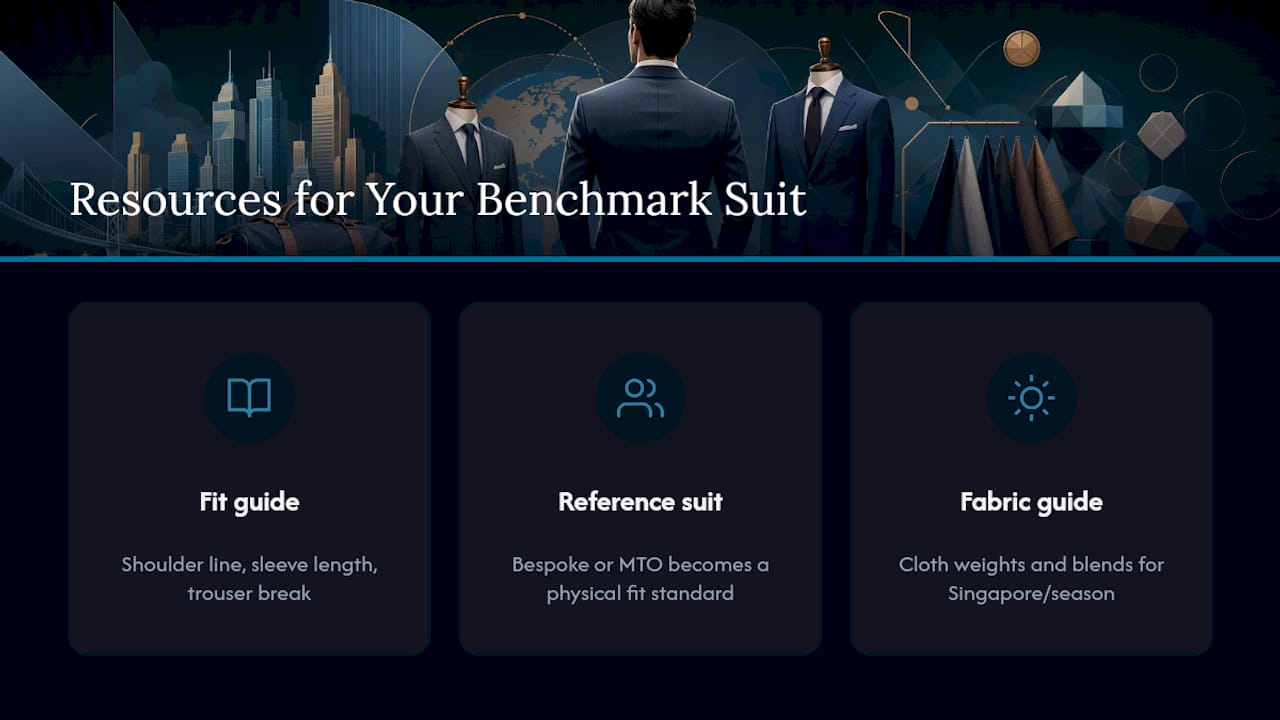
Everything above depends on getting one suit right first, and that’s where a proper fit guide earns its place on a reading list. Ron & Rich’s complete fit guide walks through shoulder line, sleeve length, and trouser break, the exact checkpoints worth noting down for future purchases.
A well-executed bespoke suit, or a carefully made-to-measure one, becomes a physical reference point. Once you know how a jacket should sit across your shoulders, every ready-to-wear purchase afterwards gets measured against that standard rather than guessed at. For choosing the right cloth weight for Singapore’s climate or a cooler destination wardrobe, the fabric guide covers which blends suit which seasons before you commit to cloth.
Why one good suit beats five average ones
Most men overbuy suits the same way they overbuy gym kit: hoping the purchase substitutes for the decision it should follow. My honest view, after years around fittings and fabric bolts, is that a wardrobe of five ill-fitting suits is worse than owning one that fits properly and wearing it twice as often.
Start with three things: get properly measured, buy one benchmark suit you trust completely, then set a simple care rhythm, wear it, rest it, clean it sparingly. Skip the temptation to buy several suits in one sitting to “save time.” That’s how wardrobes end up full of near-misses nobody reaches for. Buy well once, and the maths on cost-per-wear takes care of itself over the following years.
Aaron Fan
Ready to build your suit wardrobe around one that actually fits?
Every recommendation above assumes you’ve got one suit that fits properly to measure everything else against. That’s the part most off-the-rack shopping skips, and it’s a service bespoke tailors exist to solve. Since 1979, our tailors have built suits around individual measurements rather than standard sizing, which means the benchmark fit you take away isn’t a guess, it’s a pattern kept on file for every future order.
If you’re ready to make that first suit count, explore our bespoke tailoring process or book a consultation directly through our bespoke suit page to start with the fit right, before you think about the next four.
Sources
- How Many Suits Should a Man Own? – The Manual
- Your first suit & work wardrobe: The young professional’s complete guide
- Personal stylist wardrobe guide, Style by Manasa
- How many suits does a man need?, Gentleman’s Gazette