Six month groomsmen suit plan with outfit formulas and bespoke fit
Choose one unifying decision, whether that is matching suits exactly, coordinating within a shared palette, or following a theme, then translate it into concrete outfit formulas for each groomsman. The three practical routes are an exact match, a mix-and-match palette, or uniform accessories over varied suits. What follows covers outfit formulas, fabric and colour pairing, fit checks, sourcing routes, and a timeline to keep the whole party on schedule.
TL;DR:
- Exact match suits are ideal for large weddings where visual uniformity enhances group cohesion and photographs.
- Fabric and color coordination should focus on a simple three-color palette, with fabric weight matching outdoor or indoor settings for best results.
- Proper fitting is crucial, with shoulders and trouser length being the most difficult alterations; group fittings streamline adjustments.
- Bespoke suits are recommended for varied body types and humid climates, while rental or off-the-rack options suit shorter lead times and tighter budgets.
- Starting the suit process six months in advance ensures enough time for decisions, fittings, and alterations to achieve a stress-free experience.
Table of Contents
- Set the vibe: choose one unifying decision for the wedding party
- Translate the dress code into real outfits
- Colour and fabric coordination: palettes, contrasts and fabric weight
- Accessories and small accents that create cohesion
- Fit and tailoring: essential fitting checklist and common alterations
- How groomsmen get their suits: buy, rent, bespoke
- Timeline and budget checklist for coordinating groomsmen suits
- Expert perspective from Ron: bespoke considerations and tailoring trade-offs
- Balancing style and practicality for a stress-free wedding party
- How Ron & Rich can help with tailoring and group bookings
- Sources
- FAQ
Set the vibe: choose one unifying decision for the wedding party
Before any suit is bought or booked, the wedding party needs one governing rule. According to guidance on matching versus complementary attire, the choice is generally between an exact match, a coordinated palette, or a themed look, and each produces a distinct effect in photographs and on the day.
- Exact match: every groomsman wears the same suit colour, cut and accessories, which suits formal weddings and larger parties where visual consistency matters more than individual flair.
- Coordinated palette (mix-and-match): suits vary in shade or cut within a limited colour range, which works well for relaxed or outdoor weddings and smaller groups where personality can show through.
- Themed look: colours or fabrics follow a season, venue or cultural tradition, suiting weddings with a strong setting, such as a countryside estate or a cultural ceremony.
A large wedding party tends to photograph best with an exact match, since variation multiplies visually across a group. A photographer’s preference is worth asking about early, since some favour subtle tonal variety over flat uniformity.
Translate the dress code into real outfits
Once the approach is chosen, the next task is turning the invitation’s dress code into an outfit each groomsman can simply follow. Practical outfit formulas work precisely because they remove guesswork from an email instruction.
- Black tie: midnight navy or black dinner suit, white dress shirt, black bow tie, black patent shoes.
- Formal or cocktail: charcoal or navy suit, white or pale blue shirt, silk tie in a shared accent colour, pocket square.
- Smart casual: light grey or tan suit, open-collar shirt, no tie, leather belt matched to shoes.
- Outdoor or seaside: lightweight linen or cotton-blend suit in a soft neutral, unstructured jacket, loafers rather than formal lace-ups.
The groom can stand out within any of these formulas through a contrasting lapel, a waistcoat the groomsmen skip, or a boutonnière in a different flower. On camera, a single point of contrast, rather than several, reads clearly and keeps the groom visually distinct without breaking the group’s cohesion.
Colour and fabric coordination: palettes, contrasts and fabric weight
A simple three-colour palette, a base, a mid-tone and an accent, keeps mixed suits looking deliberate rather than accidental. The base carries the suit itself, the mid-tone sits in the shirt, and the accent appears in the tie or pocket square.
- Navy pairs well with almost every skin tone and works as a dependable base across formal and semi-formal weddings.
- Charcoal suits cooler complexions and evening settings, while light grey and tan read lighter and suit daytime or outdoor ceremonies.
- Darker accents (burgundy, forest green) tend to suit deeper skin tones, while lighter accents (dusty blue, sage) flatter paler complexions.
Fabric weight matters as much as colour. Lighter wool and linen blends suit warm or humid climates and outdoor venues, as outlined in guidance on seaside wedding suits, while heavier wool suits indoor, air-conditioned formal venues. Mixed suits still read as a set when the texture and weight match, even if the exact shades differ slightly.
Pro Tip: Photograph the chosen fabrics together in daylight before ordering. Colours that look coordinated under shop lighting can clash outdoors.

Accessories and small accents that create cohesion
Suits do the heavy lifting, but accessories are what make a group photograph read as one unit. Pick a single rule and apply it consistently.
- Identical accessories: every groomsman wears the same tie, pocket square and boutonnière, which is the simplest route to visible cohesion.
- Shared accent, varied suits: suits differ slightly in shade while one accessory, usually the tie, stays identical across the party.
- Groom-only statement: groomsmen share accessories entirely, while the groom wears one distinguishing piece, such as a patterned tie or a waistcoat.
Boutonnières in a single flower type and colour photograph more cleanly than a mix of varieties. Shoes matter more than planners often expect: matching the shoe colour, even when suits vary, does more for a cohesive look than matching ties. Keep patterns to one scale across the group; a fine stripe on one tie and a bold check on another will read as mismatched even within the same colour family.
Fit and tailoring: essential fitting checklist and common alterations
A well-fitted suit in a slightly different shade will photograph better than an identical suit that fits poorly. Four points matter most.
- Shoulders: the seam should sit at the edge of the shoulder bone with no pulling or excess fabric, since this is the hardest point to alter later.
- Jacket length: the hem should cover the seat, roughly in line with the curve of the hand.
- Sleeve length: roughly 1 to 1.5 centimetres of shirt cuff should show beyond the jacket sleeve.
- Trouser break and waist: trousers should sit at the natural waist with a slight break at the shoe, avoiding bunching.
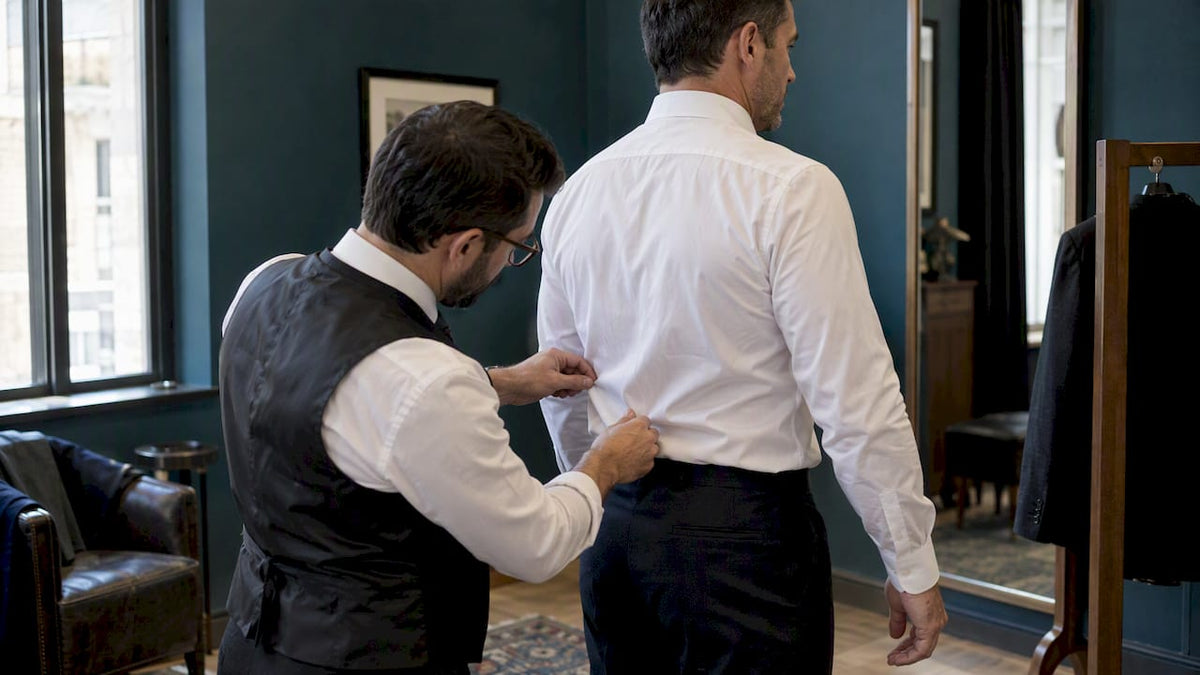
Common alterations, sleeve shortening, trouser tapering and waist take-ins, are usually quick fixes with a few days’ turnaround, while shoulder adjustments take longer and are sometimes not worth attempting on an off-the-rack jacket. For a party with varied body shapes, made-to-measure or bespoke tailoring avoids the compromises that standard sizing forces on broader or slimmer builds.
Pro Tip: Book group fittings on the same day where possible. It keeps the tailor’s notes on colour and fabric consistent across every groomsman.
How groomsmen get their suits: buy, rent, bespoke
Each sourcing route carries a different balance of cost, fit and effort.
- Buying off-the-rack: least expensive upfront and widely available, but fit is rarely precise across a group with varied body shapes.
- Renting: convenient for one-time wear and avoids storage afterwards, though fabric quality and fit consistency vary by provider and availability can be tight close to the date.
- Bespoke or made-to-measure: the highest upfront cost but the most reliable fit across different builds, and a workshop can standardise fabric and colour across the whole party in one booking, as described in guidance on bespoke tailoring for weddings.
The practical workflow runs in five steps: agree the unifying decision, place the order as a group where the provider allows it, attend a first fitting, complete alterations, then collect the finished garments ahead of the wedding. Payment is typically handled individually per groomsman, though some grooms cover a portion as a gift. Collecting everyone’s measurements early, even rough ones, speeds up every step that follows.
Timeline and budget checklist for coordinating groomsmen suits
Groomsmen suits generally need lead time similar to the groom’s own suit, particularly for bespoke or made-to-measure orders. A six-month runway gives enough room for decisions, ordering, fittings and alteration buffers without last-minute pressure.
| Milestone | Timing before wedding |
|---|---|
| Decide on approach (match, palette or theme) | six-month runway |
| Place suit order (buy, rent or bespoke) | four months |
| First fitting | 2 to 3 months |
| Alterations and second fitting | four weeks |
| Final pickup | 1 to 2 weeks |
Budget bands vary widely by route, from modest rental fees to several hundred pounds for bespoke work, as laid out in a wedding suit budget breakdown. Savings are easiest to find in accessories and shirting rather than in the suit itself, where fit and fabric quality carry the visible result.
Expert perspective from Ron: bespoke considerations and tailoring trade-offs
Fabric choice is the first decision Ron makes with any wedding party, since a suit that performs well in air-conditioned halls can feel heavy and look rumpled outdoors within an hour. For humid climates, lighter wool blends and breathable linen weaves hold their shape better across a long day of photographs and dancing.
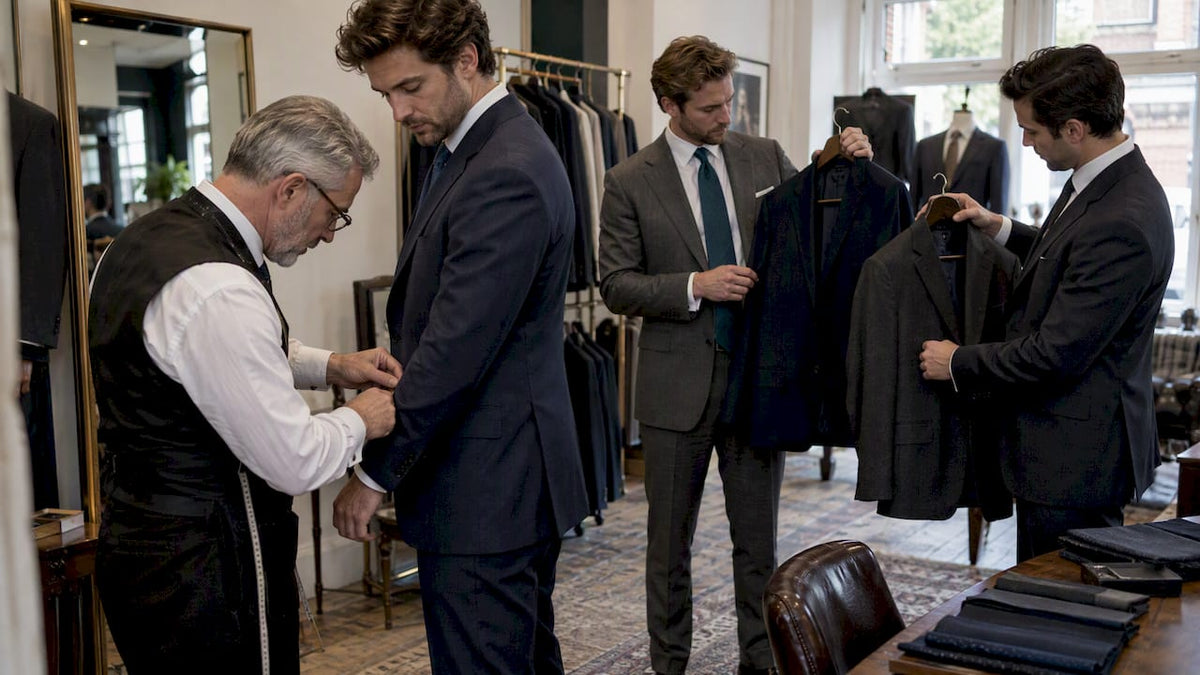
Bespoke is worth the lead time specifically when a party includes varied builds that off-the-rack sizing cannot flatter consistently. A group booking, with measurements taken together and fittings scheduled on shared days, keeps colour and fabric notes aligned across every groomsman rather than left to individual memory.

Balancing style and practicality for a stress-free wedding party
The groomsmen who look best in photographs are rarely in the most elaborate outfits. They are the ones whose suits fit properly and whose accessories follow one clear rule instead of five competing ideas.
Fit first, one unifying decision second, and logistics handled early: that order of priorities saves far more stress than chasing a trend. Hand the timeline checklist to one person, whether that is the best man or a planner, and let everyone else simply follow the brief.
— Aaron Fan
How Ron & Rich can help with tailoring and group bookings
Coordinating a wedding party’s suits is as much a logistics challenge as a style one, and that is where our studio’s group booking process earns its place. Rooted in nearly five decades of tailoring practice, RON & RICH works with wedding parties on fabric selection suited to the climate, fitting schedules that keep every groomsman’s notes aligned, and finishing timelines built around the wedding date rather than a generic rush order.
- Bespoke suits starting at prices shown on our pricing page, tailored individually within one coordinated group order.
- Shirting to complete the outfit formula without clashing with the suit fabric; current prices are available on the pricing page.
- Group fittings scheduled together to keep colour and cut consistent across the whole party.
Readers planning a wedding party can browse our suit constructions and book a consultation to walk through fabric options and timing for the full group.
FAQ
How do you coordinate bridesmaids and groomsmen outfits?
Match the formality level and lean on one shared colour between the two parties, often picked up through the groomsmen’s tie or pocket square echoing the bridesmaids’ dress shade. A defined palette approach keeps both parties visually linked without requiring identical colours.
Do groomsmen usually wear the same suit as the groom?
Groomsmen often wear a similar suit to the groom but with a point of difference, such as a plain tie where the groom wears a patterned one or a waistcoat reserved for the groom alone. This keeps the groom visually distinct while the party still reads as cohesive.
How do groomsmen get their suits sorted for a wedding?
Groomsmen typically source suits by buying off-the-rack, renting for the day, or commissioning bespoke or made-to-measure tailoring as a group. Bespoke offers the most consistent fit across varied body shapes, though it needs the longest lead time of the three routes.
Does the father of the groom dress the same as the groomsmen?
The father of the groom usually follows the same dress code and colour palette as the groomsmen but is not required to wear an identical suit. Many choose a subtly distinct detail, such as a different tie colour, to mark his separate role while staying within the agreed look.
How far in advance should groomsmen order their suits?
Around six months before the wedding is a comfortable starting point for bespoke or made-to-measure orders, allowing time for fittings and alterations. Off-the-rack or rental suits can be arranged with less notice, though availability tightens closer to the date.