Which Dress Shirt Collar Should You Actually Wear?
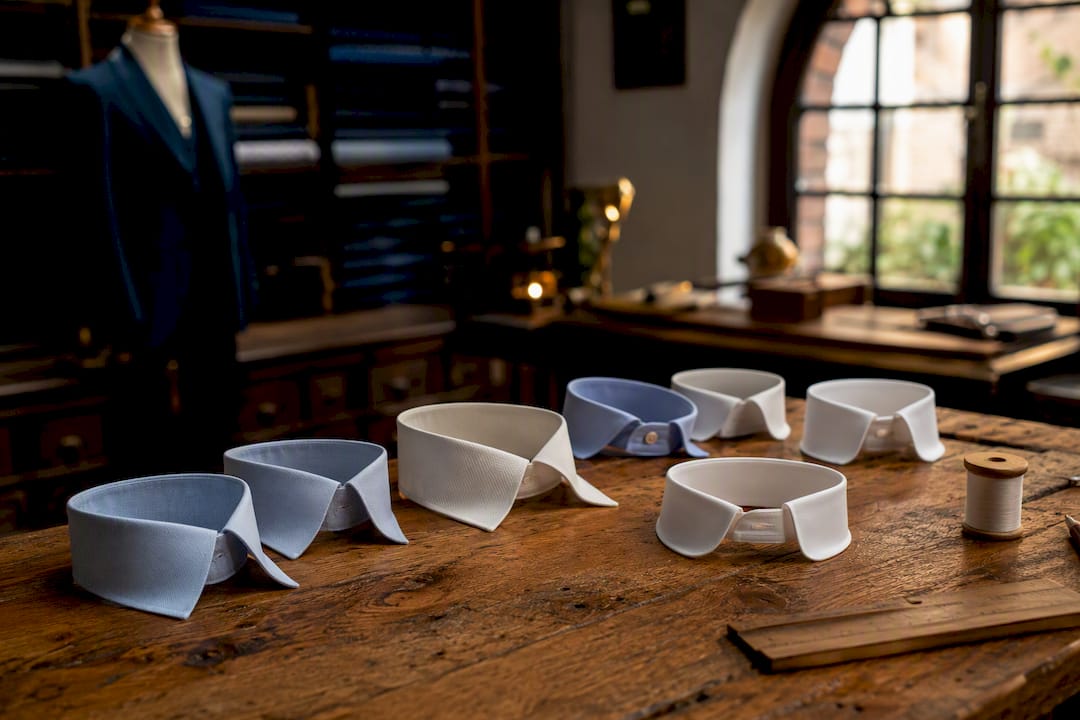
Nine collar families cover nearly every dress shirt you’ll encounter: point, spread, cutaway, button-down, wing, club, tab, pin, and band or Cuban camp collars. The choice comes down to one rule: if you’re wearing a tie, choose point, spread, or cutaway; black tie calls for a wing collar with a bow tie; casual dressing belongs to button-down, Cuban, or band collars.
A collar isn’t just a shape stitched onto a shirt. Its construction, meaning the height of the collar stand and the interlining sewn inside it, changes how the collar sits against your neck, how it holds up by 6 p.m., and how formal it reads next to a jacket. Get the shape right and the construction wrong, and the collar still looks off.
Here’s the quick reference before we go deeper:
- Point collarnarrow spread, traditional, works with most tie knots
- Spread collarmoderate to wide angle, the most versatile business choice
- Cutaway collarextreme spread, bold and modern, needs a substantial knot
- Button-down collarcasual, sporty origin, works with or without a tie
- Wing collarformal only, bow ties exclusively
- Club collarrounded points, vintage character
- Tab and pin collarshidden hardware that lifts the tie knot
- Band/mandarin collarno points at all, minimalist
- Cuban/camp collarflat, open, built for warm-weather ease
Key Takeaways
Getting a dress shirt collar right depends less on picking a trendy shape and more on matching collar geometry to tie knot, lapel width, and construction quality.
| Point | Details |
|---|---|
| Match collar to occasion first | Point, spread, or cutaway for ties; wing for black tie; button-down or Cuban for casual wear. |
| Fill the gap, not the chart | The tie knot should fill the space between collar points without bulging or leaving a gap. |
| Construction beats shape | Collar stand height and interlining type control roll and formality more than the collar’s outline. |
| Check the roll, not the starch | A visible, soft collar roll behind the knot signals sewn interlining and better construction. |
| Bespoke solves persistent fit issues | Ron & Rich fittings let you specify stand height and interlining weight when off-the-rack collars slump or gap. |
Table of Contents
- Dress Shirt Collar Types: A Complete Field Guide
- How Should You Choose a Dress Shirt Collar?
- What Makes a Well-Constructed Collar?
- Pairing Collars With Ties, Lapels, and Occasions
- Ready to Build Collars Around Your Own Fit?
- Sources
Dress Shirt Collar Types: A Complete Field Guide
Every collar on this list solves a different problem, and once you can identify them on sight, dressing well stops being guesswork.
1. Point collar
The point collar is the shirt world’s default setting. Its collar points sit close together, creating a narrow V beneath the tie. That narrow spread pairs naturally with slim knots like the four-in-hand or the Pratt, since there isn’t enough real estate for anything bulkier. It’s the collar most American businessmen grew up wearing, and regional habit plays a real role here: point collars dominate US business wardrobes while spread collars are the default across much of Europe. Neither is “more correct.” It’s simply what men see on colleagues and copy. In Asia, the point colour is a favoured choice, however the gentlemen here tend to be more flexible with their choices, and may occasionally pick a spread collar due to the nature of their business.
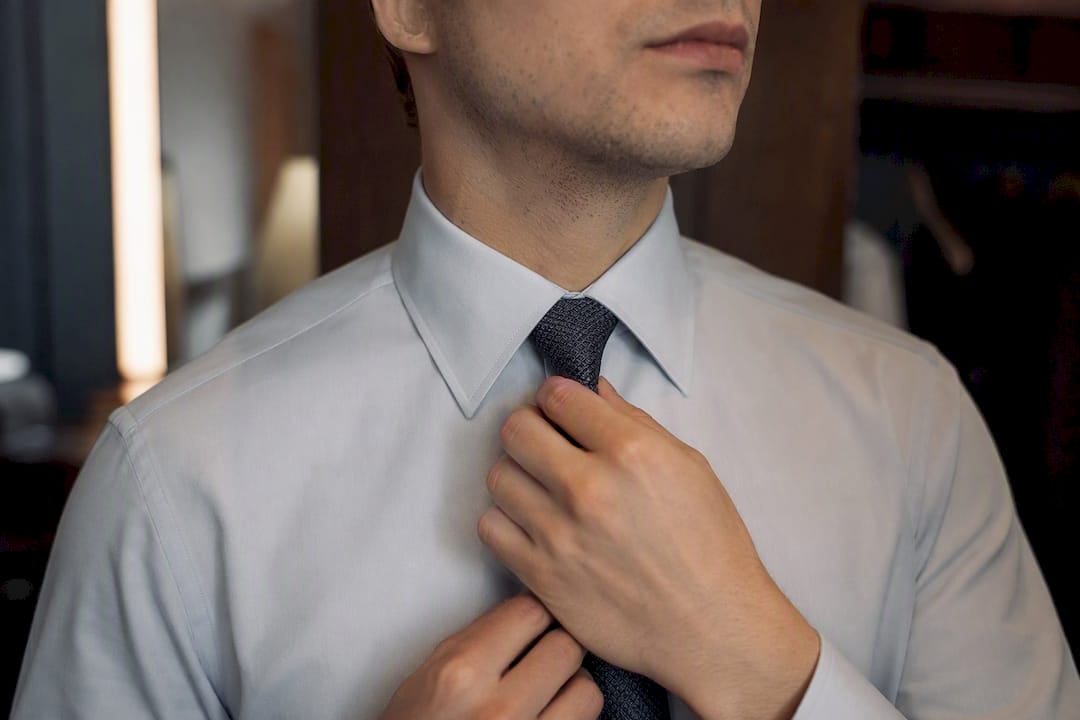
Point collars flatter narrower, longer faces particularly well, since the tight angle adds visual width rather than elongating an already long jawline.
2. Spread collar
The spread collar opens wider than the point, creating a wider angle between the points. That extra angle does real work: it accommodates a broader range of tie knots, from a simple four-in-hand to a fuller half-Windsor, and it reads as slightly more formal and modern than the point collar. The spread collar one of the most universally flattering styles a man can own, and that reputation holds up because it works across board meetings, weddings, and client dinners without looking over- or under-dressed. If you only own one collar style beyond the basics, this is the one to default to.

3. Cutaway (and extreme cutaway) collar
Push the spread angle further, close to horizontal in extreme versions, and you get the cutaway. The wider geometry creates a bold, deliberately modern silhouette, often associated with Italian tailoring houses that favor a more expressive shirt collar than the conservative American point. Because the points sit so far apart, a cutaway demands a substantial knot, think full Windsor, to fill the visible gap. Skip a slim knot here and you’ll end up with an awkward triangle of exposed placket. This collar rewards confidence more than caution, and it looks best on rounder or squarer faces that benefit from added length.
4. Button-down collar
The button-down started as sportswear. Polo players needed their collars to stay put during a match, so someone added buttons to anchor the points, and the style migrated from the polo field into Ivy League wardrobes and eventually into offices that lean smart-casual rather than formal. That sporting DNA is exactly why the button-down reads more relaxed than any other collar on this list. It works open-necked under a blazer with no tie at all, and its natural roll looks intentional rather than sloppy even without one, which is more than you can say for a point or spread collar worn tieless. Some versions hide the buttons under the collar fabric for a cleaner formal look; most show them plainly, which is part of the appeal.

5. Wing collar
The wing collar stands upright with small folded “wings” at the front points, and it exists for exactly one purpose. It belongs to white tie and black tie events, worn exclusively with a bow tie, never a necktie. Showing up to a black-tie dinner in a wing collar with a four-in-hand knotted underneath is the sartorial equivalent of wearing sneakers with a tuxedo. If your event calls for a tie rather than a bow tie, the wing collar isn’t on the table, full stop.
6. Club collar
Rounded rather than pointed, the club collar carries an unmistakable vintage air, closer to 1920s Oxford than 2026 boardroom. It suits evening events, cocktail parties, and any occasion where a little personality is welcome. The rounded edges soften a strong jaw and work especially well on square faces that would otherwise look severe under sharp points.
7. Tab and pin collars
Both styles solve the same problem in different ways: lifting and shaping the tie knot for a cleaner, more formal presentation. The tab collar has small built-in fabric tabs that snap or button together behind the tie, pushing the knot slightly forward. The pin collar achieves a similar effect with a small metal collar bar threaded through eyelets on each point, over or under the tie. Both are vintage-leaning choices that read as more deliberate than a standard point or spread, and both require a bit more effort to put on correctly. Reach for a collar bar only when you want your outfit to say you thought about it.
8. Band (mandarin) collar
No points, no fold, just a short standing band of fabric around the neck. The band collar, sometimes called a mandarin collar, is the most minimalist option on this list and reads casual to smart-casual depending on the fabric and the rest of the outfit. It has no formal tie-wearing function since there’s nothing to knot a tie against, which makes it a strong choice for warm-weather dressing or for men who want a clean, collarless-looking silhouette without going full T-shirt.
9. Cuban (camp) collar
The Cuban or camp collar lies flat and open, usually with a notch where the lapel-like points meet the placket. Built for resort wear and warm climates, it’s meant to be worn open, untucked or tucked, with no tie and often no undershirt bunching at the neck. It’s the collar equivalent of loafers with no socks: entirely appropriate in the right setting, entirely wrong in a boardroom.
Rarer variants worth knowing
A few less common styles round out the family. The spearpoint collar stretches the point collar’s tips longer and sharper for a more elongated look. The square collar cuts a blunter, geometric edge instead of a point. Detachable collars, once standard on formal shirting, still appear occasionally on wing-collar formal shirts, allowing the collar to be starched and laundered separately from the body of the shirt. You’ll also see boutique labels invent proprietary names for what are really just variations on spread or cutaway geometry, so don’t assume a new name means a genuinely new shape.
How Should You Choose a Dress Shirt Collar?
Start with your face, then let the occasion and the rest of your outfit narrow the field.
Round faces benefit from a point or tab collar, since the tighter angle and lifted knot add visual length rather than more width. Oblong or long faces do better in a spread or cutaway, where the wider horizontal line balances the face rather than stretching it further. Square faces soften nicely under a club or button-down collar, both of which trade hard angles for curves. Oval faces are the exception that makes every rule easier: most collar styles work well on an oval face, so personal preference and occasion matter more than face shape here.
| Face Shape | Recommended Collar | Why It Works |
|---|---|---|
| Round | Point or tab | Narrow angle and lifted knot add length |
| Oblong | Spread or cutaway | Wider spread balances a long jawline |
| Square | Club or button-down | Rounded lines soften strong angles |
| Oval | Most styles | Balanced proportions suit nearly any collar |
Face shape is only the starting point. Three more factors decide the final call:
- Lapel width and tie knot volume: a slim suit lapel pairs naturally with a narrow spread and a small knot; a wider lapel wants a wider collar spread and a fuller knot to match, since a slim four-in-hand under a broad lapel looks undersized.
- The proportional rule that beats any chart: the tie knot should fill the space between the collar points exactly, neither bulging past them nor leaving a gap. That single visual check matters more than any face-shape formula.
- Formality checklist: confirm whether the event is tie or no-tie, whether a jacket is expected, and how formal the dress code actually reads (business, black tie, smart-casual) before you pick a collar family at all.
When you’re briefing a tailor or shopping bespoke, three measurements decide fit: collar point length (how far the points extend), spread measurement (the angle and distance between points), and collar stand height (how tall the band sits around your neck). These three numbers, more than fabric or color, determine whether a collar frames your face well or fights against it.
What Makes a Well-Constructed Collar?
The shape gets all the attention, but construction is what makes a collar behave. A taller collar stand creates a more upright, formal silhouette and keeps the collar from slumping by midday, which is exactly why bespoke shirtmakers treat stand height as a variable worth adjusting per client rather than a fixed default.
Interlining is the second variable, and it matters more than most men realize. Collar stiffness comes almost entirely from the interlining sewn or fused inside the fabric, not from starch applied afterward. Fused interlining is bonded with heat and adhesive, cheaper to produce, and tends to feel stiffer and less forgiving over time. Sewn interlining is stitched in by hand or machine, holds its shape through more wash cycles, and produces the soft, rolling curve favored in Neapolitan tailoring. A visible collar roll, that gentle curve just behind the knot, is generally the mark of a well-built collar rather than a heavily starched one.
To check quality on a shirt you’re considering, look for even, tight stitching along the collar edge, a clean fold with no puckering, and stay channels sewn precisely enough that the plastic or metal stays sit flat rather than twisting.
Pro Tip: Run your thumb along the collar’s edge before buying. If it feels stiff and boardy with no give, you’re likely looking at heavy fused interlining. If it has a soft, springy resistance, that’s sewn interlining, and it’s usually the better long-term investment.
- Ask a tailor about interlining weight, not just fabric weight, when ordering shirts.
- Request a taller stand if your current collars slump by afternoon.
- Inspect the collar’s fold in person; a good roll should look natural, not pressed flat.
- A well-briefed tailor conversation about placket and collar details prevents most fit disappointments before cutting even begins.
Pairing Collars With Ties, Lapels, and Occasions
Getting the collar right is half the job. The other half is making sure everything around it agrees.
Start with knot-to-spread matching. A narrow point collar wants a slim four-in-hand or Pratt knot; a spread collar can handle a half-Windsor comfortably; a cutaway collar practically demands a full Windsor to avoid looking underfilled. The shirt collar frames the face more than any other single element of an outfit, which means a mismatched knot and spread is one of the fastest ways to look slightly off without being able to say why.
Lapel width follows the same logic in reverse. A slim two-and-a-half-inch lapel pairs naturally with a narrower collar spread; a wider three-and-a-half-inch lapel, more common on double-breasted jackets, wants a wider spread to balance it. Mixing a razor-thin lapel with a cutaway collar, or a wide lapel with a tight point collar, creates a visual mismatch even when both pieces are individually well made.
By occasion:
- Office: point or spread collar, tied with a four-in-hand or half-Windsor.
- Interview: spread collar, the safest and most universally read-as-competent choice.
- Wedding (groom): cutaway or wing collar depending on whether the ceremony is black tie.
- Black tie: wing collar, bow tie only, no exceptions.
- Smart-casual: button-down collar open at the neck, or a Cuban collar for warmer settings, paired well with the layering ideas in this smart-casual outfit guide.
Casual collars follow their own logic entirely. A button-down collar looks sharp under an unstructured blazer with no tie, and its natural roll does the styling work a tie would otherwise handle. Cuban and band collars want to be seen, worn open over a plain undershirt or nothing at all, with loafers or clean sneakers rather than dress shoes. A stand-up collar polo shows how the band-collar principle extends into knitwear too, if you want a reference point for that flat, minimal neckline outside of woven shirting.
Keeping Your Collar Looking Sharp
Collar stays matter more than most men give them credit for. Removable metal or plastic stays work for point and spread collars and should be swapped in fresh before every wear; sewn-in stays, common on button-down collars, need no daily attention but can’t be adjusted.
- Iron fused-interlining collars on medium heat with light steam; high heat can warp the bonding.
- Sewn-interlining collars tolerate more steam and hold their roll better through repeated washing.
- Fix a curling collar mid-day by tucking the stay back into place or, in a pinch, dampening the tip slightly and pressing it flat with your fingers.
- If a collar gapes or refuses to sit flat even after pressing, the interlining has likely broken down, and it’s time to have the collar re-lined or the shirt replaced.
What I’ve Learned Fitting Hundreds of Collars
Most men over-index on collar shape and under-index on collar stand height, and that’s backward. I’ve adjusted stand height by a quarter inch on two separate clients whose off-the-rack point collars looked “fine” but never quite framed their face right, and in both cases that small change did more than switching collar styles ever would have. The other pattern I see constantly: men choosing a cutaway collar because they like how it looks on someone else, then wearing it with a tie knot that’s too small to fill the spread. When you sit down with a tailor, describe how your current collars fail you, whether they slump, gape, or feel stiff, rather than just naming a style you saw online. That detail tells a tailor far more than a photo ever will.
Aaron Fan, Owner of Ron & Rich
Ready to Build Collars Around Your Own Fit?
Ron & Rich exists for exactly the moment this guide keeps circling back to: when off-the-rack collar geometry almost works but not quite, and you’d rather specify the fix than keep hunting for a lucky size match. Every distinction covered here, stand height, interlining weight, spread angle, becomes a straightforward conversation during a bespoke fitting, where collar stand and interlining are chosen for your neck and posture rather than a standard block.

Our custom shirting collection covers the full range from point to spread to button-down, each built to the collar-construction standards outlined above rather than a generic factory spec. If you’re unsure whether bespoke makes sense yet, ask yourself three questions: does your current collar slump by afternoon, do you struggle to find a spread that matches your lapels, and do you wear ties often enough to justify a collar built specifically for your knot of choice? Two yeses is reason enough to book a fitting. Walk through our bespoke process to see what a first consultation actually involves, and bring the exact frustrations you have with your current shirts. That’s the fastest way to leave with a collar that finally fits the way it should.
Sources
- Shirt Collar Styles For Men: The Complete Guide
- The HSS Guide To Dress Shirt Collars
- Types of Shirt Collars: 19 Styles & When to Wear Them