Order Bespoke Drawstring Trousers: 3 Tailoring Methods
Yes, a skilled tailor can make drawstring trousers that read as tailored rather than loungewear. The three constructions worth knowing are a hidden internal drawstring, a neat visible casing, and an elastic-drawstring hybrid. Decide which look you want, then tell your tailor exactly where you’d like the waistband to sit and how much ease you need.
TL;DR:
- Tailored drawstring trousers feature tapered or straight legs and sit at the natural waist, distinguishing them from casual joggers designed for movement.
- Construction methods include hidden internal drawstrings, visible neat casings, and elastic-drawstring hybrids, each offering different aesthetics and comfort levels.
- Proper fit depends on taking precise measurements for waist, hips, rise, and thigh, with adjustments made during fitting to ensure a clean silhouette.
- Fabric choices like linen, cotton blends, and lightweight wool maintain a crisp appearance and prevent waistband collapse over time.
- Custom details such as metal tips, contrast cords, and waistband style can be tailored for personal preference and outfit coordination.
Table of Contents
- What tailored drawstring trousers are, and when to choose them
- Key construction methods tailors use for a drawstring waist
- How do tailors fit drawstring trousers correctly?
- Which materials and finishes keep the waistband neat?
- How to style tailored drawstring trousers for smart-casual looks
- How do you care for a drawstring waistband over time?
- Choosing the right type and thickness of drawstring cords
- What customisation options exist for drawstring features?
- Coordinating drawstring trousers with different waistband types
- Tailor’s perspective: why we offer drawstring options
- How Ron & Rich brings drawstring trousers to life
- Sources
- FAQ
What tailored drawstring trousers are, and when to choose them
Tailored drawstring trousers are not casual joggers with a smarter fabric swap; the difference sits in the pattern itself: a tapered or straight leg, a proper waistband curtain, and a rise cut to sit at the natural waist rather than low on the hip. Joggers are drafted for movement first, appearance second. Drawstring trousers, cut the way we cut them, are drafted for a tailored line first, with the drawstring added purely as a comfort mechanism underneath.
That distinction matters because it decides where in your wardrobe these trousers actually belong.
- Long-haul travel, where you want to arrive looking pressed rather than slept in
- Hybrid workdays that swing between a video call and a casual lunch
- Weekend smart-casual occasions where a full suit would overdress the room
The leg cut does most of the work here. A tapered leg with a slightly higher rise reads as deliberate tailoring even with a drawstring hidden beneath the waistband. A wider, lower-slung leg drifts straight back towards loungewear, no matter how good the fabric is.
Key construction methods tailors use for a drawstring waist
Not every drawstring waistband is built the same way, and the method your tailor chooses changes both how the trousers look and how they feel against your shirt or jumper.
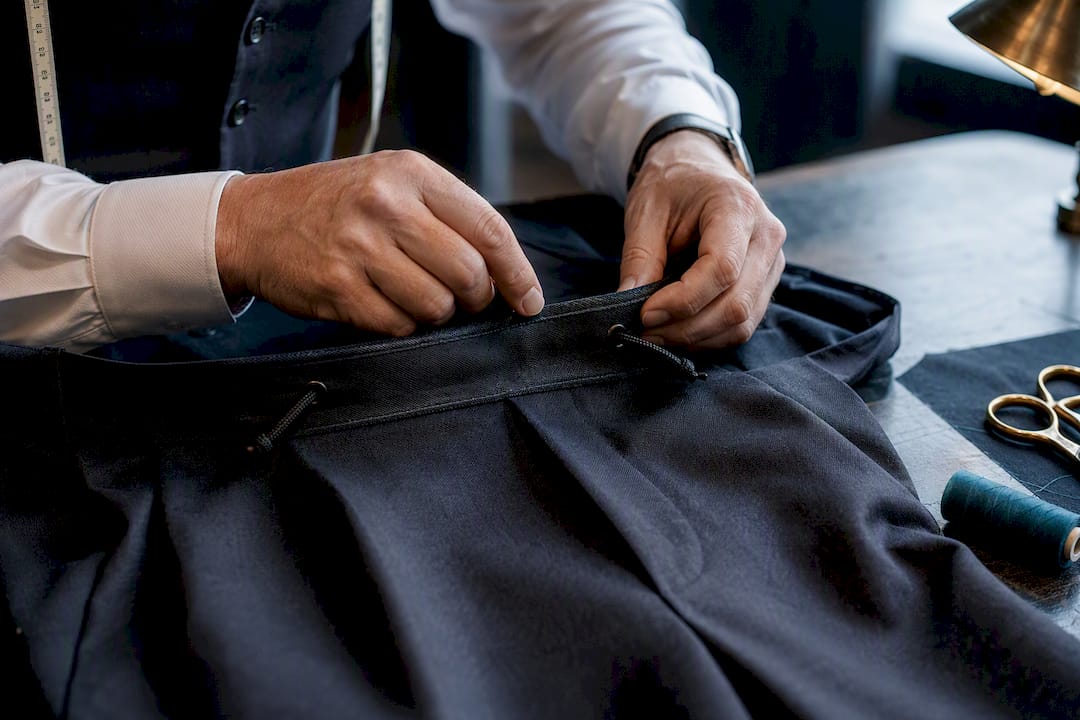
- Hidden internal drawstring. Eyelets or internal buttonholes sit inside the waistband, with fusible interfacing placed exactly where the openings will be. This gives you several centimetres of adjustable ease without a hint of it showing at the front.
- External neat casing. The drawstring sits in a visible channel, finished with reinforced buttonholes or eyelets and crisp double topstitching. It looks intentional rather than sporty, provided the casing width stays proportionate to the waistband.
- Elastic-drawstring hybrid. A short length of elastic runs across the back of the waistband and joins to the drawstring ends, so the tie never slips out of place and getting the trousers on and off takes no fiddling at all.
Bulk at the front is the enemy of a tailored look, and it’s usually solved with side-offset exits and a shaped fly guard, letting you tie the drawstring off to one side rather than bunching fabric at the centre front. Some tailors also stitch a triple-channel waistband, which stops a narrow cord from wandering inside a wider band.
Pro Tip: If you wear your trousers with a tucked shirt, ask for the hidden drawstring with side-offset exits. It keeps the front completely flat, which matters far more once a shirt is tucked in than when a jumper is covering the waistband.
Choose the hidden method for anything smart-casual, the visible casing for a more relaxed, textural look in linen, and the elastic hybrid if you’re buying trousers primarily for comfort on long days.
How do tailors fit drawstring trousers correctly?
A drawstring waistband is forgiving, but that doesn’t mean fit becomes an afterthought. If anything, a badly fitted drawstring pair looks baggier and less deliberate than a badly fitted trouser with a fixed waistband, because there’s nothing structural holding the line.
At your first appointment, expect your tailor to take and confirm:
- Waist measurement at the point you actually intend to wear the trousers, not where the tape naturally rests
- Hip measurement, since drawstring ease at the waist can mask a poor hip fit if it’s ignored
- Rise, front and back, to set how high or low the waistband sits
- Thigh circumference, which governs how the leg drapes below the seat
- Inseam, taken with the shoe you’ll actually wear with them
From there, the pattern gets small adjustments most people never see: a touch of ease built into the side seams, darts left semi-adjustable rather than pressed flat, and a shaped fly guard cut to sit cleanly under whichever exit method you’ve chosen. During fitting, the tailor will baste the waistband, pin the gather positions at the side seams and centre back, and have you try the trousers on before anything is permanently stitched.
Say plainly whether you plan to wear a belt, whether you prefer the waistband sitting on or below your natural waist, and how much cinch you actually want when the drawstring is pulled tight. That single conversation prevents most of the fit complaints tailors hear after the first wear. Bespoke trousers built to your own measurement checklist fit noticeably better than anything bought off a rail, largely because the waistband construction and hem finish are built around your body rather than a size average.
Which materials and finishes keep the waistband neat?
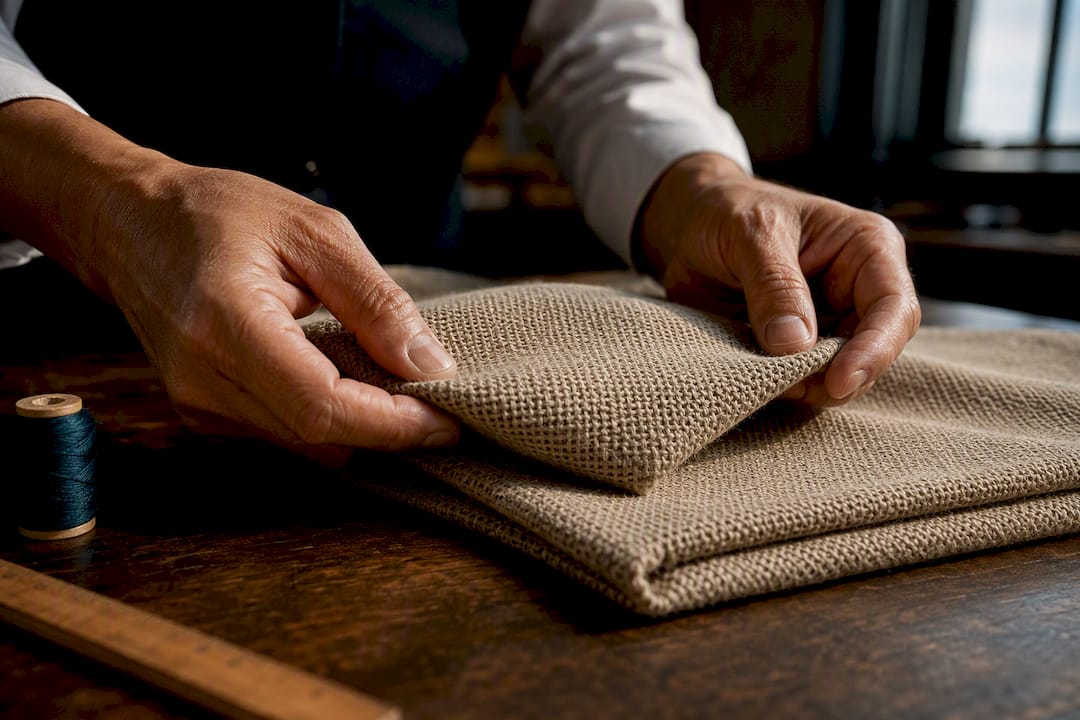
Fabric choice decides whether a drawstring waistband looks crisp or collapses into folds by lunchtime. Mid-weight linen, cotton-linen blends, and cotton-rayon blends all hold a soft structure without turning stiff, which is exactly the balance a tailored drawstring trouser needs. A lightweight wool works too, particularly for trousers meant to bridge into a smarter office setting.
- Fusible interfacing at the inner waistband stops puckering around eyelets or buttonholes
- Shaped fly guards keep the front lying flat regardless of construction method
- Discreet eyelets or hand-finished buttonholes look deliberately tailored rather than sporty
- Narrow drawstrings with finished cord ends avoid the frayed, gym-bag look
- Neat casing widths and tidy bartacks hold the tailored line together over time
Pattern references such as the Merchant & Mills 101 trousers pattern recommend 13mm webbing as a workable drawstring width, alongside optional eyelets, which gives a useful baseline for judging whether a cord looks proportionate to the waistband.
Pro Tip: Ask to see the inner waistband before your final fitting. A waistband curtain done properly should feel as finished on the inside as the outside looks. If it feels flimsy inside, the outside will start to sag within a season.
How to style tailored drawstring trousers for smart-casual looks
Drawstring trousers earn their place in a smart-casual wardrobe the moment you stop treating them as trousers with an excuse and start treating them as trousers with an advantage.
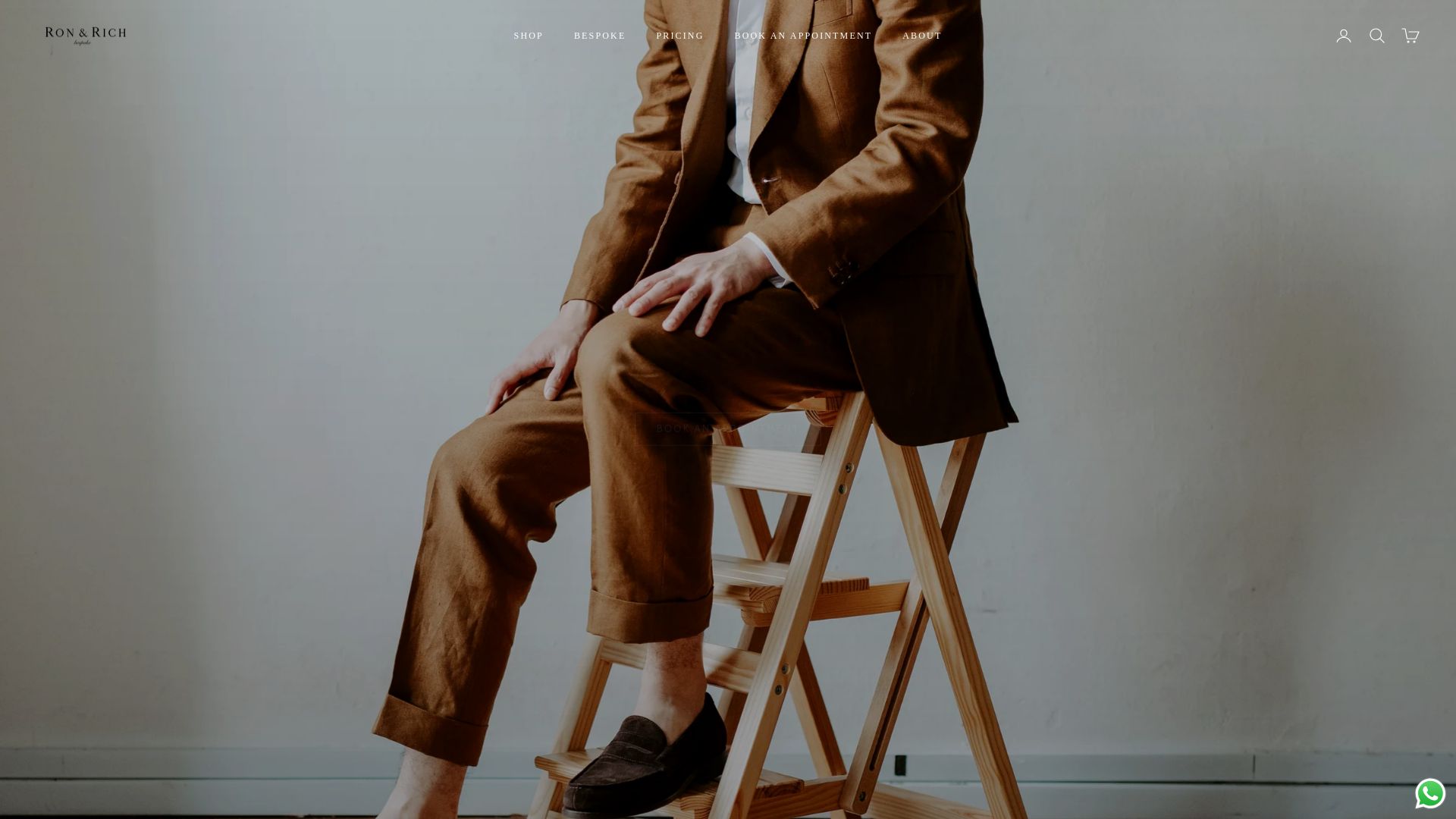
- Smart-casual formula: tailored drawstring trousers, an unstructured blazer, and loafers. The blazer’s shoulder line does the visual work of formality, so the trousers can stay relaxed underneath without the outfit reading as undressed.
- Casual-polished formula: linen drawstring trousers, a crisp linen or cotton shirt, and minimal sneakers. Keep the shirt tucked, at least partially, so the waistband’s clean line stays visible rather than hidden under bunched fabric.
- Proportion rule: balance top-half weight against the trouser’s softness. A boxy or heavy jacket over a soft drawstring leg tips the outfit towards sloppy; a slightly fitted jacket keeps the whole silhouette tailored.
- Finishing touches: a leather belt (even on trousers you won’t cinch), a structured watch, and shoes with some polish rather than trainers pull the look back towards refined.
For more outfit combinations built around this same logic, smart-casual outfit formulas and a wider set of ready-to-wear pairing ideas are both worth a browse before your fitting.
How do you care for a drawstring waistband over time?
Washing depends entirely on fabric. Linen and cotton blends generally tolerate a gentle machine wash on cool, while wool-blend drawstring trousers should go to dry cleaning to protect the interfacing and drape.
- Re-tension an elastic-drawstring hybrid by pulling the cord tight, retying, and trimming any excess rather than replacing the whole elastic
- Replace a frayed drawstring by threading a new length through the existing casing and finishing the ends yourself or at your tailor
- Return to your tailor if an eyelet pulls away from the fabric or the casing stitching starts to loosen
- Store trousers folded along the crease, waistband flat, to stop interfacing from creasing permanently
Choosing the right type and thickness of drawstring cords
Cord choice affects comfort more than most people expect before they’ve worn a badly chosen one for a full day. A cord that’s too thin digs into the fingers when you tie it and tends to fray faster at the tips. One that’s too thick sits awkwardly inside a narrow casing and can distort the waistband’s line from the outside.
Flat cotton tape, roughly 10 to 13mm wide, is the standard choice for tailored drawstring trousers, and it matches the webbing width recommended in trouser pattern guides for casings of a similar scale. It sits flat rather than round, which keeps it from creating a visible ridge under a fitted shirt or jumper. Cotton-linen blend cord offers a slightly softer hand and pairs well with linen trousers, since the texture matches rather than fighting against the fabric.
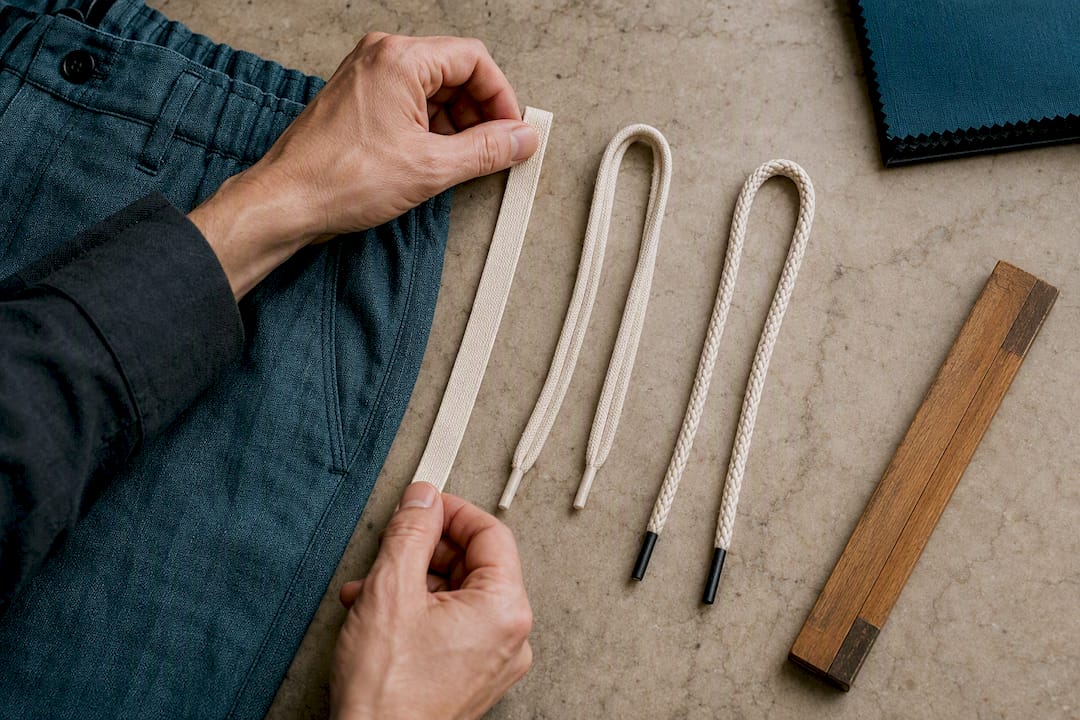
Braided round cords, more common on outerwear and sportswear, tend to look out of place on tailored trousers. They’re built for grip and durability in conditions bespoke trousers rarely see, and the round profile shows through fine fabric far more than flat tape does.
Durability matters most at the tips and at the point where the cord passes through the eyelet or buttonhole repeatedly. A slightly heavier cord, in the region of 13 to 15mm, holds up better if you tend to cinch and release the waist several times a day. For trousers worn mostly for comfort at home or on flights, a lighter, softer cord in the 8 to 10mm range feels kinder against the skin during long stretches of sitting.
What customisation options exist for drawstring features?
Off-the-rail drawstring trousers give you almost no say in the small details. A tailor gives you all of them, and the choices are where a bespoke pair starts to feel genuinely personal rather than merely well-fitted.
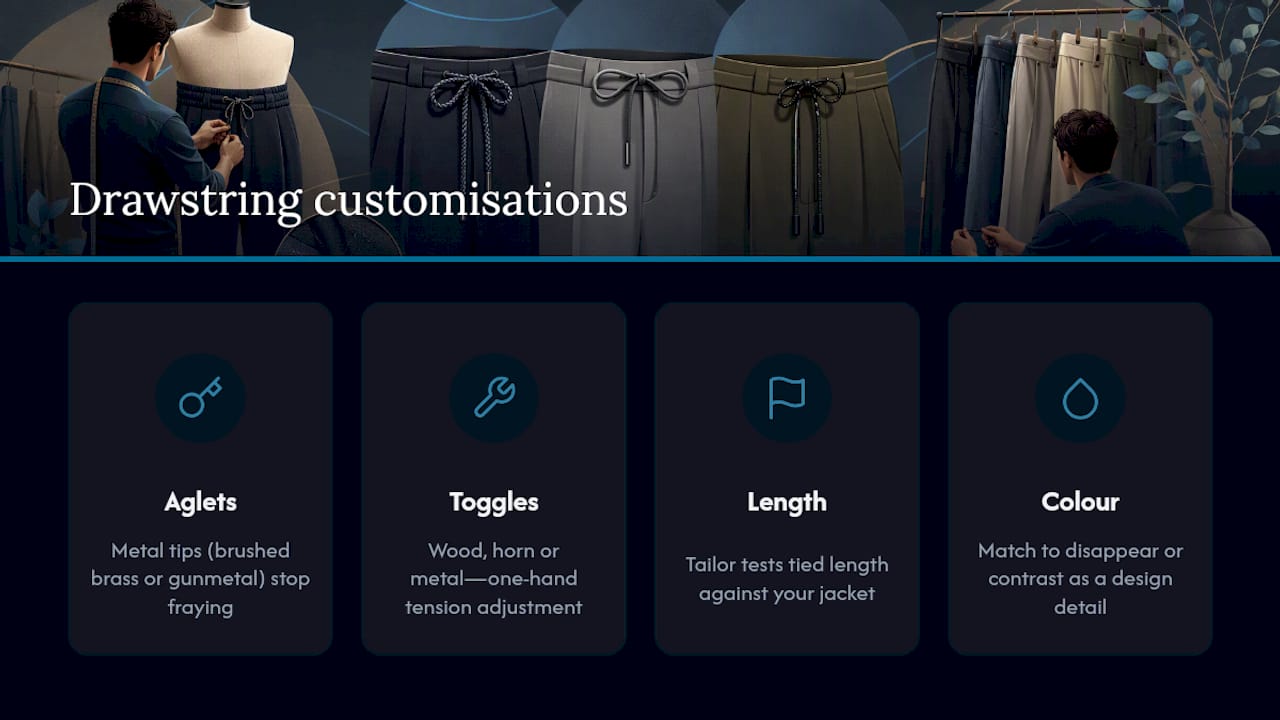
Metal tips, known as aglets, stop cord ends from fraying and add a small point of visual interest if you choose a brushed brass or gunmetal finish over plain cotton binding. Toggles, whether wood, horn, or metal, let you adjust tension with one hand and add a tactile, slightly heritage feel that plain knotted ends don’t offer. Both are minor hardware decisions, but they change how the trousers feel to put on every single morning.
Length adjustment is worth discussing early, since a drawstring cut too long leaves loose ends hanging below a jacket hem, while one cut too short is awkward to tie. Ask your tailor to test the tied length against the specific jacket or shirt you plan to wear most, not just against the trousers alone.
Colour is the easiest customisation and the one people underestimate. A cord dyed to match the trouser fabric disappears into the waistband, reinforcing the tailored look. A contrast cord, in a complementary or tonal shade, becomes a deliberate design detail rather than a functional afterthought, similar in spirit to contrast stitching on a jacket lapel.
Coordinating drawstring trousers with different waistband types
Not every drawstring waistband is built the same way underneath the cord, and the type you choose changes how the trousers behave through a full day of wear.
A flat waistband, with the drawstring as the sole adjustment mechanism, gives the cleanest line and the most formal appearance. It suits trousers you intend to wear with a tucked shirt and a blazer, since there’s no visible elastic gather to interrupt the silhouette. The trade-off is less forgiveness after a heavy meal, since the flat waistband has no give beyond what the cord itself allows.
Partial elastic waistbands, where elastic sits only at the back or sides, strike a middle ground. They flex with the body while keeping the front completely flat and tailored, which is exactly the logic behind the elastic-drawstring hybrid construction. This type suits trousers built primarily for comfort across long days, travel, or wear after meals, without sacrificing the front’s appearance.
Full elastic waistbands, elastic running the entire circumference, sit at the casual end and rarely pair well with a tailored aesthetic. They’re worth avoiding if the trousers are meant to work in a smart-casual context, since the gathered look at the front undoes much of the tailoring elsewhere in the trouser.
Tailor’s perspective: why we offer drawstring options
Traditional tailoring techniques have been valued since 1979, emphasizing meticulous attention to detail. Drawstring trousers fit that legacy naturally: comfort and craftsmanship were never opposites in tailoring workshops. Common requests for drawstring construction include the hidden drawstring or the elastic hybrid. Bring a pair of trousers whose fit you already like, and be ready to say where you want the waistband to sit.
— Ron
How Ron & Rich brings drawstring trousers to life
A bespoke drawstring trouser only works when the construction, fabric, and fit are decided together rather than bolted on afterwards. Each pair is built to exact measurements, guiding clients through fabric selection, from mid-weight linen to softer cotton blends, before the first fitting.
Come to your consultation with a pair of trousers whose fit you already like, and be ready to state your preferred construction, hidden drawstring, visible casing, or elastic hybrid, along with how high you want the waistband to sit. The bespoke tailoring process walks through measurements and fittings step by step, so nothing about the final garment is left to guesswork on either side. Browse the full range of bespoke trousers or start with the primary bespoke booking page to arrange your first fitting.
Sources
- Make tailored trousers more comfortable with a secret drawstring waist — Threads
- Add a no-fuss, comfy drawstring waistband — Threads
- 101 trousers - Merchant & Mills
- Luna pants with a triple channel drawstring — Made by Rae
FAQ
Can drawstring trousers look formal enough for the office?
Yes, provided the construction hides the drawstring and the leg is cut with a tapered, tailored line rather than a relaxed jogger fit.
What’s the best fabric for tailored drawstring trousers?
Mid-weight linen, cotton-linen blends, and lightweight wool all hold structure well while staying soft enough for a drawstring waistband.
How do I stop the drawstring from bulging under a shirt?
Ask for a side-offset exit with a shaped fly guard, which keeps the front waistband flat instead of bunching fabric at the centre.
Should I choose elastic, a fixed casing, or a hidden drawstring?
Choose the hidden drawstring for the most formal look, the elastic hybrid for daily comfort, and a visible casing for a relaxed, textural style.
Where can I get drawstring trousers made to measure?
Ron & Rich builds bespoke drawstring trousers to your exact measurements, guiding fabric and construction choices through the full tailoring process.