Build 25 Piece Capsule Wardrobe in 6 to 12 Months With Tailored Fit for Men
A capsule wardrobe is a small, deliberately chosen set of clothes where every piece pairs with several others, cutting decision fatigue to almost nothing. The practical starting point most style authorities agree on is 25 pieces, built over six to twelve months rather than bought in one sitting. Two rules govern everything that follows: fit outranks brand, and you buy slowly.
TL;DR:
- Prioritize high-quality shoes, suits, and outerwear early in the build to maximize durability and cost-per-wear over several years.
- Build the wardrobe over six to twelve months, starting with shoes and shirts, and layering in trousers, jackets, and knitwear gradually.
- Focus on a neutral color palette of navy, charcoal, white, tan, and olive, then add one to three accent colors for variety and interest.
- Ensure all pieces fit properly, with tailored adjustments or bespoke options for the most-worn and visible items to avoid looking inexpensive.
- Use wardrobe audits based on weekly wear to determine essential pieces, and adapt the list depending on your lifestyle and activity levels.
Table of Contents
- What is a capsule wardrobe for men, and why 25 pieces?
- How to build a capsule wardrobe: buy order, timing and the wardrobe audit
- Choosing a colour palette that multiplies your outfits
- Fit, tailoring, and why bespoke matters for a capsule
- Where to spend and where to save on a capsule budget
- Outfit formulas: turning 25 pieces into dozens of looks
- Care, rotation and the habits that protect cost-per-wear
- Customising the capsule for your actual lifestyle
- Publisher perspective: on fit, craft and capsule longevity
- How Ron & Rich builds the foundation pieces of your capsule
- Sources
What is a capsule wardrobe for men, and why 25 pieces?
A capsule wardrobe for men works on one principle: interchangeability. Every jacket should sit comfortably with more than one pair of trousers. Every shirt should work under a jumper, under a blazer, or alone. Nothing earns a place in the wardrobe unless it multiplies your options rather than sitting in isolation, waiting for one specific occasion.
Some style guides champion a leaner approach, a compact “hit list” of around 15 foolproof pieces built entirely from neutral basics and durable footwear. It works well for men who genuinely live in three or four settings a week. But for most working men juggling an office, weekends, and the odd evening out, a fuller 25-piece capsule covers work, leisure and most social events without leaving gaps. Some lists stretch further still, up to 33 pieces, when accessories are folded in as multipliers rather than afterthoughts.
Here is a 25-piece breakdown that holds up across most British, Italian and Southeast Asian working lives:
- Tailoring and jackets (3): one navy suit, one grey or textured sports jacket, one lightweight blazer for warmer months.
- Shirts (6): two white, two light blue, one check or subtle stripe, one casual chambray or oxford for weekends.
- Tees and knitwear (5): three plain crew or henley tees, one merino crewneck jumper, one quarter-zip or cardigan for layering.
- Trousers and jeans (5): two tailored trousers (charcoal and tan), one pair of dark selvedge jeans, one pair of chinos, one pair of tailored shorts.
- Shoes (3): one pair of brown Oxfords or Derbies, one pair of clean white leather trainers, one pair of loafers.
- Outerwear (2): one wool overcoat or field jacket, one lightweight rain shell or bomber.
- Accessories (1): a leather belt, a simple watch, and sunglasses count together as one category, but treat them as a set worth investing in.
That gives you 25 core pieces before underwear, gym kit or socks, which most lists exclude from the count entirely.
If you live somewhere genuinely hot for most of the year, rebalance the ratios rather than the total. Drop one pair of trousers for tailored shorts, swap the wool overcoat for a lightweight unlined jacket, and lean harder into linen and cotton shirts over knitwear. The category counts stay roughly the same; the fabric weights shift.
Not every piece deserves the same budget. Prioritise tailoring for the suit, the sports jacket, and your two best shirts, since these carry the most visual weight and get worn under the most scrutiny. A pair of plain tees or basic chinos can come off the rack with no alterations at all.
Pro Tip: Count your existing wardrobe against this list before buying anything. Most men already own eight to ten pieces that qualify; the gap is usually smaller and cheaper to close than they expect.
How to build a capsule wardrobe: buy order, timing and the wardrobe audit
Building the capsule in the right order matters more than buying it quickly. A phased build order reduces upfront cost and produces a more coherent wardrobe than buying everything in one shopping spree, according to guidance on building a men’s capsule wardrobe.
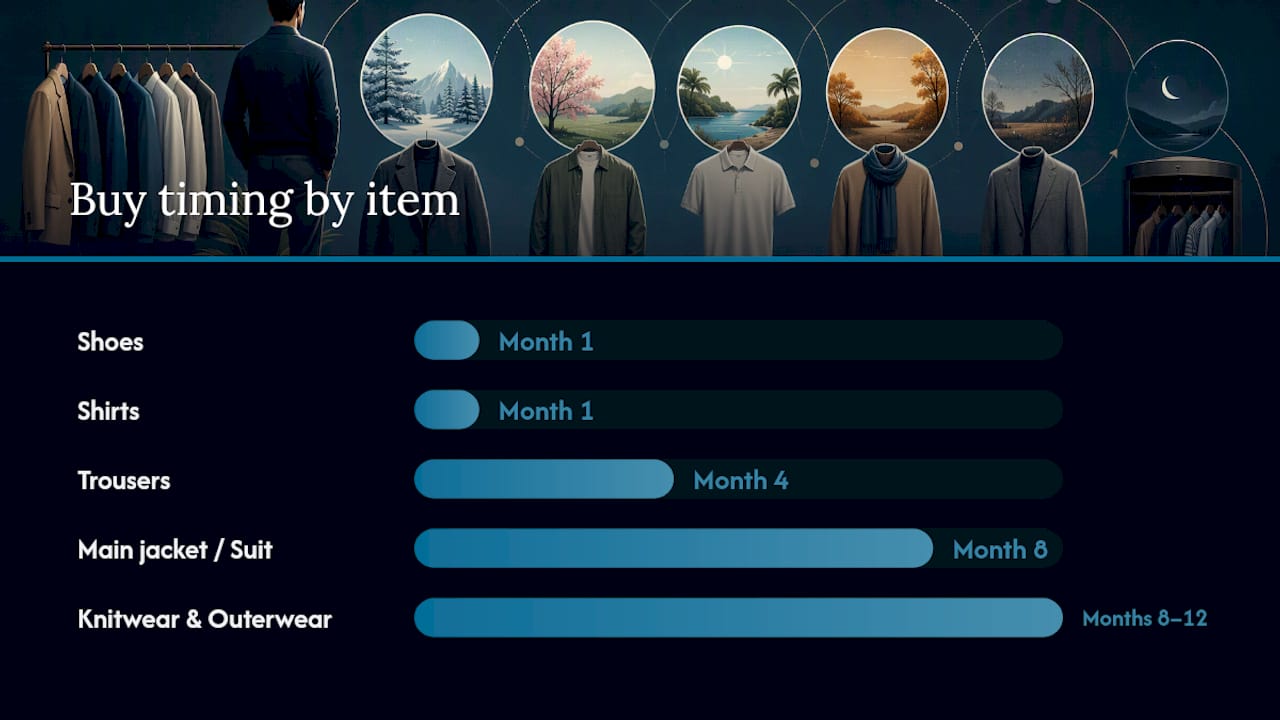
- Shoes first. They anchor every outfit and are the hardest thing to get right cheaply, so buy quality early and rotate two pairs from day one.
- Shirts next. They see the most wear per week of anything you own, particularly if you’re in an office several days out of five.
- Trousers, then a blazer or suit. Once your shirt and shoe foundation is set, add tailored bottoms, then your main jacket or suit.
- Knitwear and outerwear last. These are seasonal and lower-frequency, so they can wait until months eight to twelve without leaving you short.
Spread this across six to twelve months and budget in phases rather than one lump sum. Month one might cover shoes and three shirts; month four adds trousers; month eight brings in the suit.
Run a simple wardrobe audit before you buy anything new. For two weeks, note what you actually wear and how often it goes to the laundry. Items worn once a week earn a permanent spot; items untouched in a month get donated or sold. This wear-frequency method, tracking weekly wear against laundry cadence, gives you a tailored piece count instead of copying someone else’s list wholesale.
Don’t purge your existing wardrobe on day one. Build by addition, not subtraction: keep anything that already fits the neutral-plus-accent palette and slot new purchases in around it. Buying everything at once, then discovering half of it doesn’t suit your life, is the fastest way to abandon the whole project.
Choosing a colour palette that multiplies your outfits
Five neutrals do most of the heavy lifting in any men’s minimalist wardrobe: navy, charcoal, white, tan, and olive. Every one of these pairs with every other one, which is the entire point of a capsule.
Where most men go wrong is stopping there. Style editors warn that an all-neutral capsule quickly turns monotonous, and daily repetition of the same three colours starts to feel less like restraint and more like a rut.
The fix is deliberate, not decorative:
- Pick two or three accent colours, no more, and let them recur across categories, following advice on how to curate an identity-driven capsule wardrobe here.
- Burgundy or bottle green works well as a knitwear or accessory accent.
- Apply one accent to a casual shirt, one to a knit, and one to a small accessory like a watch strap or pocket square.
- Use texture, a heavier flannel, a nubby knit, a wool with visible weave, to add interest without adding colour.
Pro Tip: If you’re nervous about colour, start with texture instead. A ribbed knit and a smooth cotton shirt in the same navy read as two different pieces, not one repeated one.
Fit, tailoring, and why bespoke matters for a capsule
Fit is the single biggest factor separating a wardrobe that looks expensive from one that looks expensive but sits wrong. Style guides consistently rank fit above brand when it comes to how a garment actually performs on a body.
Four checks catch most problems: shoulder seams should sit at the edge of your shoulder bone, not beyond it; sleeves should end at the wrist bone; trousers should break just once at the shoe, or sit clean with no break for a slim silhouette; and a shirt collar should allow two fingers, no more, between fabric and neck.
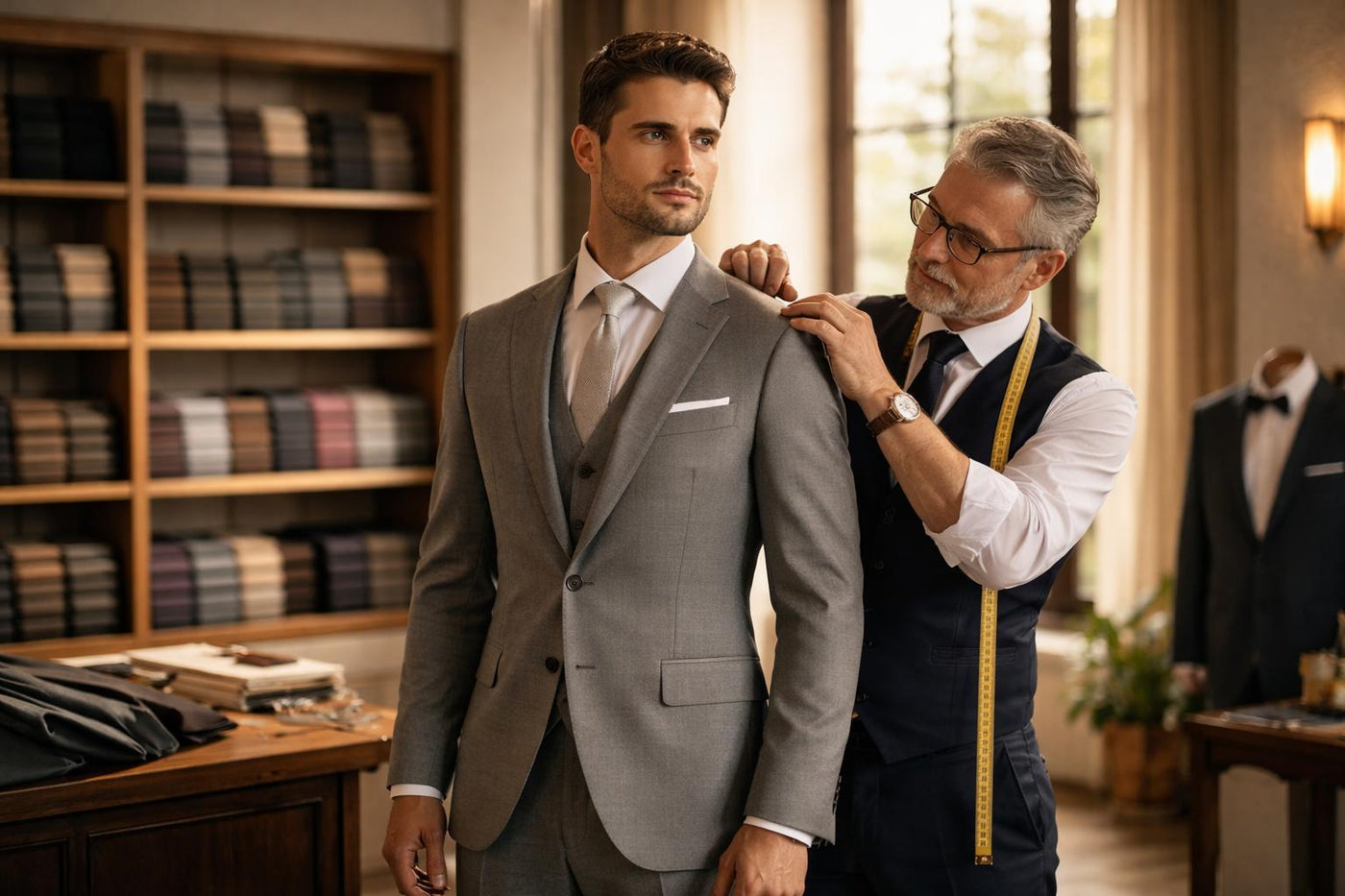
Hemming trousers, taking in a waist, or shortening sleeves on an off-the-rack jacket are inexpensive fixes that solve most fit complaints. But some pieces are worth building from scratch. A navy suit, your two most-worn shirts, and a blazer are exactly the categories where bespoke tailoring earns its price, because these are the pieces you’ll wear hundreds of times over several years.
The difference between an off-the-rack suit and a bespoke one isn’t the fabric on the bolt. It’s whether the jacket was cut for a body that exists in a size chart, or for yours specifically, down to how your shoulders sit and how you actually stand.
Ron & Rich has built suits and jackets on that exact principle since 1979, when founder Richard Fan began training tailors in techniques most workshops have since abandoned.
Where to spend and where to save on a capsule budget
Spend where the cost-per-wear is highest and the fit stakes are steepest: shoes, your main suit, and outerwear. These three categories get worn hardest, seen most closely, and are the most expensive to redo if you buy them cheap the first time.
Save on categories with low visual stakes and short lifespans anyway, plain tees, basic chinos, and gym-adjacent pieces that wear out regardless of price.
A quality 25-piece capsule, built over six to twelve months, typically runs somewhere in the $5,000 to $8000 range depending on how much of it is bespoke versus ready-to-wear. A few tactics stretch that budget further:
- Buy heavier outerwear in spring and summer sales, when demand is lowest.
- Repair before replacing: a resoled shoe or a re-lined jacket often costs a fraction of a new one.
- Think in cost-per-wear, not sticker price. A £400 suit worn twice a week for three years costs less per wear than a £120 suit that falls apart in eight months.
Outfit formulas: turning 25 pieces into dozens of looks
The multiplication effect is the entire reward for building a capsule properly. Six shirts, five bottoms and three layering pieces can produce roughly ninety base combinations before you even factor in shoes or accessories, and that’s the maths that makes a small wardrobe outperform a cluttered one.
- Office: navy suit, white shirt, brown Oxfords, no tie for a modern read.
- Office, dressed down: grey trousers, light blue shirt, sports jacket, loafers.
- Smart casual Friday: chinos, chambray shirt, quarter-zip knit, white trainers.
- Weekend errands: dark jeans, plain tee, bomber jacket, trainers.
- Weekend, smarter: chinos, check shirt untucked, loafers.
- Travel day: jeans, merino jumper, rain shell, trainers for comfort through transit.
- Client dinner: charcoal trousers, white shirt, blazer, Derbies.
- Cocktail event: navy suit worn without the tie, swapped for a knit underneath the jacket instead of a shirt, a formula worth exploring further in any cocktail attire guide.
- Cold weekend: jeans, henley, cardigan, wool overcoat over the top.
- Warm-climate office: tailored shorts, linen shirt, loafers, no jacket.
Swap one layer, a blazer for a knit, a tie removed, and the same outfit moves formality up or down without a single new purchase.
Care, rotation and the habits that protect cost-per-wear
Cost-per-wear only stays low if the garment lasts, and that comes down to habits more than fabric quality.
- Wash shirts and trousers less than you think you need to; over-washing breaks down fibres faster than wear does.
- Hang shirts and jackets on proper shaped hangers rather than folding them into drawers.
- Rotate at least two pairs of shoes so each pair gets a full day to dry out before its next wear.
- Resole leather shoes rather than replacing them; most soles can be renewed two or three times before the upper wears out.
- Run the “one-load test” before travel: pack only what fits one wash load, and you’ll rarely overpack.
Fold garments loosely for a suitcase rather than rolling tailored pieces, which creates permanent crease lines that ironing won’t fully remove.
Customising the capsule for your actual lifestyle
The 25-piece framework is a starting shape, not a fixed rule, and the categories bend depending on how you actually spend your week.
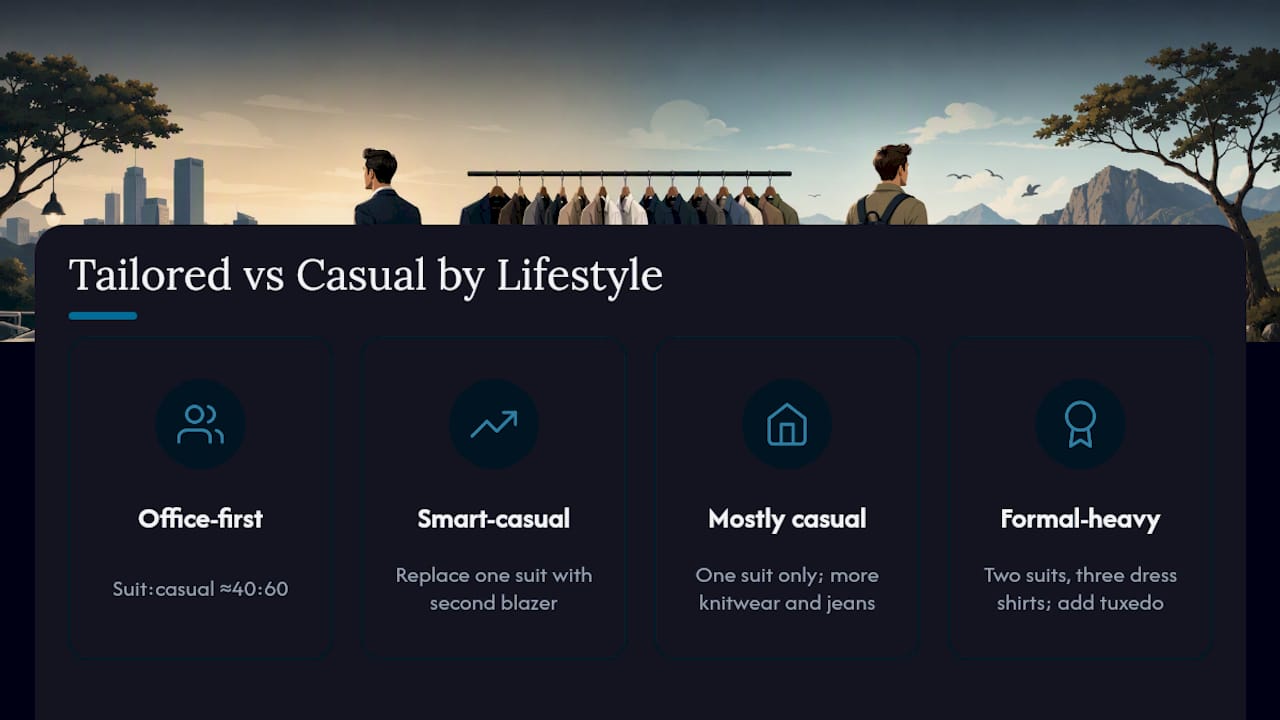
For an office-first, business capsule wardrobe: weight the list toward tailoring. Two suits instead of one, a fourth dress shirt, and one extra pair of trousers gives you more rotation for five-day office weeks. Cut a jean and a tee to make room. Readers building specifically toward an office capsule wardrobe usually find the suit-to-casual ratio needs to run closer to 40:60 than the standard 30:70.
For a smart-casual or hybrid work lifestyle: trade one suit for a second blazer and lean into knitwear, chinos and clean trainers. This suits men whose week mixes client meetings with remote days, where smart-casual formulas do more daily work than a full suit ever will.
For a mostly casual lifestyle: drop to one suit reserved for weddings and formal events, and put the extra budget into knitwear, jeans and outerwear instead, since those are the categories doing the daily heavy lifting.
For a formal-heavy lifestyle: two suits, three dress shirts, and a tuxedo or dark evening option replace some of the weekend casual pieces, since formal-first men need more rotation within tailoring, not more variety outside it.
The category totals barely move. What shifts is the ratio between tailored and casual pieces inside them, which is exactly why an audit of your actual week should come before any shopping list, borrowed from this article or anywhere else.
Publisher perspective: on fit, craft and capsule longevity
Richard has spent decades watching men buy well and dress badly, because the garment never fit the body underneath it. A capsule only works if every piece earns its place, and nothing exposes a poor-fitting suit faster than wearing it week after week. Fit first, always.
Aaron Fan
How Ron & Rich builds the foundation pieces of your capsule
A well-built navy suit, a properly cut blazer, and two shirts that fit through the shoulder and collar without adjustment are the hardest pieces to get right off the rack, and the ones that carry your capsule the furthest. Some bespoke tailors have decades of experience cutting foundation pieces for men who wear them hundreds of times a year, not once.
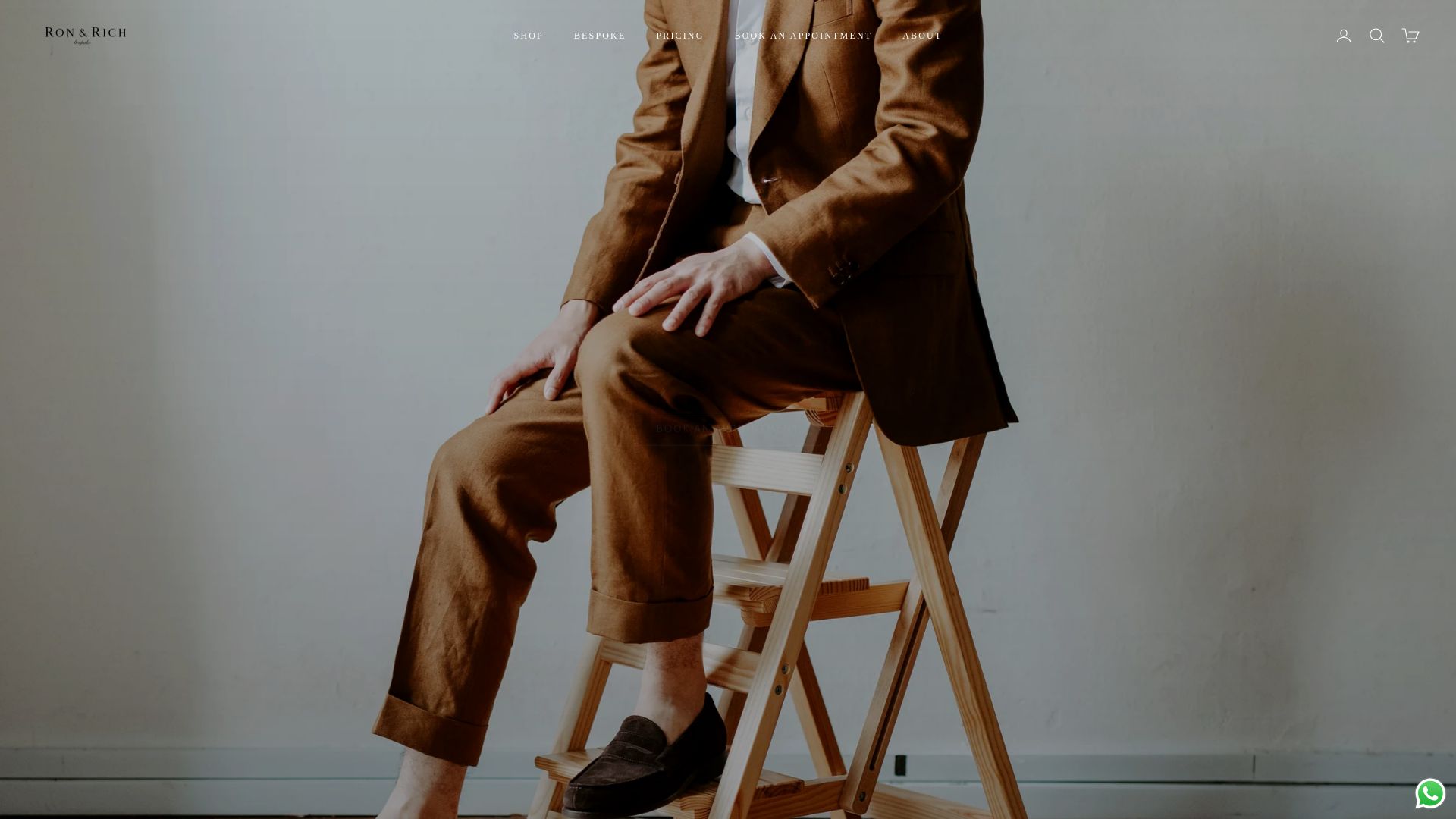
A consultation with Ron & Rich starts with a conversation about how you actually live in your clothes: office days, travel, the events you dress up for. From there, a tailor talks you through fabric weight and finish before taking a full set of measurements, with a realistic timeline agreed before you leave. Whether you need custom shirting, a foundational bespoke suit, or a look at the full bespoke process before committing, the starting point is the same fitting room conversation. Book a fitting and let the two or three hardest pieces in your capsule be the ones built specifically for you.
Sources
- The 25-Piece Men’s Capsule Wardrobe for 2026
- The Ultimate Men’s Capsule Wardrobe, in 15 Foolproof Pieces
- Capsule wardrobe mistakes and how to avoid them
- How to Build a Capsule Wardrobe: 10 Pieces Every Man Needs