Boutonniere Loop on a Suit: What It Is and How to Use It
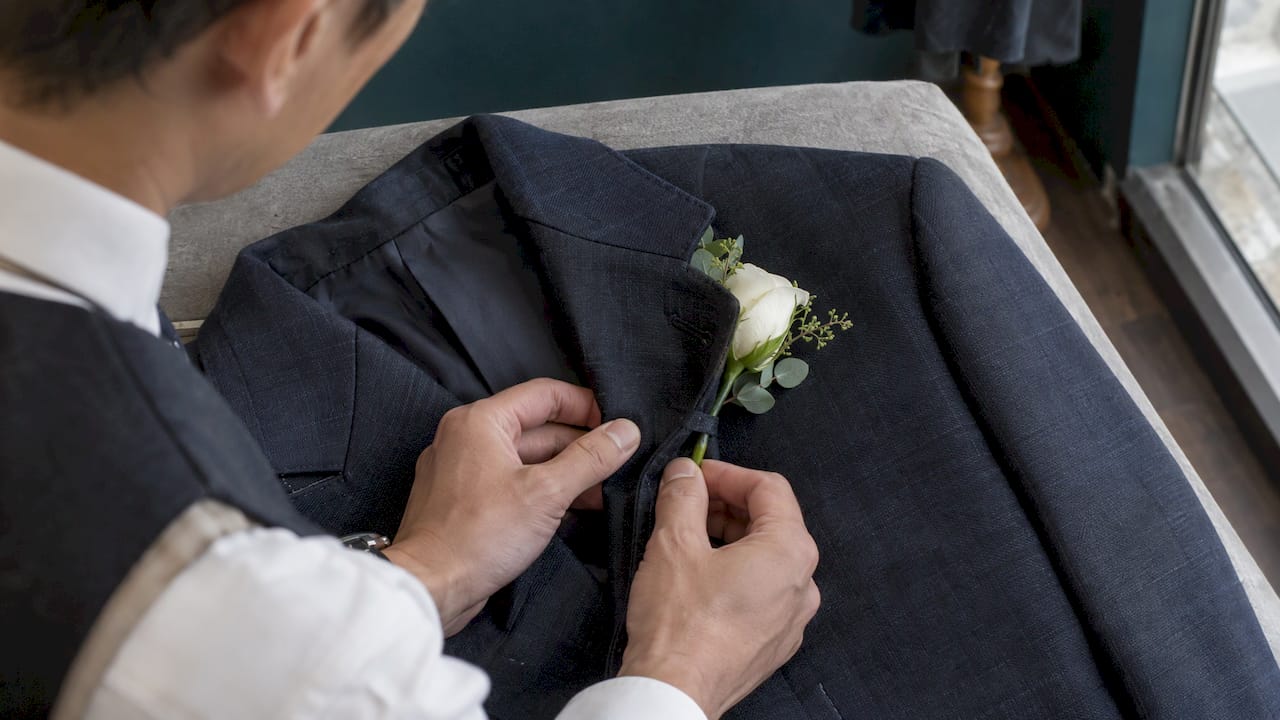
A boutonniere loop is a small stitched loop of thread or silk on the underside of the left lapel, set just below the buttonhole. It holds the stem of a lapel flower upright, so no pin is needed. It is also one of the quiet signs of a well-made jacket. Below, we explain how the loop works, where the flower belongs, what to do when your suit has no loop, and how a tailor can add one.
TL;DR
- The loop (also called a stem keeper or latch) sits on the back of the left lapel, roughly one to two inches below the buttonhole. The stem passes through the buttonhole and rests in the loop.
- Most ready-made jackets do not have one. It is traditionally found on bespoke or very expensive ready-to-wear jackets, and a tailor can add it.
- No loop? Place the flower on the left lapel at heart height and secure it from behind with a pin, or use a magnetic clip.
- A boutonniere suits weddings and formal occasions, and is best left at home for funerals and interviews.
- If you plan to wear one often, mention it when you order a suit, so the buttonhole and loop are made to hold a flower properly.
Table of Contents
- What a boutonniere loop is, and how it relates to the buttonhole
- Where the boutonniere sits on the lapel
- How to wear a flower with a loop
- How to wear a flower without a loop
- When a flower on the lapel is appropriate
- Adding a boutonniere loop to a suit you already own
- Our perspective
- Order a suit made for the flower you wear
- FAQ
- Sources
What a boutonniere loop is, and how it relates to the buttonhole
The lapel buttonhole is the small slit on the left lapel of a jacket. It is a vestige of the days when lapels could be closed up to protect the neck, and it measures about 1 to 1.5 inches, according to The Art of Manliness. Today its main purpose is to carry a flower.
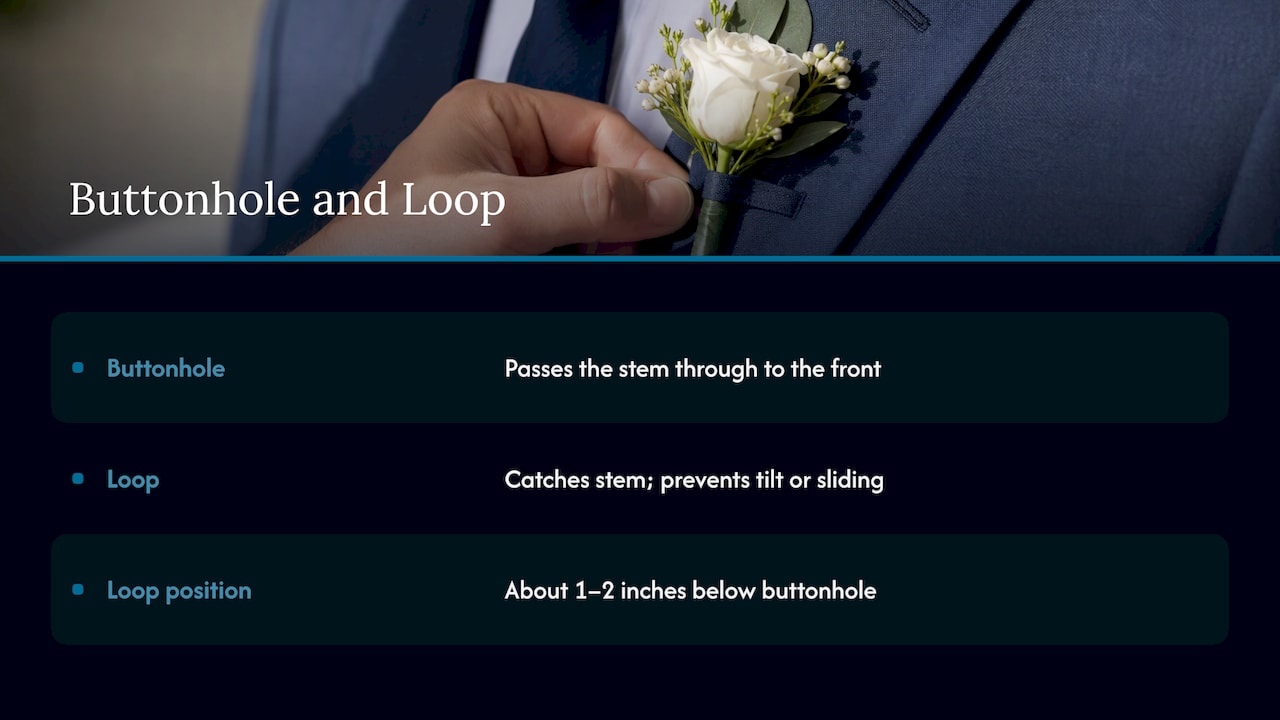
The loop is the partner of that buttonhole. Think of the two as one system: the buttonhole lets the stem pass through to the front, and the loop, hidden on the underside, catches the stem and keeps the flower from tilting or sliding out. The same source describes a properly prepared jacket as one with a strong hand-sewn inner lining, a hand-stitched buttonhole and a silk latch sewn one to two inches beneath the buttonhole.
The exact position varies from one tailor to another. Gentleman’s Gazette suggests about one inch under the buttonhole, on the backside of the lapel, and recommends a thicker thread for sturdiness. Bespoke Unit mentions about two inches. The right distance depends on the length of the stem you intend to use and on the lapel itself, which is why it is best settled at a fitting rather than by rule.
Why it marks a well-made jacket
The loop is rarely included on current jackets. Gentleman’s Gazette notes that typically only bespoke jackets or very pricey ready-to-wear garments feature one, and The Art of Manliness puts the share of modern jackets with these features very low, at 99% without them. A functional buttonhole and loop take hand work, and that is exactly why they have long been read as a small mark of quality tailoring.
The modern variation: no back loop
Not every tailor now sews a loop. A Singapore alteration service notes that recent trends allow a boutonniere to be worn without a back loop for a sleeker, more modern look. In that case the buttonhole alone does the work, often with a pin hidden behind the lapel. Both approaches are valid. The loop is the traditional answer, and the loopless buttonhole is the minimalist one.
Where the boutonniere sits on the lapel
The convention is firm and easy to remember. A boutonniere lives on the left lapel, is fastened above the heart, and is placed in or near the lapel’s buttonhole, as Bespoke Unit sets out. The Knot reports an etiquette expert’s view that the left side aligns with the heart, symbolising love and affection, and has been the standard placement for centuries. It is also the side most visible when you stand or greet people.
A few practical refinements:
- Jacket with a buttonhole: the stem goes through the buttonhole and, if there is a loop, into the loop behind it. Hesank says that for single-breasted suits a pin belongs near the buttonhole, through it if open, or just above it if closed.
- Jacket without a buttonhole: if the lapel is notched or peaked, The Knot advises pinning the boutonniere to the centre of the lapel directly under the notch.
- Height: roughly between the top and middle of the lapel, about 1 to 2 inches below the collar, according to Hesank.
- Flower size: for flowers with a large calyx, such as a carnation, Wikipedia notes a buttonhole of at least 1+1/8 inches (29 mm) is needed so the petals lie flat against the lapel.
The shape of your lapel affects how a flower looks. A broad peak lapel carries a larger bloom comfortably, while a slim notch suits something smaller. If you are weighing the two, our guide to notch versus peak lapels explains how each frames the chest. For a deeper read on lapel and buttonhole details, the wider fashion coverage there is a good companion.
How to wear a flower with a loop
If your jacket has the buttonhole and loop, the process takes less than a minute and requires no pin.
- Check the left lapel for an open buttonhole. FTD describes the latch as a horizontal string below the buttonhole on the back of the lapel.
- Slide the stem from the front through the buttonhole.
- Guide the stem behind the lapel and through the loop, so it is held snugly.
- Straighten the flower so it sits upright, with the petals resting flat against the cloth.
- Step back to a mirror: the stem should be invisible from the front and the bloom should not hang forward.
If the buttonhole is sewn shut, as is common on ready-made jackets, it can be opened. Gentleman’s Gazette explains how to open a sewn-shut buttonhole with a small sharp tool and a gentle cut, taking care not to damage the seam or the surrounding threads. We would rather you let a tailor do this on a suit you value. The cut is quick, but a slip is permanent.
How to wear a flower without a loop
Most men reading this will own at least one jacket with no loop, and a boutonniere can still be worn well.
With a pin
The aim is for the pin never to show. The Knot describes it this way: position the flower where it should sit, lift the lapel, push the pin through the underside and the thickest part of the stem, then back through the fabric, so both ends stay under the lapel. Burton Floral Design adds that you should use one or two pins and never pin through the front of the jacket. A Singapore florist, FNP, suggests a safety pin from behind the fabric, keeping the flower upright with the pin hidden.
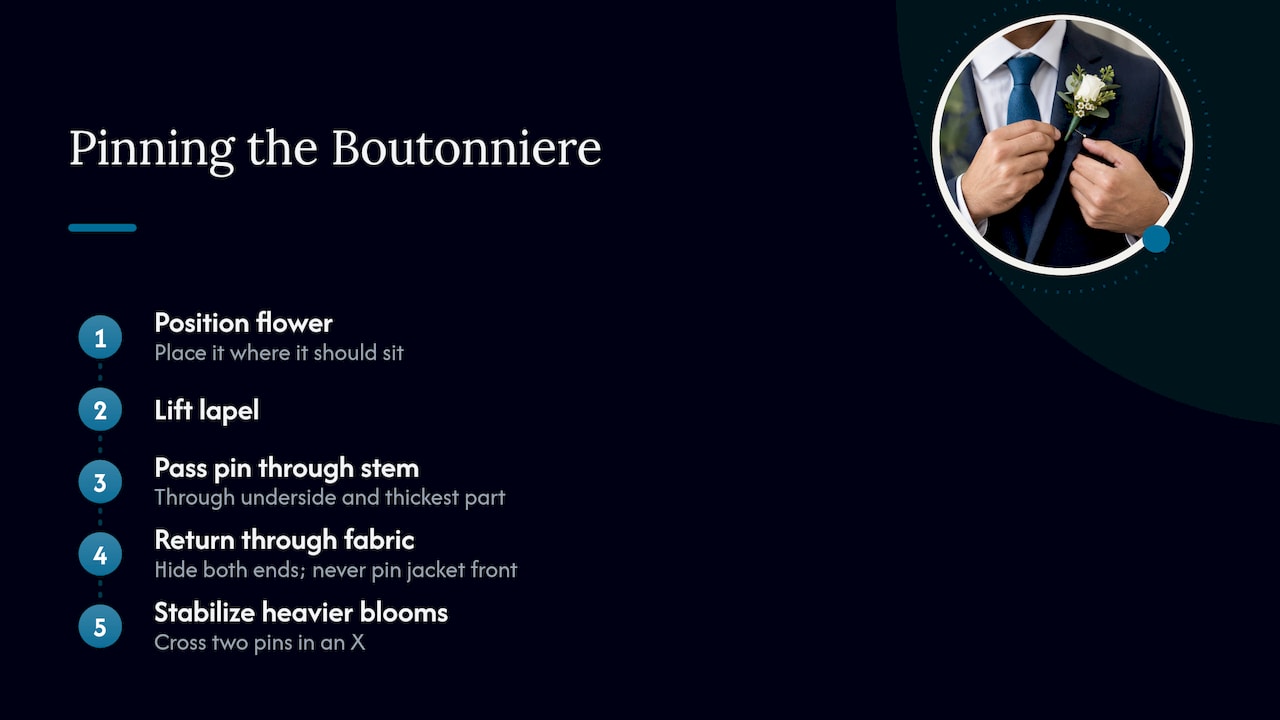
Two pins crossed in an X, with the points kept behind the cloth, hold a heavier flower more steadily than a single pin.
With a magnet
Magnetic holders place one magnetic piece on the flower and another behind the lapel, so the cloth is not punctured. QuickClips Floral describes the design as placing the magnets behind the flowers rather than in the stem, which helps stop the bloom becoming lopsided. Flowers by Janie notes this works only if the jacket is not too thick and the wearer does not have a pacemaker. If you have a pacemaker, choose another method.
Adhesive
Mixed Kreations describes using double-sided tape or floral adhesive on the back of the stem, pressed onto the fabric. This is a last resort for a short event, since adhesive can mark fine cloth.
Comparing the methods
| Method | Needs | Marks the cloth? | Best for |
|---|---|---|---|
| Buttonhole and loop | Open buttonhole, back loop | No | Bespoke jackets, daily wear |
| Buttonhole only | Open buttonhole | Minimal, with hidden pin | Modern, slim look |
| Hidden pin | Any lapel | Small pinhole | Any jacket, one-off events |
| Magnet | Not-too-thick cloth | No | Short events, delicate fabrics |
| Adhesive | Tape or floral adhesive | Possible residue | Emergencies only |
Gentleman’s Gazette cautions that pinning directly through the lapel face compromises elegance and can damage the fabric. That is the main reason a loop and buttonhole are valued: they hold the flower without any pin on show.
When a flower on the lapel is appropriate
The boutonniere symbolises fragile life, beauty in nature and love, according to The Art of Manliness. It is commonly worn at weddings, anniversaries, proms, the theatre or the opera. The same source says you do not need a special occasion, but you should skip it where you do not want to stand out or are being judged, such as funerals and interviews.
At a Singapore wedding
FNP Singapore says the boutonniere is traditionally reserved for the groom and key male members of the wedding party. It lists roses in white, ivory or red, calla lilies for black tie, alstroemeria for long vase life, orchids for slim lapels and carnations for outdoor weddings. This suits our climate well: heat and humidity are hard on fresh flowers, so a hardy stem makes sense.
A local florist, The Florté, reports a groom’s boutonniere in Singapore at $28 to $60 for a single stem or small cluster, and says a groom photographed without one at a ROM (Registration of Marriage) can look underdressed. Prices vary by florist and season, so ask for a current quote. Poppy Flowers states that fresh flowers last four to six hours out of water when prepared properly, and suggests pinning 30 to 60 minutes before the ceremony. Their figures are US-based, but the timing advice applies in any climate.
Boutonniere and pocket square
Some style guides advise against wearing a boutonniere and a pocket handkerchief together to avoid crowding, while others allow both if one or both stay simple, as Wikipedia notes. Our view: if the flower is the statement, let the pocket square be a plain white fold.
Adding a boutonniere loop to a suit you already own
The loop is small enough to be added afterwards. The Gentleman’s Gazette guide describes it as something a tailor can add, or you can sew yourself. The same applies to a missing or sewn-shut buttonhole: the Singapore alteration service mentioned above offers to create a boutonniere buttonhole for suits that did not come with one.
What a careful tailor will consider:
- Lapel construction: the loop needs a firm place to anchor, so the stitching should catch the canvas or inner lining and not just the face cloth.
- Thread: a thicker, strong thread, as Gentleman’s Gazette advises, so the loop does not fray under the weight of a stem.
- Distance from the buttonhole: one to two inches, matched to your usual flower.
- Buttonhole length: long enough for the bloom you wear. A carnation needs more room than a slim rosebud.
For a suit you care about, this is better entrusted to a tailor than done at home.
Our perspective
We have always regarded the lapel as the frame of a jacket, and the buttonhole as the place where that frame can carry a small gesture. A boutonniere loop is exactly that kind of gesture: unseen, hand-worked, and noticed only by the wearer and by those who know.
Our house was founded in 1979 by master tailor Richard Fan, and we still believe that craft lives in such details. When a gentleman tells us he will wear a flower, whether at his wedding, at a black-tie evening or simply because he enjoys it, we treat the buttonhole and its loop as part of the design of the jacket and not an afterthought.
Bespoke tailoring allows this. Your measurements, your lapel, your preferences and your climate are all considered, and the finishing is made for the way you will really wear the suit. Mention it at your first consultation, and we will gladly discuss how the lapel should be finished.
Ron
Order a suit made for the flower you wear
If you are planning a wedding or simply want a jacket that finishes properly at the lapel, our bespoke service is where we would begin. We make custom-tailored suits, tuxedos and wedding suits to individual measurements, with premium fabrics suited to Singapore’s climate. Published prices start from 2170 $ for suits, 2270 $ for tuxedos and 1790 $ for sports jackets; waistcoats start from 380 $ and shirts from 199 $. See the full bespoke pricing or explore our tailored suits.

For a groom, our tuxedos and wedding suits are made in the same way, and a quick note at the fitting about your boutonniere is all we need.
FAQ
How do you pin a flower on a suit?
Place the flower on the left lapel at heart height, lift the lapel, and push the pin up from behind through the stem. Bring the point back through the cloth so both ends remain under the lapel. Use one or two pins, and never pin through the front of the jacket.
How can you attach a boutonniere without a pin?
If your jacket has an open buttonhole, thread the stem through it and into the loop on the back of the lapel. If there is no loop, a magnetic clip is the cleanest alternative, provided the cloth is not too thick and the wearer has no pacemaker.
What does the flower on the lapel mean?
It traditionally symbolises love, beauty in nature and the fragility of life, and is worn on the left, above the heart. It is associated with weddings and formal events, and the groom and key male members of the party usually wear one.
Can a tailor add a boutonniere loop to my suit?
Yes. A tailor can open or create a buttonhole and stitch a loop beneath it, usually one to two inches below, using a strong thread. Tell the tailor which flower you plan to wear so the buttonhole length suits it.
Sources
- How to Wear a Boutonniere, The Art of Manliness
- Boutonnière Button Hole Creation, The Alteration Studio
- Boutonniere Loop Stem Keeper, Gentleman’s Gazette
- How To Put On A Boutonniere & Lapel Flower Pin, Gentleman’s Gazette
- How To Wear A Boutonnière, Bespoke Unit
- How to Put on a Boutonniere, The Knot
- How to Wear a Pin on a Suit, Hesank
- Boutonnière, Wikipedia
- How to Put on a Boutonniere in 5 Easy Steps, FTD
- How do you pin a boutonniere the right way, Burton Floral Design
- Corsage and Boutonniere Wedding Guide, FNP Singapore
- How to Attach a Boutonniere Without Pins, QuickClips Floral
- Tips for How to Wear a Boutonniere, Flowers by Janie
- How To Attach A Boutonniere Without A Pin, Mixed Kreations
- Wedding Flowers Singapore 2026, The Florté
- Wedding Boutonnieres: Styles, Etiquette & Complete Guide, Poppy Flowers