The Barchetta Breast Pocket: A Tailor's Complete Guide
A barchetta breast pocket is a curved, boat-shaped welted breast pocket rooted in Neapolitan bespoke tailoring, its name literally means “little boat” in Italian, and its gently arching welt, typically around the length suited to the wearer’s chest size, sets it apart from every straight-cut English alternative. To request one from your tailor, say: “I’d like a barchetta breast pocket; curved welt, blunted upper corner, hand-shaped.” Bring a close-up photograph of the welt arc and corner treatment. At Ron & Rich, founded in 1979 by master tailor Richard Fan, this pocket style is one of the most requested details among clients who understand what Neapolitan tailoring actually means at the construction level.
Key Takeaways
A correctly made barchetta breast pocket requires all three of its defining features a curved welt, a blunted upper corner, and a thicker welt width and can only be properly set through hand-shaping confirmed at a basted fitting.
| Point | Details |
|---|---|
| Identify a barchetta by three traits | Look for a curved welt, blunted upper corner, and a thicker welt, all three must be present. |
| Typical welt length varies with chest size and proportions | Scale up or down with chest size; a medium chest size suits a medium welt length with a moderate arc rise. |
| Hand-shaping cannot be skipped | The pocket’s float and arc are set by hand at the basted fitting stage; machine approximations collapse over time. |
| Request one with a clear brief and a photo | Tell your tailor: “curved welt, blunted corner, hand-shaped” and bring a close-up reference image. |
| Ron & Rich offers this in Singapore | Ron & Rich’s bespoke process includes a basted fitting where the barchetta’s curve is confirmed before it is permanently set, according to their stated practice. |
Table of Contents
- What makes a barchetta breast pocket look different?
- Where the barchetta comes from
- How a barchetta is constructed, step by step
- Sizing a barchetta for different body types
- How the barchetta compares to other breast pocket styles
- Which jackets and occasions suit a barchetta?
- How to request a barchetta from your Singapore tailor
- Common mistakes and how to preserve the pocket’s shape
- How we shape a barchetta at Ronandrich
- Why the barchetta matters more than most clients realize
- Commission your barchetta at Ronandrich
- Sources
What makes a barchetta breast pocket look different?
The barchetta’s identity lives in three visible details: the curve of the welt, the treatment of its upper corner, and the thickness of the welt itself. Together, these create the boat-like silhouette that distinguishes it from Anglo pocket styles.
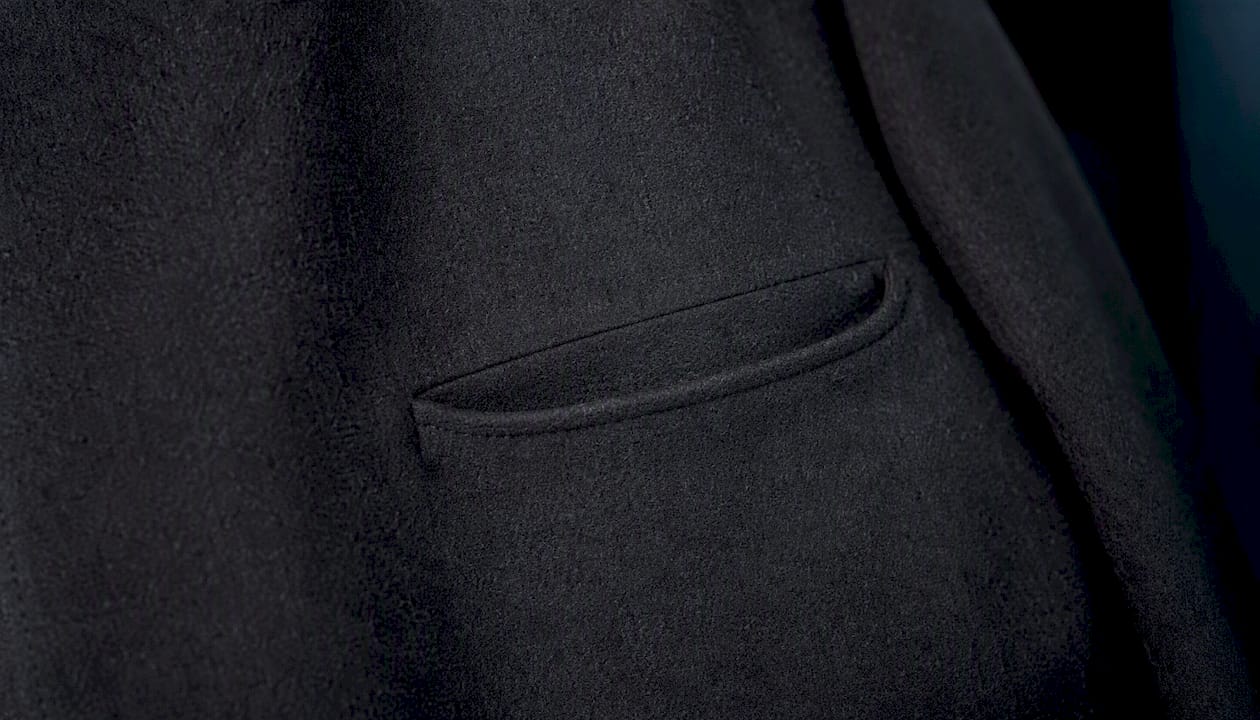
The welt arc. Rather than running in a straight horizontal line, the barchetta welt sweeps gently upward toward one or both ends. This rise is subtle, rarely more than a few millimeters at its highest point but unmistakable once you know what to look for.
The blunted upper corner. A straight welt pocket ends in a sharp, precise corner. The barchetta’s upper corner is deliberately softened, almost rounded, which reinforces the floating, organic quality of the pocket’s silhouette.
The thicker welt. Authentic barchetta pockets use a welt that is noticeably wider than a standard English welt. Where a conventional breast pocket welt typically measures about an inch, a barchetta welt is wider to give the curved opening visual weight. That extra width is not decorative, it gives the curved opening the visual weight it needs to read as intentional rather than accidental.
In photographs, look for these three cues simultaneously. A pocket with a curve but sharp corners and a thin welt is likely a machine-approximation, not a true barchetta. The pocket bag itself is shallow, and the opening sits with a soft, slightly relaxed quality, a sign of hand-finishing rather than pressed rigidity.
Identifying a barchetta at a glance: curve + blunted corner + thicker welt. All three must be present. Any two without the third is a different pocket.
Where the barchetta comes from
Barchetta translates directly as “little boat,” and the name captures something precise about the pocket’s character: it appears to float on the chest, curving upward like a bow riding a gentle swell. This is not accidental poetry. The pocket emerged from the Neapolitan bespoke tradition, where softness, handwork, and a deliberate avoidance of rigidity define the entire tailoring philosophy.
Neapolitan tailoring differs from its Savile Row counterpart in one foundational way: it prizes the appearance of ease over the appearance of structure. Jackets are built with less canvas, less padding, and more hand-shaping, the garment is meant to drape rather than hold. The barchetta is an expression of that same sensibility applied to a single detail. A straight, machine-cut welt would contradict the jacket’s entire spirit. A curved, hand-shaped one reinforces it.
The pocket also carries a social signal. Wearing a jacket with a barchetta communicates familiarity with Italian tailoring tradition, not as an affectation, but as a considered choice. It tells a knowledgeable eye that the wearer values craft over convention.
How a barchetta is constructed, step by step
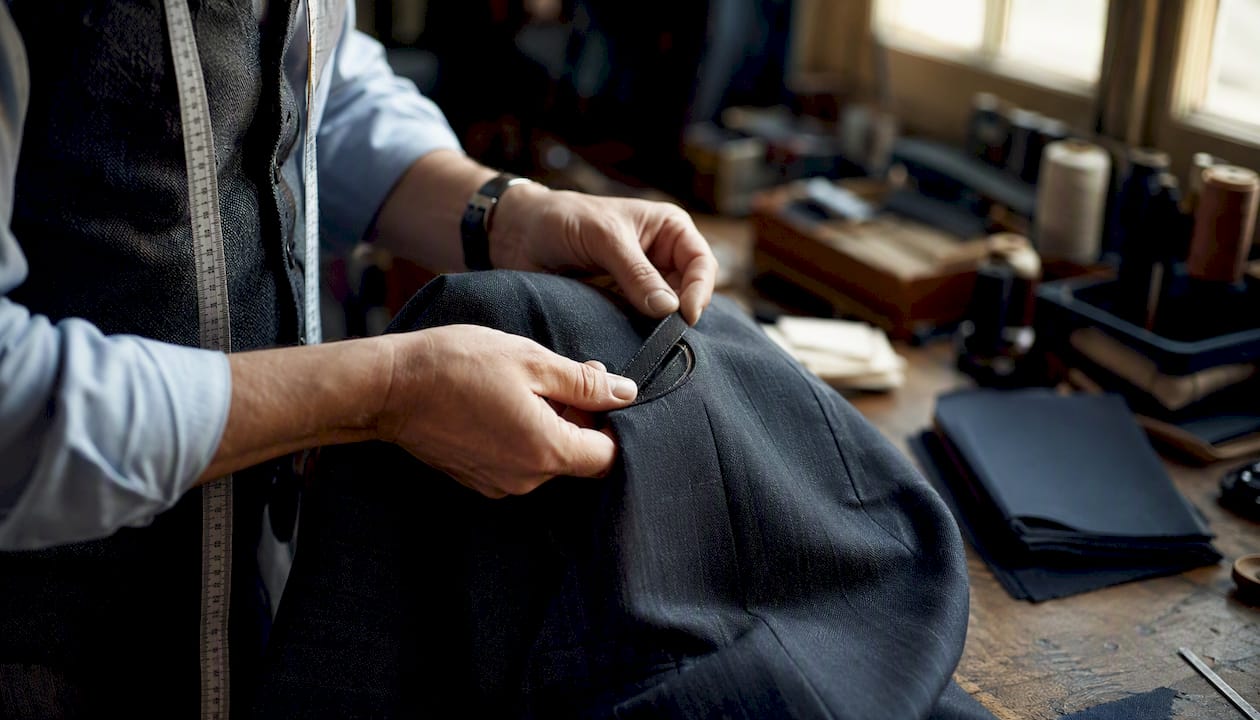
The construction sequence is where the barchetta’s character is either earned or lost. A hand-shaping process is not optional, it is the method.
- Mark the curve on the jacket front. The tailor draws the pocket’s arc directly onto the basted jacket canvas, accounting for the chest’s natural contour and the lapel’s roll line. The curve is not a template, it is drawn fresh for each client.
- Cut and prepare the welt. The welt strip is cut on the bias or straight grain depending on the fabric, then interfaced lightly to hold its shape without stiffening. Its width is cut generously to allow for the final finished measurement.
- Understitch and baste the welt. The welt is basted into position along the marked curve. At this stage, the pocket exists only as a pinned, temporary shape, the basted fitting happens before any permanent stitching.
- Bag the pocket. The pocket bag is attached behind the welt opening. Because the opening is curved, the bag must be eased carefully to avoid pulling the welt flat. This easing is done by hand.
- Hand-finish and ease the curve. The tailor works the welt’s ends by hand, coaxing the slight rise at each corner through pressing and pad-stitching near the chest. Pick-stitching along the welt edge secures the shape while maintaining a soft, unforced appearance.
- Final pressing and float check. The finished pocket is pressed lightly, never hard-pressed flat and checked for float: the welt should sit slightly proud of the jacket front, not collapsed against it.
The basted fitting stage is critical. It is the only moment when the curve’s placement, height, and arc can be adjusted before the pocket is permanently set. Skipping it means committing to a shape the client has never approved.
Pro Tip: A hand-shaped barchetta shows a very slight, organic irregularity along its arc when examined closely. A machine-made approximation will have a perfectly uniform curve, which, paradoxically, is the tell that it was not made by hand.
Sizing a barchetta for different body types
Proportion is everything. A welt that reads correctly on a 42-inch chest will look undersized on a 46-inch chest and oversized on a 38-inch chest.
The arc rise, how much the welt lifts at its ends should also respond to lapel width. A wider lapel can carry a fuller arc; a narrow lapel looks better paired with a shallower curve. For shorter torsos, keep the welt length at the lower end of the range and reduce the arc rise to avoid the pocket appearing to crowd the lapel. Heavier fabrics, such as flannel or tweed, benefit from a slightly wider welt because the cloth’s texture absorbs visual detail, a narrower welt can disappear into the weave.
How the barchetta compares to other breast pocket styles
The choice between pocket styles is a genuine design decision, not a matter of preference alone. Each type carries different formality signals and construction implications.
- Barchetta vs. straight welt: The straight welt is the Anglo standard precise, horizontal, and formal. The barchetta is softer and more Italianate. On a structured British suit, a barchetta would feel incongruous; on a Neapolitan-inspired jacket, a straight welt would feel stiff.
- Barchetta vs. flap pocket (breast position): Flap pockets at the breast are rare and typically appear on field or safari jackets. They add bulk and a utilitarian quality that contradicts the barchetta’s elegance.
- Barchetta vs. patch pocket: A patch pocket sits on the surface of the jacket front and reads as casual or sporting. The barchetta is welted and therefore more formal, though still softer than a straight welt.
- Barchetta vs. jetted pocket: A jetted pocket uses two narrow lips rather than a single welt. It is the most formal breast pocket option, associated with black-tie and very structured suits. The barchetta sits one register below in formality, appropriate for business and smart occasions without the severity of a jetted finish.
Within the barchetta family, small variations in welt width, corner blunting, and arc depth create meaningfully different results. A wider welt with a pronounced arc reads as more expressive and Neapolitan; a narrower welt with a shallower curve approaches the straight welt’s restraint while retaining the pocket’s essential softness.
Which jackets and occasions suit a barchetta?
The barchetta works best as a softer, more Italianate alternative to the straight welt, which means it belongs on jackets that share that sensibility. Unstructured or lightly structured suits in medium-weight fabrics are its natural home. Think wool fresco, mid-weight flannel, or a fine hopsack; cloths with enough body to hold the welt’s shape without the stiffness that would make the curved opening look forced.
Formality-wise, the barchetta sits comfortably between smart casual and relaxed bespoke. It is appropriate for business meetings, social dinners, and weddings where the dress code allows for personal expression. It is less suited to very formal occasions, a morning coat or black-tie jacket calls for a jetted or straight welt.
Styling notes worth keeping:
- A pocket square works beautifully with a barchetta. The curved opening frames a loosely folded square in a way that a straight welt cannot.
- Avoid overstuffing the pocket. The barchetta’s welt is shaped to float; a bulging pocket square collapses that float and defeats the pocket’s purpose.
- Spread or semi-spread collars complement the pocket’s Italian character. A button-down collar, by contrast, pulls the look toward American casual and creates a slight stylistic dissonance.
- Lapel width should be proportionate to welt length, a narrow lapel with a long, full-arc barchetta creates visual imbalance.
How to request a barchetta from your Singapore tailor
Walk into a consultation with two things: a clear verbal brief and a photograph. The photograph matters more than most clients expect, tailors work visually, and a close-up image of a welt you admire communicates arc depth, corner treatment, and welt width faster than any description.
Simple phrasing for a first consultation: “I’d like a curved breast pocket, a barchetta style, hand-shaped, with a blunted upper corner.”
More technical phrasing for a bespoke fitting: “I’d like a barchetta breast pocket, approximately 11 cm welt length, welt width around 3 cm, with a moderate arc rise and a blunted upper corner. I’d like to confirm the placement at the basted fitting.”
Checklist to bring:
- A close-up photograph showing the welt arc and corner treatment
- A reference measurement if you have one (welt length from a jacket you own)
- Your preferred pocket square fold, so the tailor can account for the opening’s depth
In Singapore, bespoke jackets with hand-shaped barchetta pockets typically require two to three fittings and a lead time of six to ten weeks, depending on the tailor’s schedule and the complexity of the commission. The handwork involved in shaping and finishing the pocket adds time relative to a straight welt this is expected and appropriate. At the basted fitting, ask specifically: “Can we check the pocket’s float and arc before you set it permanently?” A tailor who welcomes that question is one who understands what the pocket requires.
Common mistakes and how to preserve the pocket’s shape
Most barchetta failures trace back to the same small set of errors, and most of them are visible at the basted fitting if you know what to look for.
Common construction mistakes:
- Pocket cut too flat, with no genuine arc in the welt opening
- Welt too thin, which makes the curve read as a defect rather than a design choice
- Sharp upper corner left unblunted, which eliminates the boat-like silhouette
- No pad-stitching near the chest to maintain the welt’s float, causing the pocket to collapse after a few wears
Care and maintenance:
- Store the jacket on a shaped hanger, a flat hanger allows the chest to sag and the pocket to lose its float over time
- Press lightly around the pocket, never directly onto the welt; use a pressing cloth and low steam
- Do not use the pocket as a functional storage space for anything heavier than a pocket square
- If the welt begins to flatten or the arc softens noticeably, return the jacket to your tailor for re-shaping, this is a minor intervention when caught early
Red flags at delivery: a welt that lies completely flat against the jacket front, sharp corners, or pick-stitching that pulls the welt tight rather than securing it softly. Any of these indicates the pocket was not hand-shaped.
How we shape a barchetta at Ron & Rich
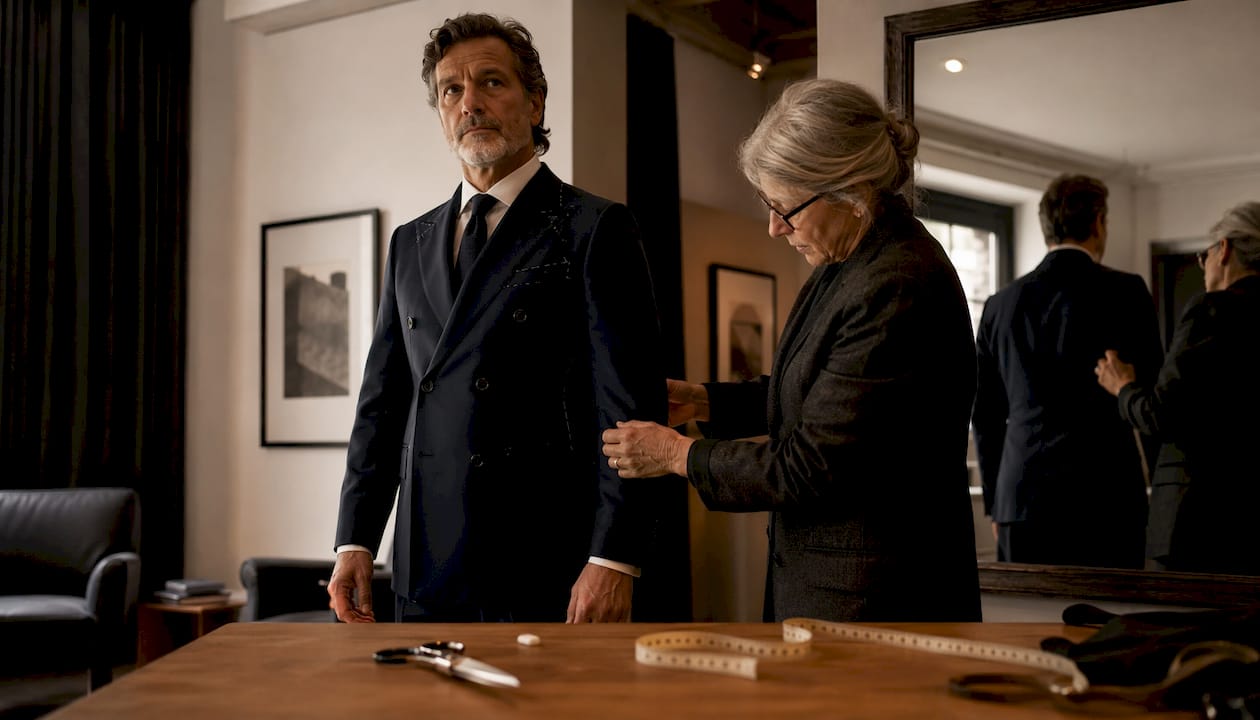
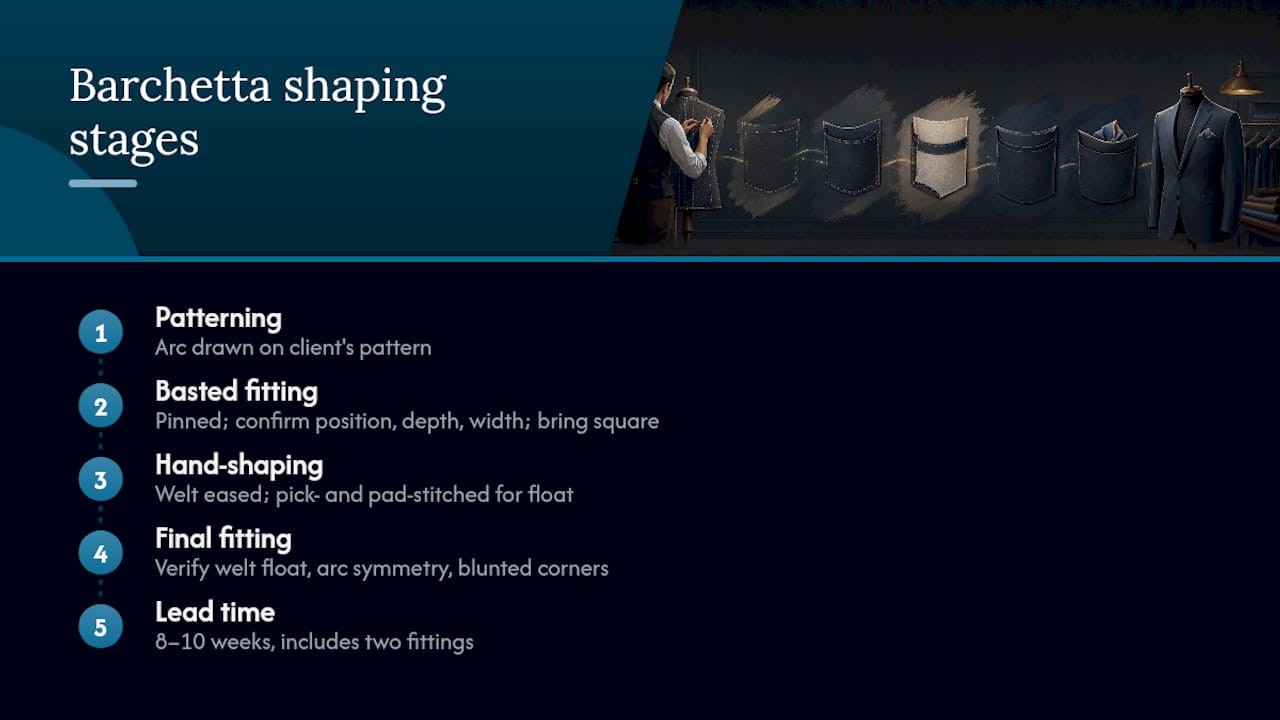
At Ron & Rich, the barchetta is formed across three distinct stages of our bespoke tailoring process. At the patterning stage, the pocket’s arc is drawn directly onto the client’s personal pattern, not transferred from a block, so the curve responds to that client’s chest contour and posture.
At the basted fitting, the pocket exists as a pinned, temporary shape. This is the moment when placement, arc depth, and welt width are confirmed with the client present. We ask clients to bring their preferred pocket square to this fitting so we can verify the opening’s depth against actual use.
Hand-shaping of the welt happens after the basted fitting is approved. The welt is eased by hand through the curve, pick-stitched along its edge, and pad-stitched near the chest to establish float. Final pressing is done with a light hand, the pocket should retain a slight lift, not lie flat.
Our typical lead time for a bespoke jacket with a barchetta breast pocket is eight to ten weeks, inclusive of two fittings. At the final fitting, we verify three things: the welt’s float, the arc’s symmetry, and the corner’s blunted finish. Clients who have commissioned bespoke suits and jackets with us consistently note that the barchetta is the detail that draws the most comment from other tailoring enthusiasts.
Why the barchetta matters more than most clients realize
There is a tendency in tailoring conversations to treat the barchetta as a stylistic flourish; a nice-to-have for clients who appreciate Italian aesthetics. That framing undersells what the pocket actually communicates.
A correctly made barchetta is evidence. It tells you that the jacket was built by someone who understands hand-shaping, who took the time to ease a curved welt rather than cut a straight one, and who cared about a detail that most people will never consciously notice. The pocket’s float, that slight lift away from the jacket front, is only possible when the construction beneath it is done correctly. You cannot fake it with pressing.
What I find most compelling about the barchetta is precisely this: it rewards the people who know what they are looking at, and it does so quietly. A client who requests one and receives a well-executed result has, in a single detail, confirmed that their tailor understands the difference between making a jacket and crafting one. That distinction is worth understanding before you walk into any fitting room.
Commission your barchetta at Ron & Rich
Ron & Rich offers a direct path from this article to a finished jacket with a hand-shaped barchetta breast pocket. Our bespoke service in Singapore includes a personal consultation, a basted fitting where the pocket’s arc and placement are confirmed with you present, and final hand-finishing by our atelier team.
To prepare for your consultation, bring a reference photograph of a barchetta welt you admire, your preferred pocket square, and any measurements from a jacket you already own. Our team will guide you through welt length, arc depth, and corner treatment based on your chest dimensions and the jacket’s cloth weight. Book your fitting through our bespoke jackets page , lead times are currently eight to ten weeks for a full bespoke commission.
Sources
The sources below offer visual and historical depth for readers who want to go further, each is listed with a note on what it contributes.
- The guide to jacket pockets
- Barchetta - The Fashiongton Post
- Creating a barchetta breast pocket for the jacket🪡