Suit Storage: How to Keep a Bespoke Suit in Shape
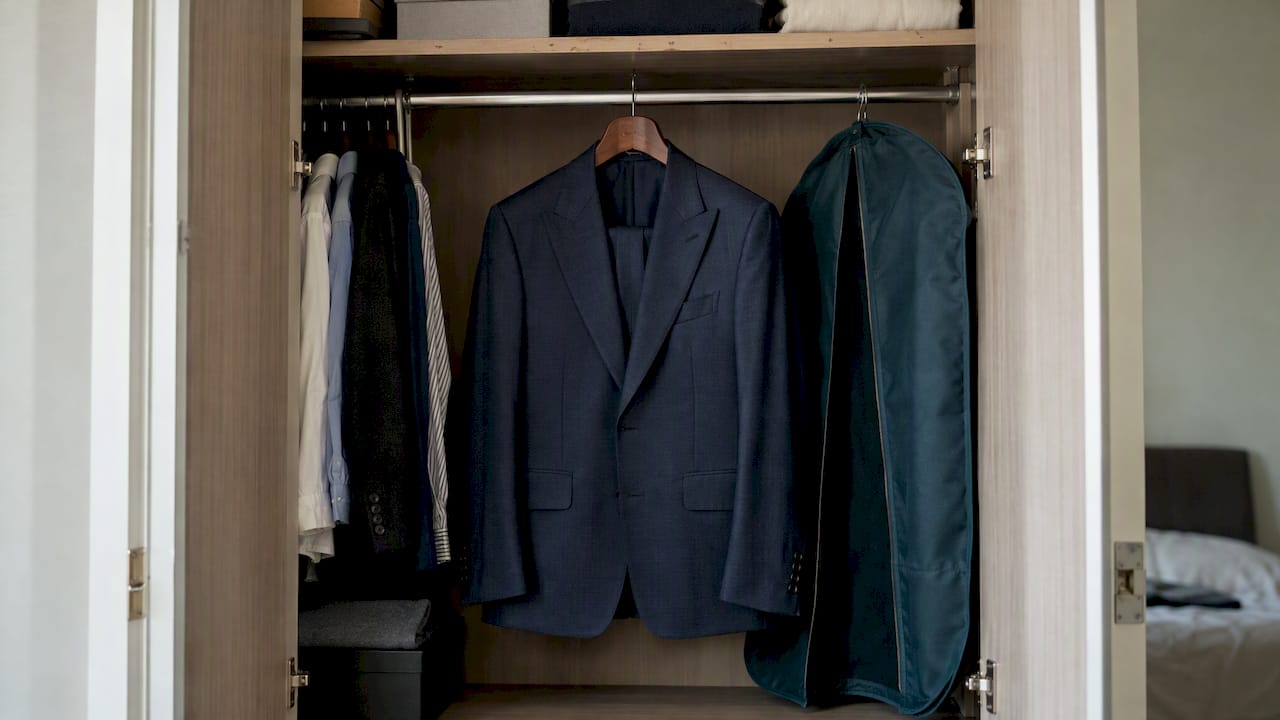
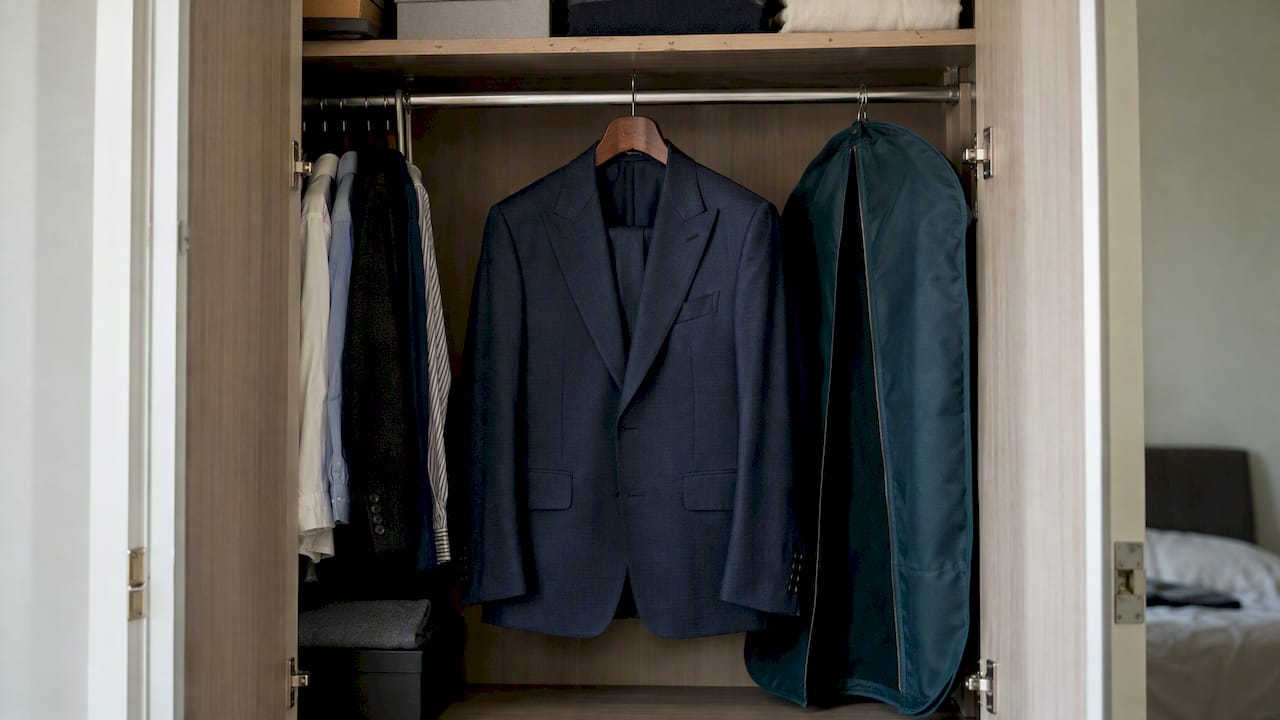
The best way to store a suit is on a broad, shoulder-shaped hanger, inside a breathable garment bag, in a wardrobe that stays dry and has room to move air. Clean the suit first, never crush it between other clothes, and fold it only when you travel. In Singapore, humidity is the real adversary, so the wardrobe matters as much as the hanger.
We have tailored suits since 1979, and a well-made jacket is shaped to the shoulder, chest and back of one man. Poor storage undoes that work slowly. This guide sets out how we advise our own clients to store suits day to day, over a season, and on the road.
TL;DR
- Hang every jacket on a wide, contoured hanger that supports the shoulders. Folding is for travel only.
- Use a breathable cotton or non-woven garment bag. Avoid sealed plastic for anything you keep for weeks, because trapped moisture invites mould.
- In Singapore, control wardrobe humidity with a dehumidifier or moisture absorbers, and leave space between suits.
- Clean before long-term storage, and check stored suits every few months.
- Packing for a flight: cushion the folds, or use a carry-on garment bag, and steam on arrival.
Table of Contents
- Why storage shapes how a suit ages
- Choosing the right hanger
- Garment bags: which ones, and when
- Storing suits at home in Singapore
- Long-term suit storage
- Storing and carrying a suit when you travel
- Our perspective: a suit is built to be hung, not stored away
- Bring your suit to us, or begin one that is made for your wardrobe
- FAQ
- Sources
Why storage shapes how a suit ages
A bespoke jacket is built from layers: cloth, canvas, padding and a carefully set shoulder. The cloth hangs from the shoulder, so that is where the weight is carried all day in the wardrobe. Experts quoted by Galaxus make the same point: structured jackets and blazers belong on supportive hangers to keep their form, and the heavier the garment, the more important the support at the shoulders.
Three things damage a stored suit more than anything else:
- Poor support. A thin wire hanger lets the shoulder collapse and leaves dimples at the sleeve head.
- Moisture. Damp cloth smells, marks and grows mould, and Singapore’s climate supplies the damp for free.
- Residue. Sweat, skin oils and food traces attract moths and set into the fibres.
Good storage deals with all three, and none of it is expensive.
Choosing the right hanger
The hanger is the single most important accessory a suit owns. Look for these qualities:
- Width. The hanger should reach nearly to the shoulder tip without pushing the seam outward. If the ends poke into the sleeve head, it is too wide. If the shoulder droops past it, it is too narrow.
- Contour. A curved, thick-shouldered shape mirrors the body. Flat, thin hangers create creases across the shoulder.
- Material. Solid wood or a well-finished moulded hanger holds weight without bending. Wire hangers are for returns from the dry cleaner, not for the wardrobe.
- A trouser bar. Hang trousers from the waistband with clips, or fold them along the crease over a padded bar. Let the weight of the cloth pull the crease straight.
One hanger per suit jacket, always. Two jackets on one hanger deform both. If your jacket has a soft shoulder, as many of our designs do, support still matters: a lighter construction relies on the hanger even more. Our fit check for a soft shoulder suit explains how that construction behaves.
A note on buttons
When you hang a jacket, fasten the top button of a two-button jacket (the button stance that sits at the waist) so the front hangs flat and does not splay. Do not leave it strained: it should rest closed without pulling. Undo it before you put the jacket on or sit down. A double-breasted jacket should hang with its inner button fastened so the overlap stays aligned.
Garment bags: which ones, and when
The garment bag is the most searched part of this topic, and the cheap options at the top of the results are not all equal. The question is not whether to use one, but what it is made of.
| Type | Best for | Watch out for |
|---|---|---|
| Cotton or canvas, breathable | Everyday wardrobe and long-term storage | Needs a clean, dry wardrobe; wash the bag itself occasionally |
| Non-woven fabric with a window | Short seasons, visible labelling | Thin fabrics tear; check zips |
| Thin plastic dry-cleaner sleeve | Carrying a suit home | Traps moisture; remove it once home |
| Nylon travel bag with a hanger | Flights and business trips | Designed to carry, not to store for months |
Our rule is simple. Cloth breathes, plastic does not. A suit that is kept for weeks in a sealed plastic cover in a humid room can grow mildew on the lining or inside the collar. Remove the dry-cleaner plastic as soon as you reach home and transfer the suit to a breathable bag.
Select a bag that is long enough for the jacket and trousers with room to spare, so that the cloth is not pressed against the zip. A bag with a gusset or a generous width suits a structured jacket better than a narrow cover.
Storing suits at home in Singapore
The average Singapore home is warm and damp throughout the year. Wardrobes, especially those against an outer wall or in a room without air conditioning, trap that humidity. Practical advice for preventing mould in Singapore’s humid climate recommends dehumidifiers and moisture-absorbing products such as calcium chloride packs, which suit wardrobes and shoe cabinets, and need replacing every few weeks.
For suits, we suggest this routine:
- Choose the right wardrobe. An interior wall in an air-conditioned bedroom is better than a cabinet beside a bathroom or a window.
- Leave breathing room. Hang suits with a hand’s width between them. A crowded rail traps moisture and creases the sleeves.
- Control moisture. Place a moisture absorber on the wardrobe floor and replace it as it fills. If you have a dehumidifier in the room, run it regularly.
- Open the doors. On a dry, breezy day, leave the wardrobe doors open for an hour or two.
- Rest the suit. Do not wear the same suit two days running. A day on its hanger lets the cloth recover its shape and shed moisture from the body.
- Air before you store. After wearing, hang the suit outside the wardrobe for several hours, away from direct sun, before returning it to its bag. Brush it lightly to lift dust.
A small point of detail: empty the pockets, including the coins and phone that stretch the cloth and spoil the line of the hip.
We discuss the relationship between how often you wear a suit and how often it needs cleaning in our guide to dry cleaning a suit every three to four months. Cleaning too often wears the cloth and the canvas. Never cleaning leaves residue behind. Between visits, a gentle steam keeps the cloth fresh, as we describe in how to steam a suit in six steps.
Long-term suit storage
A suit that you will not wear for several months, such as a dinner jacket, a wedding suit or a heavy wool suit, needs a little more care. The sequence we follow is this.
Clean first
Body oils, perspiration and food traces are what moths and mould seek. Never put a worn suit away without cleaning it. Spot-treat any stain promptly, ideally within the hour, using the method in our guide to spot cleaning a suit. For a full clean, use a professional cleaner you trust, and remove the plastic cover when the suit returns.
Inspect and repair
Look for loose buttons, open seams and thinning at the elbows or the seat. A small repair now prevents a larger one later. This is also the moment to check whether a change in your weight or posture means the suit should be adjusted before its next outing.
Hang, bag and protect
Use the shoulder-shaped hanger and a breathable bag. For natural fibres such as wool, cedar blocks or lavender sachets are the traditional deterrent; refresh them periodically and keep them from touching the cloth directly. A moisture absorber nearby handles the damp.
Check every few months
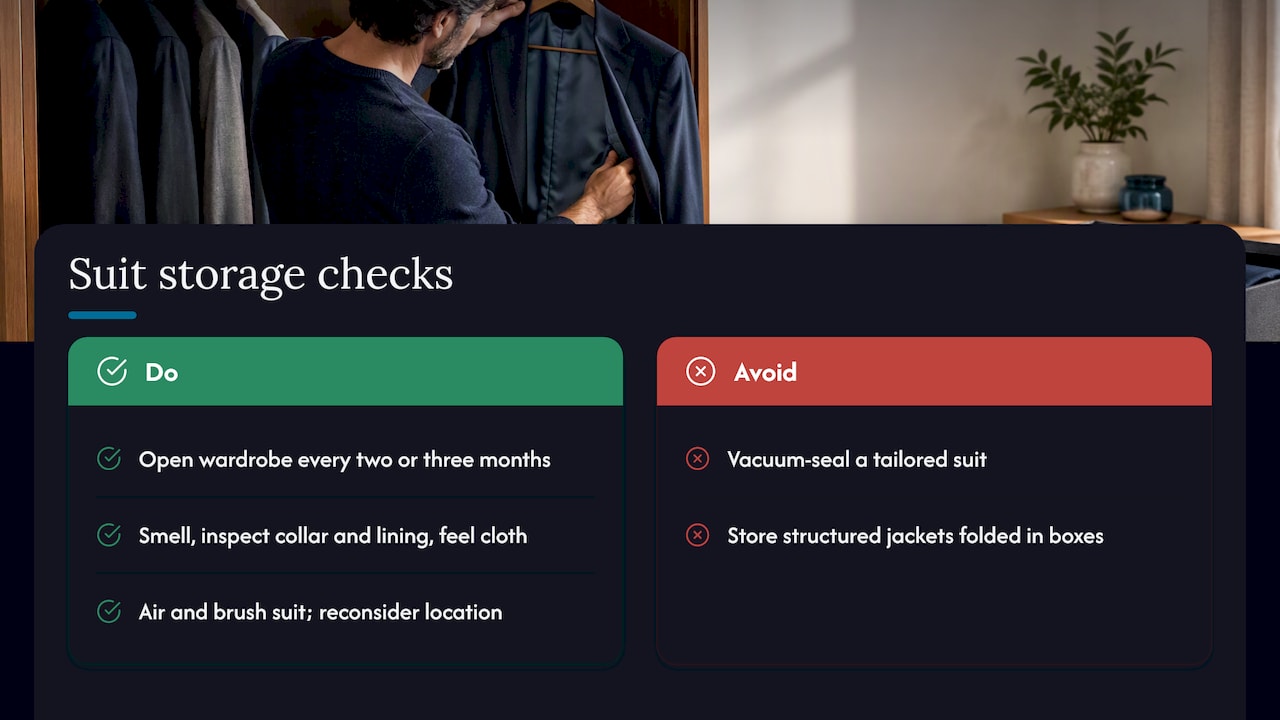
Open the wardrobe every two or three months. Smell the suits, look inside the collar and lining for spots, and run a hand over the cloth. A musty smell or a pale bloom means moisture has crept in: air the suit, brush it and reconsider the location.
We do not recommend vacuum-sealing a tailored suit. Compression flattens the canvas and padding, which are what give a jacket its chest and lapel roll. Folded storage in boxes works for knitwear and shirts, but not for structured jackets.
Storing and carrying a suit when you travel
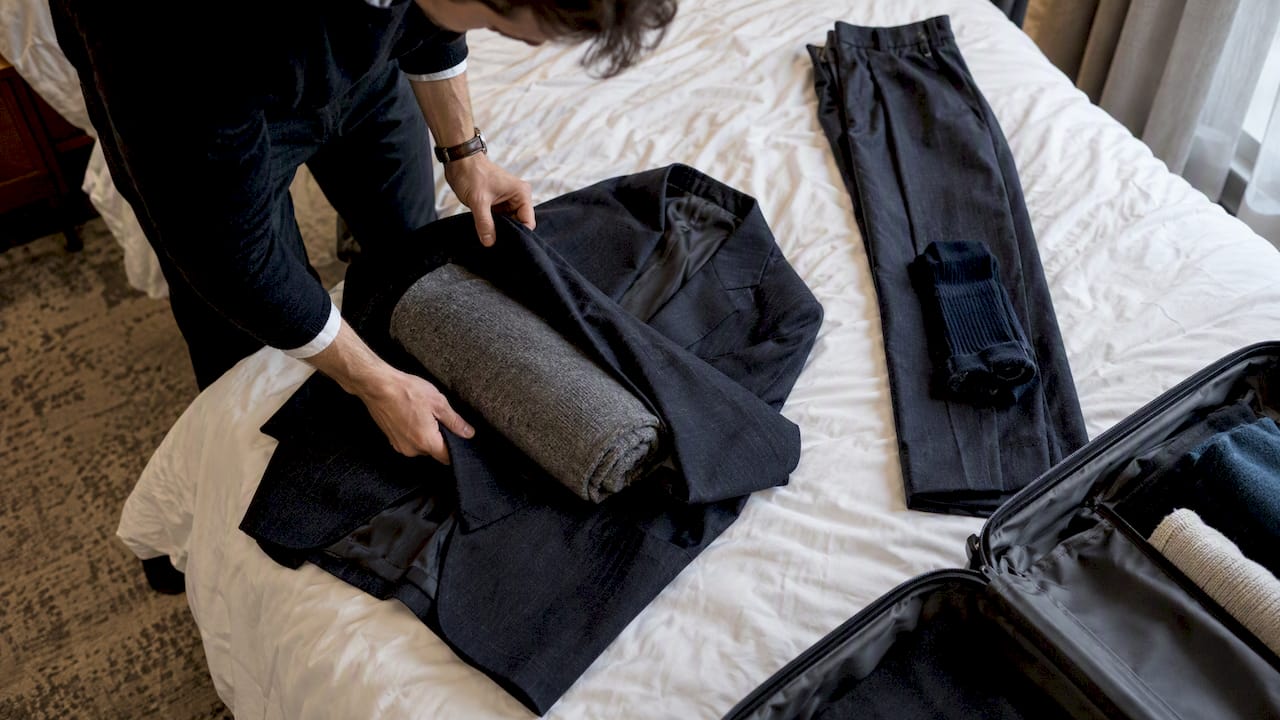
Travel is the one occasion where folding is acceptable. The aim is to avoid hard-set creases, and a good fold uses padding. According to a tailor interviewed in Wirecutter’s guide to folding a suit, a method that cushions the fold works better than simple stacking. The technique, as reported, places a soft item, such as a rolled sweater, across the waist of the jacket before folding. For trousers, align the crease, place a pair of socks at the midpoint and fold, producing a compact parcel that puts less strain on the cloth.
If you fly with a garment bag, check the airline’s rules before you leave. Most airlines allow a garment bag as cabin baggage, usually counted as your single large item in Economy, and often capped at about 57 x 54 x 15 cm. Business class often allows two pieces. Dimensions vary, so confirm with your carrier.
On arrival:
- Unpack immediately and hang the suit on the hotel hanger, or on your own travel hanger.
- Hang it in a steamy bathroom for ten minutes, or use a handheld steamer lightly.
- Do not press a bespoke jacket with a hot iron directly on the cloth.
Fabric choice makes the journey easier. Heavier cloths such as wool, flannel and tweed resist creasing better than very fine, smooth fabrics, a point also made in the Wirecutter piece. For frequent flyers we have written about 210 to 310 gsm travel suit fabrics, about wrinkle-resistant fabrics, and about preserving bespoke shape when you pack.
Our perspective: a suit is built to be hung, not stored away
When Richard Fan founded Ron & Rich in 1979, the aim was a garment that fits one person exactly. After nearly five decades, we still see the same pattern in the fittings room: the suits that age best are not necessarily the most expensive. They are the ones that have been rested, hung properly and cleaned sparingly.
We believe in a modest wardrobe cared for well. A man who owns two or three good suits and rotates them gives each time to recover, which is better for the cloth than a crowded rail of occasional pieces. Our guide on how many suits most men need takes the same view, and so does our piece on making a suit last five to fifteen years.
Singapore asks more of a tailor than a temperate city would. The cloth must suit the climate, and the wardrobe must too. If you ever notice a suit sitting differently on your shoulders after a long spell in storage, bring it to us. A shoulder that has been poorly supported can often be assessed in a few minutes at a fitting.
Ron
Bring your suit to us, or begin one that is made for your wardrobe
If you are building a wardrobe you intend to keep, we would be glad to help. Our bespoke suits start from $2,170, tuxedos from $2,270, sports jackets from $1,790, trousers from $290 and shirts from $199, all measured and fitted in person. See the full range on our pricing page, or read about our bespoke suits in Singapore for the cloths we recommend in this climate.
FAQ
Should suits be stored in a garment bag?
Yes, in a breathable one. A cotton or non-woven bag protects the cloth from dust and light while allowing air to circulate. Avoid sealed plastic for long storage, as it can trap moisture in a humid wardrobe.
Is it better to hang or fold a suit?
Hang it. A jacket needs shoulder support to keep its shape, and folding is best kept for travel, using padding to prevent hard creases. Trousers can be hung from the waistband or draped over a padded bar by the crease.
How do I store suits long term?
Clean the suit, repair any small faults, then hang it on a contoured hanger in a breathable bag. Keep it in a dry wardrobe with a moisture absorber, add cedar or lavender if you wish, and check it every two or three months.
How do I stop suits going musty in Singapore?
Control the humidity around them. Use a dehumidifier or moisture absorbers, leave space between suits, open the wardrobe on dry days and air each suit after wearing. Avoid keeping them in cupboards against damp outer walls or near bathrooms.
Can I take a suit bag on a plane as hand luggage?
Often you can. Many airlines count a garment bag as your one large cabin item in Economy, with dimensions commonly capped near 57 x 54 x 15 cm, but rules differ by airline, so check yours before you fly.
Sources
- Galaxus: hanging or folding clothes
- Casa Mia: preventing mould in Singapore’s humid climate
- Wirecutter: how to fold a suit
- Carry On Baggage: carrying suits as hand luggage